Biology · Inheritance
Sex-Linked Genetic Disorders (Higher tier)
Why are some disorders much more common in boys than girls? This lesson is for separate Biology only, and for the Higher tier only: Combined Science and Foundation students do not need it. It explains sex-linked inheritance, using haemophilia and colour blindness as examples.
Learning Objectives
- 1(Higher tier) Explain what is meant by a sex-linked disorder.
- 2(Higher tier) Explain why males are more likely than females to have a sex-linked recessive disorder.
- 3(Higher tier) Use a genetic diagram to show how sex-linked disorders are inherited.
- 4(Higher tier) Calculate the probability that a child will inherit a sex-linked disorder.
Retrieval practice
-
1
What sex chromosomes does a female have?
Show answerHide answer
XX.
-
2
What sex chromosomes does a male have?
Show answerHide answer
XY.
-
3
What is a carrier?
Show answerHide answer
Someone with one recessive allele who does not show the disorder.
-
4
Which sex chromosome do all eggs carry?
Show answerHide answer
X.
Genes on the sex chromosomes
Most genes are on the 22 pairs of chromosomes that are the same in males and females. But the X chromosome is large and carries about 800 genes, while the Y chromosome is small and carries very few. A gene that is found on one of the sex chromosomes is described as sex-linked. Because males and females have different combinations of the sex chromosomes, the inheritance of sex-linked genes follows a different pattern from other genes, and is more likely to affect males.
Why sex-linked recessive disorders affect males more
The difference comes down to the number of X chromosomes.
-
Males have one X
A male has only one X chromosome, and the Y chromosome does not carry matching alleles for most of its genes. Whatever allele he has on his X chromosome will show.
-
Females have two X chromosomes
A female has two alleles, so a recessive allele on one X can be hidden by a dominant allele on the other.
-
Males cannot be carriers
A male with the recessive allele has the disorder, since there is no second allele to hide it.
-
Females need two
A female only has the disorder if she inherits the recessive allele on both X chromosomes, which is much less likely.
Writing the genotypes
Genotypes for sex-linked genes show the allele on the X chromosome. We will use haemophilia as the example, where \(H\) is the normal allele and \(h\) is the haemophilia allele.
-
\(X^H X^H\)
A normal female.
-
\(X^H X^h\)
A female carrier. She does not have haemophilia but can pass on the allele.
-
\(X^h X^h\)
A female with haemophilia, which is rare.
-
\(X^H Y\) and \(X^h Y\)
A normal male and a male with haemophilia. The Y chromosome has no allele for the gene.
A carrier mother and an unaffected father
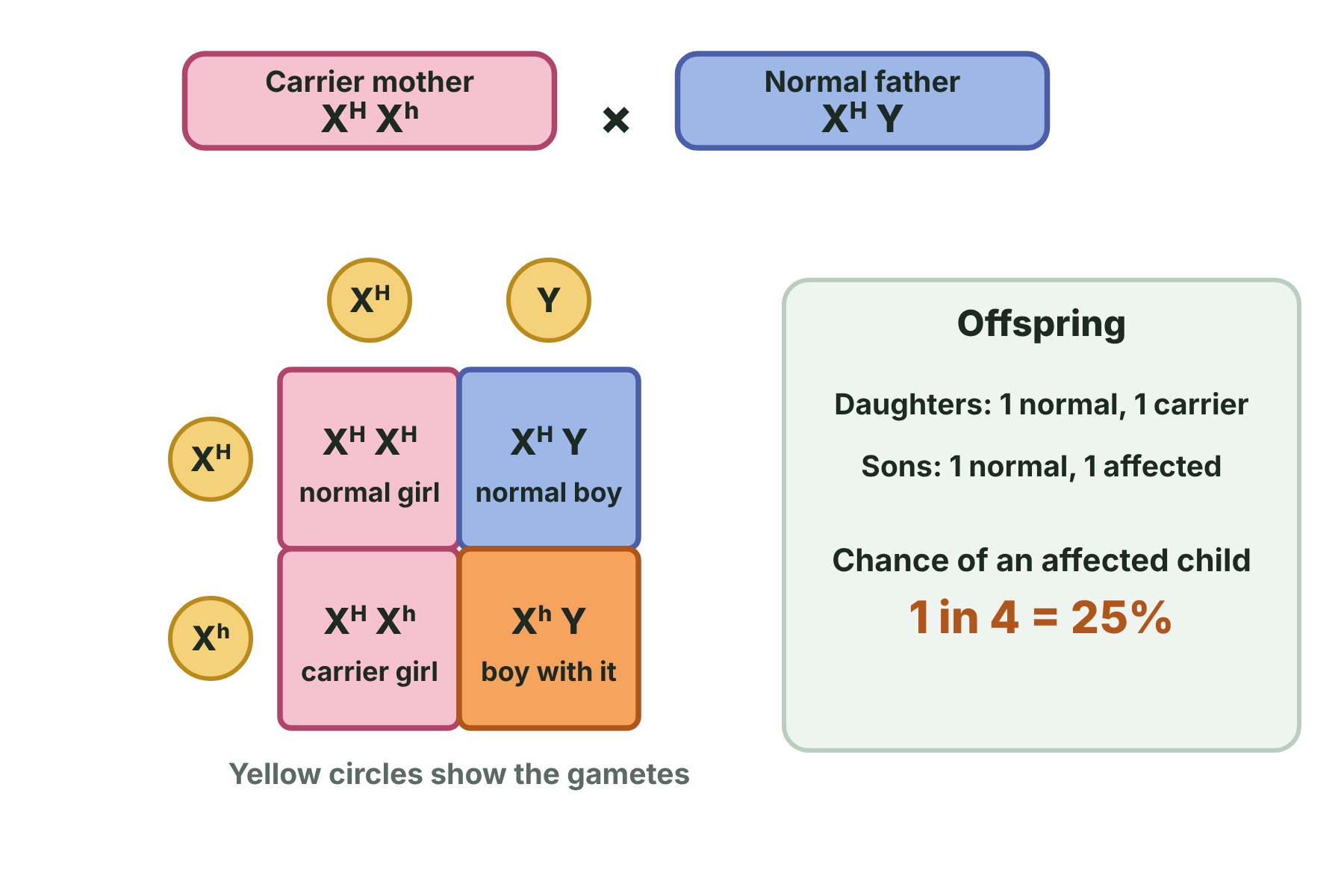
Half of the sons of a carrier mother have the disorder, but none of the daughters.
A carrier mother and a normal father
A woman is a carrier of haemophilia (\(X^H X^h\)). Her partner does not have haemophilia (\(X^H Y\)). Draw a Punnett square, and state the probability that a child is a boy with haemophilia, and the probability that a son has haemophilia.
Show the solutionHide the solution
- 1 Gametes The mother makes \(X^H\) and \(X^h\) eggs, and the father makes \(X^H\) and \(Y\) sperm.
- 2 Fill in the Punnett square The children are \(X^H X^H\), \(X^H Y\), \(X^H X^h\) and \(X^h Y\).
- 3 Probability of an affected boy Only \(X^h Y\) has haemophilia, which is 1 of the 4 boxes, so 1 in 4.
- 4 Probability for a son Of the two sons, \(X^H Y\) and \(X^h Y\), one is affected, so the chance for a son is 1 in 2.
AnswerThe probability that a child is a boy with haemophilia is 1 in 4 (25%). The probability that a son has haemophilia is 1 in 2 (50%).
A father with the disorder
A man has haemophilia (\(X^h Y\)), and his partner is homozygous normal (\(X^H X^H\)). Show how the allele is passed on.
Show the solutionHide the solution
- 1 Gametes The father makes \(X^h\) and \(Y\) sperm. The mother makes only \(X^H\) eggs.
- 2 Fill in the Punnett square The children are \(X^H X^h\), \(X^H X^h\), \(X^H Y\) and \(X^H Y\).
- 3 Daughters All receive his \(X^h\), so they are all carriers.
- 4 Sons They receive his Y, so none inherit the allele and all are unaffected.
AnswerAll daughters are carriers, and all sons are unaffected.
Examples of sex-linked disorders
These are all caused by recessive alleles on the X chromosome.
-
Haemophilia
The blood does not clot properly, so cuts and bruises bleed for a long time. It can be treated by injections of the missing clotting protein.
-
Red-green colour blindness
A person cannot tell red from green, because of faulty alleles for the cone cells. About 1 in 12 men are affected.
-
Duchenne muscular dystrophy
A severe disorder in which muscles gradually weaken, affecting about 1 in 3500 boys.
-
Patterns
They are more common in males, they do not pass from father to son, and they can skip a generation through carrier females.
Autosomal and sex-linked recessive disorders
Autosomal recessive, such as cystic fibrosis
- The gene is on one of the 22 pairs of chromosomes
- Males and females are equally likely to be affected
- Both parents are carriers or affected
- Both sexes are affected equally
Sex-linked recessive, such as haemophilia
- The gene is on the X chromosome
- Males are much more likely to be affected
- A carrier mother can have an affected son
- An affected father cannot pass it to his sons
Case study
Haemophilia in the royal families of Europe
Queen Victoria was a carrier of haemophilia. Her son Leopold had the disorder and died young after a fall in 1884, and two of her daughters were carriers. Through marriages between the royal houses, the allele spread to the families of Spain, Germany and Russia. Tsar Nicholas II's son Alexei, the heir to the Russian throne, had haemophilia. The pattern, of affected males and carrier females, is typical of a sex-linked recessive allele.
Summary and exam focus
- A sex-linked gene is one on a sex chromosome, usually the X.
- Males have only one X chromosome, so a single recessive allele on it causes the disorder.
- Females need two recessive alleles to be affected, and a female with one is a carrier.
- A carrier mother and a normal father have a 50% chance of an affected son and a 50% chance of a carrier daughter.
- An affected father passes the allele to all his daughters, but not to his sons.
Exam focus
Colour blindness is caused by a recessive allele on the X chromosome. Explain why it is more common in men than in women, and use a genetic diagram to show how a colour-blind son can have parents with normal vision. (6 marks) (6 marks)
Write the genotypes with the allele as a superscript on the X, such as \(X^B\) and \(X^b\). Say that a man has only one X, so one recessive allele is enough, and a woman needs two. For the cross, the mother must be a carrier and the father normal.
Key terms
The words this lesson expects you to use. Each one is linked from the first place it appears above.
- Sex-linked
- Describes a gene that is found on one of the sex chromosomes, usually the X.
- X-linked
- Describes a gene on the X chromosome.
- Haemophilia
- A sex-linked recessive disorder in which blood does not clot properly.
- Colour blindness
- A sex-linked recessive condition in which a person cannot tell some colours apart.
- Carrier
- A female with one recessive allele on one X chromosome, who does not have the disorder.
- Autosome
- A chromosome that is not a sex chromosome.
- Duchenne muscular dystrophy
- A sex-linked recessive disorder that causes progressive muscle weakness.
- Sex chromosomes
- The X and Y chromosomes, which decide the sex of a person.
- Clotting
- The process by which blood forms a solid plug to stop bleeding.
You've finished the notes
Check your understanding
Test yourself while it is fresh. Start with the flashcards, then try the exam questions.
Something here looks wrong?
Tell us what and we will go and look. It goes to whoever writes these pages, nobody else, and we do not ask who you are — so there is nothing to sign and nothing comes back to you.