Biology · Inheritance
Codominance and ABO Blood Groups
Sometimes neither allele is dominant, and sometimes there are more than two alleles. This lesson is for separate Biology only: Combined Science students do not need it. It covers codominance and the inheritance of the ABO blood groups.
Learning Objectives
- 1Describe the inheritance of the ABO blood groups, with reference to multiple alleles and codominance.
- 2State the genotypes that produce each of the four blood groups.
- 3Use a genetic diagram to predict the blood groups of children.
- 4Explain the difference between dominance and codominance.
Retrieval practice
-
1
What is an allele?
Show answerHide answer
A different version of the same gene.
-
2
What does heterozygous mean?
Show answerHide answer
Having two different alleles of a gene.
-
3
What does a recessive allele need to show its effect?
Show answerHide answer
Two copies of the allele.
-
4
What is the phenotype ratio of Tt x Tt?
Show answerHide answer
3 : 1.
Beyond dominant and recessive
So far each gene has had two alleles, one dominant and one recessive. Many genes are more complex. Some have more than two alleles in the population, which is called multiple alleles. In some cases two alleles can both show their effect in a heterozygous person, rather than one hiding the other, which is called codominance. The ABO blood group system has both of these features, and it is the classic example.
Blood groups
Blood group is decided by the molecules on the surface of the red blood cells.
-
Four groups
A person's blood is group A, B, AB or O, depending on the antigens on the red blood cells.
-
Group A
The red cells have A antigens.
-
Group B
The red cells have B antigens.
-
Group AB and group O
Group AB cells have both A and B antigens, and group O cells have neither.
Three alleles, but two in each person
One gene decides the ABO blood group, and it has three alleles.
-
\(I^A\)
The allele that makes the A antigen.
-
\(I^B\)
The allele that makes the B antigen.
-
\(i\)
The allele that makes no antigen. It is recessive to both of the others, and group O is sometimes written \(I^O\).
-
Only two at a time
There are three alleles in the population, but each person only inherits two, one from each parent. This is why it is called multiple alleles.
Dominance and codominance
Complete dominance
- One allele hides the other in a heterozygous person
- Example: Tt is tall
- The heterozygous phenotype is like the homozygous dominant
- A dominant and a recessive allele
Codominance
- Both alleles show their effect in a heterozygous person
- Example: \(I^A I^B\) has both antigens, so group AB
- The heterozygous phenotype shows both
- Two alleles of equal strength, neither is recessive to the other
A cross between group A and group B parents
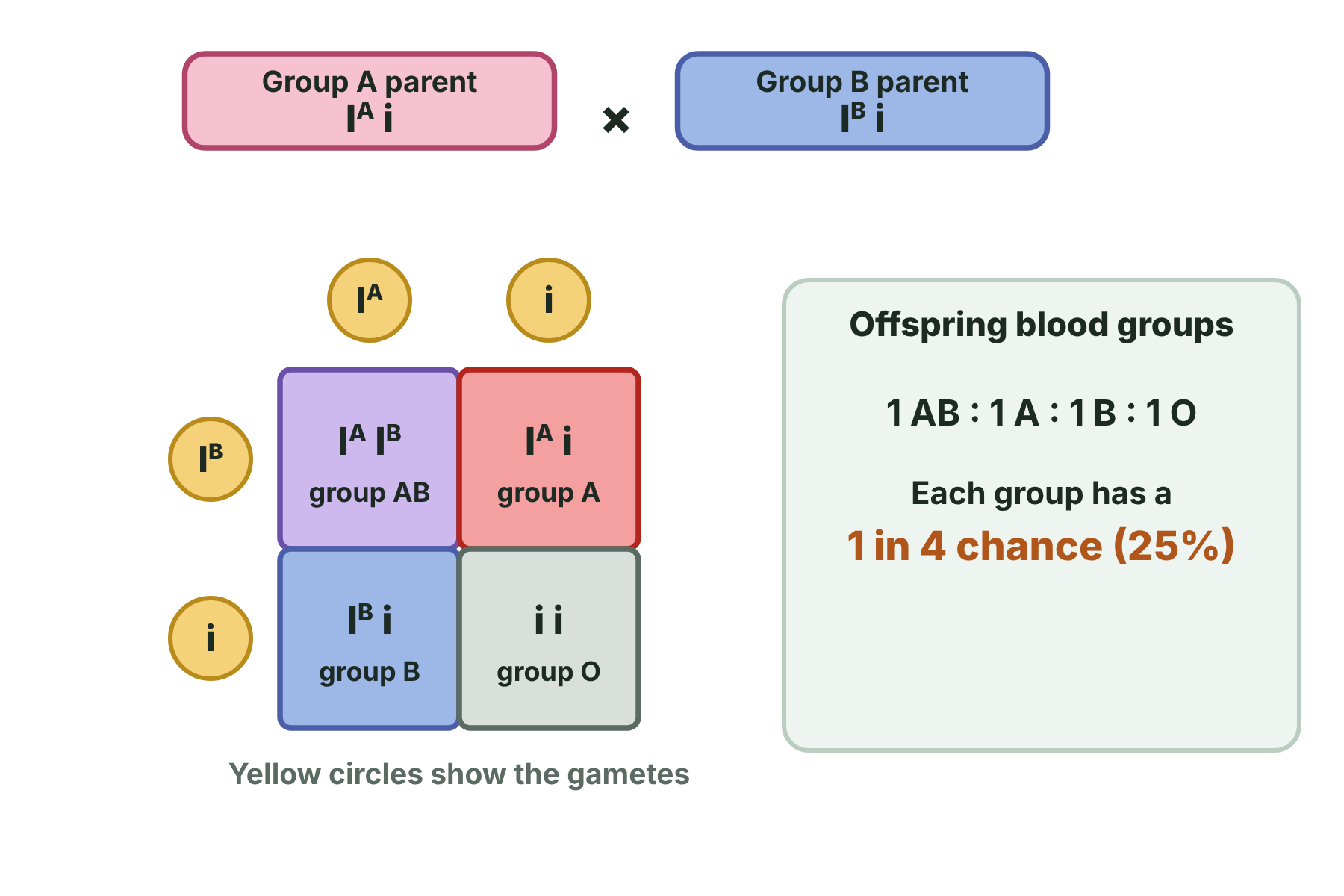
Two parents with blood groups A and B can have children of all four groups.
Genotypes and blood groups
More than one genotype can give the same blood group, apart from AB and O.
-
Group A
Genotype \(I^A I^A\) or \(I^A i\).
-
Group B
Genotype \(I^B I^B\) or \(I^B i\).
-
Group AB
Genotype \(I^A I^B\) only. The alleles are codominant.
-
Group O
Genotype \(ii\) only, since \(i\) is recessive and has an effect only when there are two copies.
Crossing group A and group B parents
A mother has blood group A, with genotype \(I^A i\). The father has blood group B, with genotype \(I^B i\). Draw a Punnett square, and state the probability that their child has blood group O.
Show the solutionHide the solution
- 1 Write the gametes The mother makes \(I^A\) and \(i\) gametes, and the father makes \(I^B\) and \(i\) gametes.
- 2 Fill in the Punnett square The four possible children are \(I^A I^B\), \(I^A i\), \(I^B i\) and \(i i\).
- 3 Read off the blood groups AB, A, B and O, in the ratio 1 : 1 : 1 : 1.
- 4 State the probability Only \(ii\) is group O, so the probability is \(\frac{1}{4}\), or 25%.
AnswerThe probability of blood group O is 1 in 4, or 25%.
Working back from a child
A child has blood group O. Her mother is group A and her father is group B. State the genotypes of both parents, and explain how you know.
Show the solutionHide the solution
- 1 The child is group O She must have the genotype \(ii\), so she inherited an \(i\) allele from each parent.
- 2 The mother has group A She has an \(I^A\) allele, and she must also have an \(i\), so her genotype is \(I^A i\).
- 3 The father has group B He has an \(I^B\) allele and an \(i\), so his genotype is \(I^B i\).
AnswerThe mother is \(I^A i\) and the father is \(I^B i\).
Other examples of codominance
Blood groups are not the only case.
-
Roan cattle
A red cow \(RR\) crossed with a white bull \(WW\) has calves that are roan, which have both red and white hairs, with genotype \(RW\).
-
Sickle cell trait
A person with one normal and one sickle-cell allele makes both types of haemoglobin, which gives some protection against malaria.
-
How to recognise it
If the heterozygous phenotype shows both alleles at once, and is not the same as either homozygous one, it is codominance.
Case study
Blood transfusions
Blood group matters most for transfusions. A person with group A blood has antibodies against the B antigen in their plasma, so if they were given group B blood, their antibodies would attack the new red blood cells, with serious results. Group O blood has no A or B antigens, so it can usually be given to people of any group in an emergency, and it is called the universal donor. Group AB people have no antibodies against A or B, so they can receive any of the groups.
Summary and exam focus
- The ABO blood groups are controlled by one gene with three alleles, \(I^A\), \(I^B\) and \(i\).
- Each person has only two alleles of the gene.
- \(I^A\) and \(I^B\) are codominant, and both show their effect in group AB.
- The allele \(i\) is recessive, so group O is \(ii\).
- Groups A and B can be homozygous or heterozygous.
Exam focus
A man with blood group AB and a woman with blood group O have a child. Use a genetic diagram to show the possible blood groups of their children. (4 marks) (4 marks)
Write the genotypes with the I and the superscript. The AB parent can only give \(I^A\) or \(I^B\), and the O parent can only give \(i\). Complete the Punnett square and state the blood groups, which in this case are A and B only.
Key terms
The words this lesson expects you to use. Each one is linked from the first place it appears above.
- Codominance
- When both alleles of a gene show their effect in a heterozygous person.
- Multiple alleles
- When a gene has more than two alleles in a population.
- Blood group
- The type of blood a person has, decided by antigens on the red blood cells.
- Antigen
- A molecule on the surface of a cell that the immune system can recognise.
- ABO system
- The system of blood groups A, B, AB and O.
- Universal donor
- A person with blood group O, whose blood can usually be given to any group.
- Roan
- An animal with a coat of mixed red and white hairs, an example of codominance.
- Genotype
- The combination of alleles that an organism has.
- Transfusion
- The transfer of blood from one person to another.
You've finished the notes
Check your understanding
Test yourself while it is fresh. Start with the flashcards, then try the exam questions.
Something here looks wrong?
Tell us what and we will go and look. It goes to whoever writes these pages, nobody else, and we do not ask who you are — so there is nothing to sign and nothing comes back to you.