Biology · Non-communicable Diseases
Treating Cardiovascular Disease
Cardiovascular disease is the world's biggest killer, and it can be treated in several ways. This lesson looks at medication taken for life, surgery and changes to lifestyle, and shows how to evaluate them by weighing up their benefits, risks and costs.
Learning Objectives
- 1Describe how coronary heart disease arises, and what it does to the heart.
- 2Describe life-long medication, surgical procedures and lifestyle changes used to treat cardiovascular disease.
- 3Evaluate the different treatments, using data on their effectiveness, risks and cost.
- 4Explain why a combination of treatments is often used.
Retrieval practice
-
1
What is atheroma?
Show answerHide answer
A fatty deposit in the wall of an artery.
-
2
Which chemical in smoke raises blood pressure?
Show answerHide answer
Nicotine.
-
3
What is a risk factor?
Show answerHide answer
Something that increases the chance of getting a disease.
-
4
What is a placebo?
Show answerHide answer
A dummy treatment with no active drug.
When the heart's own blood supply is reduced
The heart muscle needs a good supply of oxygen, which it gets from blood in its own arteries, the coronary arteries. In coronary heart disease, fatty deposits narrow these arteries, so that less blood reaches the muscle. The person may have chest pain, called angina, especially when exercising. If a clot blocks a coronary artery, part of the heart muscle is starved of oxygen and dies, which is a heart attack. The disease is not cured, but the risk can be reduced, blood flow can be restored, and a damaged organ can be replaced. The choice of treatment depends on how severe the disease is, and on the patient.
Life-long medication
Several types of drug are taken every day, for the rest of a person's life, to lower the risk.
-
Statins
They reduce the level of cholesterol in the blood, so that less fatty material builds up in the artery walls. This slows down the narrowing of the arteries.
-
Anticoagulants
Drugs such as warfarin make the blood clot less easily, so that clots are less likely to block an artery.
-
Antiplatelet drugs
Low-dose aspirin makes the platelets less sticky, which also lowers the risk of clots.
-
Blood pressure drugs
Drugs such as beta blockers lower the blood pressure and the heart rate, so the heart does not have to work as hard.
-
Advantages and disadvantages
They are cheap, easy to take and do not need an operation. They have to be taken for life, and can cause side effects, such as muscle pain with statins, or serious bleeding with anticoagulants. They do not remove deposits that are already there.
Surgical procedures
Surgery is used when an artery is badly blocked, or when a part of the heart no longer works.
-
Angioplasty and stent
A thin tube, with a balloon at the end, is threaded through an artery to the narrowed place. The balloon is inflated, which squashes the deposit against the wall, and a mesh tube called a stent is left in place to keep the artery open. It is quick, and the patient recovers in days.
-
Coronary bypass
A blood vessel, often taken from the leg, is joined to the artery on each side of the blockage, so that blood flows around it. It is major surgery, but it works well for several blockages.
-
Replacing parts
A damaged heart valve can be replaced with an artificial one, or with a valve from an animal. A pacemaker can regulate the heartbeat.
-
Heart transplant
A badly damaged heart can be replaced by a healthy one from a donor. There are not enough donors, and the patient has to take drugs, for life, to stop the immune system rejecting the new heart.
-
Advantages and disadvantages
Surgery can have an immediate effect, and save a life. It is expensive, and has the risks of any operation, such as infection, bleeding and a reaction to the anaesthetic. It does not remove the cause, so the artery can narrow again.
Angioplasty with a stent
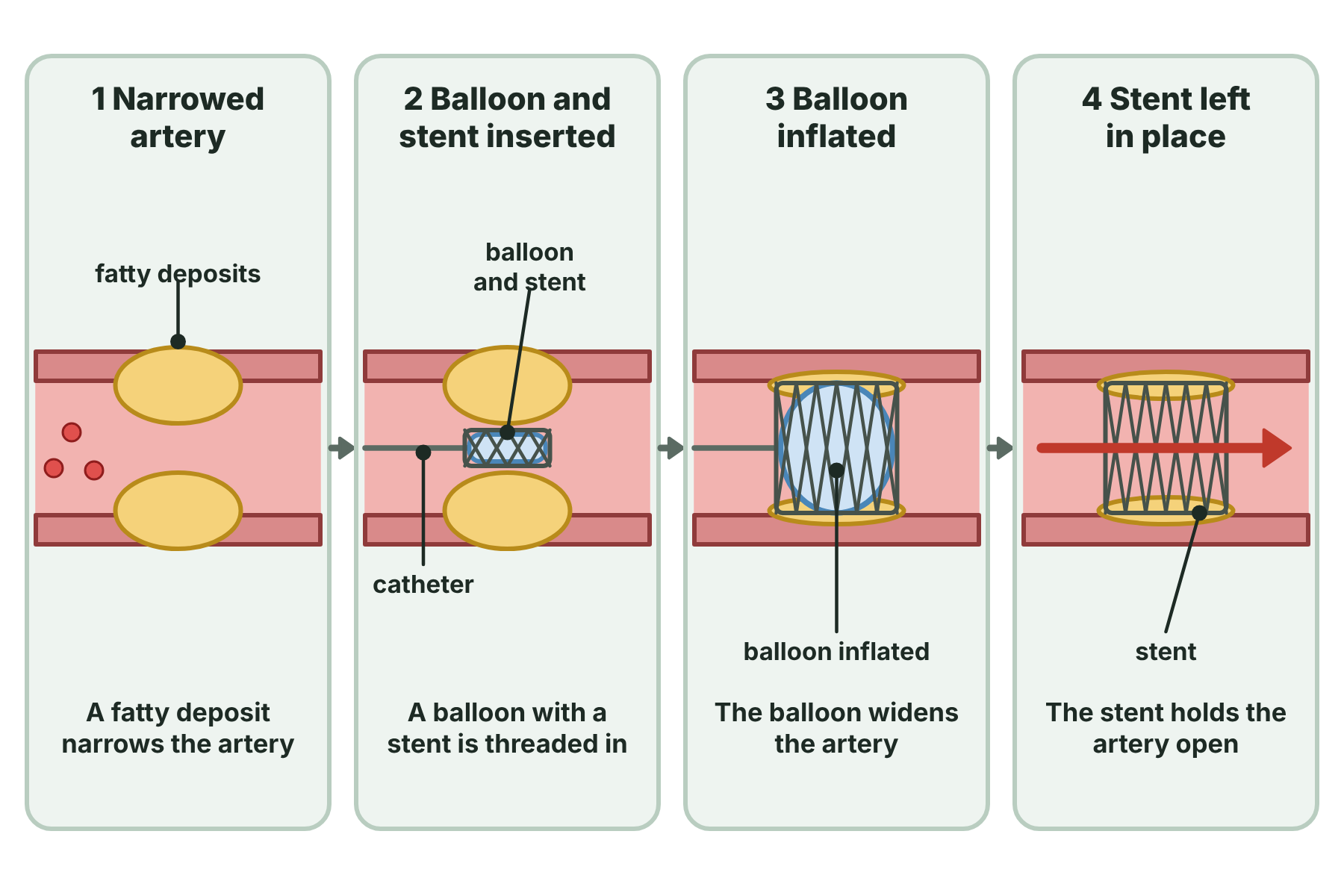
A stent keeps the artery open, so blood can flow to the heart muscle.
Lifestyle changes
The risk factors for cardiovascular disease can be reduced, for patients and for everyone else.
-
Stop smoking
This is the most important change. The risk starts to fall within days, and keeps falling for years.
-
Healthier diet
Eating less saturated fat, salt and sugar, and more fruit, vegetables and fibre, lowers cholesterol and blood pressure.
-
More exercise
Regular activity makes the heart stronger, lowers blood pressure and helps to control weight.
-
Healthy weight
Losing weight reduces the strain on the heart.
-
Less alcohol
Drinking within the limits lowers the blood pressure.
-
Advantages and disadvantages
There are no side effects and little cost, and it lowers the risk of other diseases as well. It takes motivation and time, and often is not enough by itself in a severe disease.
Medication and surgery
Life-long medication
- Tablets, taken every day
- Cheap and non-invasive
- Reduces the risk and slows the disease
- Side effects, and must be taken for life
Surgery
- Operation such as a stent, bypass or transplant
- Expensive, and needs a stay in hospital
- Restores blood flow or replaces a part, at once
- Risks of infection and bleeding, and the cause remains
Interpreting a clinical trial of a statin
In a trial, 500 patients with heart disease took a statin, and 500 took a placebo. After 5 years, 30 of those on the statin and 50 of those on the placebo had a heart attack. Calculate the percentage in each group who had a heart attack, and the percentage reduction in risk that the statin gave.
Show the solutionHide the solution
- 1 Statin group \(30 \div 500 \times 100 = 6\%\).
- 2 Placebo group \(50 \div 500 \times 100 = 10\%\).
- 3 Reduction \(10 - 6 = 4\) percentage points.
- 4 Relative reduction \(4 \div 10 \times 100 = 40\%\).
Answer6% of the statin group and 10% of the placebo group had a heart attack. The statin reduced the risk by 4 percentage points, which is a 40% reduction.
How to evaluate a treatment
There is no single best treatment. A good evaluation weighs up a number of factors and reaches a reasoned conclusion.
-
Effectiveness
How well does it work? Look at data from large trials.
-
Risks and side effects
Is it likely to cause harm?
-
Cost
The cost to the patient and to the health service, and the cost over many years.
-
Convenience
Does the patient have to take a pill every day, or have an operation?
-
Quality of life
Does it let the person do what they want to do?
-
The person
Age, other illnesses and how severe the disease is, all affect which choice is best.
Case study
The first heart transplant
On 3 December 1967 in Cape Town, the surgeon Christiaan Barnard led the first heart transplant on a human being. The patient, Louis Washkansky, received the heart of a young woman who had died in a road accident. The operation was successful, but Washkansky died of pneumonia 18 days later, because the drugs that stopped his body rejecting the heart also weakened his immune system. Better drugs now mean that many patients live for 10 years or more after a heart transplant.
Summary and exam focus
- Statins, anticoagulants and blood pressure drugs are taken for life, and lower the risk.
- Stents, bypass surgery and transplants restore blood flow or replace a part.
- Lifestyle changes include stopping smoking, a healthy diet and exercise.
- Each treatment has advantages and disadvantages.
- A combination of treatments is often the best approach.
Exam focus
Evaluate life-long medication, surgery and lifestyle changes as treatments for a patient with coronary heart disease. (6 marks) (6 marks)
Give one benefit and one drawback for each treatment, and then a judgement. For example, statins are cheap and reduce the risk but must be taken for life, a stent works at once but is expensive and does not remove the cause, and lifestyle change is cheap and safe but needs motivation.
Key terms
The words this lesson expects you to use. Each one is linked from the first place it appears above.
- Coronary artery
- An artery that supplies the heart muscle with blood.
- Statin
- A drug that lowers the level of cholesterol in the blood.
- Anticoagulant
- A drug that makes the blood clot less easily.
- Angioplasty
- A procedure in which a balloon is used to widen a narrowed artery.
- Stent
- A mesh tube that is left in an artery to hold it open.
- Bypass
- Surgery to make a new route for blood around a blocked artery.
- Transplant
- The replacement of a damaged organ with a healthy one from a donor.
- Angina
- Chest pain that is caused by too little blood to the heart muscle.
- Immunosuppressant
- A drug that reduces the activity of the immune system, so that a transplant is not rejected.
You've finished the notes
Check your understanding
Test yourself while it is fresh. Start with the flashcards, then try the exam questions.
Something here looks wrong?
Tell us what and we will go and look. It goes to whoever writes these pages, nobody else, and we do not ask who you are — so there is nothing to sign and nothing comes back to you.