Biology · Non-communicable Diseases
Alcohol and Smoking
Alcohol and tobacco are both legal, and both cause a great deal of preventable disease. This lesson explains how alcohol damages the liver, how smoking leads to cardiovascular disease, and how these lifestyle factors affect health in a town, a country and the world.
Learning Objectives
- 1Explain the effects of alcohol on the liver, and how it leads to liver disease.
- 2Explain how smoking causes cardiovascular disease, including the effects of nicotine, carbon monoxide and tar.
- 3Interpret and calculate from data on alcohol and smoking.
- 4Explain the effects of alcohol and smoking on health at local, national and global levels.
Retrieval practice
-
1
What does the liver do?
Show answerHide answer
It breaks down toxins, makes bile, and stores glycogen.
-
2
What is an artery?
Show answerHide answer
A blood vessel that carries blood away from the heart.
-
3
What does haemoglobin do?
Show answerHide answer
It carries oxygen in red blood cells.
-
4
What is a carcinogen?
Show answerHide answer
A substance that can cause cancer.
Personal choices, public costs
Drinking alcohol and smoking are lifestyle choices, but their effects reach far beyond the person who makes them. They lead to illness, to deaths at a younger age than would be expected, to accidents, and to a large cost for health services. Alcohol is broken down in the liver, so heavy drinking harms that organ in particular. Smoking harms the lungs, and also the heart and the blood vessels, because the chemicals in smoke pass into the blood. Both are examples of risk factors, which raise the chance of disease but do not make it certain.
How alcohol harms the liver
The liver is the organ that removes alcohol from the blood, and it pays a heavy price.
-
Breaking down alcohol
The liver cells use enzymes to break alcohol down into other substances, some of which are toxic. A small amount can be dealt with, but heavy drinking over many years overloads the liver.
-
Fatty liver
Fat builds up in the liver cells. There may be no symptoms, and the damage can be reversed if the person stops drinking.
-
Alcoholic hepatitis
The liver becomes inflamed, and liver cells die. It can cause jaundice, which is a yellowing of the skin and eyes.
-
Cirrhosis
Scar tissue replaces the dead liver cells, and the liver becomes smaller and hard. The damage is permanent, and the liver can no longer do its jobs. This can cause liver failure, and raises the risk of liver cancer.
Alcohol and the liver
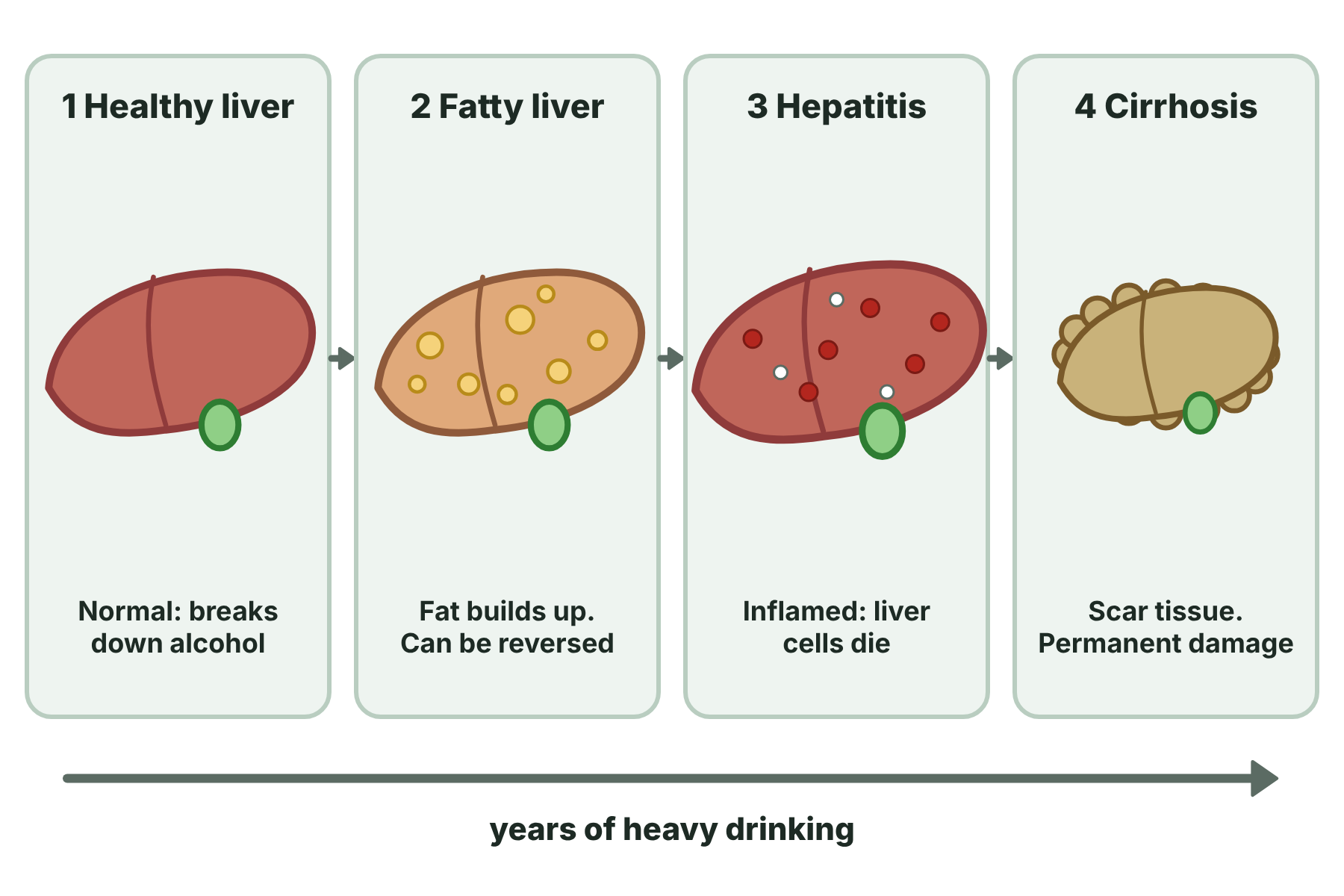
Heavy drinking over years can take the liver from healthy to cirrhosis, which cannot be reversed.
Other effects of alcohol
Liver disease is not the only harm that alcohol can do.
-
The nervous system
Alcohol slows the reactions of the brain, so reaction times are longer, judgement is poor, and there is a greater risk of accidents.
-
Pregnancy
Alcohol can pass from the mother to the baby, and can cause damage to the baby's development.
-
Other diseases
It raises the risk of some cancers, high blood pressure, and weight gain, because alcoholic drinks contain a lot of energy.
-
Society
It is linked to accidents, violence and time lost from work.
Measuring alcohol intake
Doctors measure how much a person drinks in units of alcohol.
-
One unit
One unit is 10 cm cubed (10 ml) of pure alcohol.
-
The equation
Units \(=\) volume in ml \(\times\) alcohol by volume (as a percentage) \(\div\) 1000.
-
Guidelines
In the UK, the advice is not to drink more than 14 units in a week, and to spread them over three or more days.
-
Why it matters
The more a person drinks, the greater the risk of liver disease, so the amount is a risk factor.
How smoking leads to cardiovascular disease
Tobacco smoke is a mixture of thousands of chemicals, and three of them are especially important.
-
Nicotine
It is addictive, which is why smokers find it so hard to stop. It makes the heart beat faster, and narrows the blood vessels, so it raises the blood pressure.
-
Carbon monoxide
This gas combines with haemoglobin in red blood cells, instead of oxygen. The blood carries less oxygen, so the heart has to work harder to supply the tissues.
-
Tar and other chemicals
Tar is a sticky mixture that contains many carcinogens, and damages the lungs. Other chemicals in the smoke damage the lining of the arteries.
-
Fatty deposits
Where the lining is damaged, fatty material from the blood builds up in the wall. These deposits narrow the artery and make it harder for blood to flow.
-
Clots
Smoking also makes the blood more likely to clot, and a clot can block a narrowed artery.
-
The result
A blocked artery in the heart causes a heart attack, and a blocked artery in the brain causes a stroke.
How smoking damages arteries
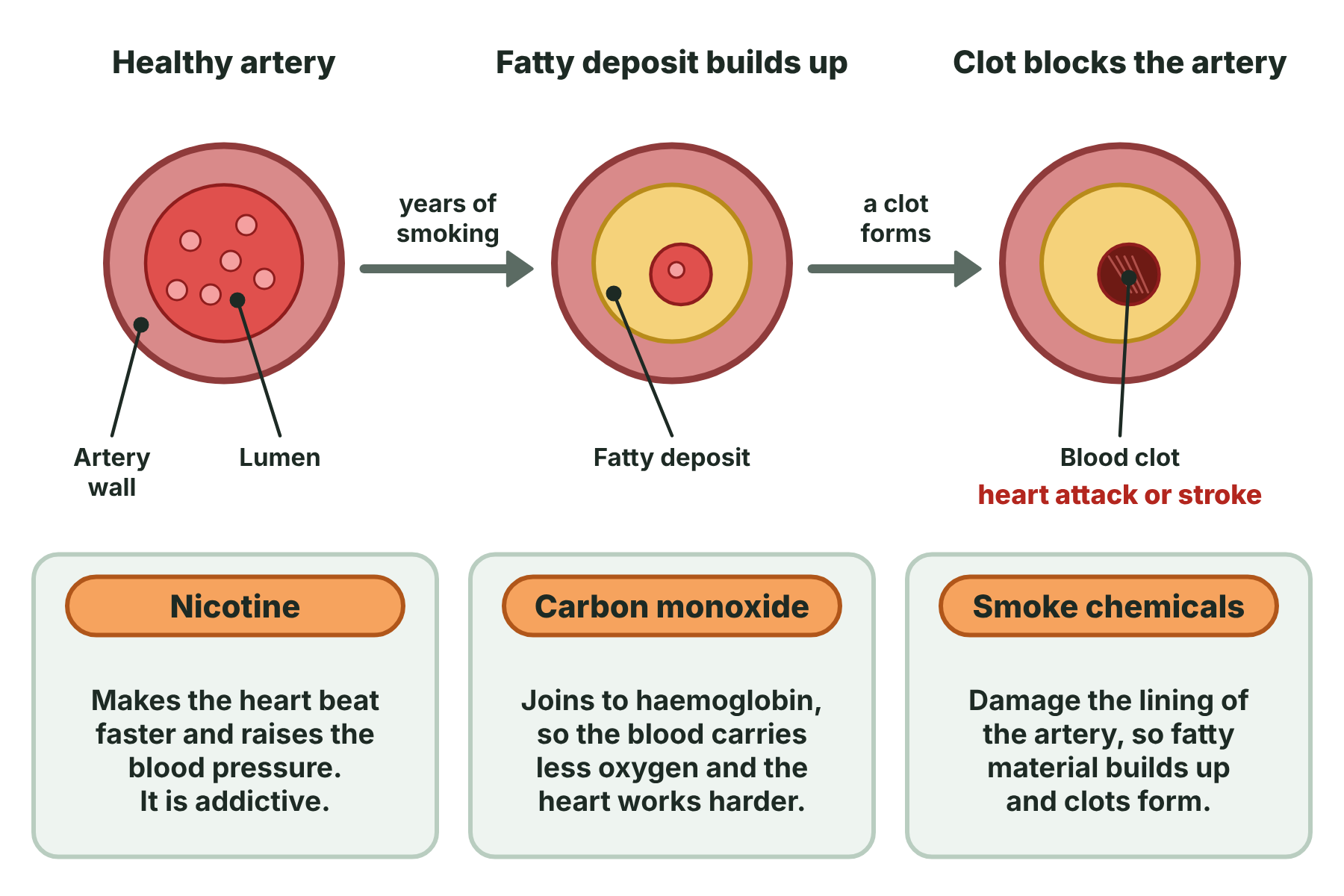
Smoking damages the artery wall, so fatty deposits build up and a clot can block the artery.
Smoking and the lungs
Smoke passes through the lungs first, so they suffer as well as the heart.
-
Lung cancer
The carcinogens in tar cause mutations in the lung cells. Smoking causes most of the cases of lung cancer.
-
Emphysema
The walls of the alveoli break down, so there is less surface for gas exchange, and the person becomes short of breath.
-
Chronic bronchitis
The airways are inflamed and full of mucus, and the cilia are damaged, which leads to a long-term cough.
-
Passive smoking
People who breathe in other people's smoke also have a higher risk of disease.
Alcohol and smoking compared
Alcohol
- Broken down by the liver
- Heavy drinking leads to fatty liver, hepatitis and cirrhosis
- Slows reaction times, so accidents are more likely
- Can harm a developing baby
Smoking
- Nicotine, carbon monoxide and tar are the harmful chemicals
- Fatty deposits narrow the arteries, so heart attacks and strokes are more likely
- Causes lung cancer, emphysema and bronchitis
- Passive smoking harms other people
Local, national and global levels
The harm is seen at every scale.
-
Local
Rates of smoking and heavy drinking are higher in some communities, and so is the number of people treated for them in local hospitals.
-
National
Smoking is responsible for about 1 in 4 deaths from cancer in the UK. The number of adults who smoke has fallen from nearly half in the 1970s to about 1 in 8 today, because of the ban on smoking in public places, higher taxes, health warnings and the support to give up. Alcohol-related liver disease is rising, and costs the NHS billions of pounds.
-
Global
Tobacco kills more than 8 million people every year, and alcohol causes millions of deaths. Smoking is falling in some rich countries, but rising in some poorer ones.
Calculating units of alcohol
A pint of beer is 568 ml and has an alcohol content of 4% by volume. Calculate the number of units in the beer, to 1 decimal place. Then calculate how many such pints would be 14 units.
Show the solutionHide the solution
- 1 Substitute Units \(= 568 \times 4 \div 1000\).
- 2 Calculate \(568 \times 4 = 2272\), and \(2272 \div 1000 = 2.3\) units, to 1 decimal place.
- 3 Number of pints \(14 \div 2.3 = 6.1\), so about 6 pints in a week would be the limit.
AnswerThe pint contains 2.3 units, and 14 units is about 6 pints.
Comparing death rates
In a study, the number of deaths from heart disease per 100 000 men per year was 120 for non-smokers and 300 for men who smoked 20 or more cigarettes a day. Calculate how many times higher the death rate was for the heavy smokers, and say what the data suggest.
Show the solutionHide the solution
- 1 Divide \(300 \div 120 = 2.5\).
- 2 Link There is a positive correlation between smoking and deaths from heart disease.
- 3 Cause A mechanism is known: the chemicals in smoke damage the arteries, so the link is likely to be causal.
AnswerThe death rate for the heavy smokers was 2.5 times higher. The data show a link between smoking and heart disease deaths, and the other evidence on how smoking damages arteries suggests that smoking is a cause.
Summary and exam focus
- Alcohol is broken down in the liver, and heavy drinking leads to fatty liver, hepatitis and cirrhosis.
- Cirrhosis is permanent, and can lead to liver failure.
- Nicotine raises blood pressure, and carbon monoxide reduces the oxygen carried by the blood.
- Smoke damages the arteries, so fatty deposits build up, and clots can block them.
- Both alcohol and smoking affect health at local, national and global levels.
Exam focus
Describe how smoking can lead to a heart attack, and explain how heavy drinking can lead to liver failure. (6 marks) (6 marks)
For smoking, name two chemicals, such as carbon monoxide and nicotine, and say what each does, then describe how the arteries narrow, and that a clot blocks them. For alcohol, give the order: fatty liver, hepatitis, cirrhosis, and say that scar tissue stops the liver doing its jobs.
Key terms
The words this lesson expects you to use. Each one is linked from the first place it appears above.
- Cirrhosis
- Permanent scarring of the liver, which stops it working properly.
- Unit of alcohol
- 10 ml of pure alcohol.
- Nicotine
- An addictive drug in tobacco smoke, which raises heart rate and blood pressure.
- Carbon monoxide
- A poisonous gas in smoke that binds to haemoglobin and reduces the oxygen carried by the blood.
- Tar
- A sticky mixture in smoke that contains carcinogens.
- Atheroma
- A fatty deposit in the wall of an artery.
- Heart attack
- Damage to the heart muscle when a coronary artery is blocked.
- Stroke
- Damage to part of the brain, when a blood vessel to it is blocked or bursts.
- Passive smoking
- Breathing in the smoke from other people's cigarettes.
You've finished the notes
Check your understanding
Test yourself while it is fresh. Start with the flashcards, then try the exam questions.
Something here looks wrong?
Tell us what and we will go and look. It goes to whoever writes these pages, nobody else, and we do not ask who you are — so there is nothing to sign and nothing comes back to you.