Biology · Plant Defences and Disease
Detecting Plant Diseases
How do you tell what is wrong with a sick plant? This lesson is for separate Biology only: Combined Science students do not need it. It covers the ways of detecting and identifying plant diseases, in the field and in the lab.
Learning Objectives
- 1Describe how plant diseases can be detected and identified, in the field and in the laboratory.
- 2Explain how environmental causes of damage can be eliminated.
- 3Explain how the distribution of affected plants and the symptoms give clues about the cause.
- 4Describe diagnostic tests that are used to identify the pathogen.
Retrieval practice
-
1
What is a pathogen?
Show answerHide answer
A microorganism that causes disease.
-
2
What mineral do plants need to make chlorophyll?
Show answerHide answer
Magnesium.
-
3
What does a lack of nitrate cause in a plant?
Show answerHide answer
Stunted growth and yellow leaves.
-
4
What is a symptom?
Show answerHide answer
A sign of disease that can be seen or felt.
Plant detectives
Farmers and plant scientists need to know quickly if a crop is diseased, so they can stop the spread. But many things can make a plant look unwell, and not all of them are infections. The plant may lack minerals, be short of water or be damaged by frost. A plant doctor works like a detective: observing the symptoms, ruling out the environmental causes, studying how the damage is spread across the field, and then using tests to find the pathogen.
Finding the cause of a plant disease
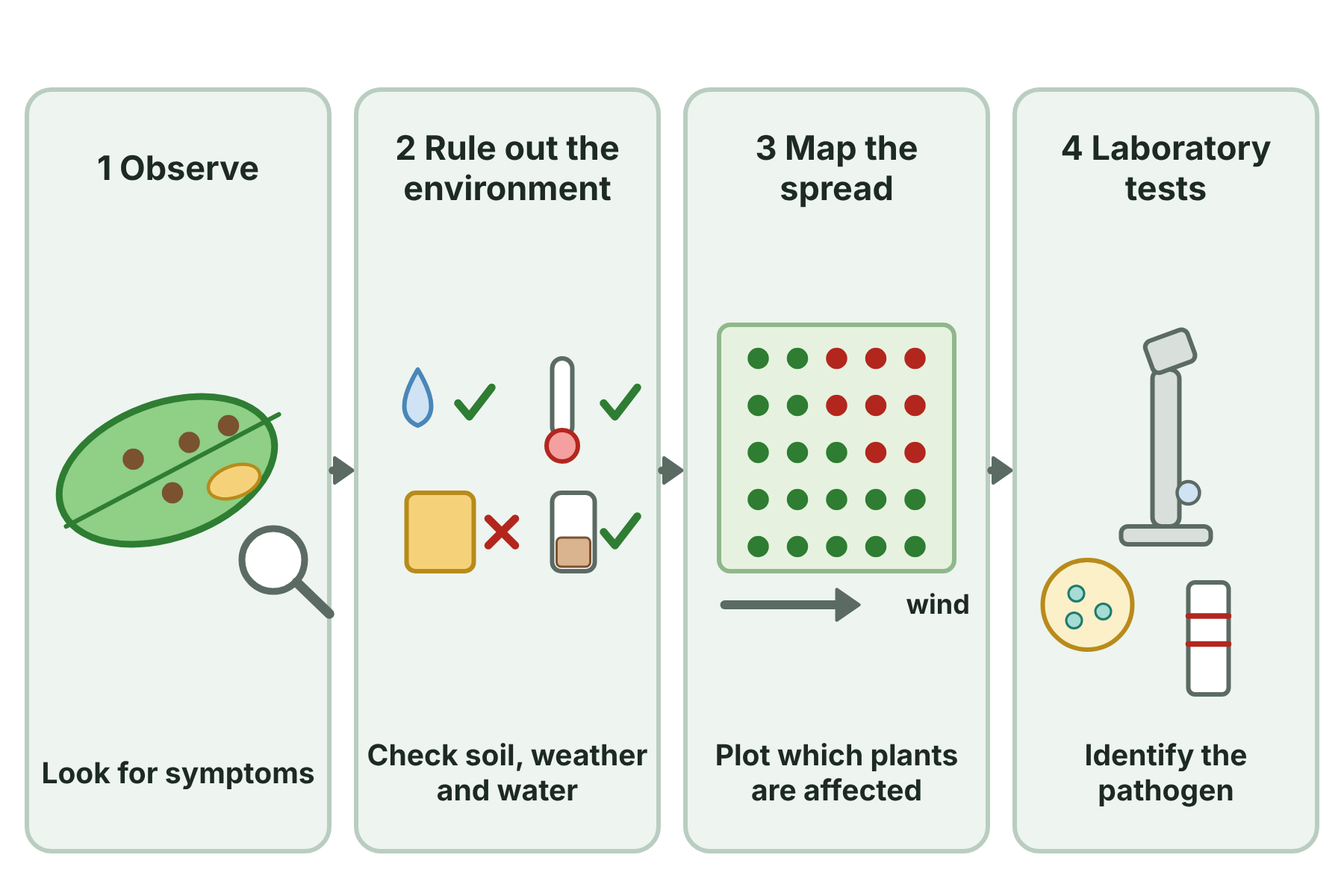
A pattern that spreads from a point suggests a pathogen, and an even pattern suggests the environment.
Observing the symptoms
The first clue is what the plant looks like.
-
Leaves
Spots, yellowing (chlorosis), curling, wilting, mould or holes. For example, black spot on roses, and mottled leaves caused by tobacco mosaic virus.
-
Stems and roots
Cankers, rotting, swellings called galls, or stunted roots.
-
Growth
Stunted growth, or poor fruit or flowers.
-
The pest itself
Insects or fungal growth may be visible, such as aphids or white powder (mildew) on the surface.
-
Matching
Symptoms are compared with pictures and descriptions in a reference guide, to suggest a possible disease.
Eliminating environmental causes
Damage can be caused by the environment and not by a pathogen, so these are checked first.
-
Mineral deficiency
Yellow leaves can be a sign of a shortage of magnesium or nitrate. A soil test measures the minerals, and adding fertiliser shows if it cures the problem.
-
Water
Too little water causes wilting, and too much causes rot. The watering and the drainage are checked.
-
Temperature and light
Frost, heat or lack of light can damage plants.
-
Chemical damage
Herbicides, pollution or spray drift can cause spots and distortion.
-
If the cause is found
If correcting the environment cures the plants, no pathogen is needed to explain the damage.
Distribution analysis
Where the affected plants are gives information about the cause.
-
Spreading from a point
Affected plants clustered around one place, with fewer further away, suggest a pathogen that is spreading by contact, wind or water.
-
Even distribution
If all the plants are equally affected, the cause is more likely to be the soil, the weather or a chemical.
-
Following a pattern
If damage follows the direction of the wind, or a line of irrigation, the way of spread can be guessed.
-
Sampling
In a large field not every plant can be checked, so a random sample is taken, such as the plants in quadrats, and the percentage affected is found.
Diagnostic testing
Laboratory tests are used to confirm the pathogen.
-
Microscopy
A sample of the infected tissue is looked at under a microscope, to find fungal threads, spores or bacteria.
-
Culturing
The pathogen is grown on agar jelly, so that it can be identified from the way it grows.
-
DNA testing
The DNA of the pathogen is compared with that of known pathogens, which is very accurate, and can find viruses.
-
Antibody tests
Monoclonal antibodies that bind to a specific pathogen are used in test kits. A positive result shows as a colour change or a line, and they can be used in the field.
Pathogen or environment?
Signs of a pathogen
- Affected plants clustered, and spreading
- Symptoms start in one place and move outwards
- A pathogen is found in a test
- Does not improve when the environment is corrected
Signs of an environmental cause
- Plants affected evenly across the area
- A deficiency or damage is found in the soil or weather
- No pathogen is found
- Improves when the environment is corrected
Estimating how many plants are affected
A farmer takes a random sample of 50 plants from a field containing 8000 plants. Twelve of the sampled plants show symptoms of a fungal disease. Calculate the percentage of the sample that is affected, and estimate the number of affected plants in the whole field.
Show the solutionHide the solution
- 1 Percentage of the sample \(12 \div 50 \times 100 = 24\%\).
- 2 Estimate for the field \(24\% \text{ of } 8000 = 0.24 \times 8000 = 1920\).
- 3 Limits of the estimate A larger or repeated sample would give a more reliable estimate.
Answer24% of the sample is affected, so about 1920 plants in the field.
Case study
Ash dieback detective work
When ash trees in the UK began to die in 2012, scientists first had to decide whether it was a pathogen or an environmental problem. They looked at the symptoms of leaf loss and diamond-shaped lesions on the bark, and mapped the places where the trees were affected, which showed a pattern spreading from the east. Samples were examined under the microscope, and DNA tests identified the fungus Hymenoscyphus fraxineus. Tracing where it had come from showed that it had been brought in on imported saplings.
Summary and exam focus
- Plant diseases are detected by observing symptoms in the field.
- Environmental causes, such as lack of minerals, are checked and eliminated.
- The pattern of affected plants gives clues: spreading from a point suggests a pathogen.
- Samples are tested in a laboratory using microscopy, culturing, DNA testing or antibody kits.
- Random sampling is used to estimate the amount of disease.
Exam focus
A farmer finds that the leaves of some of the plants in a field are turning yellow. Describe how the cause could be investigated, and explain how the farmer could tell whether it is a disease or an environmental problem. (6 marks) (6 marks)
Put the steps in order: observe the symptoms, test for environmental causes, such as minerals, water and temperature, look at the pattern in the field and use lab tests. Say what result would point to a pathogen, and what would point to the environment.
Key terms
The words this lesson expects you to use. Each one is linked from the first place it appears above.
- Symptom
- A visible sign of disease in a plant, such as spots or wilting.
- Chlorosis
- Yellowing of leaves because of a lack of chlorophyll.
- Mineral deficiency
- A lack of a mineral that a plant needs, such as nitrate or magnesium.
- Distribution
- The pattern of where the affected plants are in an area.
- Diagnostic test
- A test used to identify the cause of a disease.
- Culture
- Growing microorganisms on a nutrient medium.
- Monoclonal antibody
- An antibody that binds to one specific substance, used in tests.
- Random sample
- A sample in which every individual has an equal chance of being chosen.
- Lesion
- An area of damaged or diseased tissue.
You've finished the notes
Check your understanding
Test yourself while it is fresh. Start with the flashcards, then try the exam questions.
Something here looks wrong?
Tell us what and we will go and look. It goes to whoever writes these pages, nobody else, and we do not ask who you are — so there is nothing to sign and nothing comes back to you.