Biology · Plant Defences and Disease
Chemical Defences of Plants
Many plants make poisons, bitter chemicals and antibiotics. This lesson is for separate Biology only: Combined Science students do not need it. It explains how plants defend themselves with chemicals, and how some of those chemicals have become important medicines.
Learning Objectives
- 1Describe how plants defend themselves against pests and pathogens by producing chemicals.
- 2Give examples of plant chemicals that are used to treat human diseases or relieve symptoms.
- 3Describe how antimicrobial properties of plants can be investigated.
- 4Evaluate the use of plants as a source of new medicines.
Retrieval practice
-
1
What is a physical defence of a plant?
Show answerHide answer
A structure, such as the cuticle or cell wall, that stops attackers getting in.
-
2
What are antibiotics?
Show answerHide answer
Drugs that kill bacteria or stop them growing.
-
3
What is a pathogen?
Show answerHide answer
A microorganism that causes disease.
-
4
What is a herbivore?
Show answerHide answer
An animal that eats plants.
Chemical warfare
Plants cannot run away, so many of them make chemicals that make them dangerous or unpleasant to eat, or that kill microorganisms. Some of these chemicals are always present, and some are made when the plant is attacked. They work in several ways: some taste bitter, some are poisonous, and some are antibacterial or antifungal. People discovered that many of these chemicals can also act on the human body, so they can be used as medicines.
How plants use chemicals
Chemical defences can protect against both pests and pathogens.
-
Antibacterial chemicals
Plants such as garlic, mint and onion make chemicals that kill or stop the growth of bacteria. These protect the plant from infection.
-
Antifungal chemicals
Some plants make chemicals that damage the cell walls of fungi, so that infection is stopped.
-
Poisons
Plants such as foxglove, deadly nightshade and yew contain poisons that harm or kill animals that eat them.
-
Deterrents
Bitter or irritating chemicals make the plant unpleasant to eat, for example the caffeine in coffee plants, or the chemicals of chilli peppers, which cause a burning sensation.
-
Made on demand
Some chemicals are made only when the plant is damaged, so the plant does not waste energy making them all the time.
Plant chemicals that became medicines
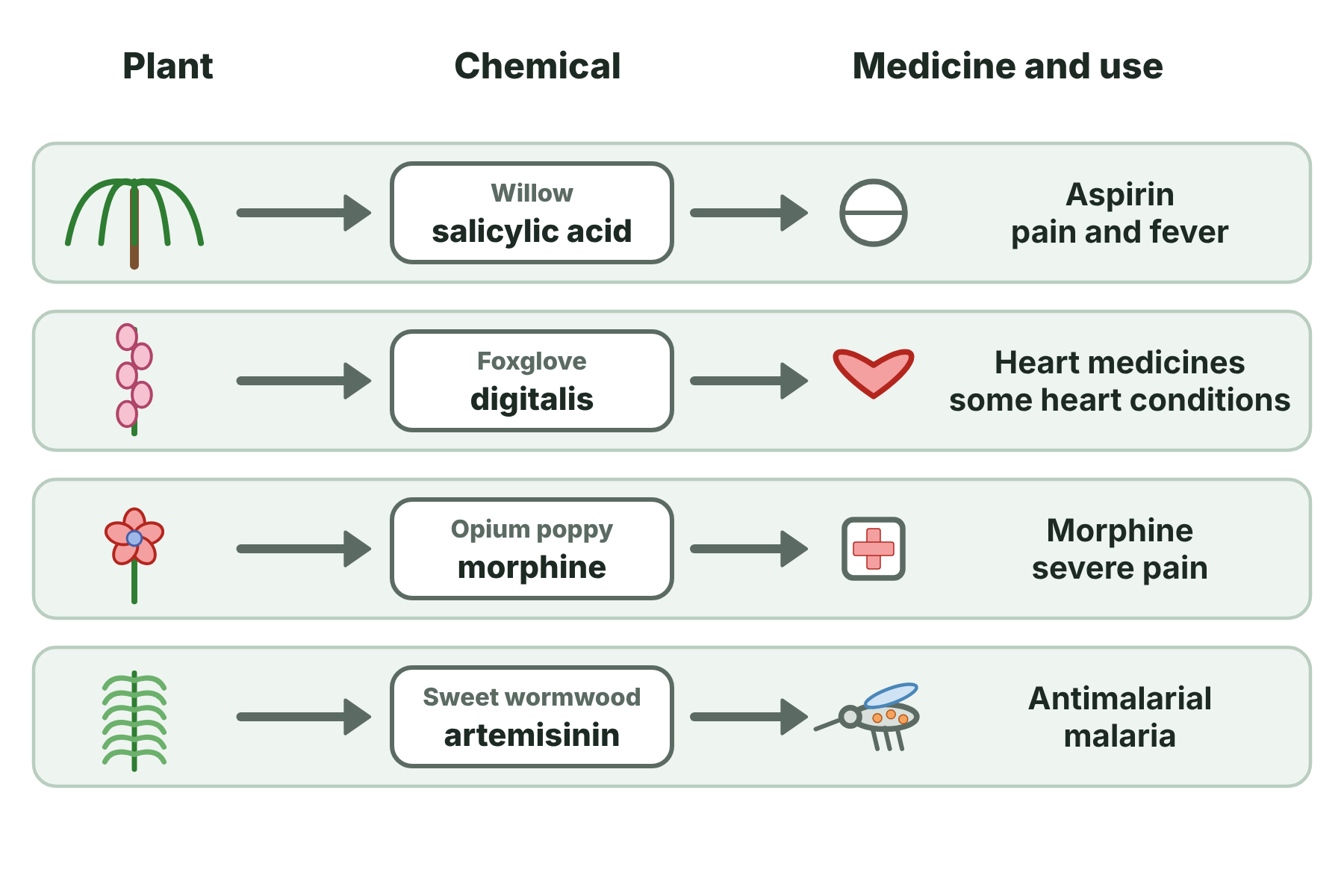
Many important medicines began as plant defence chemicals.
Plant chemicals used as medicines
People have used plants as medicine for thousands of years, and some of these uses have been confirmed by science.
-
Aspirin
The bark of the willow contains salicylic acid, which the plant uses in its defence. Aspirin is a modified form of it, and is used to relieve pain and reduce fever and inflammation.
-
Digitalis
Foxgloves make chemicals that affect the heart. They are used in low doses to treat some heart conditions, although the plant is poisonous.
-
Morphine
The opium poppy makes morphine, which is used in hospitals to relieve severe pain. It comes from the sap of the seed pods.
-
Quinine and artemisinin
The bark of the cinchona tree gave quinine to treat malaria, and the sweet wormwood plant gave artemisinin, which is now the main treatment.
-
Taxol
A chemical from the bark of the yew tree, made into a medicine for some cancers.
Plants and their chemicals
How the plant uses the chemical
- Poison to stop herbivores eating the plant
- Antibacterial or antifungal chemicals to kill pathogens
- Bitter taste or irritant to deter pests
- Signals to start the plant's defences
How people use it
- Medicines for pain, such as aspirin and morphine
- Drugs for the heart, such as digitalis
- Antimalarial drugs, such as quinine and artemisinin
- Cancer treatment, such as taxol
Investigating antimicrobial plants
Scientists test plant extracts to find out if they kill microorganisms.
-
Make an extract
Crush the plant material, such as garlic or mint, in a solvent such as ethanol or water, and filter it.
-
Prepare the plate
Spread bacteria evenly over agar jelly in a sterile petri dish.
-
Add the extracts
Place small paper discs soaked in each extract on the agar. Also add a control disc with only the solvent.
-
Incubate
Seal the dish loosely, and keep it at about 25 \(^\circ\)C for two days.
-
Measure
A clear area around a disc, where no bacteria have grown, is called a zone of inhibition. A bigger zone shows a stronger antibacterial effect.
Comparing the effect of plant extracts
Discs soaked in garlic extract, mint extract and ethanol alone (the control) were placed on an agar plate with bacteria. The diameters of the clear zones were garlic 16 mm, mint 9 mm and ethanol 0 mm. State which was the most effective, and what the control shows.
Show the solutionHide the solution
- 1 Compare the zones Garlic 16 mm is larger than mint 9 mm.
- 2 Conclude Garlic extract is the most effective of the two at stopping bacterial growth.
- 3 Explain the control The ethanol disc has no zone, so the solvent does not kill bacteria.
AnswerGarlic was the most effective, with the largest zone of 16 mm. The control, with 0 mm, shows that the ethanol itself had no effect, so the zones are due to the plant extracts.
Case study
Artemisinin from sweet wormwood
For many years the herb sweet wormwood was used in Chinese traditional medicine to treat fever. In the 1970s a Chinese scientist, Tu Youyou, tested hundreds of plant extracts for activity against malaria, and found that a cool extract of wormwood worked best. The chemical, artemisinin, is now the main drug used against malaria, and has saved millions of lives. Tu was awarded the Nobel Prize in Physiology or Medicine in 2015.
Summary and exam focus
- Plants make chemicals that poison, deter or kill pests and pathogens.
- Some chemicals are antibacterial or antifungal, and some are poisons.
- Many have been developed as medicines, such as aspirin, digitalis, morphine and artemisinin.
- Antimicrobial properties can be tested by placing extract discs on a plate of bacteria, and measuring the zones.
- A control disc shows that the solvent has no effect.
Exam focus
Describe how plants defend themselves using chemicals, and explain how plant chemicals can be used to treat human diseases. Give two examples. (6 marks) (6 marks)
Give two ways that plants use chemicals (poisons, antibacterial chemicals, bitter deterrents) and then link them to humans with named examples, such as aspirin from willow, or digitalis from foxglove, with the condition each one is used to treat.
Key terms
The words this lesson expects you to use. Each one is linked from the first place it appears above.
- Chemical defence
- A chemical made by a plant that protects it from pests and pathogens.
- Antibacterial
- Able to kill bacteria or stop them growing.
- Toxin
- A poison.
- Deterrent
- Something that puts an animal off eating a plant, such as a bitter taste.
- Aspirin
- A medicine developed from salicylic acid in willow bark, used for pain and fever.
- Digitalis
- A chemical from foxgloves, used to treat some heart conditions.
- Zone of inhibition
- A clear area around a disc on an agar plate where bacteria cannot grow.
- Extract
- A substance that has been taken out of a plant using a solvent.
- Control
- A part of an experiment that shows what happens without the factor being tested.
You've finished the notes
Check your understanding
Test yourself while it is fresh. Start with the flashcards, then try the exam questions.
Something here looks wrong?
Tell us what and we will go and look. It goes to whoever writes these pages, nobody else, and we do not ask who you are — so there is nothing to sign and nothing comes back to you.