Biology · Plant Defences and Disease
Physical Defences of Plants
Plants cannot run away from the animals that eat them, or from the microorganisms that infect them. This lesson is for separate Biology only: Combined Science students do not need it. It covers the physical barriers that stop pests and pathogens from getting in, including the cuticle and the cell wall.
Learning Objectives
- 1Describe how plants defend themselves against pests and pathogens using physical barriers.
- 2Describe the structure and function of the leaf cuticle and the cell wall as barriers.
- 3Describe other physical defences, such as bark, thorns and hairs.
- 4Explain how a plant's physical defences protect it, and what happens if they are breached.
Retrieval practice
-
1
What is a pathogen?
Show answerHide answer
A microorganism that causes disease.
-
2
What is a plant cell wall made of?
Show answerHide answer
Cellulose.
-
3
What are stomata?
Show answerHide answer
Tiny pores in the leaf surface that let gases in and out.
-
4
What is a pest?
Show answerHide answer
An organism that damages a crop or plant.
Plants under attack
A plant is a rich source of food, so it is attacked by many organisms. Pests such as aphids and caterpillars feed on the leaves and stems, and herbivores such as deer and rabbits eat the plant. Pathogens such as fungi, bacteria and viruses get into the plant and cause disease. Because plants cannot move away, they rely on defences that are always in place. These include physical barriers, which are structures that stop an attack from getting started, and chemical defences, which are covered in the next lesson.
The leaf cuticle
The cuticle is the first barrier that a pathogen meets on a leaf.
-
What it is
A waxy layer that covers the outer surface of the epidermis of leaves and stems.
-
Barrier to pathogens
The wax is waterproof, so water stays on the leaf and drops off it. Many pathogens, such as fungal spores, need water to germinate, so a dry waxy surface makes infection harder.
-
Prevents water loss
It also stops the leaf from losing water by evaporation, which is its main role.
-
Hard to breach
It is a smooth, tough layer that few microorganisms can get through, so they usually enter at stomata or wounds instead.
Cell walls
Every plant cell is surrounded by a wall, and this is the second barrier.
-
Cellulose
The cell wall is made of cellulose fibres, which are strong and difficult for microorganisms to digest.
-
Strength
The wall is rigid, so a pathogen cannot easily push through to the contents of the cell.
-
Thickening
When a plant detects an attack, it can strengthen the wall at the point of infection by laying down extra material, so that the pathogen cannot spread.
-
Fungal enzymes
Some fungi produce enzymes to digest the wall, but this takes time, which gives the plant a chance to respond.
A leaf as a barrier
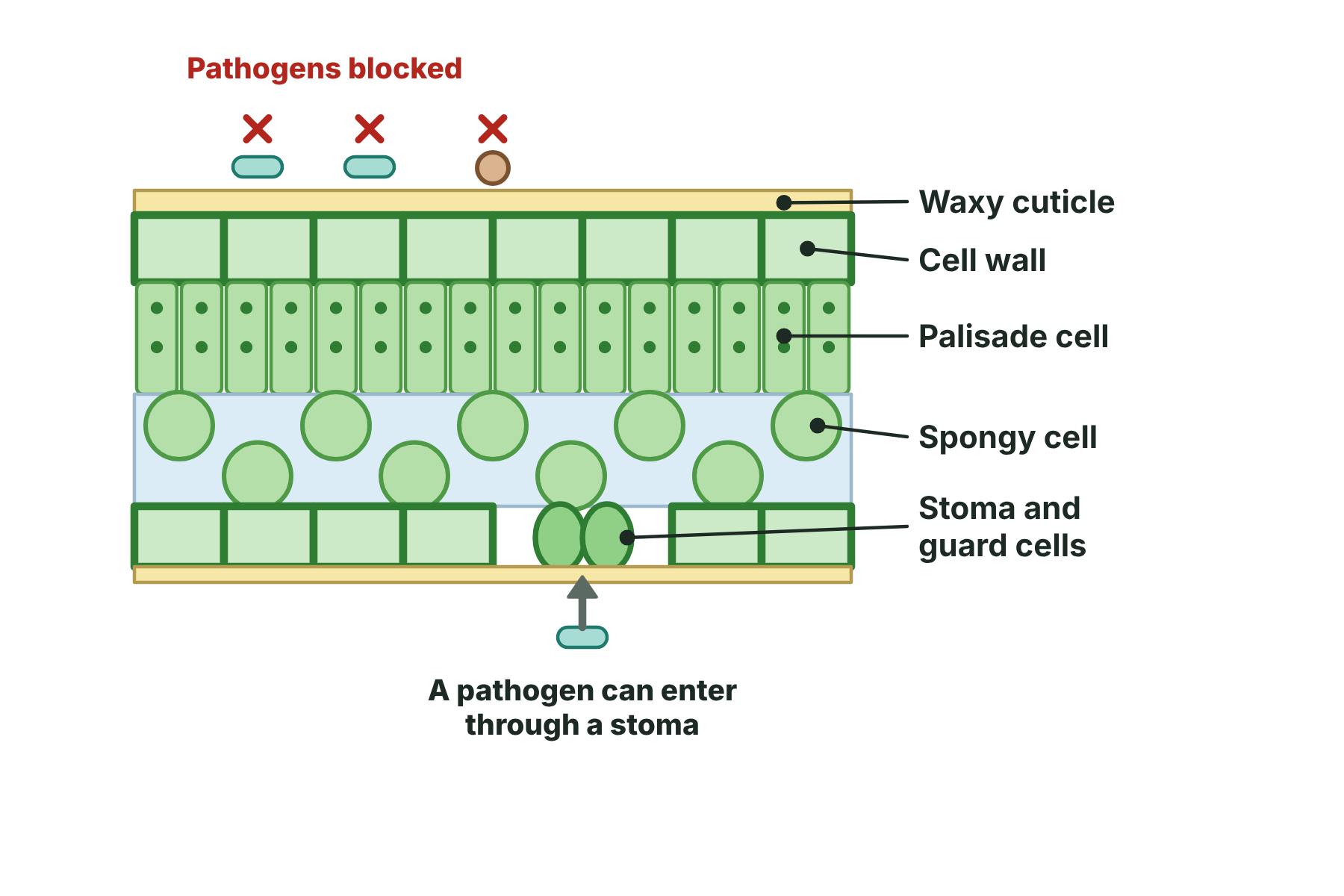
The cuticle and the cell walls block most pathogens. Stomata and wounds are weak points.
Other physical defences
Different plants have more ways of keeping attackers away.
-
Bark
Trees have a layer of dead cells covered in waxy cork, which forms a tough, waterproof barrier around the trunk and branches.
-
Thorns and spines
Sharp structures, as in roses, hawthorn and cacti, stop animals from eating the plant.
-
Hairs
Leaves covered in fine hairs, such as stinging nettles, deter insects and grazing animals, and some trap small insects. The hairs of nettles contain irritating chemicals.
-
Leaf movement
Some plants, such as the sensitive plant Mimosa, fold their leaves when they are touched, which makes them less visible and less appetising.
-
Mimicry
Some plants look like something unappetising. The passion flower makes small yellow structures that look like butterfly eggs, so butterflies avoid laying eggs on it.
Physical and chemical defences
Physical defences
- Structures that stop an attack from getting in
- Always present, as part of the plant
- Examples: cuticle, cell wall, bark, thorns
- Do not stop pathogens that enter by wounds or stomata
Chemical defences
- Substances that kill or deter attackers
- Many are made when the plant is under attack
- Examples: poisons, antibacterial chemicals, bitter compounds
- Work inside the plant, once the barrier is breached
Estimating how common a defence is
A student examines leaves from 40 plants and finds that 28 of them have hairs on the surface. Calculate the percentage with hairs. The student then looks at insect damage, and 4 of the 28 hairy plants have damage, compared with 9 of the 12 plants without hairs. Calculate the percentage damaged in each group, and say what this suggests.
Show the solutionHide the solution
- 1 Percentage with hairs \(28 \div 40 \times 100 = 70\%\).
- 2 Percentage of hairy plants damaged \(4 \div 28 \times 100 = 14\%\).
- 3 Percentage of plants without hairs damaged \(9 \div 12 \times 100 = 75\%\).
- 4 Conclusion Damage is much less common on the plants with hairs, so the hairs may help to protect them.
Answer70% have hairs. Of the hairy plants 14% have damage (to the nearest whole number), and of the plants without hairs 75% have damage, which suggests that the hairs protect against insects.
Case study
Stomata, the weak point
A leaf must have stomata, so that carbon dioxide can get in for photosynthesis. But they are also open doors for pathogens, and some bacteria and fungi enter the leaf through them. The plant protects itself by closing the stomata when it detects bacteria on the surface, using the guard cells. Some pathogens have learned to force the stomata to open again. It shows that defences are always part of a contest between the plant and the pathogen.
Summary and exam focus
- Plants have physical barriers that stop pathogens and pests from getting in.
- The waxy cuticle is waterproof and difficult for pathogens to get through.
- The cellulose cell wall is strong, and can be thickened at the site of an attack.
- Bark, thorns and hairs protect trunks, stems and leaves from animals and microorganisms.
- Stomata and wounds are weak points that pathogens can use.
Exam focus
Describe how the leaf cuticle and the cell wall help to protect a plant against pathogens, and give two other physical defences of plants. (6 marks) (6 marks)
For each barrier, state what it is, and how it blocks an attack. For the cuticle, mention the wax and waterproofing, and for the cell wall, the cellulose and the strength. Then name two others, such as thorns and bark, and say what each one does.
Key terms
The words this lesson expects you to use. Each one is linked from the first place it appears above.
- Cuticle
- The waxy layer on the surface of a leaf that reduces water loss and is a barrier to pathogens.
- Cell wall
- The rigid outer layer of a plant cell, made of cellulose.
- Physical barrier
- A structure that stops a pathogen or a pest from entering a plant.
- Epidermis
- The outer layer of cells of a plant.
- Stoma
- A tiny pore in the leaf surface, surrounded by two guard cells (plural: stomata).
- Bark
- The outer layer of dead cells that protects the trunk and branches of a tree.
- Herbivore
- An animal that eats plants.
- Mimicry
- When an organism looks like something else, which gives it protection.
- Pest
- An organism that damages a plant.
You've finished the notes
Check your understanding
Test yourself while it is fresh. Start with the flashcards, then try the exam questions.
Something here looks wrong?
Tell us what and we will go and look. It goes to whoever writes these pages, nobody else, and we do not ask who you are — so there is nothing to sign and nothing comes back to you.