Biology · Reproduction, Meiosis and Variation
Asexual and Sexual Reproduction
Some organisms reproduce with one parent and some need two. This lesson is for separate Biology only: Combined Science students do not need it. It compares the advantages and disadvantages of asexual and sexual reproduction.
Learning Objectives
- 1Describe asexual reproduction and sexual reproduction.
- 2Explain the advantages and disadvantages of asexual reproduction, including that there is no variation.
- 3Explain the advantages and disadvantages of sexual reproduction, including variation but the need to find a mate.
- 4Evaluate why some organisms use both types of reproduction.
Retrieval practice
-
1
Which type of cell division is used in asexual reproduction?
Show answerHide answer
Mitosis.
-
2
What are the cells made by meiosis?
Show answerHide answer
Haploid gametes.
-
3
What is a clone?
Show answerHide answer
An organism that is genetically identical to its parent.
-
4
What happens at fertilisation?
Show answerHide answer
A male gamete and a female gamete fuse to form a zygote.
One parent or two
All living things reproduce, but they do not all do it in the same way. In asexual reproduction there is only one parent, and the offspring are genetically identical to it. In sexual reproduction there are two parents, and they each pass on a gamete, so the offspring are genetically different from each other and from the parents. Neither method is better in all situations, and the best choice depends on the organism and its environment.
Asexual and sexual reproduction
Asexual reproduction
- One parent only
- No gametes, and no fertilisation
- Cells divide by mitosis
- Offspring are genetically identical to the parent (clones)
Sexual reproduction
- Two parents
- Gametes are made by meiosis and fuse at fertilisation
- Offspring are genetically different from both parents
- Produces variation in the population
Clones and variation
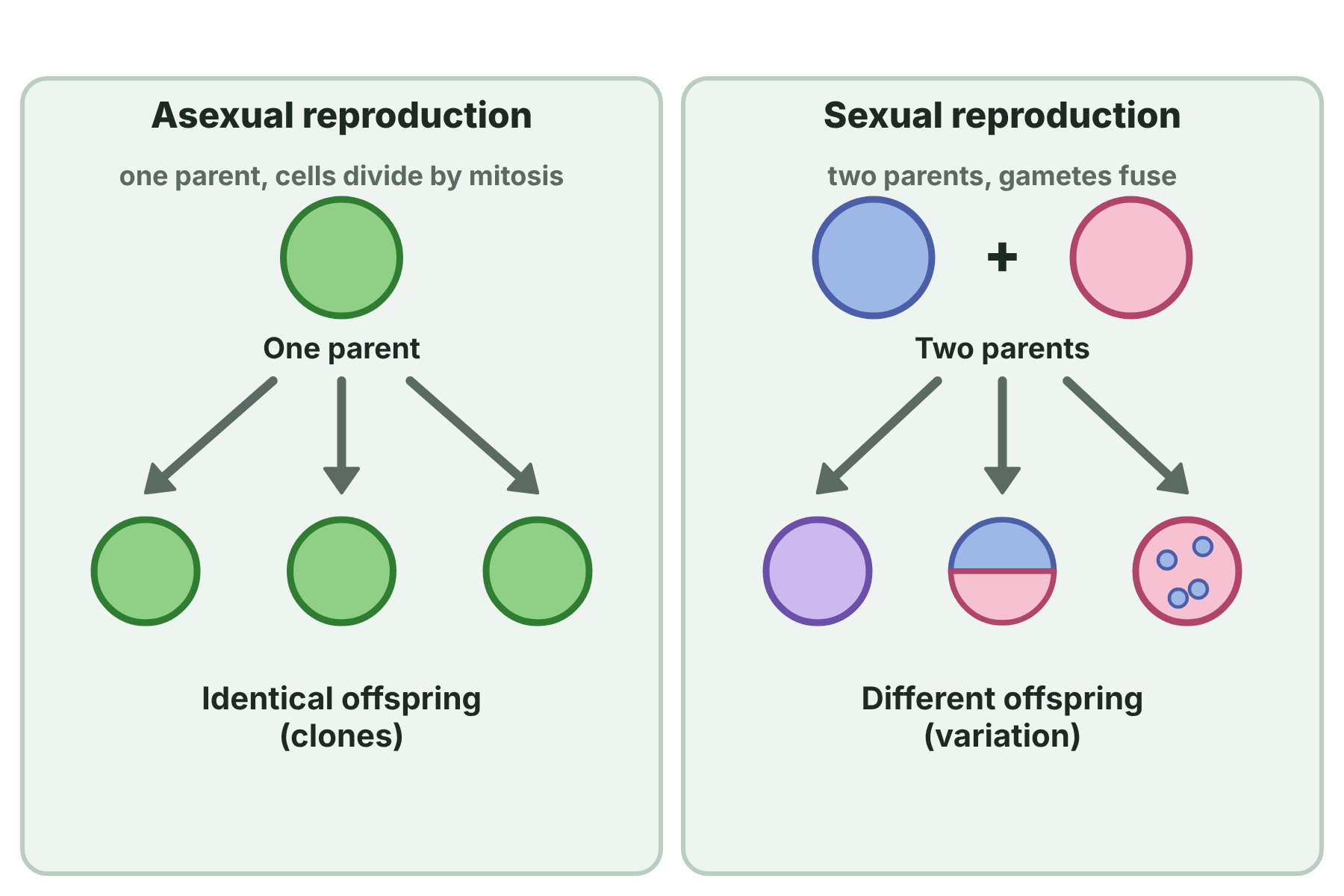
Asexual reproduction gives clones. Sexual reproduction gives variation.
Advantages of asexual reproduction
Asexual reproduction works well when conditions are stable and the organism is already well adapted.
-
No mate needed
An organism can reproduce on its own, which is useful for plants that cannot move or animals that live alone or are far apart.
-
Rapid
A rapid reproductive cycle means many offspring are made quickly. Bacteria can divide every 20 minutes in good conditions.
-
Saves energy
There is no need to make gametes, flowers or courtship displays.
-
Good traits are kept
If the parent is well adapted, so are all of its offspring.
Disadvantages of asexual reproduction
The main problem is that the offspring are all the same.
-
No variation
There is no genetic variation in the population, except for rare mutations.
-
Vulnerable to disease
A new disease can affect every individual, because all have the same genes and no one is resistant.
-
Cannot adapt quickly
If the environment changes, the whole population may be unsuited to it and may die out.
-
Overcrowding
Offspring stay close to the parent and compete with it and with each other for resources.
Advantages of sexual reproduction
Sexual reproduction creates the variation that populations need.
-
Variation in the population
Offspring are all different, because of random mixing in meiosis and random fertilisation.
-
Survives change
If the environment changes, or a new disease appears, some individuals are likely to have features that help them survive.
-
Natural selection
Variation allows species to adapt over many generations, so they can evolve.
-
Selective breeding
Humans can use variation to breed animals and plants with useful features.
Disadvantages of sexual reproduction
The extra variation comes at a cost.
-
A mate must be found
Organisms spend time and energy finding a mate, and this can be difficult when population densities are low.
-
Slower
It takes time to make gametes, mate, and rear young, so fewer offspring are produced.
-
Uses more energy
Producing gametes, flowers or courtship displays is costly, and young may need care.
-
Offspring are not always as well adapted as the parents
Good combinations of genes are broken up.
Case study
The Irish potato famine
Potatoes are normally grown from pieces of the parent plant, which is a form of asexual reproduction, so the plants in a field are clones. In the 1840s the potatoes grown in Ireland were all from a very small number of types. When a fungus-like pathogen called potato blight spread in 1845, none of the plants were resistant, and the whole crop failed for several years running. About a million people died and a million more left Ireland. It is a famous example of the danger of having no variation.
Organisms that use both
Some organisms can switch between the two types, which gives them the best of both.
-
Strawberry plants
They reproduce asexually by growing runners that make new plants, and sexually by flowering and making seeds.
-
Fungi
Many make spores asexually for fast spread, and reproduce sexually when conditions are difficult.
-
Aphids
In summer they reproduce asexually, building up numbers quickly, and sexually in the autumn to make eggs that survive the winter.
-
Malaria parasite
It reproduces asexually in the human host, and sexually inside the mosquito.
Summary and exam focus
- Asexual reproduction needs only one parent, and the offspring are genetically identical clones.
- Its advantages are no need to find a mate and a rapid reproductive cycle.
- Its disadvantage is no variation, so a disease or change could affect all of the population.
- Sexual reproduction needs two parents and produces variation.
- Its disadvantages are the need to find a mate and the slower rate of reproduction.
Exam focus
Explain the advantages and disadvantages of asexual reproduction and of sexual reproduction. (6 marks) (6 marks)
Give at least two points for each type, and link each advantage to its matching disadvantage in the other, for example no mate needed against the need to find a mate. Use the word variation and say what it means for survival.
Key terms
The words this lesson expects you to use. Each one is linked from the first place it appears above.
- Asexual reproduction
- Reproduction with one parent, in which the offspring are genetically identical to the parent.
- Sexual reproduction
- Reproduction involving the fusion of male and female gametes, which produces genetically different offspring.
- Clone
- An organism that is genetically identical to another.
- Variation
- The differences between individuals of the same species.
- Mate
- A partner for sexual reproduction.
- Reproductive cycle
- The time it takes an organism to reproduce.
- Pathogen
- A microorganism that causes disease.
- Population
- All of the individuals of one species living in a particular area.
- Runner
- A stem that grows along the ground from a plant and grows roots, making a new plant.
You've finished the notes
Check your understanding
Test yourself while it is fresh. Start with the flashcards, then try the exam questions.
Something here looks wrong?
Tell us what and we will go and look. It goes to whoever writes these pages, nobody else, and we do not ask who you are — so there is nothing to sign and nothing comes back to you.