Biology · Reproduction, Meiosis and Variation
Causes of Variation
No two people are exactly alike. This lesson explains how genes and the environment each cause differences between individuals, and how to tell continuous variation from discontinuous variation.
Learning Objectives
- 1Explain what is meant by variation, and give examples of it.
- 2Describe the causes of genetic variation and of environmental variation.
- 3Explain that most features are controlled by many genes, and that some are controlled by a single gene.
- 4Compare continuous and discontinuous variation, and represent each using suitable graphs.
Retrieval practice
-
1
What is a gamete?
Show answerHide answer
A sex cell with half the number of chromosomes.
-
2
What is a gene?
Show answerHide answer
A section of DNA that codes for a particular protein.
-
3
What process produces genetically different gametes?
Show answerHide answer
Meiosis.
-
4
What does asexual reproduction produce?
Show answerHide answer
Genetically identical offspring.
Different, and the same
Look at the people in a classroom. They are all human, but they differ in height, hair colour, blood group and many other features. These differences between individuals of the same species are called variation. Some variation is caused by the genes that a person has inherited, some is caused by the environment in which they have lived, and much of it is caused by both. Understanding the causes of variation is the key to understanding both inheritance and evolution.
Genetic variation
Genetic variation is the differences in characteristics caused by differences in genes.
-
Sexual reproduction
The random mixing of chromosomes in meiosis, and the random fertilisation of eggs by sperm, give each person a unique combination of alleles.
-
Mutation
A mutation is a change in a gene. It can create a new allele that did not exist before in the population.
-
Examples
Blood group, eye colour, natural hair colour and inherited disorders such as cystic fibrosis.
-
Passed on
Genetic variation is inherited from parents, and it can be passed on to the next generation.
Environmental variation
Environmental variation is the differences in characteristics caused by an organism's environment. These are acquired characteristics.
-
Diet and exercise
A person's body mass and muscle size depend on what they eat and how much they exercise.
-
Climate and light
A plant in a shady place grows taller and thinner than the same plant in full sun, and a person's skin tans in sunlight.
-
Accidents and illness
Scars, lost limbs and damage from disease are acquired during a person's life.
-
Learning
Language, accent and skills are acquired from the environment.
-
Not inherited
Acquired characteristics are not passed on to children, because they do not change the genes in the gametes.
Genes, environment, or both
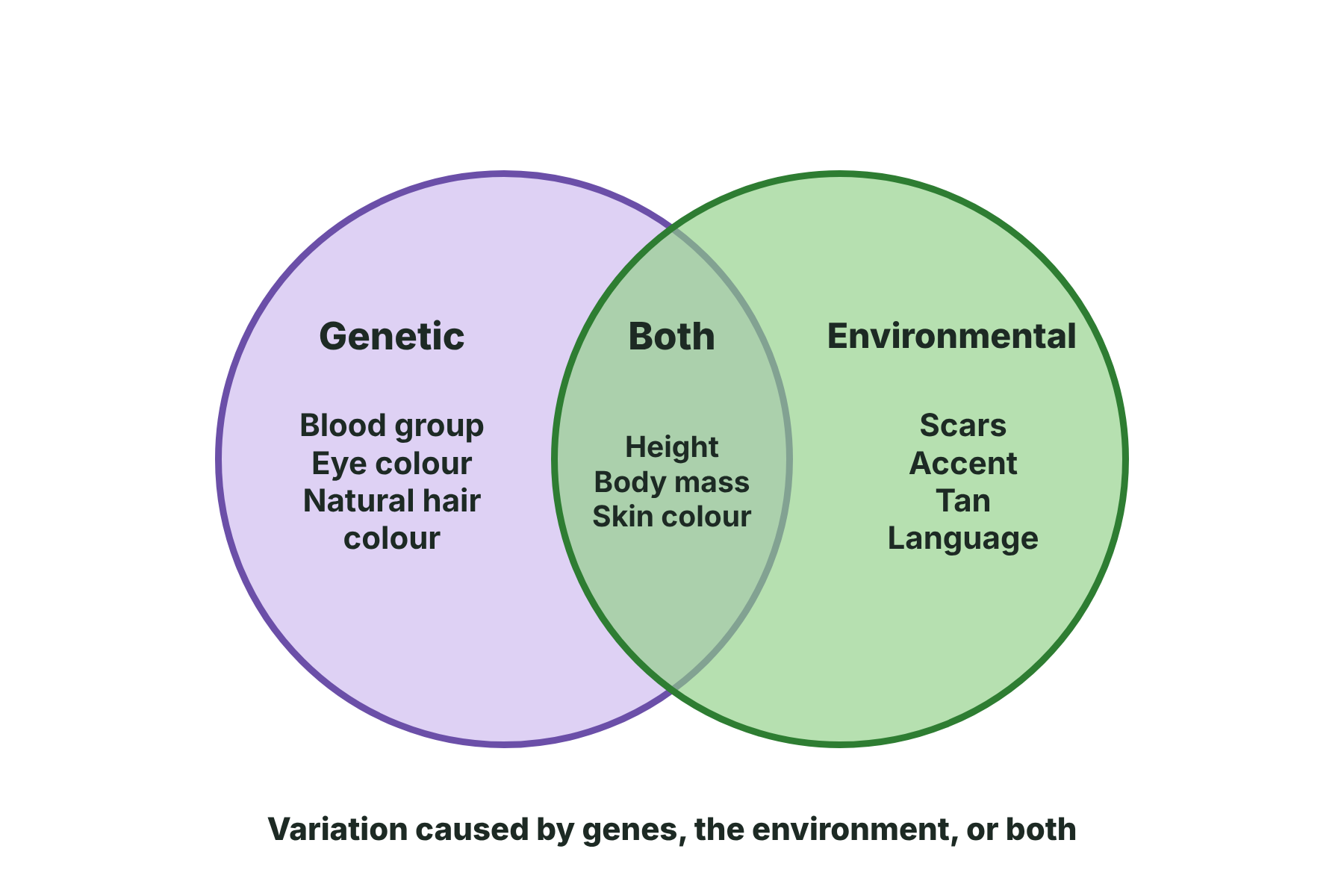
Many characteristics, such as height, are caused by both genes and the environment.
Features controlled by many genes
Most features are not controlled by one gene.
-
Polygenic features
Most characteristics, such as height, skin colour and body shape, are controlled by many genes acting together. This is why they vary so smoothly.
-
Single-gene features
Some characteristics are controlled by one gene, with a small number of different alleles, such as ABO blood group or whether you have cystic fibrosis.
-
Gene and environment
Even for polygenic features, the environment has an effect. A person's genes may set a possible height, but diet decides how close they get to it.
-
Why the difference matters
It affects what kind of variation you see in a population.
Continuous and discontinuous variation
Continuous variation
- Any value in a range, with no clear groups
- Examples: height, mass, leaf length
- Usually controlled by many genes, and often by the environment as well
- Shown by a histogram or a line graph, often in a bell shape
Discontinuous variation
- Falls into distinct categories, with no in-between values
- Examples: blood group, sex, ability to roll your tongue
- Usually controlled by one gene (or a few)
- Shown by a bar chart, with gaps between the bars
Two types of variation
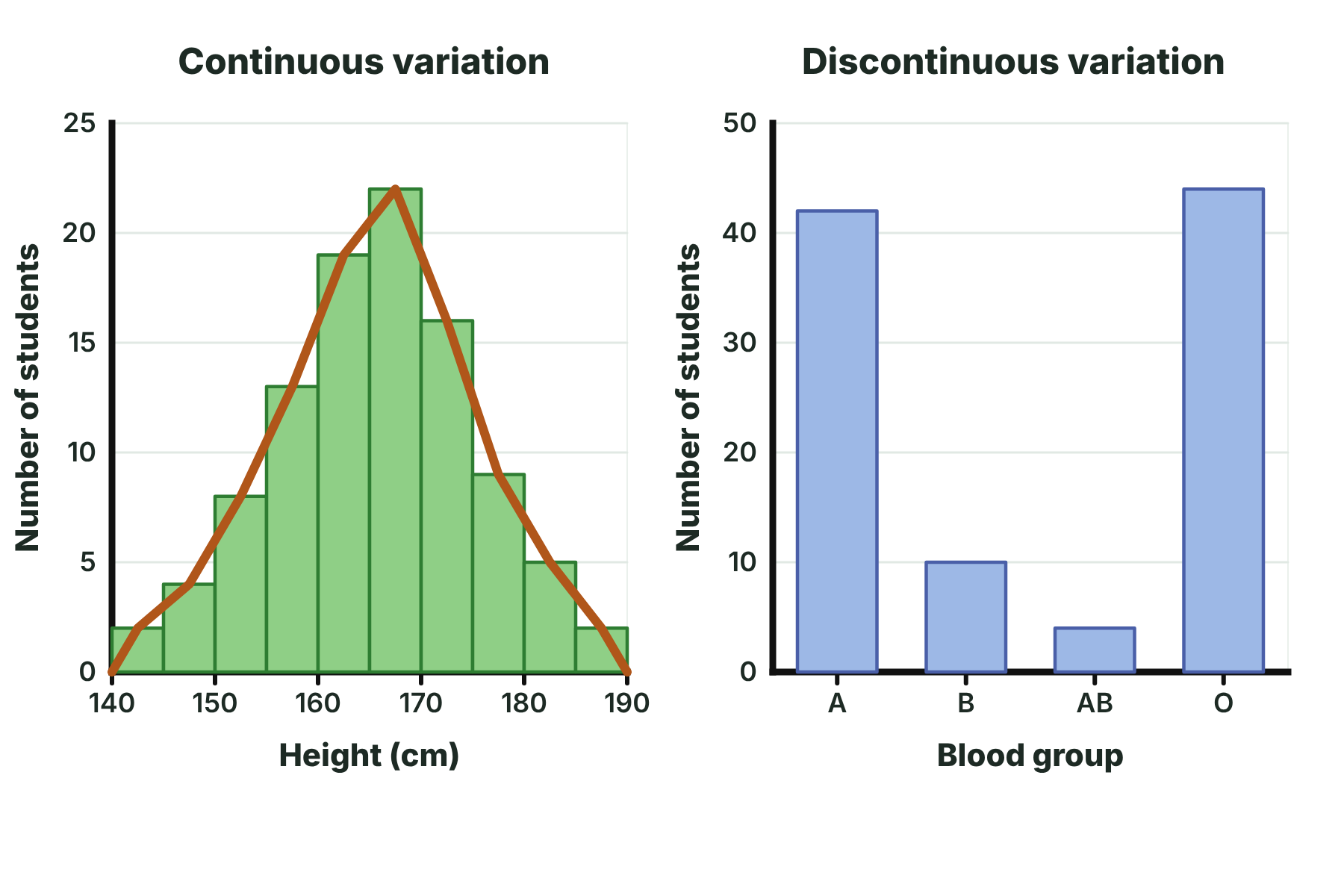
Continuous data fits a histogram. Discontinuous data fits a bar chart with gaps.
Mean and mode of leaf lengths
A student measured the leaf lengths of ten leaves from one tree: 5, 6, 6, 7, 7, 7, 8, 8, 9 and 9 cm. Calculate the mean and state the mode. Say whether this is continuous or discontinuous variation.
Show the solutionHide the solution
- 1 Add the lengths \(5 + 6 + 6 + 7 + 7 + 7 + 8 + 8 + 9 + 9 = 72\) cm.
- 2 Divide by 10 \(72 \div 10 = 7.2\) cm.
- 3 Find the mode The most common length is 7 cm, which appears three times.
- 4 Classify the variation The lengths can take any value in a range, so this is continuous variation.
AnswerThe mean is 7.2 cm, and the mode is 7 cm. It is continuous variation.
Investigating variation
A suggested practical is to look at a feature in a sample of one species, such as the length of leaves.
-
Choose a feature
For example, the length of leaves from one species of tree, or the arm span of students.
-
Random sample
Use a random sample of at least 30 leaves, so that the sample is not biased and a larger sample gives a more reliable mean.
-
Measure and record
Measure each in the same way, to the nearest millimetre, and record the results in a table.
-
Process the data
Group them into classes, draw a histogram and calculate the mean.
-
Interpret
A bell-shaped histogram suggests continuous variation controlled by many genes and the environment.
Case study
Identical twins
Identical twins have exactly the same genes, so differences between them must come from the environment. Studies of twins who grow up in different homes show which features are strongly controlled by genes and which by the environment. Their height and eye colour tend to be very similar, but their body mass and the skills they have learned depend much more on how they live. Twin studies are one of the best ways to separate genetic and environmental variation.
Summary and exam focus
- Variation is the differences between individuals of the same species.
- Genetic variation comes from mutation and from sexual reproduction.
- Environmental variation comes from an organism's surroundings, and the characteristics are not inherited.
- Most features are controlled by many genes, and some by a single gene.
- Continuous variation shows a range, and discontinuous variation falls into categories.
Exam focus
Explain why two identical twins may have different heights as adults, and give one feature that would not be different. (4 marks) (4 marks)
Start with what is the same, the genes, and then say what can differ, the environment, such as diet and illness. Link it to the type of variation, and give a feature controlled by a single gene, such as blood group, as the unchanged feature.
Key terms
The words this lesson expects you to use. Each one is linked from the first place it appears above.
- Variation
- The differences between individuals of the same species.
- Genetic variation
- Differences in characteristics caused by differences in genes.
- Environmental variation
- Differences in characteristics caused by the environment, also called acquired characteristics.
- Phenotype
- The characteristics of an organism, caused by its genes and the environment.
- Continuous variation
- Variation in which a feature can take any value within a range.
- Discontinuous variation
- Variation in which a feature falls into distinct categories.
- Acquired characteristic
- A feature that an organism gains during its life, which is not inherited.
- Polygenic
- Controlled by many genes.
- Random sample
- A sample in which every individual has an equal chance of being chosen.
- Mutation
- A change in the DNA of a gene.
You've finished the notes
Check your understanding
Test yourself while it is fresh. Start with the flashcards, then try the exam questions.
Something here looks wrong?
Tell us what and we will go and look. It goes to whoever writes these pages, nobody else, and we do not ask who you are — so there is nothing to sign and nothing comes back to you.