Biology · Reproduction, Meiosis and Variation
Mutations and Genetic Variation
Every new allele began as a mutation. This lesson explains what mutations are, what causes them, why most of them do nothing, and why a population of a species usually has a lot of genetic variation.
Learning Objectives
- 1Describe a mutation as a random change in the DNA of an organism.
- 2State the factors that increase the rate of mutation.
- 3Explain that most mutations have no effect on the phenotype, some have a small effect and a few have a large effect.
- 4Explain why there is usually extensive genetic variation in a population, and why this matters.
Retrieval practice
-
1
What is an allele?
Show answerHide answer
A different version of the same gene.
-
2
What is genetic variation?
Show answerHide answer
Differences in characteristics caused by differences in genes.
-
3
What is a gene?
Show answerHide answer
A section of DNA that codes for a protein.
-
4
What do we call the full set of DNA in an organism?
Show answerHide answer
The genome.
Where new alleles come from
Meiosis and fertilisation mix up existing alleles, but they cannot make new ones. New alleles come from mutations. A mutation is a change in the sequence of bases in DNA. It happens at random, and it can happen in any cell, in any gene or between genes. Over many generations, mutations build up in a population, so there is usually a lot of genetic variation in a species. This variation is the raw material on which natural selection can act.
What is a mutation
A mutation is a random change to the base sequence of DNA.
-
A change in the bases
One or more bases are swapped, added or deleted. This changes the sequence along the DNA molecule.
-
Random
Mutations happen by chance. They can occur anywhere in the genome, and nobody can predict where or when.
-
Spontaneous
Most happen when DNA is copied before cell division, and the copying process makes a mistake.
-
New allele
A mutation in a gene can produce a new allele of that gene, which may give the protein a different structure.
What increases the rate of mutation
Mutations happen naturally at a low rate, but certain things make them more likely. These are called mutagens.
-
Ionising radiation
X-rays, gamma rays and ultraviolet light can damage DNA. Radiation is a risk to people who work with it, such as radiographers.
-
Chemicals
Some chemicals, such as those in tobacco smoke and some industrial substances, can damage DNA.
-
Which cells matter
A mutation in a body cell can cause cancer, but it is not passed on. A mutation in a gamete, or in a cell that makes gametes, can be inherited.
Effects of mutations
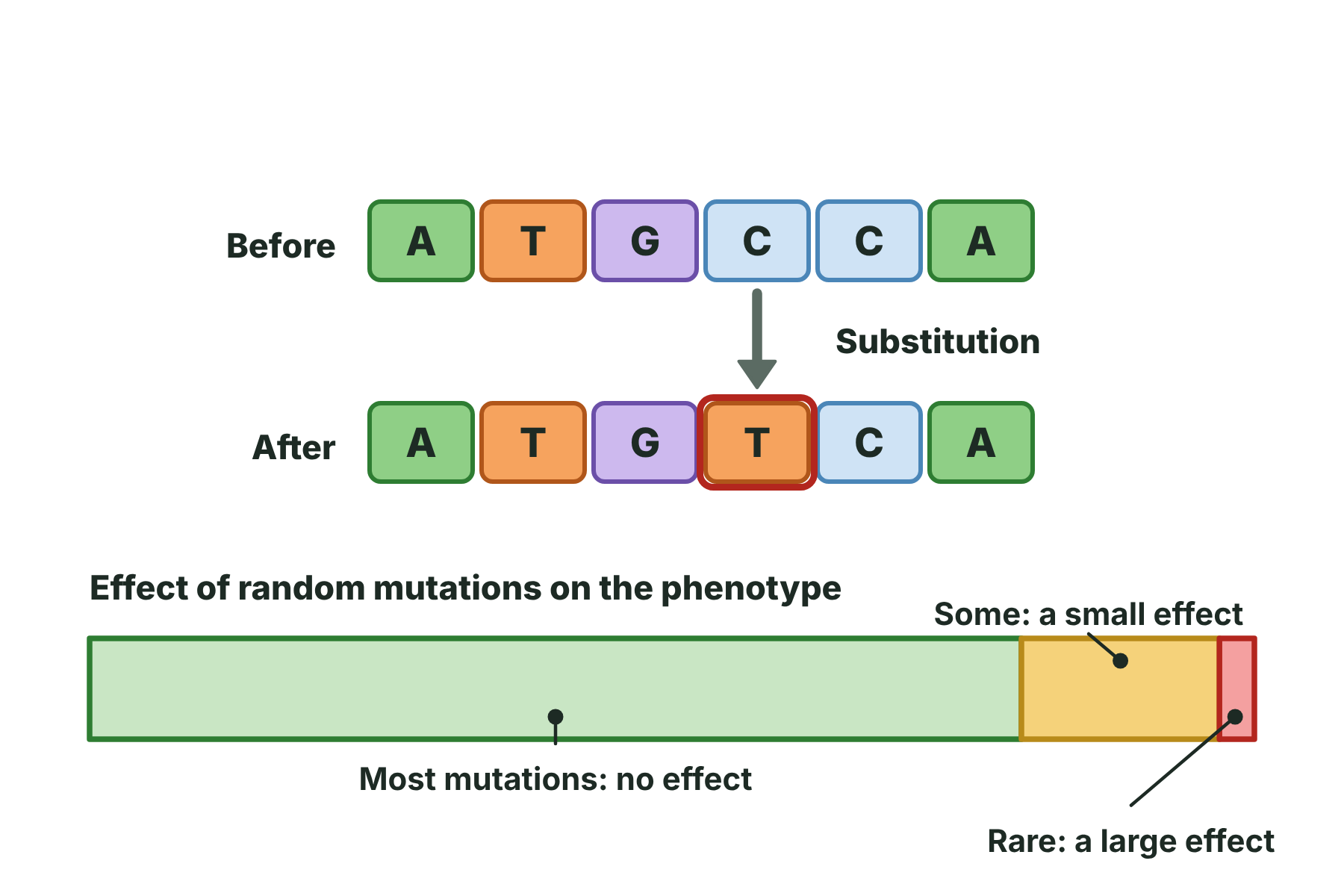
Most mutations make no difference to the organism.
The effects of mutations
The effect depends on where the mutation is and how it changes the protein.
-
Most: no effect on the phenotype
Most DNA does not code for proteins, so many mutations happen in non-coding DNA. Also, different triplets can code for the same amino acid, so some changes in a gene make no difference.
-
Some: a small effect
A mutation can change one amino acid, so a protein works slightly differently. For example, a small change in hair or eye colour.
-
A few: a large effect
A single mutation can change the phenotype significantly, if it stops an important protein working or makes it work in a new way.
-
Rarely beneficial
Occasionally a mutation helps an organism survive, such as a bacterium that becomes resistant to an antibiotic.
Mutations in different cells
Mutation in a body cell
- Happens in a cell such as the skin
- Can be copied into the new cells made by mitosis
- May cause cancer if it affects the control of cell division
- Is not passed on to the next generation
Mutation in a gamete
- Happens in a cell that makes gametes, or a gamete
- Is present in every cell of the offspring
- May cause an inherited disorder or a new variation
- Is passed on to the next generation
Variation in a population
Over a long time, mutations produce a very large number of different alleles in a species.
-
Extensive variation
In any species there is usually a lot of genetic variation, because new mutations have been occurring for millions of years.
-
Mixed up in each generation
Sexual reproduction mixes the alleles into new combinations, so each individual is unique.
-
Neutral variants
Many variants have no effect now, but they could be useful if the environment changes.
-
Raw material for evolution
Natural selection can only act on variation that is already present, so mutations are what allow species to evolve.
Case study
Antibiotic resistance in bacteria
Bacteria reproduce very quickly, and a population contains millions of cells. Occasionally a mutation in one bacterium gives it resistance to an antibiotic. Usually this makes no difference, because the bacterium does not meet the antibiotic. But when the antibiotic is used, the non-resistant bacteria are killed and the resistant bacterium survives and reproduces, so the whole population soon becomes resistant. It shows how a single rare mutation can have a large effect.
Summary and exam focus
- A mutation is a random change in the base sequence of DNA.
- Ionising radiation and some chemicals increase the rate of mutation.
- Most mutations have no effect on the phenotype, some have a small effect and a few have a large effect.
- Mutations in gametes can be inherited, and mutations in body cells cannot.
- Mutations are a source of new alleles, and so of genetic variation in a population.
Exam focus
Explain why most mutations do not affect the phenotype, and explain why a population of a species usually has a lot of genetic variation. (4 marks) (4 marks)
Give two reasons for mutations having no effect, such as non-coding DNA and the same amino acid being coded by different triplets. For variation, say that mutations happen at random over many generations, and that they produce new alleles.
Key terms
The words this lesson expects you to use. Each one is linked from the first place it appears above.
- Mutation
- A random change in the base sequence of DNA.
- Allele
- A different version of the same gene.
- Mutagen
- Something that increases the rate of mutation, such as ionising radiation or certain chemicals.
- Ionising radiation
- Radiation, such as X-rays and gamma rays, that can damage DNA.
- Genetic variation
- Differences in the genes of individuals in a species.
- Phenotype
- The observable characteristics of an organism.
- Neutral mutation
- A mutation that has no effect on the phenotype.
- Inherited
- Passed from parent to offspring in the genes.
- Antibiotic resistance
- The ability of bacteria to survive an antibiotic that would normally kill them.
You've finished the notes
Check your understanding
Test yourself while it is fresh. Start with the flashcards, then try the exam questions.
Something here looks wrong?
Tell us what and we will go and look. It goes to whoever writes these pages, nobody else, and we do not ask who you are — so there is nothing to sign and nothing comes back to you.