Biology · Selective Breeding and Genetic Engineering
Evaluating Genetic Engineering and Selective Breeding
Is it right to change the genes of living things? This lesson weighs up the benefits and the risks of genetic engineering and selective breeding in agriculture and medicine, including the practical and the ethical implications.
Learning Objectives
- 1Evaluate the benefits and the risks of genetic engineering in agriculture and medicine.
- 2Evaluate the benefits and the risks of selective breeding.
- 3Describe the practical and the ethical issues involved.
- 4Construct a balanced argument, and reach a justified conclusion.
Retrieval practice
-
1
What is selective breeding?
Show answerHide answer
Humans choosing which organisms breed, to produce desired characteristics.
-
2
What is genetic engineering?
Show answerHide answer
Modifying the genome of an organism by adding a gene from another organism.
-
3
Why can a human gene work in a bacterium?
Show answerHide answer
All organisms use the same genetic code.
-
4
What is a drawback of selective breeding?
Show answerHide answer
Reduced genetic variation, and inbreeding.
Science and society
Science can tell us what is possible, but it cannot tell us what we should do. Decisions about genetic engineering and selective breeding involve science, economics and ethics, and different people reach different conclusions. In your exam you may be asked to evaluate these techniques. This means that you should weigh up benefits and risks, use evidence, and reach a reasoned judgement rather than just listing points.
Comparing the two methods
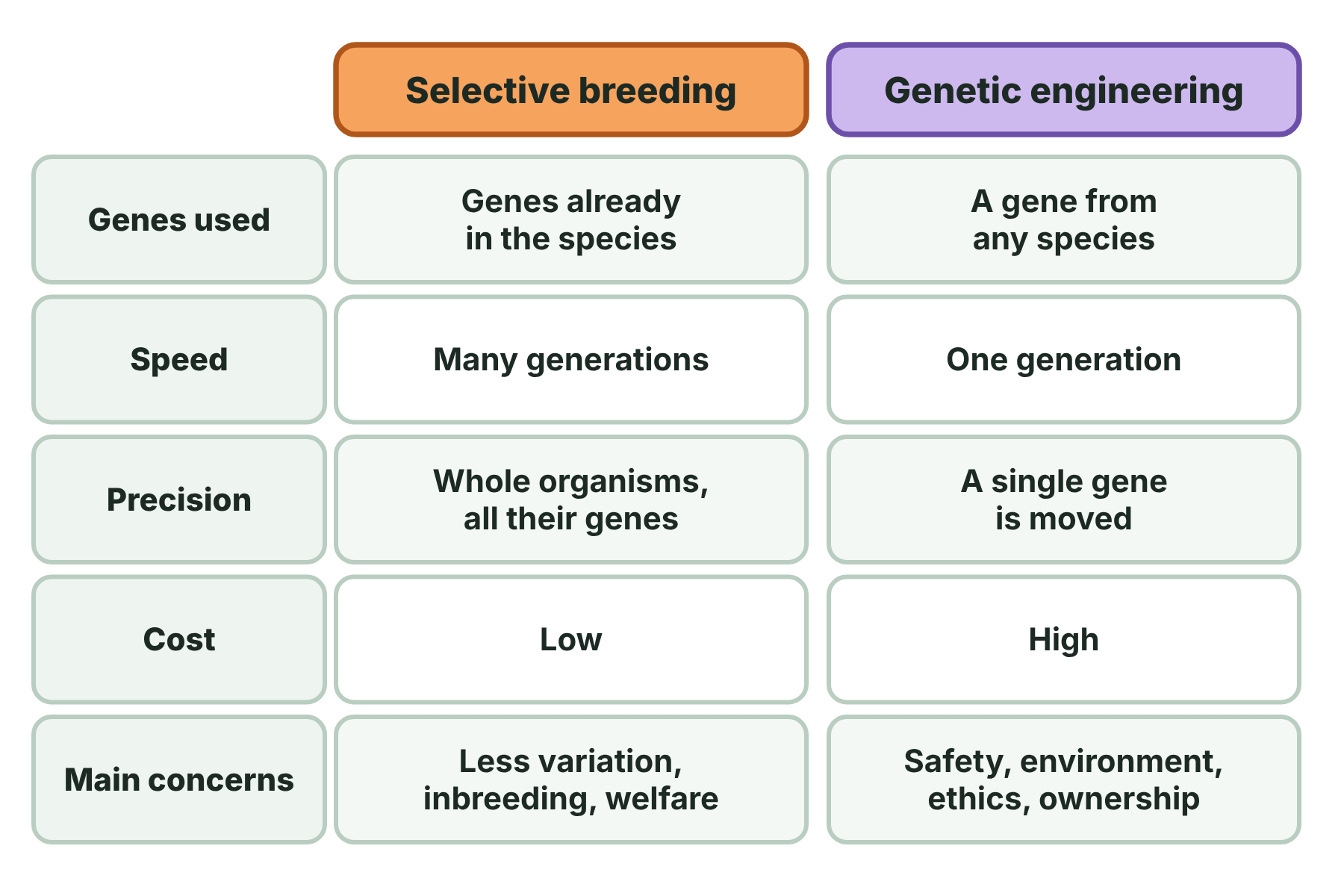
Both methods change the characteristics of organisms, but in very different ways.
Genetic engineering in agriculture
GM crops show how a technology can help and also raise concerns.
-
Benefits
Higher yields, resistance to pests, drought or herbicides, and more nutrients, as in golden rice. These can help to feed a growing population.
-
Environmental benefit
Fewer pesticide sprays, and less land needed for the same amount of food.
-
Practical risks
Pests may evolve resistance. Modified genes might spread to wild plants. Harm to other species is possible.
-
Ethical and social issues
Companies own the patents on GM seeds, which makes farmers dependent on them. Some people think it is wrong to interfere with genes, and want food labelled.
Genetic engineering in medicine
The benefits for health are the most clearly accepted.
-
Medicines
GM bacteria make insulin, growth hormone and clotting factors that are cheap and safe, and available in large amounts.
-
Gene therapy
Faulty genes can be replaced to treat inherited disorders such as severe immune deficiency, although the technology is still developing and risks remain.
-
Practical risks
A vector might put a gene in the wrong place and cause cancer, or the immune system might attack it.
-
Ethical issues
Altering the genes in gametes or embryos would pass changes on to the next generation, and could lead to choosing a baby's features. This is not allowed in the UK.
Selective breeding
Selective breeding is older, and more accepted, but it also has problems.
-
Benefits
Higher yields of crops and animal products, disease-resistant plants, and breeds suited to a purpose. It is cheap, and does not involve moving genes between species.
-
Practical risks
Reduced genetic variation makes populations vulnerable to disease. Inbreeding causes genetic disorders.
-
Ethical issues
Animal welfare is a major concern, such as breeds of dog with breathing problems, and cows with very high yields that suffer from udder infections and lameness.
-
Public opinion
It is less controversial than genetic engineering, since it uses natural variation.
Benefits and risks
Benefits
- More food from the same land, helping to feed more people
- Healthier or more nutritious food
- Medicines that are cheap, safe and plentiful
- Less use of pesticides and fertilisers
Risks and concerns
- Harm to the environment or to health that is not yet known
- Loss of genetic variation
- Animal welfare, and ethical objections to changing genes
- Control of food supply by large companies
Case study
The AquAdvantage salmon
AquAdvantage salmon are Atlantic salmon that have been engineered with a growth hormone gene from another type of salmon. They grow to market size in about half the time of ordinary farmed salmon, so they use less feed. They were approved for sale as food in the USA in 2015 and in Canada in 2016. Supporters say that they give cheap protein, but critics worry about what would happen if they escaped into the wild, and about the ethics of genetically modifying animals.
Summary and exam focus
- Genetic engineering can move genes between species in a single generation, and is used for crops and medicines.
- Selective breeding uses variation that already exists, takes many generations, and is cheap.
- Benefits include higher yield, better nutrition and medicines, and less use of chemicals.
- Risks include harm to the environment, loss of variation, animal welfare, and uncertainty over health.
- Ethical issues include interfering with genes, patents and the control of the food supply.
Exam focus
Evaluate the benefits and risks of using genetic engineering and selective breeding in modern agriculture. Include practical and ethical implications. (6 marks) (6 marks)
Organise your answer into benefits and risks for each method, and include at least one practical and one ethical point. Finish with a conclusion that says which you think is better, or under what conditions, and give a reason.
Key terms
The words this lesson expects you to use. Each one is linked from the first place it appears above.
- Evaluate
- To weigh up the benefits and the drawbacks, and reach a judgement.
- Ethical issue
- A question of what is right or wrong, rather than what is possible.
- Practical issue
- A question about how well something works, or what problems it may cause.
- Patent
- A legal right that stops other people from copying or selling an invention.
- Food security
- Having a reliable supply of enough safe and nutritious food.
- Gene therapy
- Treating a genetic disorder by putting a healthy gene into cells.
- Animal welfare
- The health and well-being of animals.
- Regulation
- Rules and tests that control how a technology is used.
- Biodiversity
- The variety of living things in an area.
You've finished the notes
Check your understanding
Test yourself while it is fresh. Start with the flashcards, then try the exam questions.
Something here looks wrong?
Tell us what and we will go and look. It goes to whoever writes these pages, nobody else, and we do not ask who you are — so there is nothing to sign and nothing comes back to you.