Biology · Selective Breeding and Genetic Engineering
Feeding a Growing Population
The world population is rising, and everyone needs food. This lesson is for separate Biology only: Combined Science students do not need it. It looks at two agricultural solutions, fertilisers and biological control, and weighs up their advantages and disadvantages.
Learning Objectives
- 1Explain why agriculture needs to produce more food for a growing human population.
- 2Explain the advantages and disadvantages of using fertilisers.
- 3Explain the advantages and disadvantages of biological control.
- 4Interpret data on crop yield, and evaluate agricultural solutions.
Retrieval practice
-
1
What is a pest?
Show answerHide answer
An organism that damages crops or other things that people value.
-
2
What do plants need to make proteins?
Show answerHide answer
Nitrates (nitrogen) from the soil.
-
3
What is a predator?
Show answerHide answer
An animal that hunts and eats other animals.
-
4
What does GM stand for?
Show answerHide answer
Genetically modified.
More mouths to feed
The world population has grown from about 2.5 billion in 1950 to over 8 billion today, and it is still rising. To feed everyone, farmers have to produce more food, and more food from each hectare of land, because there is little new farmland. Crops lose a lot to pests, diseases and poor soil. Selective breeding and genetic engineering help, and so do two other solutions that are on the specification, which are fertilisers and biological control.
Fertilisers
Plants take minerals from the soil, and when a crop is harvested the minerals are removed. Fertilisers put them back.
-
Nitrates
Needed to make proteins and chlorophyll. A shortage causes stunted growth and yellow leaves.
-
Phosphates
Needed for making DNA and cell membranes, and for energy transfer. A shortage causes poor root growth.
-
Potassium
Needed for enzymes in respiration and photosynthesis. A shortage causes yellow leaves with dead patches.
-
Types
Inorganic fertilisers, such as NPK, are chemicals that contain nitrogen, phosphorus and potassium. Organic fertilisers include manure and compost.
Effect of nitrogen fertiliser on wheat yield
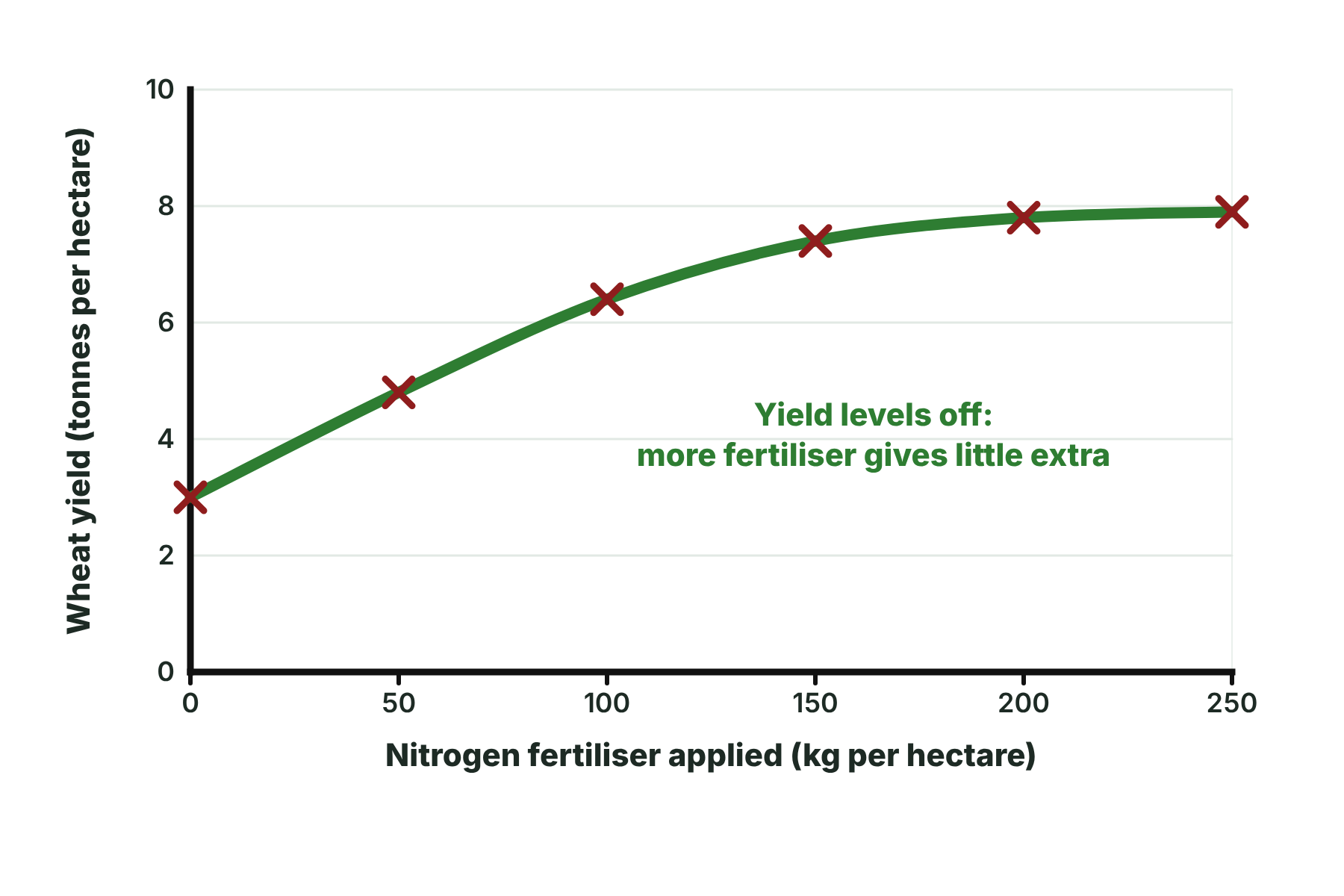
The yield rises with fertiliser, but it levels off, so extra fertiliser is wasted.
Advantages and disadvantages of fertilisers
Fertilisers are very effective, but they can cause damage.
-
Advantage: higher yields
Crops get the minerals they need, so they grow larger and produce more food from the same land.
-
Advantage: quick and reliable
Fertilisers can be added in exact amounts, to meet the crop's needs.
-
Disadvantage: eutrophication
Rain washes the nitrates and phosphates into rivers and lakes, where they cause algae to grow rapidly. The algae block light, and the plants below die, and bacteria feeding on the dead material use up oxygen, so fish and other animals die.
-
Disadvantage: cost and pollution
They are expensive, and making them uses a lot of energy. Nitrates in drinking water can be a health risk.
-
Disadvantage: overuse
Using too much is wasteful, as the graph shows, and it can harm soil organisms.
Biological control
Biological control means using a living organism to control a pest, in place of chemical pesticides.
-
Predators
Ladybirds and their larvae eat aphids, which feed on crops, and are sold to gardeners and growers.
-
Parasites
A tiny wasp lays its eggs in whiteflies, and the young wasps kill them. It is used in greenhouses to protect tomatoes and cucumbers.
-
Pathogens
A bacterium such as Bacillus thuringiensis can be sprayed to kill caterpillars. The myxoma virus was used in Australia to control rabbits.
-
How it works
The control organism is released in the crop, where it reduces the number of the pest, but does not remove all of them.
Biological control and chemical pesticides
Biological control
Chemical pesticides
- Uses chemicals sprayed on the crop
- May kill other, useful, insects such as bees
- Can pollute soil and water
- Fast and effective, but pests can become resistant
Advantages and disadvantages of biological control
It is a less damaging approach, but it has limits.
-
Advantage: specific
The control organism is chosen for one pest, so other animals are less likely to be harmed.
-
Advantage: no pollution
There are no chemicals to wash into water or stay in food.
-
Advantage: lasting
The control organism may breed and keep the pest down for a long time, which saves money.
-
Disadvantage: not complete
It is slow, and the pest is reduced and not removed, so some damage to crops continues.
-
Disadvantage: may become a pest
An introduced species may spread and harm local wildlife.
-
Disadvantage: depends on conditions
It may not work if the weather is wrong, and it needs good timing.
Working out the benefit of fertiliser
Use the figures from the graph: yield was 3.0 tonnes per hectare with no fertiliser, and 6.4 tonnes per hectare with 100 kg of fertiliser. Calculate the percentage increase in yield, and the extra yield for each kg of fertiliser.
Show the solutionHide the solution
- 1 Find the increase \(6.4 - 3.0 = 3.4\) tonnes per hectare.
- 2 Percentage increase \(3.4 \div 3.0 \times 100 = 113\%\).
- 3 Extra yield per kg \(3.4 \div 100 = 0.034\) tonnes per kg, which is 34 kg of wheat for each kg of fertiliser.
AnswerThe yield increased by 113% (to the nearest whole number), by 0.034 tonnes (34 kg) for every kg of fertiliser.
Case study
Cane toads in Australia
In 1935 cane toads were brought from South America to Queensland, Australia, to control the beetles that were damaging sugar cane. The toads did not control the beetles, which live at the top of the cane where the toads could not reach, but they bred rapidly and spread. Their skin is poisonous, so they kill many native animals that eat them. They are now in millions across northern Australia. It is a famous example of biological control going wrong.
Summary and exam focus
- Fertilisers replace the minerals that crops remove from the soil, and increase yield.
- Run-off of fertiliser causes eutrophication, which kills aquatic life.
- Biological control uses a predator, parasite or pathogen to control a pest.
- It causes less pollution, but it is slow and may not be complete, and the control organism could become a pest.
- A combination of methods is often the best solution.
Exam focus
Evaluate the use of fertilisers and biological control to increase food production. (6 marks) (6 marks)
Treat the two methods separately, giving at least one advantage and one disadvantage of each, using key words such as yield, eutrophication, pest, predator and non-target organisms. Then compare them and give a justified conclusion.
Key terms
The words this lesson expects you to use. Each one is linked from the first place it appears above.
- Fertiliser
- A substance containing minerals that is added to soil to help plants to grow.
- NPK fertiliser
- An inorganic fertiliser that contains nitrogen, phosphorus and potassium.
- Eutrophication
- Rapid growth of algae in water caused by too many nutrients, which leads to a lack of oxygen.
- Biological control
- Using a living organism, such as a predator or parasite, to control a pest.
- Pest
- An organism that damages a crop or something else people value.
- Predator
- An animal that hunts and eats other animals.
- Parasite
- An organism that lives on or in another organism and harms it.
- Pesticide
- A chemical that kills pests.
- Invasive species
- A species introduced to an area where it harms the native species.
You've finished the notes
Check your understanding
Test yourself while it is fresh. Start with the flashcards, then try the exam questions.
Something here looks wrong?
Tell us what and we will go and look. It goes to whoever writes these pages, nobody else, and we do not ask who you are — so there is nothing to sign and nothing comes back to you.