Biology · Selective Breeding and Genetic Engineering
Selective Breeding
For thousands of years farmers have chosen the best animals and plants to breed from. This lesson explains how selective breeding works, what it has achieved in food crops and domesticated animals, and what the drawbacks are.
Learning Objectives
- 1Describe the process of selective breeding, in plants and in animals.
- 2Give examples of characteristics that have been selected in food plants and domesticated animals.
- 3Explain the impact of selective breeding on the genetic variation of a population.
- 4Evaluate the benefits and the drawbacks of selective breeding.
Retrieval practice
-
1
What is variation?
Show answerHide answer
The differences between individuals of the same species.
-
2
What is natural selection?
Show answerHide answer
The process by which better adapted individuals survive and reproduce.
-
3
What is an allele?
Show answerHide answer
A different version of the same gene.
-
4
What is meant by a characteristic being inherited?
Show answerHide answer
It is passed from parents to offspring in the genes.
Breeding by choice
In natural selection the environment decides which individuals survive and breed. In selective breeding, which is also called artificial selection, people decide. Farmers and breeders choose the plants or animals with the features they want, and breed only from those. Over many generations the desired features become stronger and more common. All of our food crops and farm animals, and all breeds of dog, have been changed from their wild ancestors in this way.
The steps of selective breeding
The process is the same for plants and for animals. It depends on there being variation in the population.
-
1
Choose parents
Select the individuals that show the characteristic you want, such as high milk yield or large fruit.
-
2
Breed them
Breed the selected parents together, so that their alleles are passed on to the offspring.
-
3
Select the best offspring
From the offspring, choose the ones with the characteristic most strongly, and discard the others.
-
4
Repeat
Repeat the process over many generations, until the desired characteristic is well established.
The cycle of selective breeding
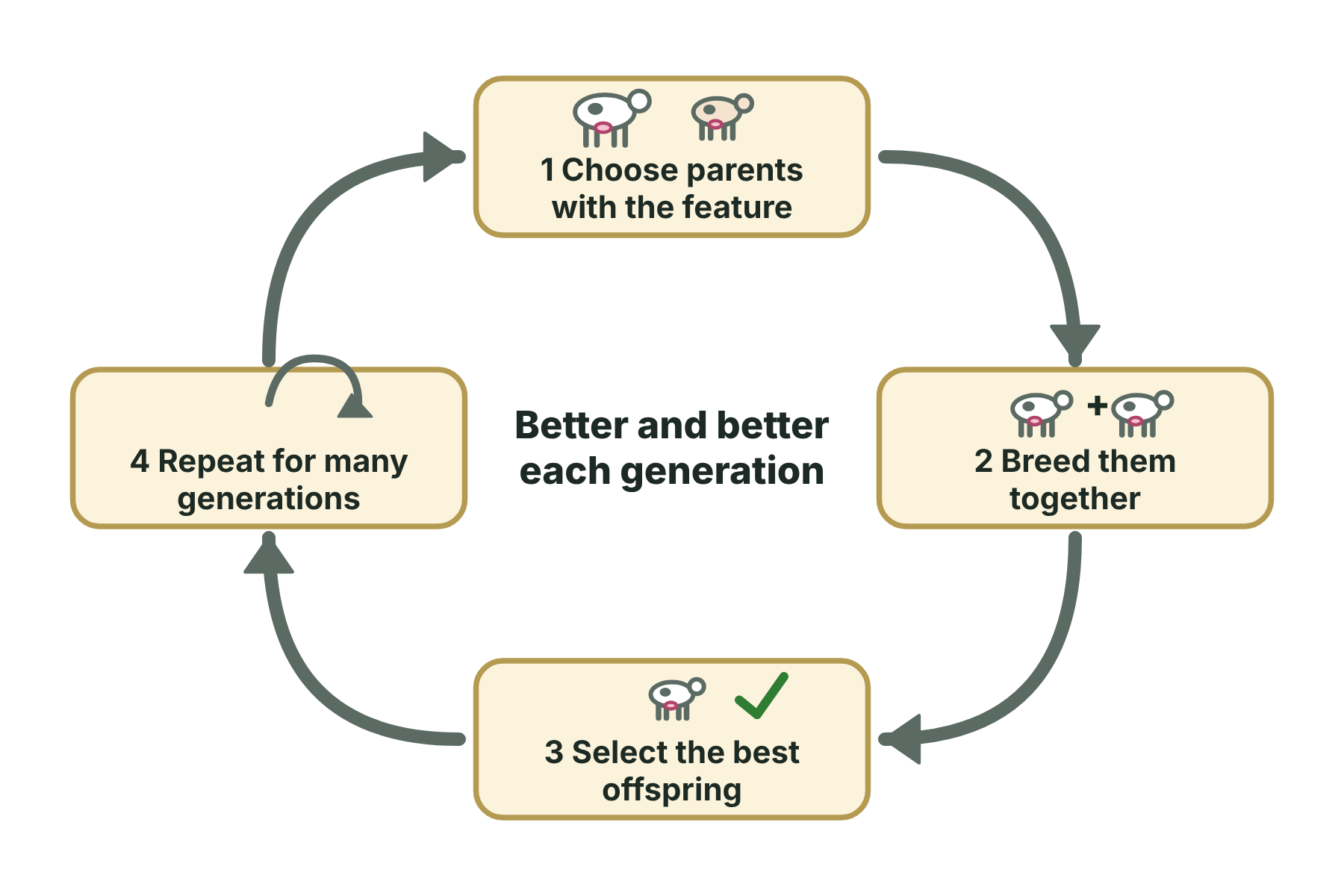
Each generation is chosen by people, so the desired feature increases.
Selective breeding in plants
Plants are selected for features that improve yield, quality and ease of growing.
-
Disease resistance
Wheat and other crops are bred to resist fungal diseases, so that less is lost to disease and fewer pesticides are needed.
-
Large fruit and seeds
Tomatoes, apples and wheat have been bred to have bigger and more fruits or grains than their wild ancestors.
-
Taste and appearance
Sweeter fruit, or flowers of different colours, shapes and scents in garden plants.
-
Wild cabbage
Selecting different features of one wild plant gave cabbage (leaves), broccoli (flowers), kale (large leaves), kohlrabi (stem) and Brussels sprouts (buds).
Selective breeding in animals
Domesticated animals are chosen for a range of features.
-
Dairy cattle
Cows are bred for a high milk yield. The average yield in the UK rose from about 5000 litres a year in 1990 to about 8000 litres in 2020.
-
Meat and wool
Beef cattle are bred for fast growth and lean meat, and sheep for good quality wool.
-
Hens
Chickens are bred to lay a large number of eggs, or to grow quickly for meat.
-
Dogs and horses
Dogs are bred for a gentle nature or for work, such as herding, and horses are bred for speed or strength.
Percentage increase in milk yield
The average milk yield of a herd of cows increased from 5000 litres per cow per year to 8000 litres per cow per year, over 30 years. Calculate the percentage increase.
Show the solutionHide the solution
- 1 Find the increase \(8000 - 5000 = 3000\) litres.
- 2 Divide by the original \(3000 \div 5000 = 0.6\).
- 3 Convert to a percentage \(0.6 \times 100 = 60\%\).
AnswerA 60% increase.
Natural selection and selective breeding
Natural selection
- The environment decides which individuals survive
- Features that help survival become more common
- No one has a goal in mind
- Takes place in wild populations
Selective breeding
- People decide which individuals breed
- Features that people want become more common
- It has a purpose, such as a higher yield
- Takes place in farms, gardens and homes
Benefits and drawbacks
Selective breeding has greatly increased food production, but it has costs.
-
Benefit: higher yield
More food is produced from the same land and animals, which helps to feed a growing population.
-
Benefit: better quality and resistance
Crops that resist disease need fewer chemicals, and animals can be bred with better meat or milk.
-
Drawback: reduced variation
Breeding from a few individuals makes the population genetically similar, so a disease or a change in the environment could harm all of them.
-
Drawback: inbreeding
Breeding close relatives increases the chance that two copies of a harmful recessive allele are inherited. Some dog breeds suffer from breathing problems or hip joint disease.
-
Drawback: slow
It takes many generations to produce a change, and it can only use the variation that already exists.
Case study
Breeding dogs
All breeds of dog, from a chihuahua to a Great Dane, came from the wolf, by selective breeding over thousands of years. People chose dogs that were calm, good at herding, or good at hunting, and later for appearance. Some breeds, such as pugs and bulldogs, have been bred to have such short faces that they find it hard to breathe, and many German shepherds have hip problems. The breeds show how powerful selective breeding is, and how it can cause welfare problems if it is taken too far.
Summary and exam focus
- Selective breeding is when humans choose which organisms breed, to produce a desired characteristic.
- The process involves choosing parents, breeding them, selecting the best offspring and repeating over generations.
- It has produced high-yield crops, disease-resistant plants and productive farm animals.
- It reduces genetic variation and can cause inbreeding, so some breeds have health problems.
- It is slow, and it can only use the variation that already exists.
Exam focus
Describe how a farmer could use selective breeding to produce cattle that give more milk, and explain one disadvantage of this process. (6 marks) (6 marks)
Give the steps in order: choose the cows with the highest yield, breed them with a bull whose mother had a high yield, select the best offspring and repeat over many generations. For the disadvantage, link inbreeding or loss of variation to a specific harm, such as disease or genetic disorders.
Key terms
The words this lesson expects you to use. Each one is linked from the first place it appears above.
- Selective breeding
- Breeding organisms with desired characteristics over many generations, so that the characteristics become more common.
- Artificial selection
- Another name for selective breeding, since humans do the selecting.
- Domesticated
- Tamed and kept by humans, as farm animals and pets are.
- Yield
- The amount of a product, such as milk or grain, that is produced.
- Inbreeding
- Breeding between close relatives, which increases the chance of genetic disorders.
- Breed
- A variety of a domesticated animal, with its own distinct characteristics.
- Gene pool
- All of the alleles in a population.
- Disease resistance
- The ability of an organism to avoid or survive a disease.
- Characteristic
- A feature of an organism.
You've finished the notes
Check your understanding
Test yourself while it is fresh. Start with the flashcards, then try the exam questions.
Something here looks wrong?
Tell us what and we will go and look. It goes to whoever writes these pages, nobody else, and we do not ask who you are — so there is nothing to sign and nothing comes back to you.