Biology · Selective Breeding and Genetic Engineering
Tissue Culture
A single plant cell can grow into a whole new plant. This lesson is for separate Biology only: Combined Science students do not need it. It explains how tissue culture is carried out, and how it is used in plant breeding and medical research.
Learning Objectives
- 1Describe the process of tissue culture in plants.
- 2Explain the advantages of tissue culture in plant breeding programmes.
- 3Describe how tissue culture is used in medical research.
- 4Evaluate the advantages and the disadvantages of tissue culture.
Retrieval practice
-
1
What is a stem cell?
Show answerHide answer
An undifferentiated cell that can divide and differentiate into specialised cells.
-
2
Where are the stem cells in a plant?
Show answerHide answer
In the meristems, at the tips of the roots and shoots.
-
3
What is a clone?
Show answerHide answer
An organism that is genetically identical to another.
-
4
What is asexual reproduction?
Show answerHide answer
Reproduction with one parent, producing genetically identical offspring.
Growing tissue in a dish
Plant cells can be unusual. Many of them are able to differentiate into any other type of plant cell, so that a small piece of tissue can grow into a complete plant. Tissue culture uses this to grow large numbers of plants quickly, in a laboratory, from tiny samples of tissue. The technique also works for animal cells, which can be grown in a dish to study diseases and test drugs, although they cannot grow into whole animals in this way.
Plant tissue culture
Everything must be sterile, as microorganisms would grow faster than the plant cells and spoil the culture.
-
1
Choose the parent
Select a plant with the desired features, such as high yield or disease resistance.
-
2
Take small pieces
Cut tiny pieces, called explants, from the tip of a shoot or from a leaf.
-
3
Sterilise
Wash them in disinfectant to kill any microorganisms on the surface, and use sterile tools.
-
4
Grow on nutrient agar
Place them on sterile agar jelly containing nutrients and plant hormones, in a warm, well lit place.
-
5
A callus forms
The cells divide, producing a mass of undifferentiated cells called a callus.
-
6
Shoots and roots
The callus is moved to a medium with different hormones, so that it grows shoots and roots, forming plantlets.
-
7
Plant out
The plantlets are moved into compost, and gradually moved into normal conditions.
Steps in plant tissue culture
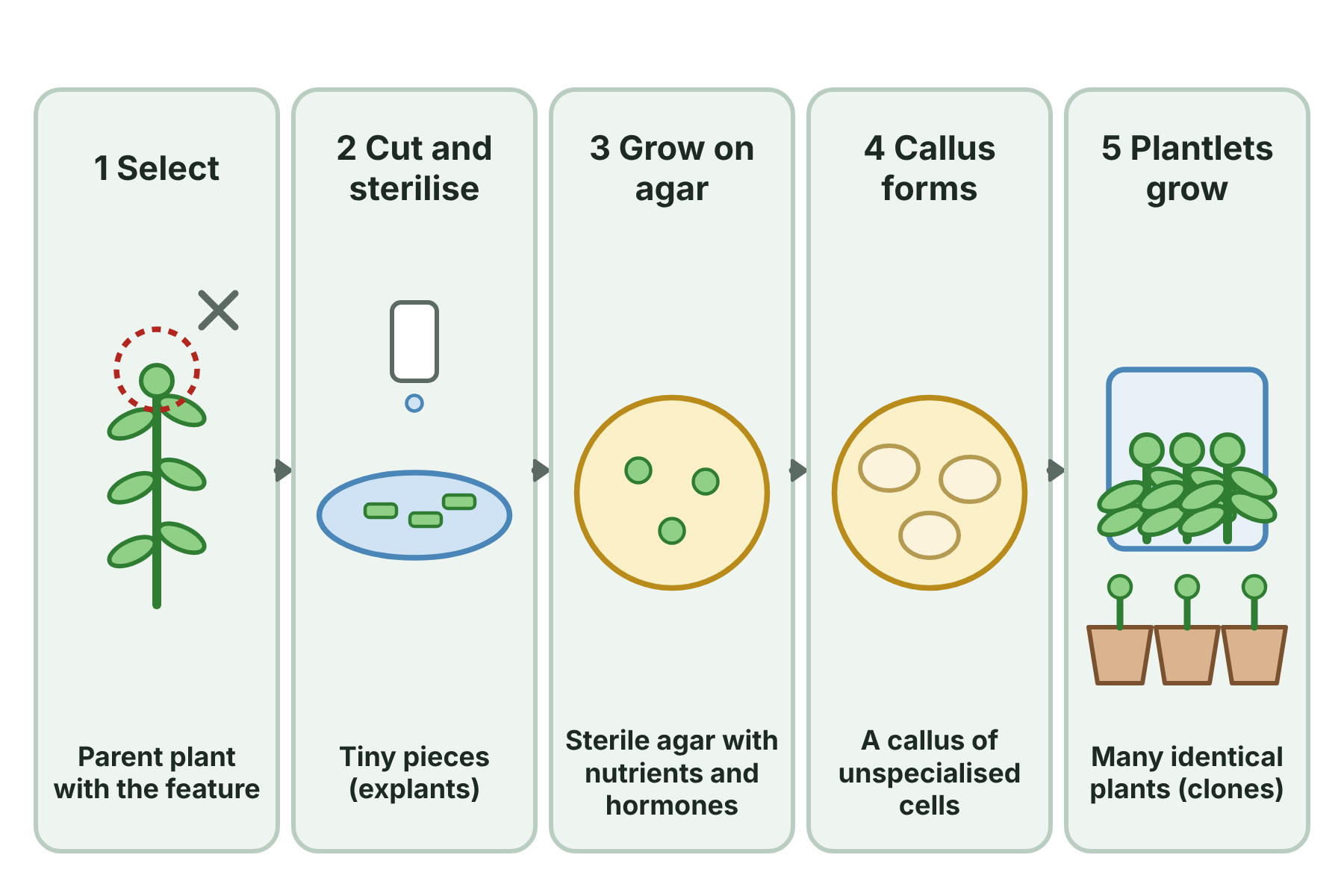
A few cells from one plant can make hundreds of identical plantlets.
Advantages in plant breeding
Tissue culture is widely used in horticulture and agriculture.
-
Many plants quickly
Hundreds or thousands of new plants can be produced from one parent in a short time, whatever the season.
-
Identical plants
They are all clones, so the useful features of the parent, such as a good flavour, are kept.
-
Disease-free plants
The cells at the tip of a shoot are often free of viruses, so plants grown from them are disease-free.
-
Rare plants
Species that are in danger of extinction, such as some orchids, can be saved and grown in large numbers.
-
Genetically engineered plants
A single cell with a new gene can be grown into a whole plant, so the characteristic can be copied.
Uses in medical research
Animal and human cells can also be cultured.
-
Growing cells in medium
Cells are taken from an organism and grown in a sterile dish with nutrients, at body temperature.
-
Testing drugs
New medicines can be tested on cultured cells, which reduces the need to test on animals.
-
Studying diseases
Cancer cells can be grown to find out how they divide, and to test treatments, such as chemotherapy drugs.
-
Making vaccines and proteins
Some viruses are grown in cultured cells to make vaccines, and some cell cultures make medical proteins.
-
Growing tissue for patients
Skin cells can be grown in a lab to make skin grafts for burns victims.
Advantages and disadvantages of tissue culture
Advantages
- Produces many identical plants quickly
- Works all year round, in a small space
- Plants can be free of disease
- Saves endangered species
Disadvantages
- Expensive, and needs skilled workers and special equipment
- Plants are clones, so there is no variation and one disease could affect all of them
- A sterile technique is needed, and contamination ruins the culture
- Not possible for all species
How many plantlets?
A scientist cuts 20 explants from one shoot tip. Each explant grows into a callus that can be split into 15 pieces, and each piece forms one plantlet. How many plantlets are produced? What is the genetic relationship between them?
Show the solutionHide the solution
- 1 Pieces from each explant Each explant gives 15 pieces, which is 15 plantlets.
- 2 Multiply by the number of explants \(20 \times 15 = 300\) plantlets.
- 3 Describe the relationship They all came from the cells of one parent by mitosis, so they are genetically identical.
Answer300 plantlets, all of them genetically identical clones of the parent.
Case study
Saving the orchids
Many orchids are rare in the wild, and they can be difficult to grow from seed because the seeds are tiny and need a fungus to germinate. Using tissue culture, growers can produce thousands of orchid plants from a small piece of tissue, and sell them without taking any from the wild. Kew Gardens uses these techniques to conserve rare plants, and to grow plants to be reintroduced. It shows how tissue culture helps both horticulture and conservation.
Summary and exam focus
- Tissue culture grows new plants from small pieces of tissue, in sterile conditions on agar with nutrients and hormones.
- A callus of undifferentiated cells forms first, and then shoots and roots grow.
- The plants are clones, so tissue culture quickly makes many identical plants.
- It is used to save rare plants, to make disease-free plants and to grow genetically engineered plants.
- Cell culture is also used in medical research to study diseases and test drugs.
Exam focus
Describe the process of tissue culture, and evaluate its use in a plant breeding programme. (6 marks) (6 marks)
Give the stages in order: small pieces of tissue, sterile conditions, agar with nutrients and hormones, callus, plantlets. In the evaluation, state at least two advantages and at least one disadvantage, such as lack of variation, and conclude.
Key terms
The words this lesson expects you to use. Each one is linked from the first place it appears above.
- Tissue culture
- Growing tissues or cells in a sterile laboratory dish with nutrients.
- Explant
- A small piece of tissue taken from a plant, to grow in culture.
- Callus
- A mass of undifferentiated plant cells that grows in tissue culture.
- Plantlet
- A small young plant grown from a callus.
- Sterile
- Free from microorganisms.
- Agar
- A jelly used as a growth medium for tissue culture, and to grow microorganisms.
- Plant hormone
- A chemical that controls the growth and development of a plant.
- Clone
- An organism that is genetically identical to another.
- Culture
- A growth of cells or microorganisms in a laboratory.
You've finished the notes
Check your understanding
Test yourself while it is fresh. Start with the flashcards, then try the exam questions.
Something here looks wrong?
Tell us what and we will go and look. It goes to whoever writes these pages, nobody else, and we do not ask who you are — so there is nothing to sign and nothing comes back to you.