Biology · The Nervous System
Eye Defects and Their Correction
Many people need glasses or an operation to see clearly. This lesson is for separate Biology only: Combined Science students do not need it. It covers cataracts, short and long sight and colour blindness, and how each is corrected or managed.
Learning Objectives
- 1Describe the defects of the eye called cataracts, long-sightedness, short-sightedness and colour blindness.
- 2Explain the causes of short sight and long sight in terms of where the light is focused.
- 3Explain how cataracts, long sight and short sight can be corrected.
- 4Draw and interpret ray diagrams showing the effect of a corrective lens.
Retrieval practice
-
1
What is the function of the cornea and lens?
Show answerHide answer
To refract light and focus it onto the retina.
-
2
Which cells detect colour?
Show answerHide answer
Cone cells.
-
3
What does the retina contain?
Show answerHide answer
The light receptors: rod cells and cone cells.
-
4
What happens to the lens when looking at a near object?
Show answerHide answer
It becomes thicker and more curved.
When the eye does not focus
A healthy eye brings light from objects at all distances to a focus exactly on the retina. When the cornea and lens cannot do this, the image is blurred. The common reason is that the light is focused in front of the retina or behind it. Other defects come from a lens that has become cloudy, or from missing cone cells. All of them are common, and most can be corrected.
The four defects
Each defect affects vision in a different way.
-
Short-sightedness
A person can see near objects clearly but distant objects are blurred. The light from distant objects is focused in front of the retina.
-
Long-sightedness
A person can see distant objects clearly but near objects are blurred. The light from near objects would focus behind the retina.
-
Cataracts
The lens becomes cloudy, so light cannot pass through it properly. Vision becomes misty or blurred, and bright lights can seem dazzling.
-
Colour blindness
A person cannot tell some colours apart, most commonly red and green, because one or more types of cone cell are missing or do not work.
Causes of short sight and long sight
Both are caused by the shape of the eye, or by the lens not bending light by the right amount.
-
Short sight
The eyeball is too long, or the cornea and lens bend the light too much. The light focuses before it reaches the retina and then spreads out again, so the image on the retina is blurred.
-
Long sight
The eyeball is too short, or the lens is too weak, so it cannot bend light enough. The light would focus behind the retina, so the image on the retina is blurred.
-
Ageing
The lens becomes stiffer with age and cannot become thick enough to focus on near objects, so most people become long-sighted as they get older.
Short sight and its correction
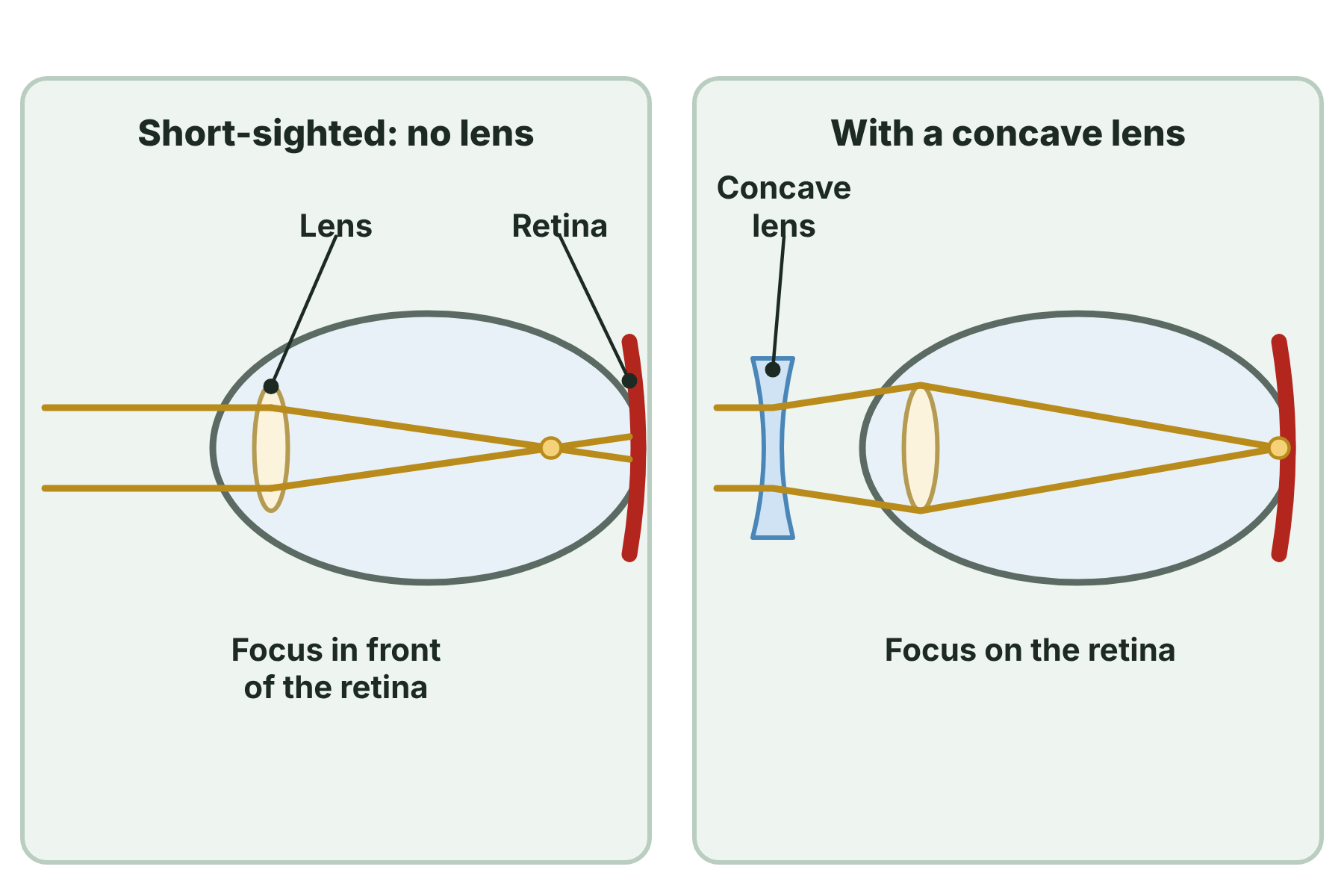
A concave lens spreads the light out, so the eye's own lens focuses it further back, on the retina.
Long sight and its correction
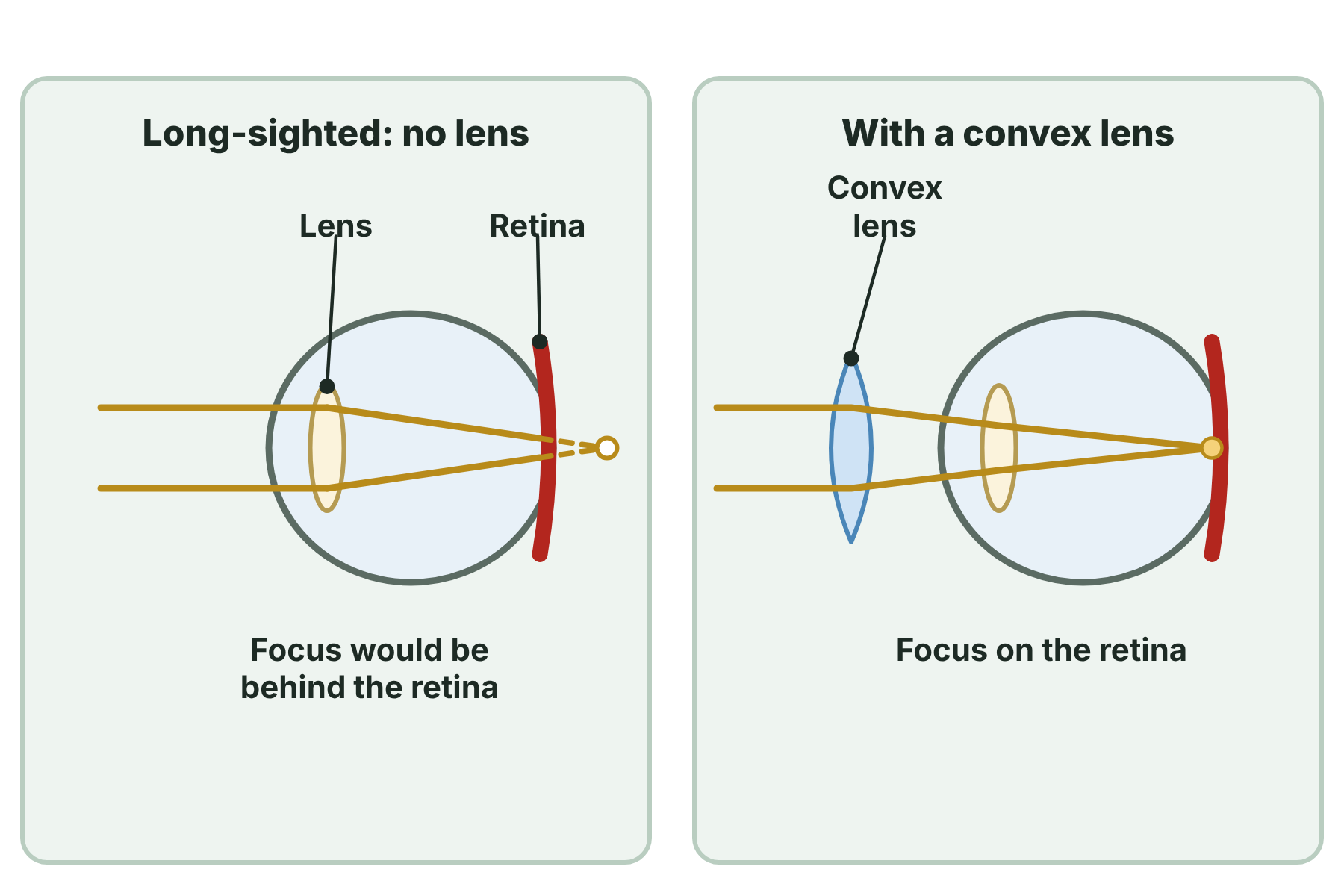
A convex lens brings the light together, so the eye can focus it on the retina.
Correcting the defects
Each defect has a different treatment.
-
Short sight
A concave (diverging) lens in glasses or contact lenses spreads the light out slightly before it enters the eye, so the focus moves back onto the retina. Laser surgery can flatten the cornea.
-
Long sight
A convex (converging) lens in glasses or contact lenses brings the light together before it enters the eye, so the focus moves forward onto the retina.
-
Cataracts
An operation replaces the cloudy lens with a clear artificial lens. It is quick and usually restores good vision, and it is one of the most common operations in the UK.
-
Colour blindness
It is usually inherited, and there is no cure. Special tinted lenses can help some people tell colours apart, and a person can learn ways to work around it.
Short sight and long sight
Short-sighted
- Near objects are clear, distant ones are blurred
- Focus is in front of the retina
- Eyeball too long, or lens too strong
- Corrected by a concave lens
Long-sighted
- Distant objects are clear, near ones are blurred
- Focus is behind the retina
- Eyeball too short, or lens too weak
- Corrected by a convex lens
Case study
Colour blindness and the Ishihara test
Colour blindness is much more common in men than in women, because the genes for red and green cone cells are carried on the X chromosome. About 1 in 12 men have some form of it, compared with about 1 in 200 women. A doctor can test for it using plates made of coloured dots, called Ishihara plates, which have a number hidden in them. A person with red-green colour blindness cannot see the number that most people can.
Summary and exam focus
- Short sight is caused by light focusing in front of the retina, and is corrected with a concave lens.
- Long sight is caused by light focusing behind the retina, and is corrected with a convex lens.
- Cataracts make the lens cloudy, and are treated by replacing the lens.
- Colour blindness is caused by missing or faulty cone cells.
- Laser surgery can reshape the cornea to correct short and long sight.
Exam focus
A student is short-sighted. Explain what causes this, what the student sees, and how it can be corrected. (6 marks) (6 marks)
Say where the light is focused (in front of the retina) and why (eyeball too long or lens too strong), then state the correction (a concave lens) and what the lens does to the light. Draw a simple ray diagram if the question allows it.
Key terms
The words this lesson expects you to use. Each one is linked from the first place it appears above.
- Short-sightedness
- A defect in which distant objects look blurred because light is focused in front of the retina.
- Long-sightedness
- A defect in which near objects look blurred because light would be focused behind the retina.
- Cataract
- A cloudy area in the lens of the eye that makes vision misty or blurred.
- Colour blindness
- A defect in which a person cannot tell certain colours apart because some cone cells are missing or faulty.
- Concave lens
- A lens that is thinner in the middle and spreads out light rays (diverging).
- Convex lens
- A lens that is thicker in the middle and brings light rays together (converging).
- Ray diagram
- A diagram that uses lines with arrows to show the path of light.
- Laser eye surgery
- An operation in which a laser reshapes the cornea to change how it bends light.
- Artificial lens
- A clear plastic lens that is put into the eye to replace a damaged natural lens.
You've finished the notes
Check your understanding
Test yourself while it is fresh. Start with the flashcards, then try the exam questions.
Something here looks wrong?
Tell us what and we will go and look. It goes to whoever writes these pages, nobody else, and we do not ask who you are — so there is nothing to sign and nothing comes back to you.