Biology · The Nervous System
Synapses and Neurotransmitters
Neurones do not touch each other. This lesson explains the tiny gap between them, called a synapse, and how a chemical message crosses it so that the impulse can carry on.
Learning Objectives
- 1Describe the structure of a synapse.
- 2Explain how an impulse is passed across a synapse by a neurotransmitter.
- 3Explain why synapses make impulses travel in one direction only.
- 4Calculate the speed of an impulse from the distance travelled and the time taken.
Retrieval practice
-
1
Which type of neurone carries impulses to the CNS?
Show answerHide answer
Sensory neurones.
-
2
What is diffusion?
Show answerHide answer
The net movement of particles from a region of higher concentration to a region of lower concentration.
-
3
Name the fatty layer that speeds up impulses.
Show answerHide answer
The myelin sheath.
-
4
What are the two types of effector?
Show answerHide answer
Muscles and glands.
A gap in the pathway
A message in the nervous system is made of an electrical impulse that races along a neurone. But the pathway from receptor to effector is not one single cell. It is a chain of neurones, and between the end of one neurone and the start of the next there is a tiny gap. This gap is called a synapse. An electrical impulse cannot jump across it, so the message has to be changed into a chemical signal for a moment before it becomes electrical again on the other side.
How an impulse crosses a synapse
Learn these steps in order, and use the words neurotransmitter, diffuses and receptor.
-
1
Impulse arrives
An electrical impulse reaches the end of the first neurone.
-
2
Neurotransmitter released
The impulse makes the neurone release a chemical called a neurotransmitter from small sacs called vesicles into the gap.
-
3
Diffusion
The neurotransmitter molecules diffuse across the synaptic gap, which is very narrow, so this is quick.
-
4
Binding
The molecules bind to specific receptor molecules on the membrane of the next neurone.
-
5
New impulse
Binding makes the next neurone start an electrical impulse of its own, and the message carries on.
-
6
Clearing the gap
The neurotransmitter is then broken down or taken back up, so the second neurone is not stimulated for ever.
Structure of a synapse
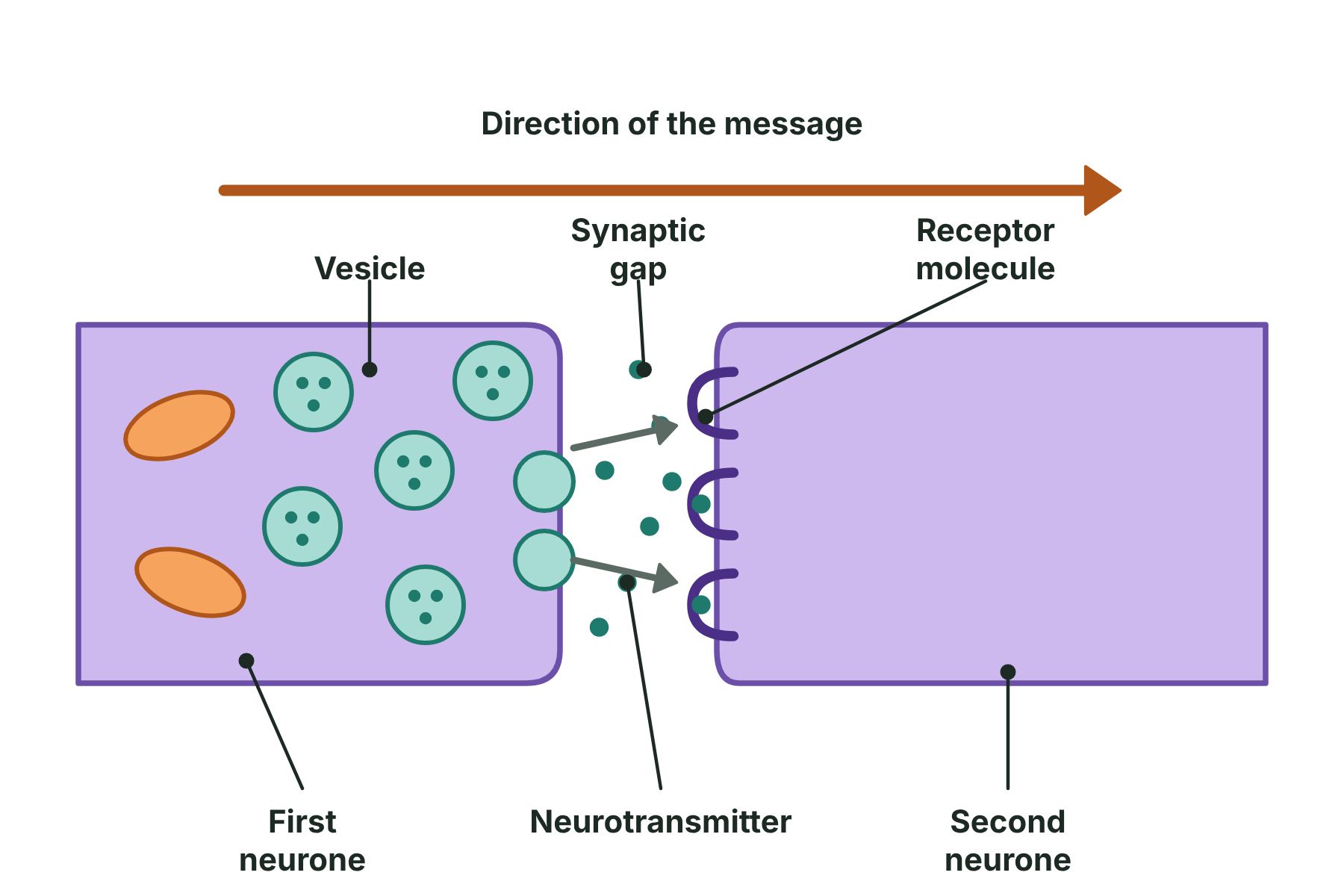
Neurotransmitter diffuses across the gap and fits into receptors on the next neurone.
The parts of a synapse
A synapse is made of three things, and each part has a job.
-
The first neurone's ending
Holds vesicles full of neurotransmitter, and many mitochondria to provide the energy for making and releasing it.
-
The synaptic gap
A very narrow space, about 20 nanometres wide, between two neurones. Neurotransmitter has only a short distance to diffuse.
-
The membrane of the second neurone
Carries receptor molecules with a specific shape. Only the neurotransmitter fits into them, like a key into a lock.
Why synapses work in one direction only
Impulses cannot go backwards along a pathway, and the synapse is the reason.
-
Vesicles on one side
Only the first neurone has vesicles of neurotransmitter, so only that side can release the chemical into the gap.
-
Receptors on the other side
Only the second neurone has the receptor molecules, so only that side can detect the neurotransmitter.
-
A one-way valve
Together this makes the synapse work like a one-way valve, which makes sure information flows from receptor to effector and not the other way.
Why synapses matter
The gap could seem like a nuisance, but it has useful effects.
-
Slows the message down a little
Diffusion across the gap takes a short time, so an impulse is slightly delayed at each synapse. This is one reason why reflexes use few synapses.
-
Allows the signal to be controlled
A synapse can be switched on or off by the amount of neurotransmitter released, so messages can be sent or blocked.
-
Lets neurones connect to many others
One neurone can form synapses with lots of others, so a message can be passed to several places at once.
Two kinds of signal in the nervous system
Inside a neurone
- An electrical impulse
- Travels along the axon or dendron
- Very fast, especially along a myelinated neurone
- Starts at one end, so it moves in one direction along the neurone
At a synapse
- A chemical signal
- Neurotransmitter diffuses across the synaptic gap
- Slower, because diffusion takes time
- Only goes in one direction, from the first neurone to the next
The speed of an impulse
An impulse travels along a motor neurone that is 1.5 m long. It takes 0.015 s to travel from the spinal cord to the foot. Calculate the speed of the impulse in metres per second.
Show the solutionHide the solution
- 1 Write down the formula Speed = distance divided by time.
- 2 Substitute the values Speed = \(1.5 \div 0.015\).
- 3 Calculate and give the unit Speed = 100 m/s.
Answer100 m/s.
Case study
Acetylcholine at the muscle
Where a motor neurone meets a muscle there is a special synapse. When an impulse arrives, the neurone releases a neurotransmitter called acetylcholine into the gap. It fits into receptors on the muscle and makes the muscle contract. Some poisons and drugs work by blocking the receptors, so that acetylcholine cannot bind and the muscle cannot be told to contract. This shows how important the neurotransmitter and its receptors are.
Summary and exam focus
- A synapse is a tiny gap between two neurones.
- An impulse triggers the release of a neurotransmitter, which diffuses across the gap.
- The neurotransmitter binds to receptors on the next neurone and sets off a new impulse.
- Because vesicles and receptors are on opposite sides, impulses only travel one way.
- The neurotransmitter is then removed so the signal stops.
Exam focus
Explain how an impulse passes from one neurone to the next at a synapse, and why it can only pass in one direction. (6 marks) (6 marks)
Write the steps in order and name the structures: impulse, vesicles, neurotransmitter, diffusion across the gap, receptor molecules, new impulse. For the one-way part, say that only the first neurone has vesicles and only the second has receptors.
Key terms
The words this lesson expects you to use. Each one is linked from the first place it appears above.
- Synapse
- The junction between two neurones, where a gap separates them.
- Synaptic gap
- The very narrow space between the end of one neurone and the start of the next.
- Neurotransmitter
- A chemical released by a neurone that diffuses across a synapse and triggers an impulse in the next neurone.
- Vesicle
- A small membrane-bound sac that stores neurotransmitter in the end of a neurone.
- Receptor molecule
- A protein on the membrane of a cell with a specific shape, which a particular chemical fits into.
- Diffusion
- The net movement of particles from a region of higher concentration to a region of lower concentration.
- Electrical impulse
- The signal that travels along a neurone.
- Acetylcholine
- A neurotransmitter that is released at the synapse between a motor neurone and a muscle.
- Axon terminal
- The branched end of an axon, where neurotransmitter is released.
You've finished the notes
Check your understanding
Test yourself while it is fresh. Start with the flashcards, then try the exam questions.
Something here looks wrong?
Tell us what and we will go and look. It goes to whoever writes these pages, nobody else, and we do not ask who you are — so there is nothing to sign and nothing comes back to you.