Biology · The Nervous System
Reflex Arcs and Reaction Times
Some responses are too urgent to wait for you to think about them. This lesson follows a reflex arc from stimulus to response, compares reflexes with voluntary actions, and shows how to investigate reaction time.
Learning Objectives
- 1Explain the structure and function of a reflex arc, including the sensory, relay and motor neurones.
- 2Explain why reflex actions are rapid, automatic and protective.
- 3Compare a reflex action with a voluntary action.
- 4Describe how to investigate reaction time and evaluate the method.
Retrieval practice
-
1
What does a sensory neurone do?
Show answerHide answer
Carries impulses from a receptor to the central nervous system.
-
2
Where are relay neurones found?
Show answerHide answer
In the central nervous system.
-
3
What crosses a synapse?
Show answerHide answer
A neurotransmitter.
-
4
What are the two types of effector?
Show answerHide answer
Muscles and glands.
Faster than thinking
If you touch a hot pan, your hand pulls away before you feel the pain. This type of response is called a reflex action. Reflexes are rapid, automatic and do not involve conscious thought. They protect the body from harm, and they work because the pathway is as short as possible. The pathway that an impulse follows in a reflex is called a reflex arc.
A reflex arc: touching a hot object
Each step uses a part of the nervous system that you met in earlier lessons.
-
1
Stimulus
The heat of a hot pan acts on the skin of the hand.
-
2
Receptor
Temperature and pain receptors in the skin detect the stimulus and start electrical impulses.
-
3
Sensory neurone
The impulse travels along a sensory neurone to the spinal cord.
-
4
Relay neurone
In the spinal cord, a synapse passes the impulse to a relay neurone, which passes it on to a motor neurone at another synapse.
-
5
Motor neurone
The impulse travels along a motor neurone out of the spinal cord to the arm.
-
6
Effector
The muscle in the arm is the effector, and it receives the impulse.
-
7
Response
The muscle contracts and the hand is pulled away from the pan.
A reflex arc
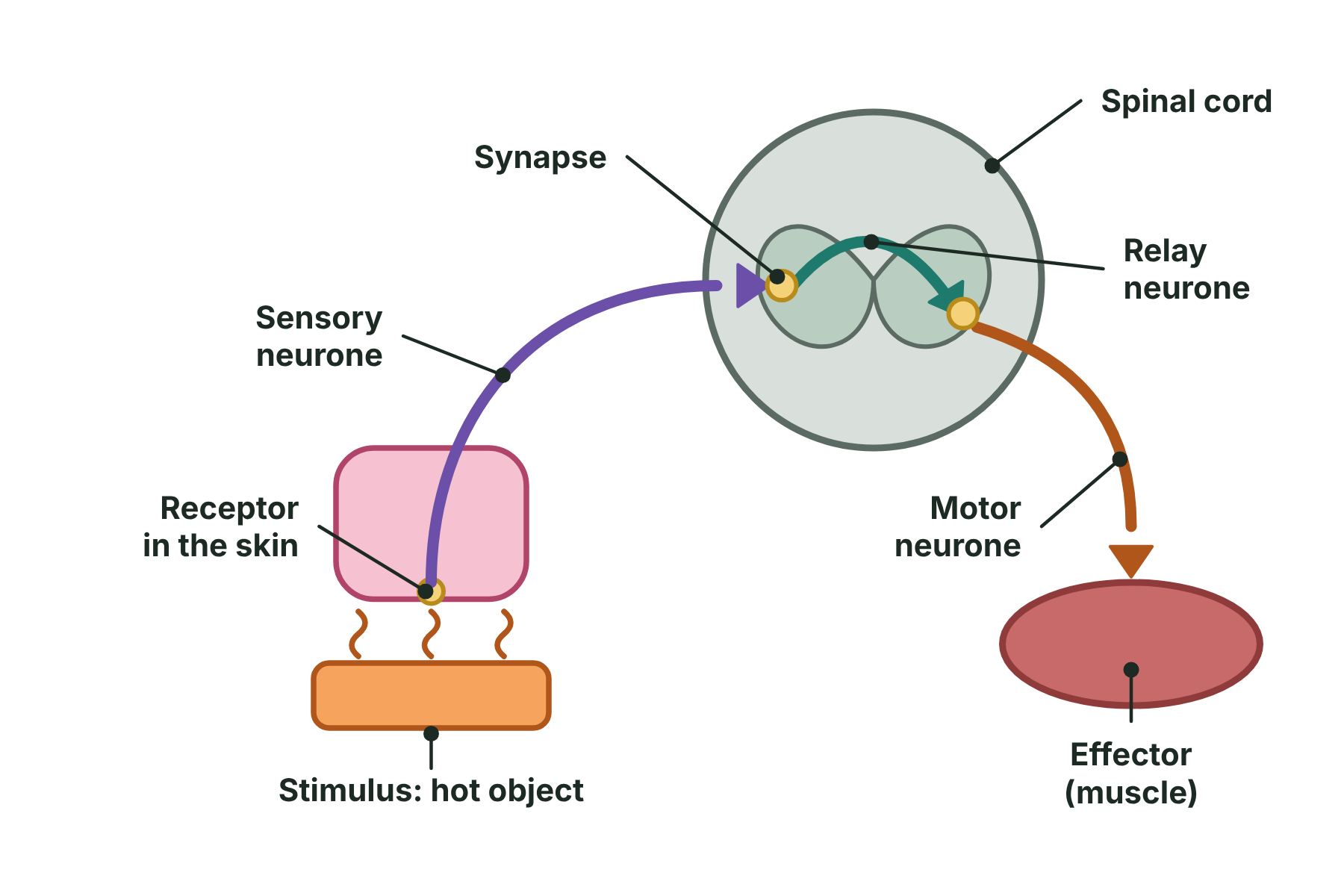
The impulse passes through the spinal cord without going to the brain first.
Why reflexes are fast
A reflex is quicker than a normal response for three reasons.
-
Few neurones
Only three neurones are involved, so the pathway is short and the impulse has little distance to cover.
-
Few synapses
There are only two synapses in the pathway, and each one adds a slight delay, so fewer synapses means a faster response.
-
No thinking
The response is automatic. The impulse goes through the spinal cord and does not have to be processed by the conscious part of the brain.
Why reflexes protect the body
Most reflexes are about staying safe and working properly.
-
Withdrawal reflex
Pulling away from a hot or sharp object limits the damage to the skin and muscles.
-
Pupil reflex
The pupil gets smaller in bright light so that too much light does not damage the retina.
-
Blinking
The eyelid closes when something touches or gets close to the eye, which protects it from damage.
-
The brain still finds out
After the reflex has happened, the impulse also goes up to the brain. This is why you feel the pain a moment after you have moved.
Reflex and voluntary actions
Reflex action
- Automatic, no conscious thought
- Very fast
- Passes through the spinal cord or the unconscious brain
- Same response every time
- Protects the body from harm
Voluntary action
- Decided on by the person, using conscious thought
- Slower
- Involves the cerebral hemispheres of the brain
- The response can be different each time
- Includes writing, walking and answering a question
Investigating reaction time
Reaction time is the time between a stimulus and the response. It is a good way to measure how fast the nervous system works, and it is a voluntary action, not a reflex.
-
The ruler drop test
One person holds a ruler vertically with the zero level with the top of another person's thumb and finger, held apart. The ruler is dropped without warning, and the second person catches it.
-
Measure the result
Read the distance on the ruler at the point where it was caught. The further it fell, the longer the reaction time.
-
Change one variable
You could test the effect of caffeine, of practice, of using the dominant hand or of a distraction on reaction time.
-
Control the other variables
Use the same ruler, the same person, the same starting position and the same hand, and drop the ruler from the same height each time.
-
Repeat and take a mean
Do at least five tries each time, ignore any anomalies and calculate a mean for the best accuracy.
Finding a mean reaction time
A student does the ruler drop test five times and records the distances caught as 14, 16, 15, 17 and 18 cm. Use the table to find the reaction time: 10 cm = 0.14 s, 15 cm = 0.17 s, 20 cm = 0.20 s, 25 cm = 0.23 s. Calculate the mean distance, then give the reaction time.
Show the solutionHide the solution
- 1 Add the five distances \(14 + 16 + 15 + 17 + 18 = 80\) cm.
- 2 Divide by the number of results \(80 \div 5 = 16\) cm.
- 3 Use the table 16 cm lies between 15 cm and 20 cm, closer to 15 cm, so the reaction time is about 0.17 s.
AnswerThe mean is 16 cm, so the reaction time is about 0.17 s.
Evaluating the investigation
This is an easy investigation to do, but the results are not very precise.
-
Human error
The person dropping the ruler might give clues or let go at different speeds, which affects the result. Using a computer reaction-time test avoids this.
-
Practice effect
The more times a person tries it, the quicker they get, so repeated tests can give falling times even when nothing else has changed.
-
Small differences
The distances are only a few centimetres, so measuring errors matter. Taking a mean of many readings reduces their effect.
-
Ethics and safety
Caffeine should only be used with permission and in sensible amounts, and nobody should be pressured to take part.
Case study
The knee-jerk reflex
When a doctor taps the tendon just below your kneecap with a small hammer, your lower leg kicks upwards. This is a reflex arc that involves only one synapse in the spinal cord. Doctors use the test to check that the pathway between the leg and the spinal cord is working. A slow or missing response can show that the nerves or spinal cord have been damaged.
Summary and exam focus
- A reflex arc is the pathway of a reflex: receptor, sensory neurone, relay neurone, motor neurone, effector.
- Reflexes are fast, automatic and protect the body.
- They are quicker because the pathway is short, with few synapses and no conscious thought.
- A voluntary action is slower because the brain decides on the response.
- Reaction time can be investigated using the ruler drop test, and repeating it gives a more reliable mean.
Exam focus
A person touches a hot plate and pulls their hand away. Describe the pathway taken by the impulses in this reflex action, and explain why a reflex is quicker than a voluntary response. (6 marks) (6 marks)
Give the pathway in order from receptor to effector, naming each neurone, and mention the spinal cord. For the explanation, give at least two reasons, such as a short pathway, few synapses and no conscious thought, and say that the brain is not involved first.
Key terms
The words this lesson expects you to use. Each one is linked from the first place it appears above.
- Reflex action
- A fast, automatic response to a stimulus that does not involve conscious thought.
- Reflex arc
- The pathway taken by an impulse in a reflex action, from receptor to effector.
- Voluntary action
- An action that is controlled by conscious thought.
- Reaction time
- The time taken between a stimulus and a response.
- Spinal cord
- The column of nervous tissue inside the backbone, which carries impulses between the body and the brain.
- Conscious
- Aware and able to think about what you are doing.
- Withdrawal reflex
- A reflex that pulls part of the body away from something harmful.
- Pupil reflex
- The reflex that changes the size of the pupil to control the amount of light entering the eye.
- Protective
- Helping to keep the body from being harmed.
- Anomaly
- A result that does not fit the pattern of the other results.
You've finished the notes
Check your understanding
Test yourself while it is fresh. Start with the flashcards, then try the exam questions.
Something here looks wrong?
Tell us what and we will go and look. It goes to whoever writes these pages, nobody else, and we do not ask who you are — so there is nothing to sign and nothing comes back to you.