Biology · Ecosystems and Communities
Knowledge organiser
The whole chapter on two pages. Print it on A4 — they are already landscape — or cover a box and see how much of it you can say from memory.
Biology · Edexcel Paper 2
Ecosystems and Communities
Levels of Organisation and Interdependence
In parasitism one organism gains and the other loses. In mutualism both gain.
- Population All the organisms of one species living in the same place at the same time.
- Community All the populations of the different species living in the same place.
- Ecosystem A community of living organisms together with the non-living parts of their environment.
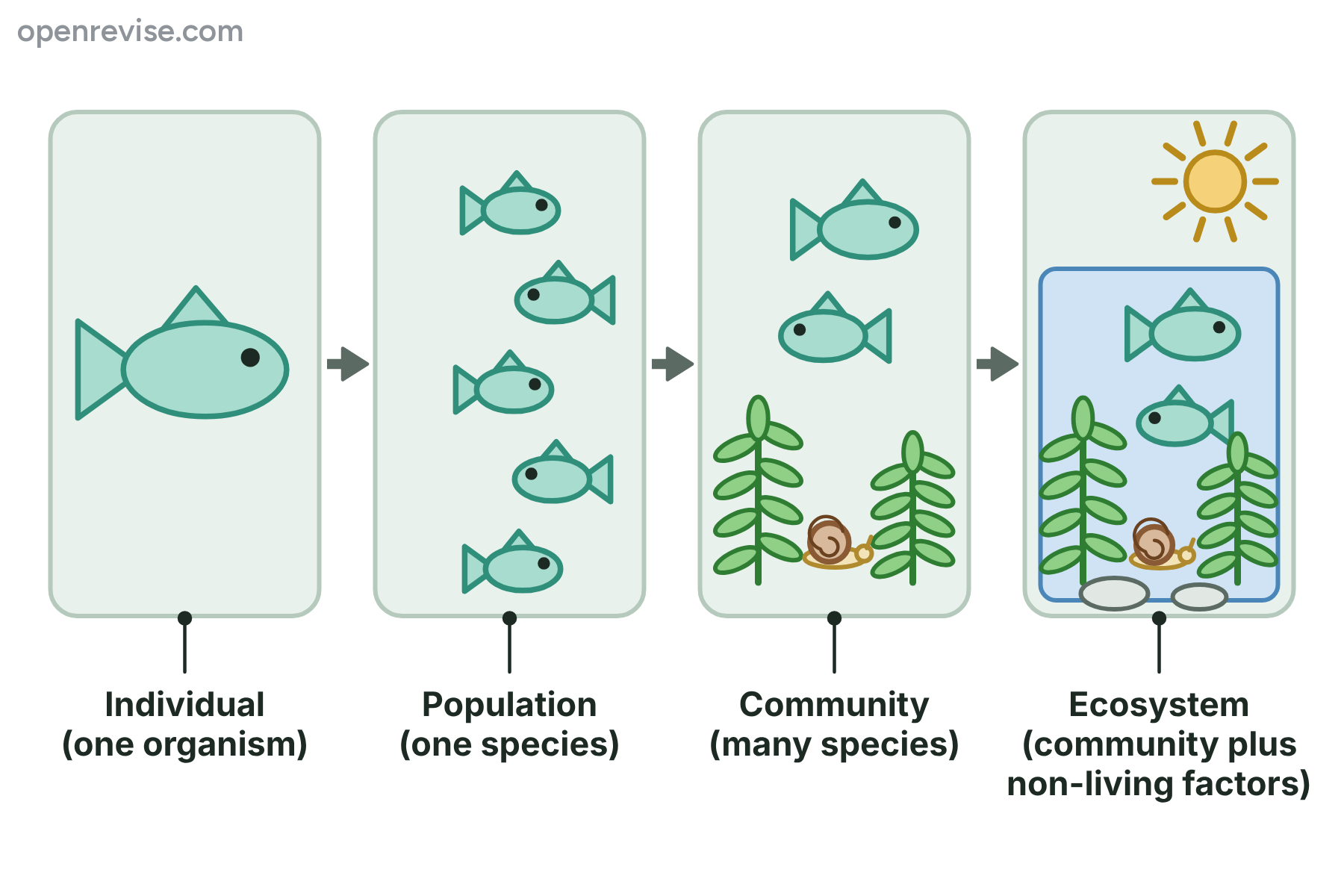
Parasitism or mutualism?
- Parasitism One organism, the parasite, benefits; The host is harmed; The parasite lives on or in the host
- Mutualism Both organisms benefit; Neither is harmed; The two species live in close association
What happens when one species is lost
- Foxes die out A disease kills most of the foxes, so the rabbits are no longer hunted.
- Rabbits increase With fewer predators, more rabbits survive and breed.
- Plants are overgrazed The extra rabbits eat much more grass and wildflowers.
- Other species suffer Insects and mice that depended on those plants lose their food and shelter.
Abiotic and Biotic Factors
A community is shaped by what the environment gives it and by what the other organisms take from it.
- Abiotic factor A non-living part of the environment, such as temperature, light, water or a pollutant.
- Biotic factor A living part of the environment, such as competition, predation or disease.
- Competition The struggle between organisms for the same limited resource, such as food, light, water or space.
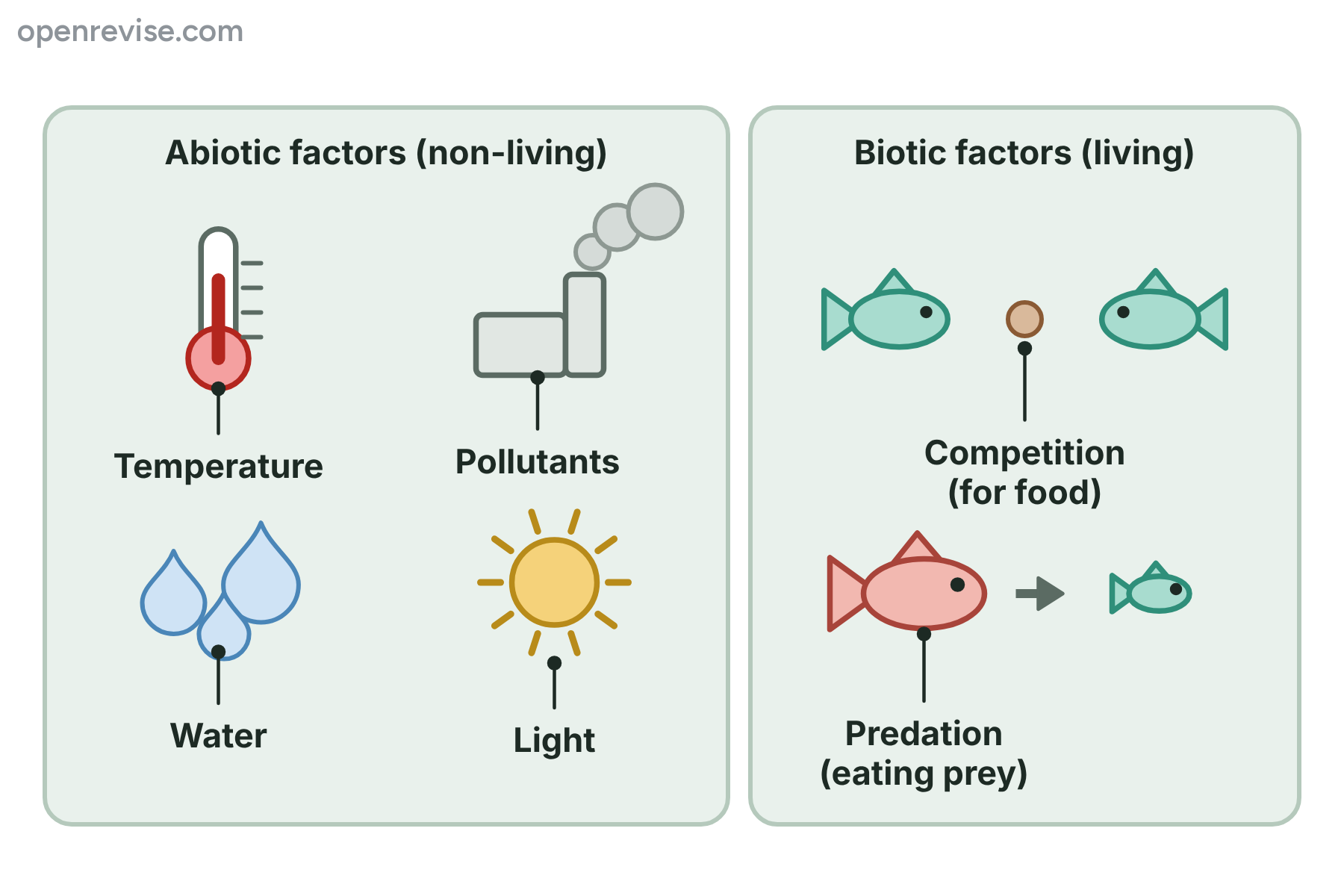
Abiotic or biotic?
- Abiotic factors (non-living) Temperature; Light intensity; Water availability
- Biotic factors (living) Competition for food, light or space; Predation; Disease caused by pathogens
The predator-prey cycle
- Prey increases There is plenty of food and few predators, so many prey survive and breed.
- Predators increase There is now plenty of prey to eat.
- Prey decreases More predators eat more prey, so the prey population falls.
- Predators decrease With less prey to eat, many predators starve or fail to breed.
Biology · Edexcel Paper 2
Ecosystems and Communities continued
Fieldwork: Quadrats and Transects
Sample at random to estimate a whole area, and sample along a line to see how a community changes.
- Quadrat A square frame that marks out a known area, used to sample the organisms in a habitat.
- Sample A small part of a habitat or population that is studied to represent the whole.
- Random sampling Choosing the positions to sample by chance, such as with random numbers, so that there is no bias.
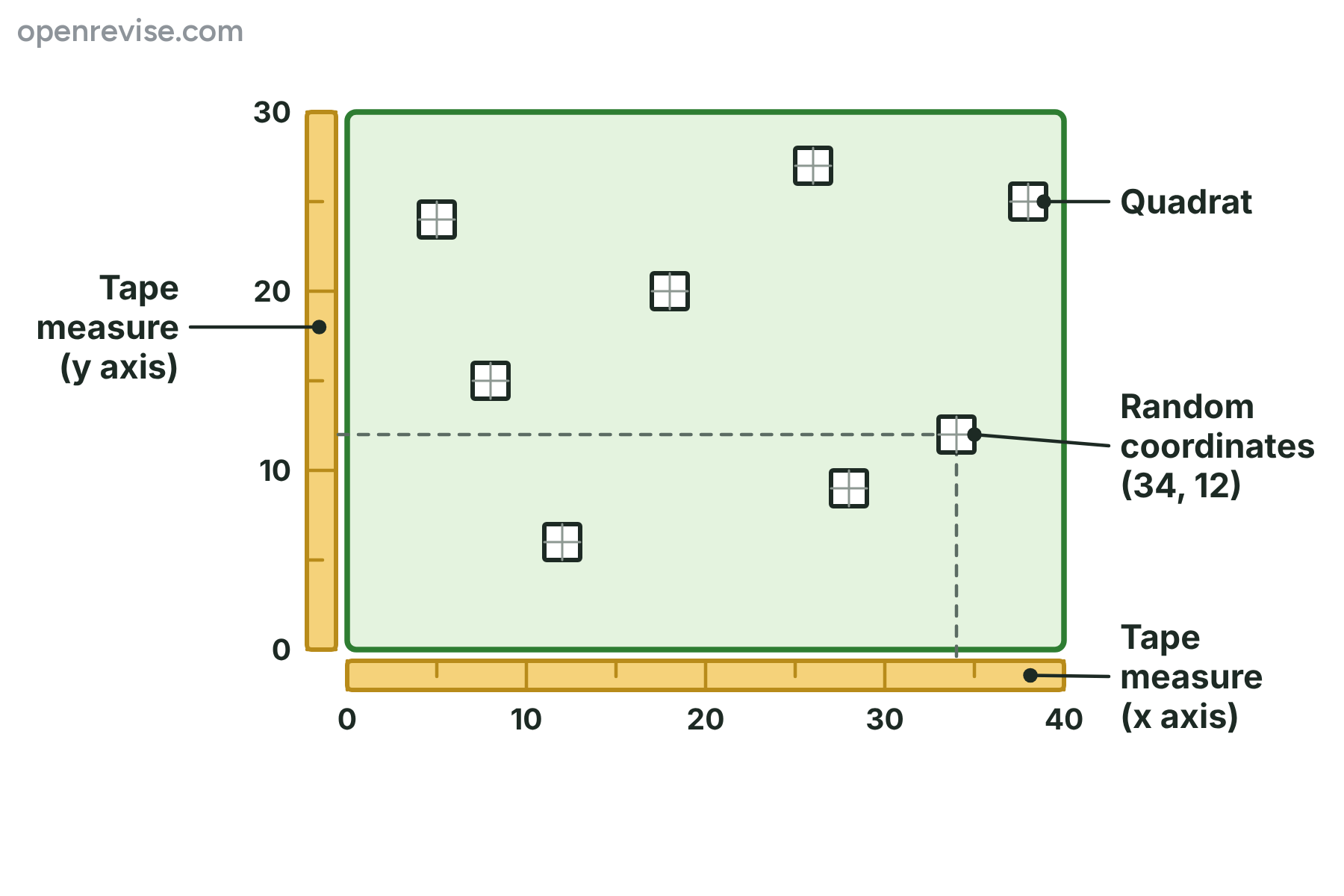
Random sampling or a belt transect?
- Random sampling with quadrats Quadrat positions chosen with random numbers; Avoids bias in where the quadrats are placed; Used to estimate the total number of organisms in an area
- Belt transect Quadrats at regular intervals along a line; Shows how the organisms change along a gradient; Used to link distribution to an abiotic factor
Core practical: a belt transect investigation
- Choose the gradient Pick a straight line that runs from the shade under a tree out…
- Lay the tape Lay a 20 m tape measure in a straight line from the base of the…
- Place the quadrats Place a 0.5 m by 0.5 m quadrat at 0 m and then at every 5 m along the line.
- Record the organisms In each quadrat identify the species with a key and count the…
Energy Transfer and Pyramids of Biomass (Separate only)
Energy is lost at every trophic level, so food chains are short and pyramids of biomass narrow towards the top.
- Trophic level A feeding stage in a food chain, such as producer, primary consumer or secondary consumer.
- Biomass The mass of living material in organisms, usually measured as dry mass.
- Pyramid of biomass A diagram with a bar for each trophic level, the width in proportion to its biomass, producers at the base.
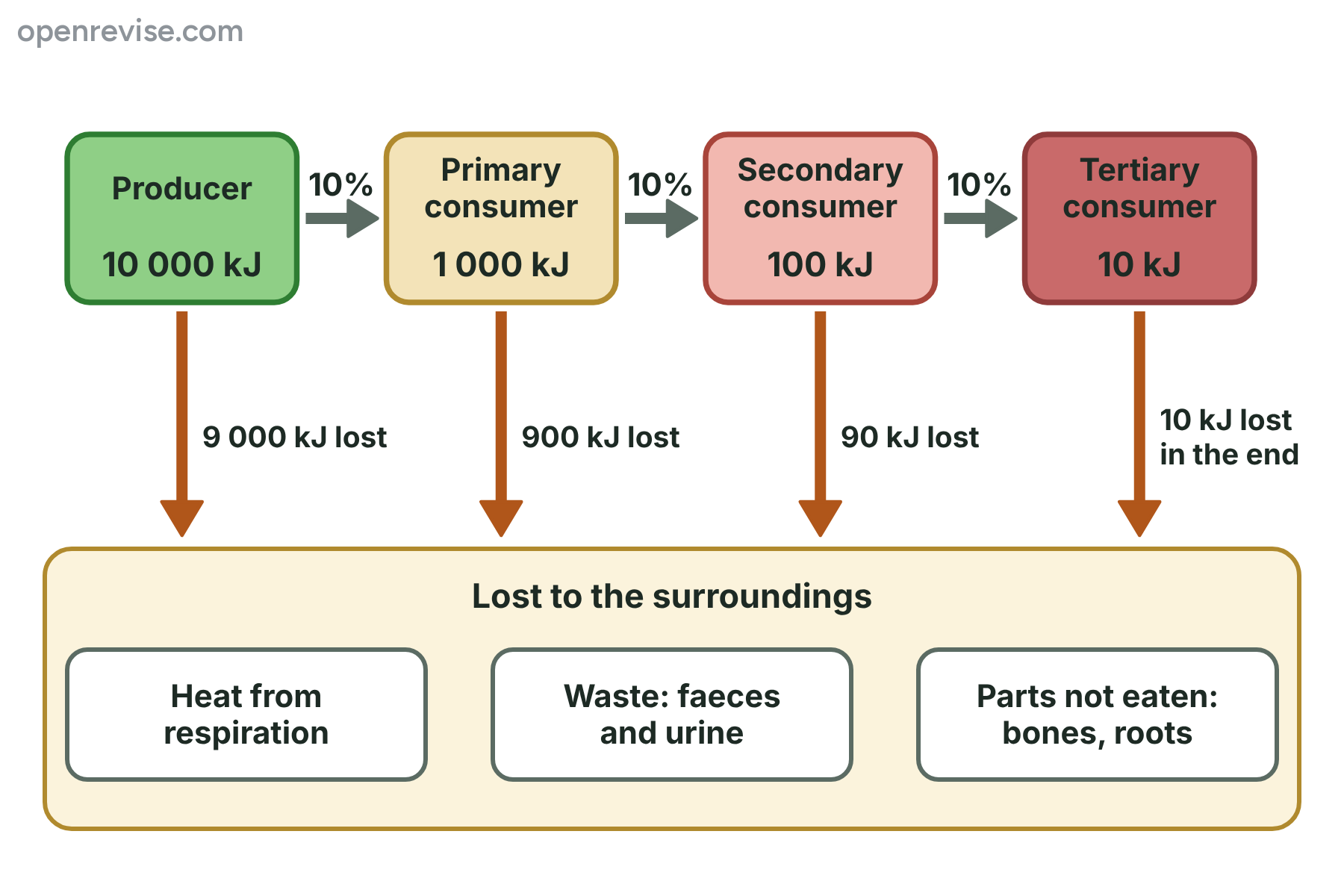
Long and short food chains
- A short food chain (crop, then people) Fewer energy transfers; Less energy is lost to the surroundings; More energy reaches the final consumer
- A long food chain (crop, cattle, people) More energy transfers; More energy is lost as heat, waste and uneaten parts; Less energy reaches the final consumer
How to draw a pyramid of biomass
- Identify the food chain List the organisms in order, from the producer up to the top consumer.
- Measure the biomass Collect a sample, dry it to remove the water and find the dry…
- Choose a scale Pick a scale so that the biggest bar fits on the page.
- Draw the bars Draw horizontal bars centred on the same line, with the…