Biology · Homeostasis
Body Mass, BMI and Type 2 Diabetes
People who are very overweight are much more likely to develop type 2 diabetes. This lesson explains how to calculate the body mass index (BMI) and the waist to hip ratio, and how to evaluate the evidence for a correlation between body mass and type 2 diabetes.
Learning Objectives
- 1Calculate the body mass index (BMI) using the equation BMI = mass (kg) divided by height (m) squared.
- 2Calculate the waist to hip ratio, and say what it shows.
- 3Describe the correlation between body mass and type 2 diabetes.
- 4Evaluate the evidence, including the limits of BMI and the difference between correlation and cause.
Retrieval practice
-
1
What is the cause of type 2 diabetes?
Show answerHide answer
The body cells no longer respond to insulin.
-
2
What is obesity?
Show answerHide answer
A condition in which a person has a large amount of excess body fat.
-
3
What is a correlation?
Show answerHide answer
A link between two variables, in which one changes as the other changes.
-
4
What is a hormone?
Show answerHide answer
A chemical messenger that is made in a gland and carried in the blood.
Measuring body mass
The mass of a person alone is not a useful guide to their health, because tall people have a greater mass than short people. The body mass index (BMI) takes the height into account. The waist to hip ratio shows where the fat is stored. Both are used by doctors to find people who are at a greater risk of type 2 diabetes, and of other diseases such as heart disease. The specification asks you to use the BMI equation, to calculate the waist to hip ratio, and to evaluate the correlation between body mass and type 2 diabetes.
Body mass index
BMI is calculated from the mass and the height of a person.
-
Equation
BMI = mass (kg) divided by height (m) squared. The units are kg per m², but they are usually not written.
-
Below 18.5
The person is underweight.
-
18.5 to 24.9
The person has a healthy mass.
-
25 to 29.9
The person is overweight.
-
30 or above
The person is obese.
Calculating BMI
A woman has a mass of 72 kg and a height of 1.70 m. Calculate her BMI to 1 decimal place, and say which group she is in.
Show the solutionHide the solution
- 1 Square the height 1.70 multiplied by 1.70 is 2.89.
- 2 Divide 72 divided by 2.89 is 24.9 to 1 decimal place.
- 3 Compare 24.9 is between 18.5 and 24.9, so it is the healthy range, though only just.
- 4 Check Height must be in metres, and mass in kilograms, before using the equation.
AnswerHer BMI is 24.9, which is in the healthy range.
The waist to hip ratio
This ratio shows how much fat is stored around the abdomen.
-
Equation
Waist to hip ratio = waist circumference divided by hip circumference, measured in the same units.
-
Reading
A higher ratio means that more fat is stored around the abdomen.
-
Risk
A ratio above about 0.90 in men, or 0.85 in women, shows a higher risk of type 2 diabetes and heart disease.
-
Why it helps
It shows the location of the fat, which BMI does not.
BMI and the waist to hip ratio
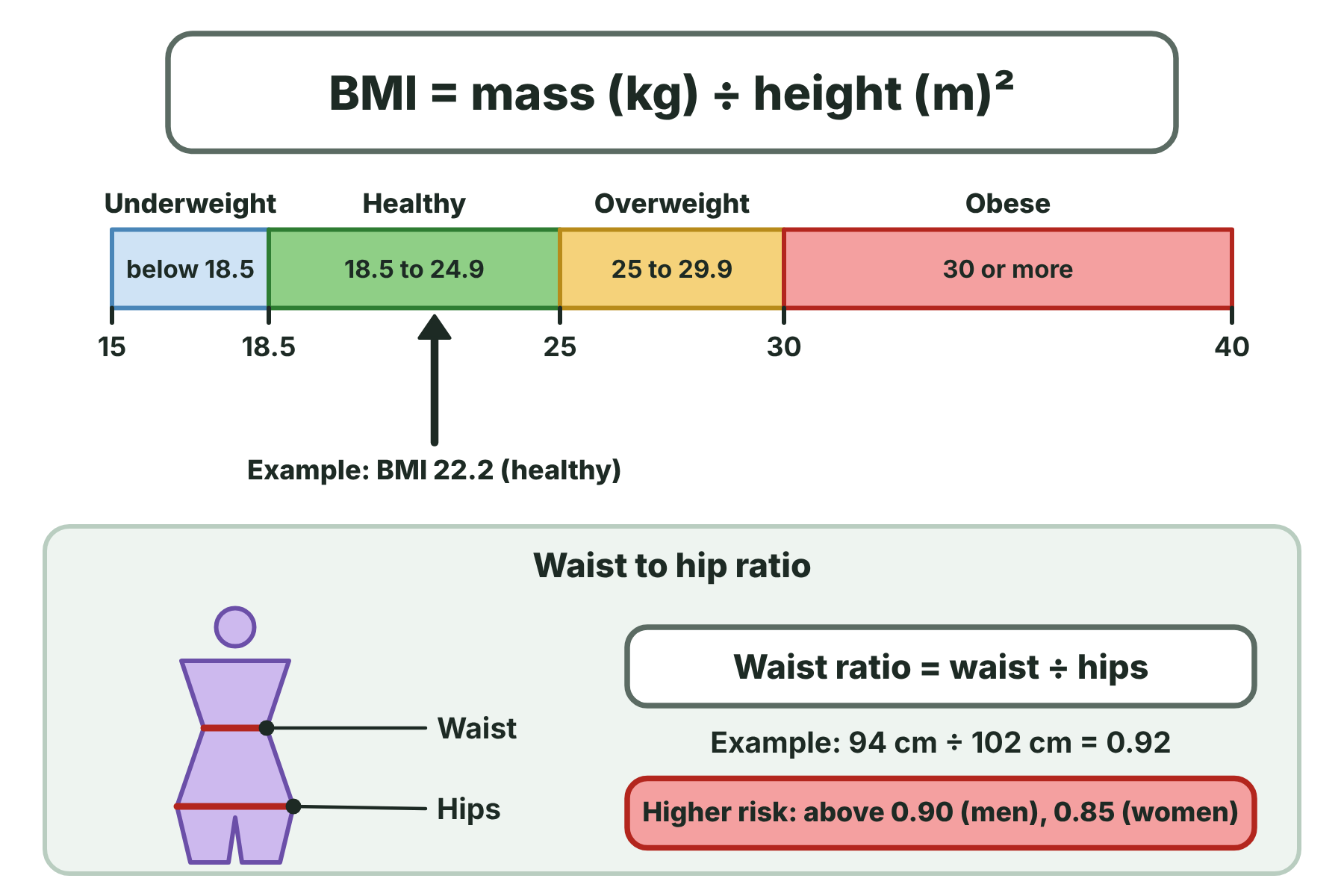
BMI and the waist to hip ratio are two ways to assess whether a person is at a healthy mass.
Calculating the waist to hip ratio
A woman has a waist circumference of 88 cm and a hip circumference of 98 cm. Calculate her waist to hip ratio to 2 decimal places, and say what it shows.
Show the solutionHide the solution
- 1 Divide 88 divided by 98 is 0.898, so 0.90 to 2 decimal places.
- 2 Compare The risk is higher above 0.85 for women.
- 3 Conclusion Her ratio is above this, so the fat is stored mainly around the abdomen, and the risk is higher.
- 4 Note Both measurements must be in the same units.
AnswerHer ratio is 0.90, which is above 0.85, so she has a higher risk of type 2 diabetes.
The correlation with type 2 diabetes
Studies of large groups of people show a pattern.
-
The pattern
As the BMI increases, the percentage of people with type 2 diabetes increases. This is a positive correlation.
-
Possible mechanism
Excess body fat, especially around the abdomen, makes the cells less sensitive to insulin, which is insulin resistance.
-
Other evidence
People with type 2 diabetes who lose a lot of mass often find that their blood glucose is controlled.
-
Confounding factors
People with a high BMI may also eat a poor diet and take little exercise, and these could also increase the risk.
Type 2 diabetes and BMI
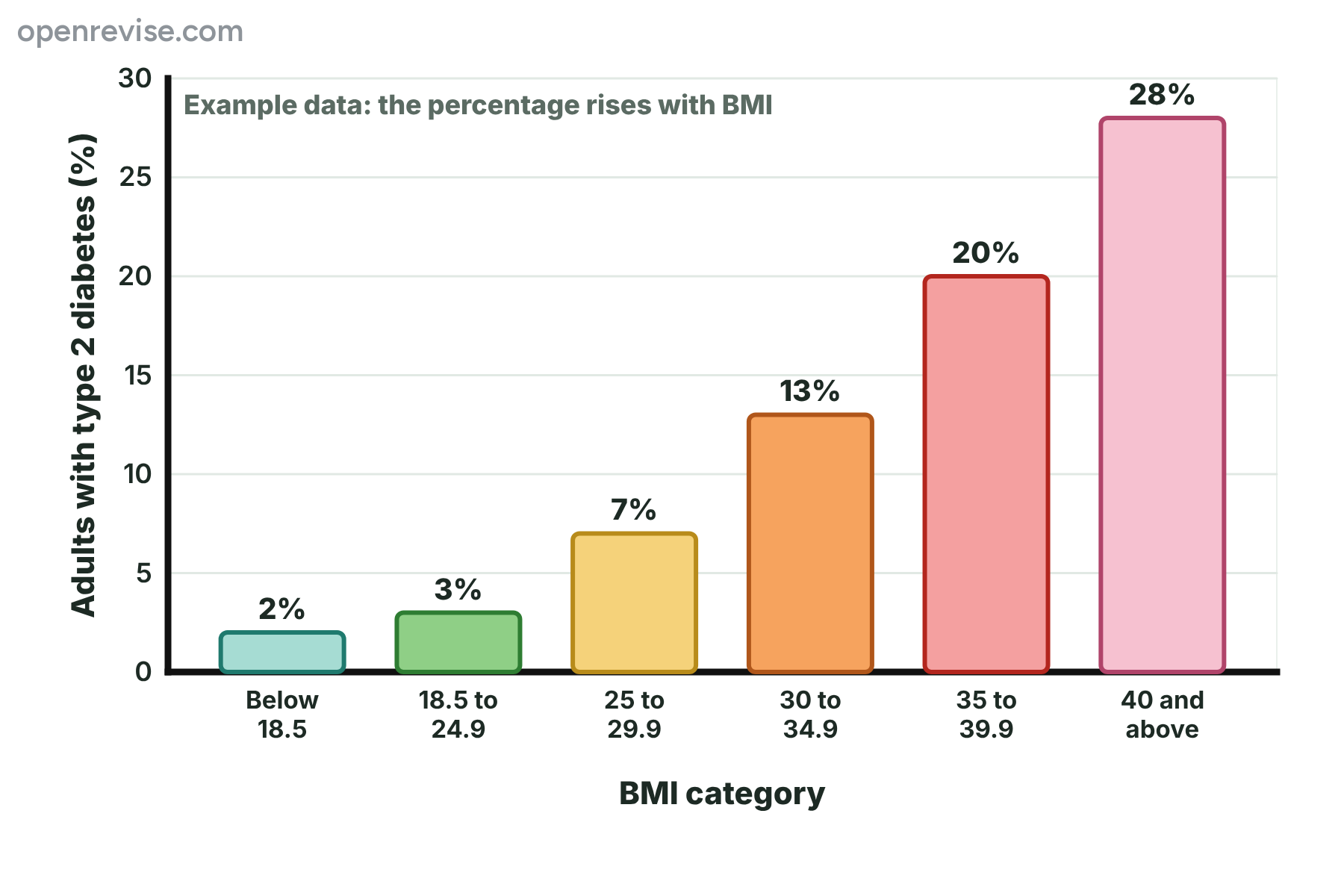
In this example, the percentage of adults with type 2 diabetes rises as the BMI increases.
Strengths and limits of the evidence
Evidence for a link
- Large studies show a positive correlation
- A mechanism is known: insulin resistance
- Weight loss often improves control
- The waist to hip ratio shows the same pattern
Limits of the evidence
- A correlation does not prove a cause
- BMI does not show where the fat is
- Muscular people can have a high BMI but little fat
- Diet, exercise and genes also affect the risk
Case study
A rugby player with a high BMI
A rugby player has a mass of 110 kg and a height of 1.85 m, so the BMI is 32.1, which is in the obese range. But most of the player's mass is muscle, not fat, so the player is not at the same risk of type 2 diabetes as an inactive person with the same BMI. The waist to hip ratio of the player is likely to be low. This shows why BMI should be used with other measurements, such as the waist to hip ratio, and why doctors look at the whole person.
Summary and exam focus
- BMI = mass (kg) divided by height (m) squared.
- A BMI of 30 or more is obese.
- The waist to hip ratio shows where fat is stored.
- There is a positive correlation between BMI and type 2 diabetes.
- A correlation does not prove that one factor causes the other.
Exam focus
Evaluate the correlation between body mass and the risk of type 2 diabetes. (6 marks) (6 marks)
Give the pattern with data, then a possible mechanism, then at least two limits: correlation is not cause, other factors such as diet and exercise, and BMI not distinguishing muscle from fat.
Key terms
The words this lesson expects you to use. Each one is linked from the first place it appears above.
- Body mass index
- A measure of mass for height, calculated as mass in kilograms divided by height in metres squared.
- Waist to hip ratio
- The waist circumference divided by the hip circumference.
- Obesity
- A condition in which a person has a large amount of excess body fat, with a BMI of 30 or more.
- Correlation
- A link between two variables.
- Positive correlation
- A link in which one variable rises as the other rises.
- Insulin resistance
- A condition in which cells do not respond properly to insulin.
- Confounding factor
- A variable, other than the one being studied, that can affect the result.
- Risk factor
- Something that increases the chance of getting a disease.
- Abdomen
- The part of the body between the chest and the hips.
You've finished the notes
Check your understanding
Test yourself while it is fresh. Start with the flashcards, then try the exam questions.
Something here looks wrong?
Tell us what and we will go and look. It goes to whoever writes these pages, nobody else, and we do not ask who you are — so there is nothing to sign and nothing comes back to you.