Biology · Homeostasis
Type 1 and Type 2 Diabetes
Diabetes is one of the most common long-term diseases in the world, and its two main forms have different causes and different treatments. This lesson explains the cause of type 1 and of type 2 diabetes, and how each of them is controlled.
Learning Objectives
- 1Describe what happens to the blood glucose concentration in diabetes.
- 2Explain the cause of type 1 diabetes, and how it is controlled.
- 3Explain the cause of type 2 diabetes, and how it is controlled.
- 4Compare type 1 and type 2 diabetes, and interpret data on blood glucose.
Retrieval practice
-
1
Which hormone lowers the blood glucose?
Show answerHide answer
-
2
Where is insulin made?
Show answerHide answer
In the pancreas.
-
3
What is a non-communicable disease?
Show answerHide answer
A disease that is not passed from one person to another.
-
4
What is a receptor?
Show answerHide answer
A cell or protein that detects a stimulus or a chemical.
Too much glucose
Diabetes is a condition in which the blood glucose concentration is not controlled properly, and it can rise to a very high level. The symptoms include a great thirst, frequent urination, tiredness and weight loss. Over many years, a high blood glucose concentration damages the blood vessels, the nerves, the kidneys and the eyes, and can lead to blindness and the loss of limbs. There are two main types, and in both, the cause is a problem with insulin, but the problems are different.
Type 1 diabetes
In type 1 diabetes, the pancreas does not produce enough insulin.
-
Cause
The immune system destroys the cells in the pancreas that make insulin. This is not caused by a person's lifestyle.
-
Effect
Without insulin, the cells cannot take up glucose from the blood, and the liver does not store it as glycogen, so the blood glucose concentration rises to a dangerous level.
-
Onset
It usually begins in childhood or in early adult life, and the person has the condition for life.
-
Control
The person has to inject insulin, usually several times a day, or uses an insulin pump. The dose is matched to the meals and to the amount of exercise.
-
Why injections
Insulin is a protein, so it would be digested in the stomach and the small intestine if it was taken by mouth.
-
Monitoring
The person tests their blood glucose concentration regularly, and controls the intake of carbohydrate, with a healthy diet and exercise.
Type 2 diabetes
In type 2 diabetes, the body cells no longer respond properly to insulin.
-
Cause
The cells have become resistant to insulin, so they do not take up the glucose, and the blood glucose concentration stays high. The pancreas may also produce too little insulin.
-
Risk factors
Obesity is the main risk factor. Others are a lack of exercise, a poor diet, increasing age and having a close relative with the disease.
-
Onset
It usually begins in adults, but it is becoming more common in younger people, as obesity becomes more common.
-
Control
A diet that is low in refined carbohydrate and fat, regular exercise and weight loss. If these are not enough, tablets are used, and sometimes insulin injections are needed.
-
Prevention
Because lifestyle is a major cause, a healthy diet and exercise can often prevent type 2 diabetes.
Type 1 and type 2 diabetes
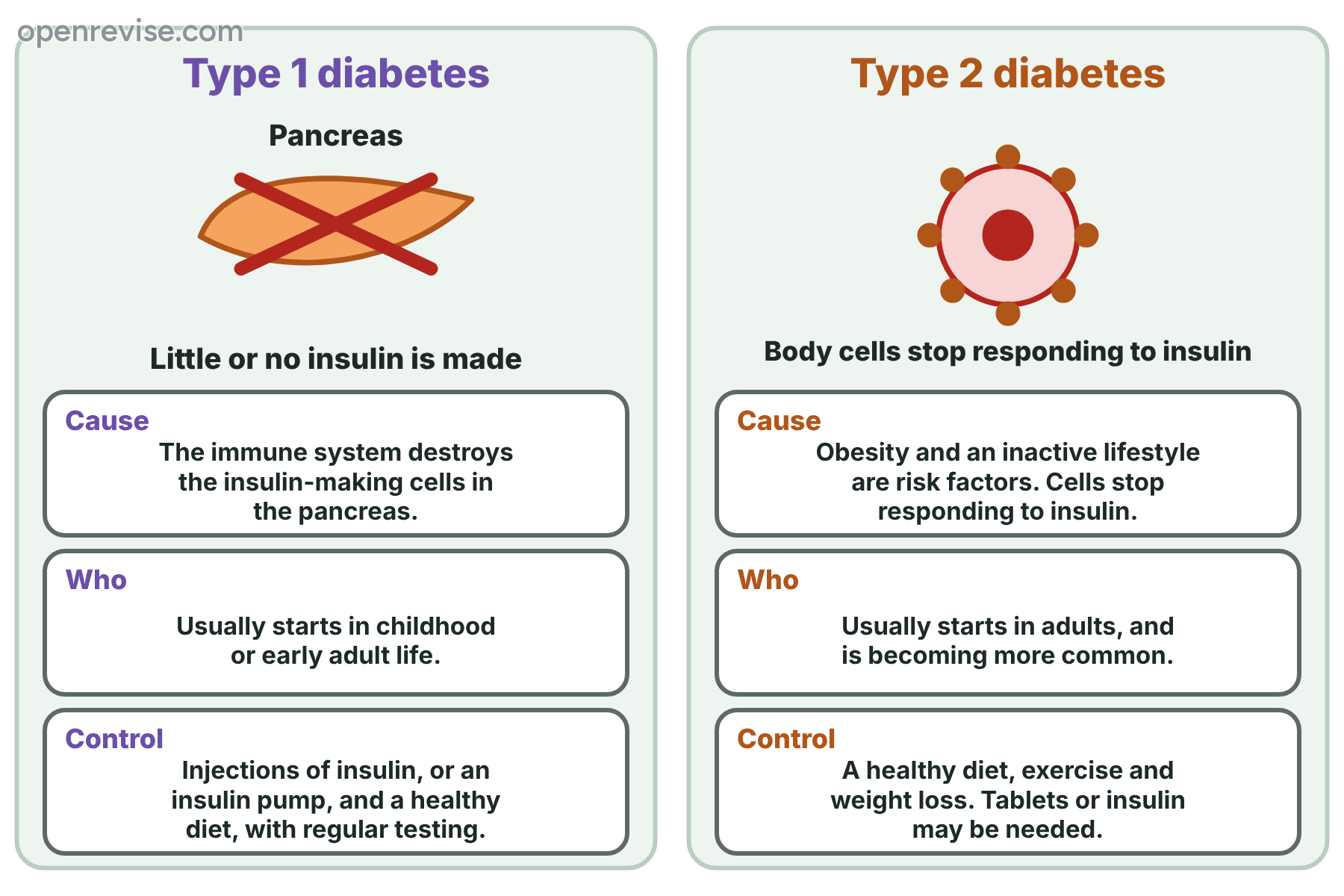
In type 1 diabetes insulin is not made, and in type 2 diabetes the cells stop responding to it.
Blood glucose after a glucose drink
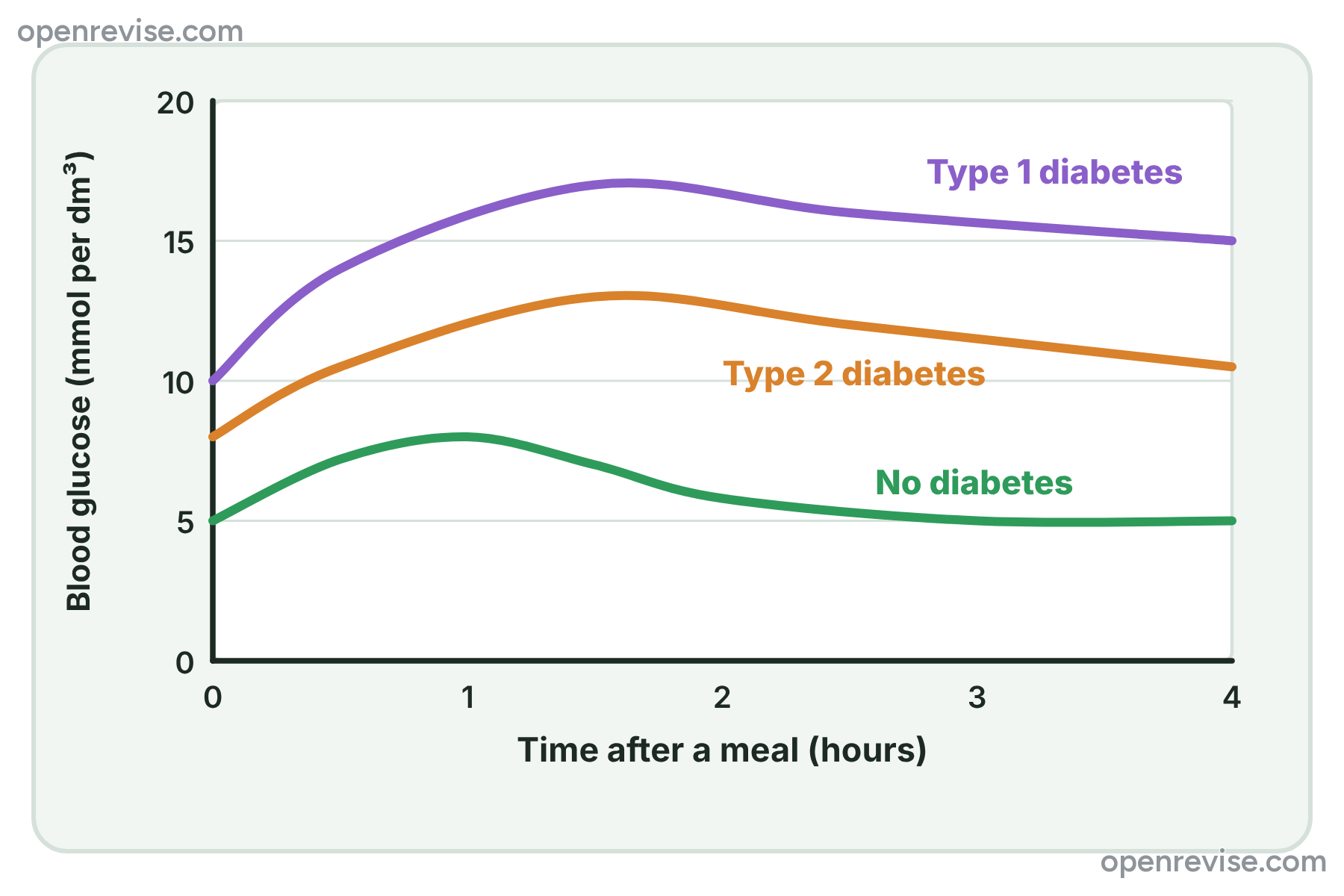
After a meal, the blood glucose of a person with diabetes rises higher, and falls back more slowly, or not at all.
Type 1 and type 2 diabetes
Type 1
- The pancreas makes little or no insulin
- The immune system destroys insulin-making cells
- Usually begins in childhood
- Controlled with insulin injections, diet and exercise
Type 2
- The cells do not respond to insulin
- Linked to obesity and an inactive lifestyle
- Usually begins in adults
- Controlled with diet, exercise and weight loss, and sometimes tablets or insulin
Reading the graph
Use the graph of blood glucose after a meal to compare the response of a person with type 2 diabetes with that of a person with no diabetes.
Show the solutionHide the solution
- 1 Start The person with type 2 diabetes starts at about 8, and the person with no diabetes at about 5 mmol per dm³.
- 2 Peak The peak is about 13 in type 2 diabetes, and about 8 with no diabetes.
- 3 Return The healthy person returns to 5 after about 2 to 3 hours, but the type 2 curve stays high.
- 4 Explanation The cells of the person with type 2 diabetes do not respond to insulin, so the glucose is not taken up.
AnswerBoth curves rise after the meal, but the person with type 2 diabetes has a higher starting concentration, about 8 mmol per dm³, and a higher peak, about 13 mmol per dm³. After 4 hours it is still about 10.5 mmol per dm³, but the person with no diabetes has fallen back to 5 mmol per dm³.
Case study
Insulin pumps and glucose monitors
Many people with type 1 diabetes now wear a small sensor on the skin, which measures the glucose concentration of the body fluid every few minutes and sends the reading to a phone. Some are linked to an insulin pump, which delivers a dose of insulin through a tube under the skin when the glucose is too high. These devices copy the way that a healthy pancreas works, with a receptor, a coordination centre and an effector, so they are an example of a negative feedback system built by engineers. Insulin is still not a cure, because the person must still count carbohydrates, and the pump can fail.
Summary and exam focus
- In diabetes the blood glucose concentration is not controlled.
- In type 1 the pancreas does not produce enough insulin.
- Type 1 is controlled by insulin injections, diet and exercise.
- In type 2 the body cells no longer respond to insulin.
- Type 2 is linked to obesity, and is controlled by diet, exercise and weight loss.
Exam focus
Compare the causes of type 1 diabetes and type 2 diabetes, and how each is controlled. (6 marks) (6 marks)
Use a fact from each type for every point of comparison. For the cause, say that type 1 is destroyed insulin-making cells, and type 2 is cells that do not respond to insulin. For the control, give injections for type 1, and diet, exercise and weight loss for type 2.
Key terms
The words this lesson expects you to use. Each one is linked from the first place it appears above.
- Diabetes
- A condition in which the blood glucose concentration is not controlled properly.
- Type 1 diabetes
- Diabetes in which the pancreas does not produce enough insulin.
- Type 2 diabetes
- Diabetes in which the body cells no longer respond to insulin.
- Insulin
- A hormone that lowers the blood glucose concentration.
- Insulin resistance
- A condition in which cells do not respond properly to insulin.
- Obesity
- A condition in which a person has a large amount of excess body fat.
- Insulin pump
- A device that delivers insulin under the skin.
- Immune system
- The body system that defends against pathogens.
- Blood glucose concentration
- The amount of glucose in the blood.
You've finished the notes
Check your understanding
Test yourself while it is fresh. Start with the flashcards, then try the exam questions.
Something here looks wrong?
Tell us what and we will go and look. It goes to whoever writes these pages, nobody else, and we do not ask who you are — so there is nothing to sign and nothing comes back to you.