Biology · Homeostasis
Maintaining a Constant Internal Environment
Whatever the weather, and whether you are asleep or sprinting, your body temperature stays close to 37 °C. This lesson explains homeostasis, the control of the conditions inside the body, and shows how a negative feedback system keeps them steady when the internal or external environment changes.
Learning Objectives
- 1Define homeostasis, and give the conditions that the body keeps constant.
- 2Explain why a constant internal environment is important for the cells of the body.
- 3Describe how internal and external changes act as stimuli that the body responds to.
- 4Explain how a negative feedback control system, with a receptor, a coordination centre and an effector, restores a condition to its normal level.
Retrieval practice
-
1
What is a receptor?
Show answerHide answer
A cell or organ that detects a stimulus.
-
2
What is an effector?
Show answerHide answer
A muscle or a gland that carries out a response.
-
3
What is a hormone?
Show answerHide answer
A chemical messenger that is made in a gland and carried in the blood.
-
4
What is a stimulus?
Show answerHide answer
A change in the environment that is detected by a receptor.
Keeping conditions steady
The cells of your body work best when their surroundings stay almost the same. Homeostasis is the regulation of the conditions inside the body, so that they stay constant, even when the conditions outside the body change, or when the body itself changes, for example when you exercise or eat a meal. The conditions that are controlled include the body temperature, the concentration of glucose in the blood, and the water content of the body. The control does not hold a condition at one exact value, but keeps it within narrow limits, by making small corrections all the time.
What is controlled
Three of the conditions that are controlled by homeostasis are in this specification.
-
Body temperature
It is kept at about 37 °C, which is the temperature at which the enzymes in the body work best.
-
Blood glucose concentration
It is kept at a steady level, so that the cells always have glucose for respiration, and the blood does not become too concentrated.
-
Water content
The balance between the water taken in and the water lost is kept steady, so that cells do not gain or lose too much water by osmosis.
-
Other conditions
The levels of carbon dioxide and of ions, such as sodium ions, in the blood are also kept within limits.
Why a constant environment matters
Cells are made of chemicals and run on chemical reactions, so changes in their surroundings can stop them from working.
-
Enzymes
They control the reactions in the cells. Their activity depends on the temperature, so a change in temperature makes the reactions go too slowly, or stops them.
-
Osmosis
If the water content or the ion concentration of the blood changes, water moves into or out of cells by osmosis, and the cells can swell or shrink.
-
Supply of energy
Cells need a steady supply of glucose for respiration. Too little makes cells run out of energy, and too much damages tissues over a long time.
-
Survival
If the internal conditions go outside their limits for long enough, the body stops working properly, which is why illness and death can follow.
Internal and external changes
The conditions in the body change in response to things that happen inside the body, and to things that happen outside it.
-
Internal changes
These include eating a meal, which raises the glucose concentration of the blood, and exercise, which warms the body and uses up glucose and oxygen.
-
External changes
These include a hot day, a cold day, and drinking a large amount of water, or going without a drink for hours.
-
Detection
Each change is a stimulus that is detected by receptors, which start the body's response.
-
Response
The response brings the condition back towards its normal level.
A negative feedback control system
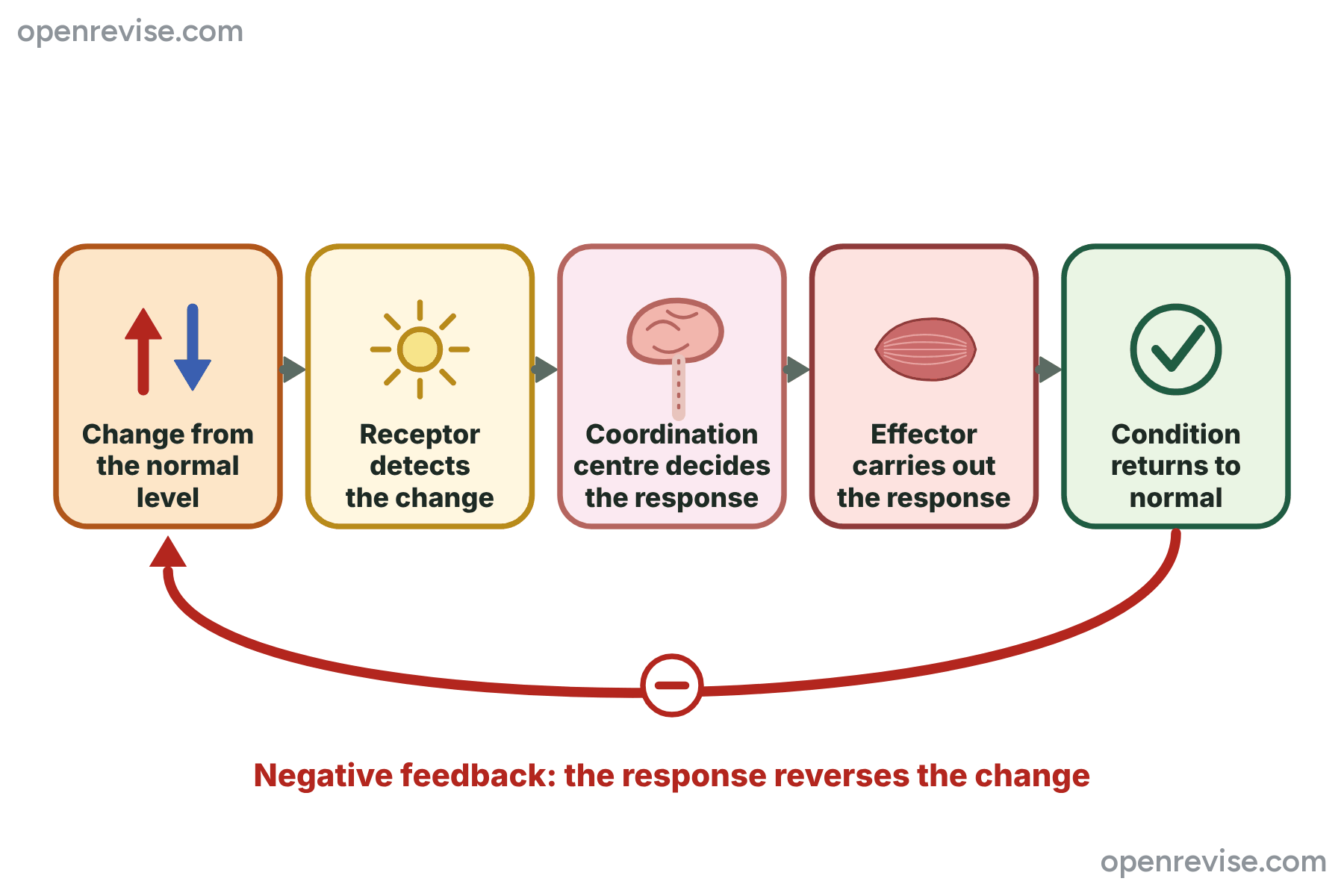
Homeostatic control systems work by negative feedback.
The parts of a control system
Every homeostatic system has the same three parts, plus the stimulus and the response.
-
Receptors
Cells that detect a change in the condition, for example temperature receptors in the skin, or cells in the pancreas that detect the glucose concentration.
-
Coordination centre
It receives information from the receptors, and decides what to do. It may be the brain, the spinal cord or the pancreas.
-
Effectors
They are muscles or glands, which carry out the response, for example a gland that releases a hormone, or muscles that contract.
-
Negative feedback
The response reverses the original change. If the condition rises, the response makes it fall, and if the condition falls, the response makes it rise.
Nervous and hormonal control
Nervous control
- Uses electrical impulses along neurones
- Very fast response
- The effect usually lasts a short time
- Effectors are muscles or glands
Hormonal control
- Uses hormones carried in the blood
- Slower response
- The effect usually lasts longer
- Effectors are target organs and glands
Applying the control system
Blood glucose concentration rises after a meal. Use the parts of a control system to describe how the body returns it to its normal level.
Show the solutionHide the solution
- 1 The change The glucose concentration of the blood rises, which is the stimulus.
- 2 Receptor and coordination centre The cells of the pancreas detect the rise, and the pancreas decides to release insulin.
- 3 Effector The liver and other cells respond to insulin, by taking glucose out of the blood.
- 4 Result The concentration falls, so less insulin is released. The response has reversed the change, which is negative feedback.
AnswerThe pancreas detects the rise and releases insulin. The liver takes up glucose and converts it to glycogen, so the blood glucose concentration falls back to normal. This is negative feedback.
Case study
Running a marathon
A marathon runner puts the control systems of the body to a hard test. The muscles release a great deal of heat, so the body temperature tends to rise. The muscles use up glucose, so the blood glucose concentration tends to fall. Sweat is lost, so the water content tends to fall. Each condition is detected, and the body responds, by sweating more, by releasing glucose from stores, and by making the runner feel thirsty. If the control is overwhelmed, for example on a very hot day, the temperature can rise too far, and the runner can collapse, which shows why homeostasis matters.
Summary and exam focus
- Homeostasis is the regulation of the conditions inside the body.
- It keeps temperature, blood glucose and water content steady.
- A control system has a receptor, a coordination centre and an effector.
- Negative feedback reverses a change and returns the condition to normal.
- The cells and enzymes of the body only work well within narrow limits.
Exam focus
Explain the importance of maintaining a constant internal environment in the body. (4 marks) (4 marks)
Pick a condition and link it to a cell process: enzymes need a steady temperature, and cells need steady water content so that osmosis does not make them swell or shrink. Then state that homeostasis keeps the conditions within narrow limits using negative feedback.
Key terms
The words this lesson expects you to use. Each one is linked from the first place it appears above.
- Homeostasis
- The regulation of the conditions inside the body, so that they stay constant.
- Internal environment
- The conditions inside the body, such as temperature and blood glucose.
- Stimulus
- A change that is detected by a receptor.
- Receptor
- A cell that detects a stimulus.
- Coordination centre
- The part of a control system that receives information and decides on the response.
- Effector
- A muscle or gland that carries out a response.
- Negative feedback
- A response that reverses a change, and returns a condition to its normal level.
- Hormone
- A chemical messenger that is made in a gland and carried in the blood.
- Enzyme
- A biological catalyst that speeds up a reaction in cells.
You've finished the notes
Check your understanding
Test yourself while it is fresh. Start with the flashcards, then try the exam questions.
Something here looks wrong?
Tell us what and we will go and look. It goes to whoever writes these pages, nobody else, and we do not ask who you are — so there is nothing to sign and nothing comes back to you.