Biology · Homeostasis
Why Homeostasis Matters: Enzymes and Osmosis
Two things go wrong very quickly if the internal environment is not controlled: the enzymes stop working, and the cells gain or lose water. This lesson is for separate Biology only: Combined Science students do not need it. It explains the importance of homeostasis for thermoregulation, through enzyme activity, and for osmoregulation, through the effect on animal cells.
Learning Objectives
- 1Explain why the control of body temperature, which is thermoregulation, is important for the activity of enzymes.
- 2Explain what denaturing means, and why a high temperature stops an enzyme from working.
- 3Explain why the control of water content, which is osmoregulation, is important for animal cells.
- 4Describe what happens to red blood cells in solutions that are more dilute, or more concentrated, than the cytoplasm.
Retrieval practice
-
1
What is an enzyme?
Show answerHide answer
A biological catalyst, which is a protein that speeds up a reaction.
-
2
What is the active site?
Show answerHide answer
The part of an enzyme to which the substrate binds.
-
3
What is osmosis?
Show answerHide answer
The net movement of water across a partially permeable membrane from a dilute solution to a more concentrated solution.
-
4
What is a partially permeable membrane?
Show answerHide answer
A membrane that lets some substances pass through, but not others.
Two reasons for control
Homeostasis is not just a convenience. If the temperature of the body was allowed to drift, the enzymes that control the reactions of the cells would stop working properly, and if the water content of the body was not controlled, water would move into or out of the cells, and damage them. The specification asks you to explain both of these, which are the importance of thermoregulation, through the effect on enzyme activity, and the importance of osmoregulation, through the effect on animal cells.
Thermoregulation and enzyme activity
Thermoregulation is the control of body temperature, which is kept at about 37 °C.
-
Enzymes are proteins
Each enzyme has a specific three-dimensional shape, with an active site that fits one substrate.
-
Optimum temperature
The activity of an enzyme is greatest at its optimum temperature, which for the enzymes in the human body is about 37 °C.
-
Too cold
The enzyme and substrate molecules move more slowly, so there are fewer collisions, and the rate of the reaction falls. The enzyme is not damaged.
-
Too hot
At higher temperatures the bonds that hold the enzyme in shape break, and the active site changes shape. The substrate no longer fits, so the enzyme is denatured, and the change is not reversed when the temperature falls again.
-
Consequence
If the enzymes in the cells are slowed or denatured, reactions such as respiration stop, and the cells, and then the body, cannot survive.
Enzyme activity and temperature
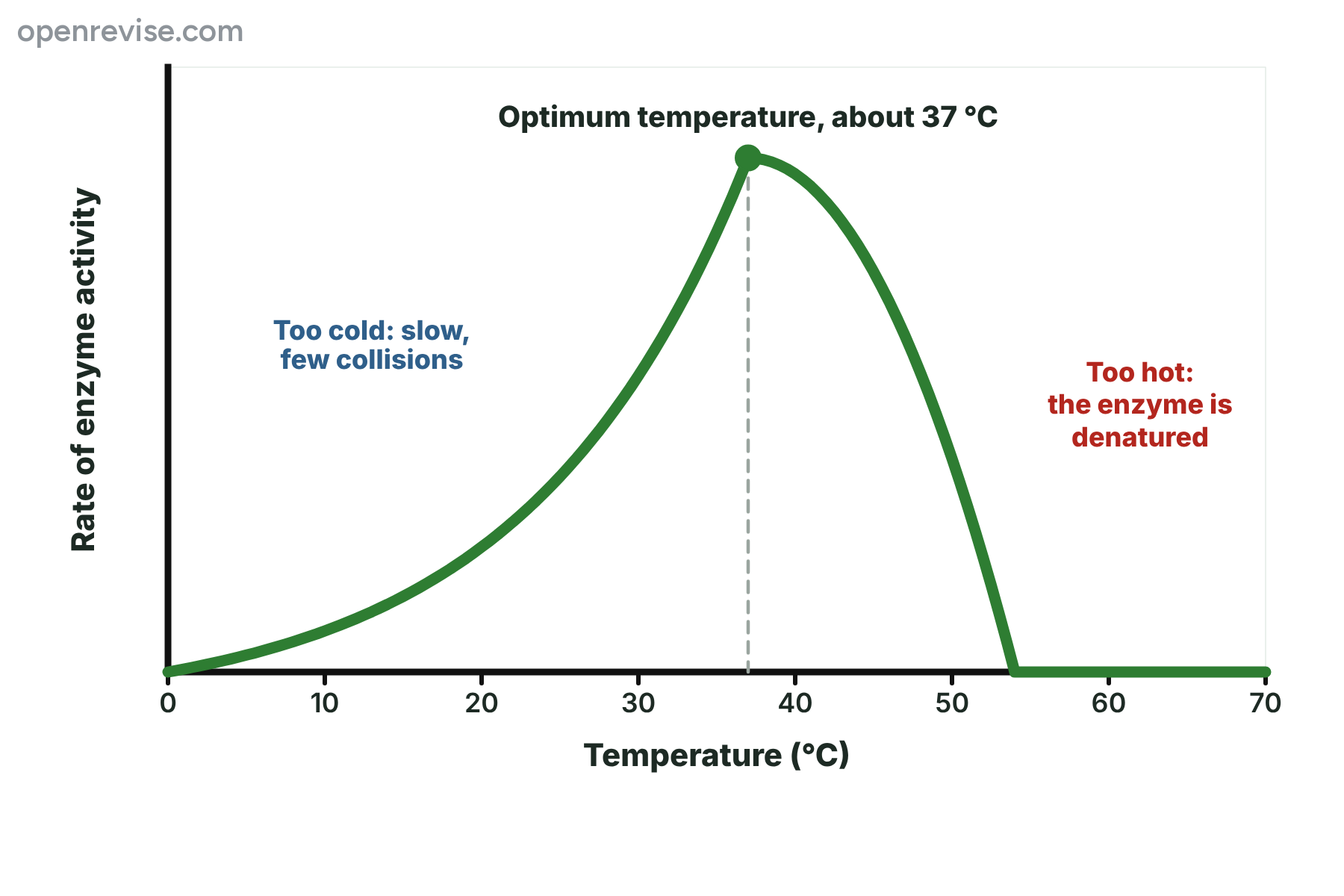
Enzyme activity is greatest at the optimum temperature, and the enzyme is denatured at high temperatures.
Osmoregulation and animal cells
Osmoregulation is the control of the water content of the blood and body fluids.
-
Animal cells have no cell wall
Their cell surface membrane is partially permeable, and it is the only barrier, so they cannot resist a large gain of water.
-
In a solution more dilute than the cytoplasm
If the blood plasma has too much water, water enters the cells by osmosis. A red blood cell swells, and it may burst.
-
In a solution more concentrated than the cytoplasm
If the blood plasma has too little water, water leaves the cells by osmosis. A red blood cell shrinks and shrivels, and it cannot work properly.
-
In a solution of the same concentration
There is no net movement of water, and the cell stays normal.
-
Consequence
The water content of the blood is kept constant, so the cells keep their normal size and shape and can do their jobs, such as carrying oxygen.
Red blood cells in different solutions
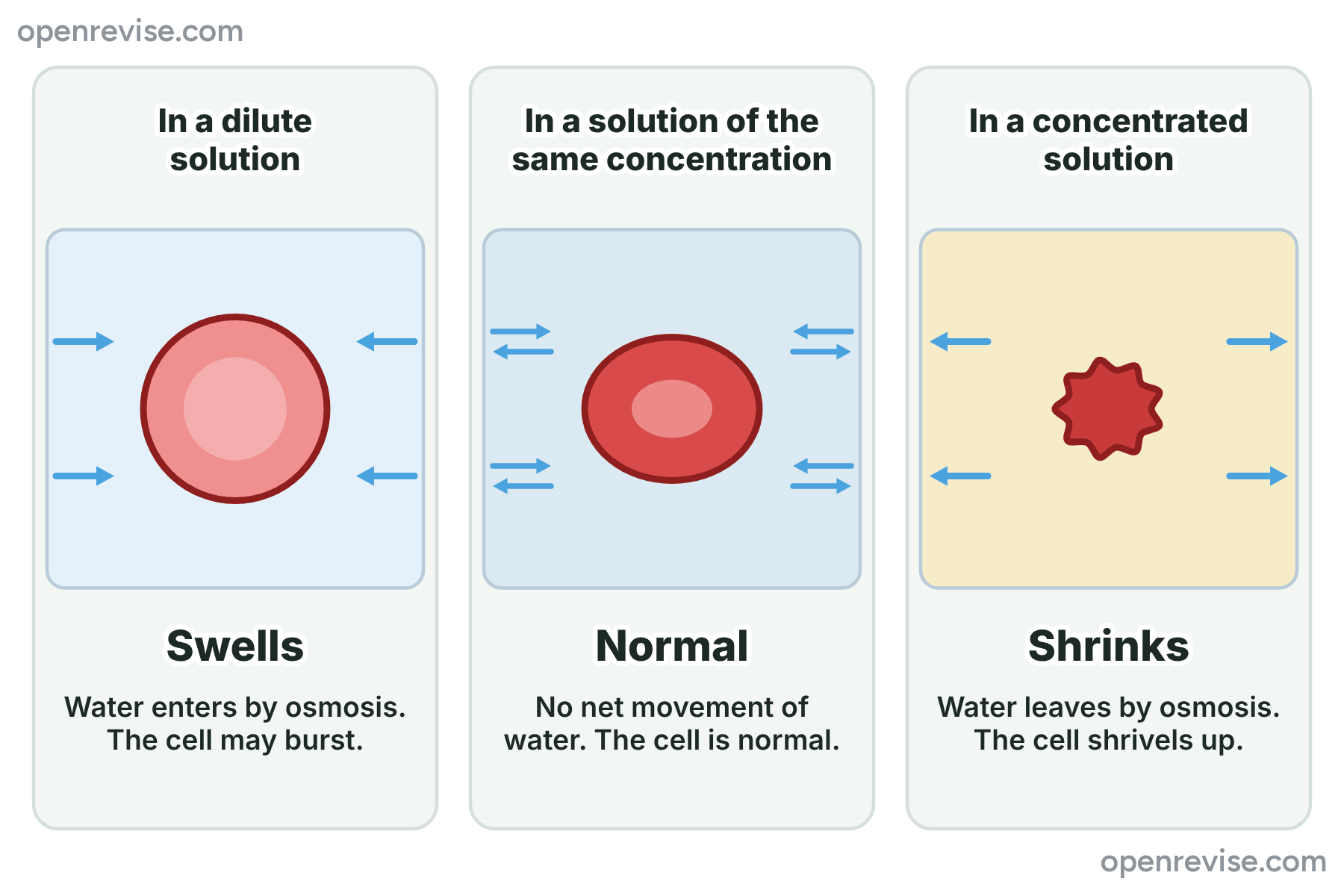
A red blood cell gains water in a dilute solution and loses water in a concentrated solution.
Too hot and too cold, and too dilute and too concentrated
Temperature problems (enzymes)
- Too cold: enzymes work slowly, because of fewer collisions
- Too hot: enzymes are denatured
- Denaturing is not reversed
- All the reactions in the cells are affected
Water problems (animal cells)
- Too dilute: cells swell and may burst
- Too concentrated: cells shrink and shrivel
- Caused by osmosis
- Animal cells have no cell wall to prevent bursting
Percentage change in mass
A cylinder of potato of mass 4.0 g is placed in pure water for one hour. Its mass is then 4.6 g. Calculate the percentage change in mass, and explain the change.
Show the solutionHide the solution
- 1 Change in mass 4.6 g minus 4.0 g is 0.6 g.
- 2 Percentage 0.6 divided by 4.0, multiplied by 100, is 15%.
- 3 Direction The mass increased, so water moved in by osmosis.
- 4 Link to animal cells An animal cell in a dilute solution would also gain water, and might burst, because it has no cell wall.
AnswerThe percentage change in mass is an increase of 15%. Water entered the potato cells by osmosis, because the water outside was more dilute than the cytoplasm.
Case study
Drinking too much water
Athletes in long races sometimes drink far more water than they lose, without taking in any salts. The water in the blood becomes too dilute, and the cells of the body, including the brain cells, take in water by osmosis and swell. This is called water intoxication, or hyponatraemia, and it can cause headaches, confusion and, in severe cases, death. It shows that the control of the water content of the body is essential, and that too much water is as dangerous as too little.
Summary and exam focus
- Enzymes have an optimum temperature, about 37 °C in humans.
- A low temperature slows enzymes, and a high temperature denatures them.
- Animal cells have no cell wall, so they are damaged by osmosis.
- In a dilute solution animal cells swell, and may burst.
- In a concentrated solution animal cells shrink.
Exam focus
Explain why it is important for the body to control both its temperature and the water content of its blood. (6 marks) (6 marks)
Treat the two controls separately. For temperature, link to the optimum, slower reactions when cold, and denaturing when hot. For water, link to osmosis, and say what happens to animal cells in a dilute and in a concentrated solution.
Key terms
The words this lesson expects you to use. Each one is linked from the first place it appears above.
- Thermoregulation
- The control of body temperature.
- Osmoregulation
- The control of the water content of the body.
- Optimum temperature
- The temperature at which an enzyme works fastest.
- Denatured
- Changed in shape, so that an enzyme can no longer work.
- Active site
- The part of an enzyme where the substrate fits.
- Osmosis
- The net movement of water across a partially permeable membrane from a dilute to a more concentrated solution.
- Dilute
- Containing a lot of water, and a low concentration of solute.
- Concentrated
- Containing less water, and a high concentration of solute.
- Partially permeable
- Letting some substances through, but not others.
You've finished the notes
Check your understanding
Test yourself while it is fresh. Start with the flashcards, then try the exam questions.
Something here looks wrong?
Tell us what and we will go and look. It goes to whoever writes these pages, nobody else, and we do not ask who you are — so there is nothing to sign and nothing comes back to you.