Biology · Hormones and Reproduction
Assisted Reproductive Technology (Higher tier)
Not everyone who wants a baby can conceive naturally. This lesson is for the Higher tier only: Foundation students do not need it. It explains how hormones are used in assisted reproductive technology, including clomifene therapy and in vitro fertilisation, IVF.
Learning Objectives
- 1(Higher tier) Explain the use of hormones in assisted reproductive technology (ART).
- 2(Higher tier) Explain how clomifene therapy helps a woman who does not ovulate to become pregnant.
- 3(Higher tier) Describe the stages of IVF, including the use of FSH and LH.
- 4(Higher tier) Evaluate the advantages and disadvantages of IVF.
Retrieval practice
-
1
What does FSH do?
Show answerHide answer
Makes a follicle mature, and stimulates the ovary to make oestrogen.
-
2
What does LH do?
Show answerHide answer
Causes ovulation.
-
3
What is fertilisation?
Show answerHide answer
The fusion of a sperm and an egg cell.
-
4
What does progesterone do?
Show answerHide answer
Maintains the lining of the uterus.
Help to have a baby
About 1 in 7 couples in the UK have difficulty in conceiving a baby. There are many causes, including a woman not ovulating, blocked oviducts, and a low sperm count in the man. Assisted reproductive technology, or ART, is the name for medical treatments that help people to become pregnant, and many of them use hormones. Two of the best known are clomifene therapy, which helps a woman to release an egg, and in vitro fertilisation, which is known as IVF, in which an egg is fertilised in a laboratory.
Clomifene therapy
Clomifene is a drug that is used for women who do not ovulate regularly.
-
The problem
Some women do not release eggs, because the level of FSH and LH from the pituitary gland is too low to stimulate the ovary.
-
What clomifene does
Clomifene blocks the receptors for oestrogen in the brain. The hypothalamus and the pituitary gland then act as if the level of oestrogen is low, so they do not inhibit FSH and LH.
-
The result
The pituitary gland releases more FSH and LH, so that the follicles in the ovary mature, and ovulation happens.
-
Use
It is taken as a tablet for a few days at the start of the cycle. It may cause multiple eggs to be released, so there is a higher chance of twins.
In vitro fertilisation (IVF)
In vitro means in glass, which means that the egg is fertilised in the laboratory and not in the body.
-
Fertility drugs
The woman is given FSH and LH, by injection, which stimulate the ovaries to mature several eggs at the same time.
-
Egg collection
The mature eggs are collected from the ovaries, using a fine needle, while the woman is under a light sedative.
-
Fertilisation
The eggs are mixed with sperm from the man, in a dish in the laboratory, where the eggs are fertilised.
-
Embryo development
The fertilised eggs are kept in an incubator, and they grow into small balls of cells, called embryos, over a few days.
-
Transfer
One or two healthy embryos are placed in the uterus of the woman. Progesterone may be given to help to maintain the lining so the embryo can implant.
The stages of IVF
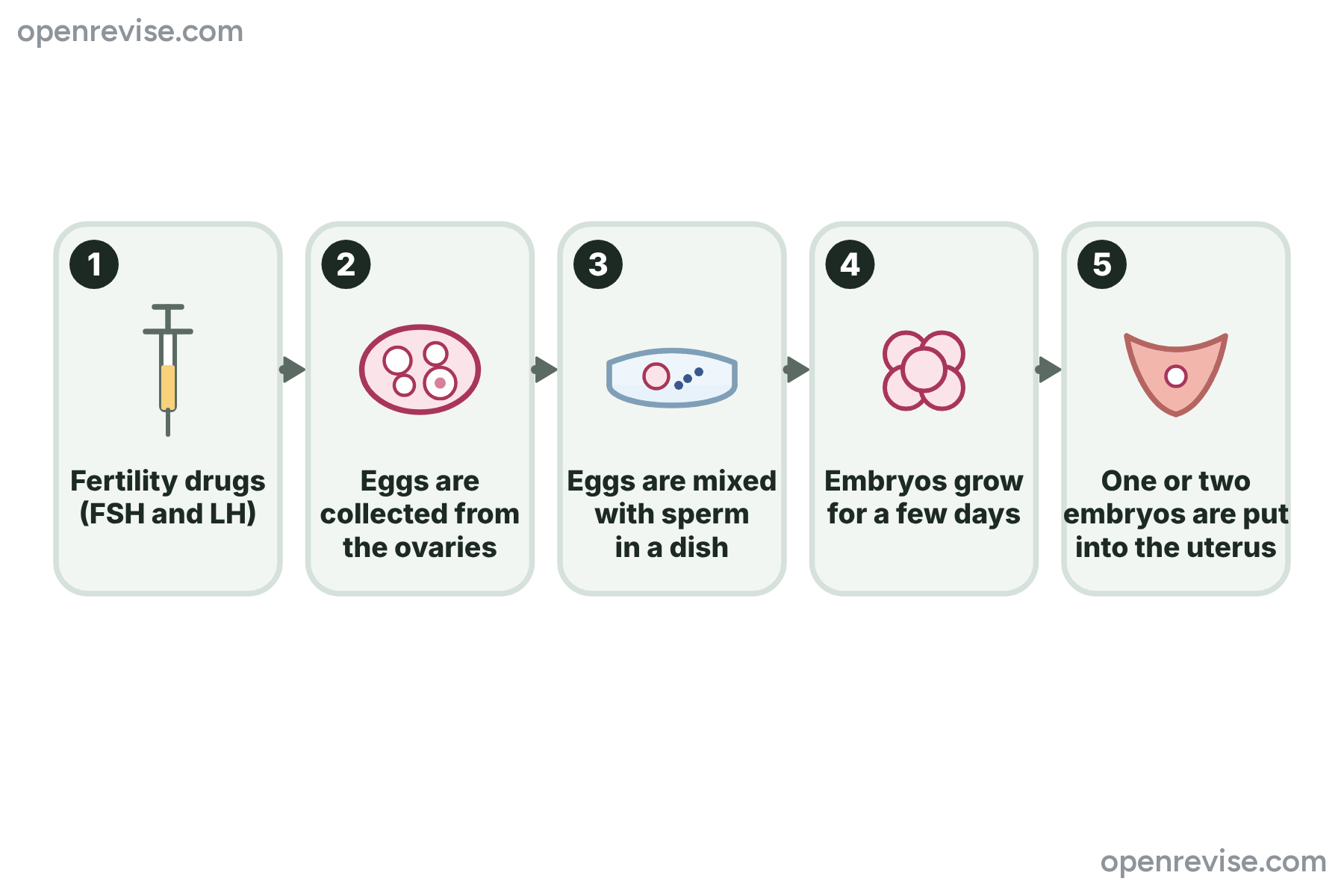
In IVF, eggs are fertilised in a dish, and one or two embryos are put back into the uterus.
Clomifene and IVF
Clomifene therapy
- A tablet
- Used when a woman does not ovulate
- Blocks oestrogen receptors, so more FSH and LH are released
- Fertilisation takes place in the body
IVF
- A series of injections and procedures
- Used when there are blocked oviducts, or other problems
- FSH and LH are given to mature several eggs
- Fertilisation takes place in a dish
Calculating the success of IVF
A clinic treated 400 women with IVF in a year. 120 of them gave birth to a baby. Each cycle of treatment costs £3500. Calculate the success rate, and the cost of treatment for each baby, assuming that each woman had one cycle.
Show the solutionHide the solution
- 1 Success rate \(120 \div 400 \times 100 = 30\%\).
- 2 Total cost \(400 \times 3500 = 1\,400\,000\) pounds.
- 3 Cost per baby \(1\,400\,000 \div 120 = 11\,667\), which is about £11 700.
- 4 Comment The cost of each baby is much more than the cost of a cycle, because most cycles do not result in a birth.
AnswerThe success rate was 30%. The total cost was £1 400 000, so the cost per baby was about £11 700.
Advantages and disadvantages of IVF
IVF helps many people, but it has costs.
-
Advantage: a chance of a baby
It gives a chance of having a child to people who would not otherwise be able to do so.
-
Advantage: genetic testing
An embryo can be tested for genetic disorders, so that only healthy embryos are chosen.
-
Disadvantage: low success
The chance of a baby from one cycle is about 3 in 10 for women under 35, and it falls with age, to less than 1 in 10 for women over 40.
-
Disadvantage: emotional and physical stress
The treatment can be stressful, and the drugs can have side effects, such as swelling of the ovaries.
-
Disadvantage: multiple births
If more than one embryo is put into the uterus, twins or triplets are more likely, with greater risks to the mother and babies.
-
Disadvantage: cost and ethics
It is expensive, and not all of it is paid for by the NHS. Spare embryos are often destroyed, or frozen, which some people think is wrong.
Case study
Louise Brown, the first IVF baby
Louise Brown was born in Oldham, in England, on 25 July 1978. She was the first baby to be conceived by IVF. Her parents had tried for nine years to have a baby, as the oviducts of her mother were blocked. The doctors who developed the technique, Patrick Steptoe and Robert Edwards, had to deal with a great deal of opposition and criticism. Since then more than 12 million babies have been born using IVF around the world, and Edwards was given the Nobel Prize in 2010.
Summary and exam focus
- ART is the name for treatments that help people to become pregnant, many of which use hormones.
- Clomifene therapy makes the pituitary gland release more FSH and LH, so that ovulation occurs.
- In IVF, FSH and LH mature several eggs, which are collected and fertilised in a dish.
- One or two embryos are put in the uterus.
- IVF has advantages, but also low success rates, costs, and ethical issues.
Exam focus
Explain how hormones are used in the treatment of infertility, including clomifene therapy and IVF, and evaluate IVF. (6 marks) (6 marks)
For clomifene, say that it makes the pituitary gland release more FSH and LH, so that ovulation occurs. For IVF, give the stages: FSH and LH, collection of eggs, fertilisation in a dish, embryo development and transfer. Then give advantages and disadvantages.
Key terms
The words this lesson expects you to use. Each one is linked from the first place it appears above.
- Assisted reproductive technology (ART)
- Medical treatments that help people to become pregnant.
- IVF
- In vitro fertilisation, in which an egg is fertilised by sperm in a laboratory.
- Clomifene
- A drug that makes the pituitary gland release more FSH and LH, to cause ovulation.
- Embryo
- A ball of cells formed from a fertilised egg.
- Infertility
- The inability to conceive a baby.
- Incubator
- A device that keeps cells at a steady temperature.
- Multiple birth
- The birth of more than one baby at a time, such as twins.
- Fertility drug
- A drug, such as FSH and LH, that helps a woman to release eggs.
- In vitro
- In glass, which means in a laboratory dish.
You've finished the notes
Check your understanding
Test yourself while it is fresh. Start with the flashcards, then try the exam questions.
Something here looks wrong?
Tell us what and we will go and look. It goes to whoever writes these pages, nobody else, and we do not ask who you are — so there is nothing to sign and nothing comes back to you.