Biology · Hormones and Reproduction
Contraception
Contraception lets people choose when to have a baby. This lesson explains how hormonal contraception influences the menstrual cycle and prevents pregnancy, and evaluates hormonal and barrier methods of contraception.
Learning Objectives
- 1Explain how hormonal contraception influences the menstrual cycle and prevents pregnancy.
- 2Describe how barrier methods and other non-hormonal methods prevent pregnancy.
- 3Evaluate hormonal and barrier methods of contraception, using data.
- 4Explain why only some methods protect against sexually transmitted infections.
Retrieval practice
-
1
What does oestrogen do?
Show answerHide answer
Repairs and thickens the lining of the uterus.
-
2
What is ovulation?
Show answerHide answer
The release of a mature egg from an ovary.
-
3
What is fertilisation?
Show answerHide answer
The fusion of a sperm and an egg cell.
-
4
What is an STI?
Show answerHide answer
A sexually transmitted infection, which is spread by sexual contact.
Choosing when to have a baby
Contraception is the prevention of pregnancy. It does this by stopping the sperm and the egg from meeting, or by stopping an embryo from developing in the uterus. Some methods use hormones, and others do not. There is no method that is perfect for everyone, and the best choice depends on how well it works, how easy it is to use, whether it has side effects, and whether it protects against sexually transmitted infections.
Hormonal contraception
Hormonal methods contain oestrogen, progesterone, or both, or a similar substance, and they act on the menstrual cycle.
-
Types
The combined pill contains oestrogen and progesterone, and is taken daily. There are also a patch, a progesterone-only pill, an injection, an implant in the arm, and an intrauterine system (IUS) in the uterus, which release hormones over a longer time.
-
Stops ovulation
The hormones keep the levels of FSH and LH low, so a follicle does not mature, and no egg is released. If there is no egg, there can be no fertilisation.
-
Thickens the mucus
Progesterone makes the mucus at the entrance of the uterus thicker, so that sperm cannot easily pass through to reach an egg.
-
Thins the lining
The uterus lining stays thin, so it is less likely that an embryo could implant.
How hormonal contraception works
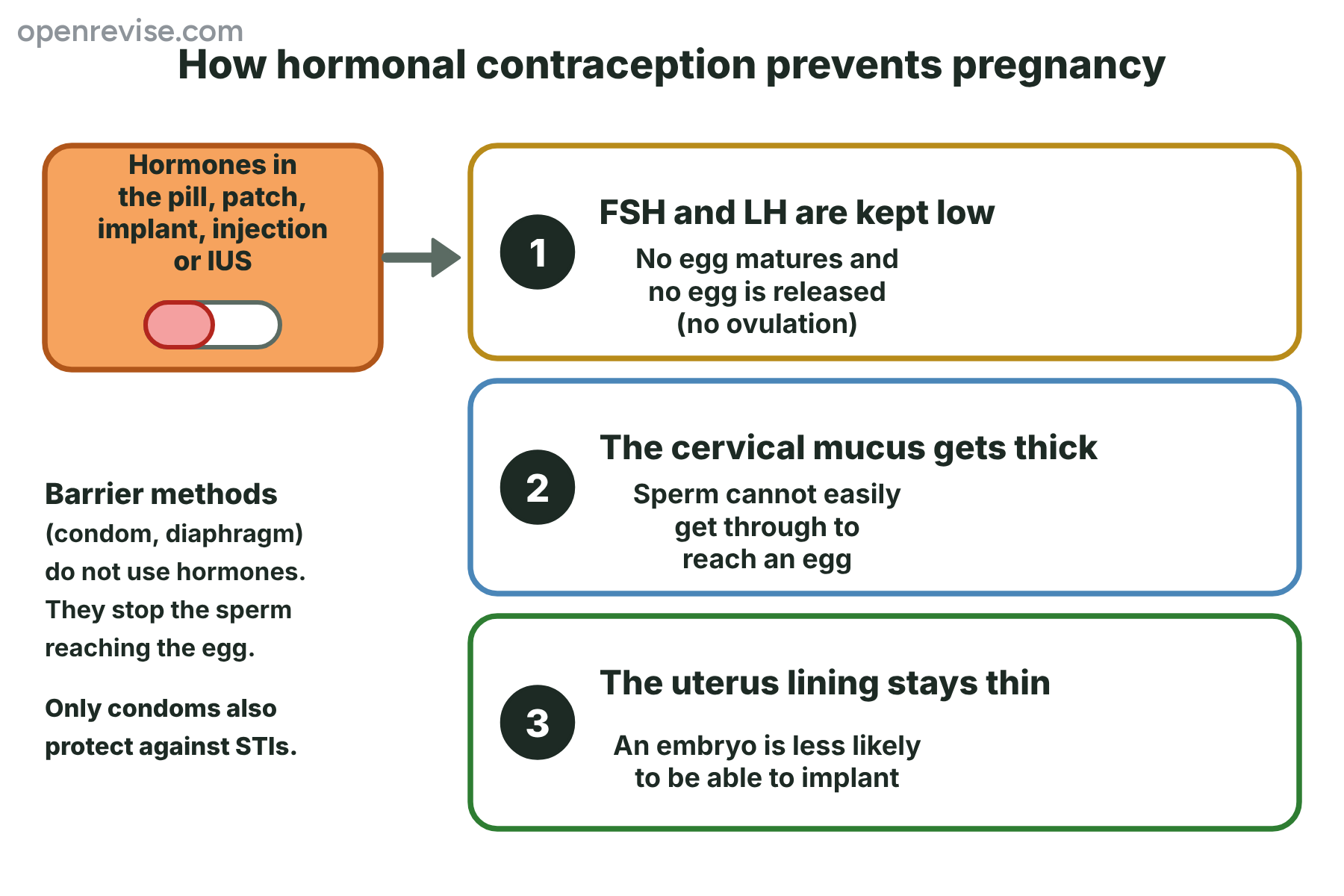
Hormonal contraception works in three ways, and the first is the most important.
Barrier and other methods
These methods do not change the hormones.
-
Male condom
A thin sheath that is worn over the penis, and stops sperm from entering the vagina. It also protects against STIs.
-
Female condom and diaphragm
The female condom lines the vagina. A diaphragm is a dome of rubber that covers the cervix, and is used with a spermicide, which kills sperm.
-
Copper IUD
A small device that is put in the uterus. The copper is toxic to sperm, and it stops an embryo from implanting. It works for up to 10 years.
-
Sterilisation
A surgical operation that cuts or blocks the tubes that carry the eggs, or the sperm. It is intended to be permanent.
-
Abstinence
Not having sex around the time of ovulation, or at all. The first is not reliable, because the time of ovulation varies.
Hormonal and barrier methods
Hormonal methods
- Use oestrogen or progesterone to stop ovulation
- Very effective if used correctly, and some last for years
- Can have side effects, such as headaches or mood changes
- Do not protect against STIs
Barrier methods
- Stop the sperm from reaching the egg
- Effective, but more easily used wrongly
- No hormonal side effects
- Condoms protect against STIs
Effectiveness of some methods
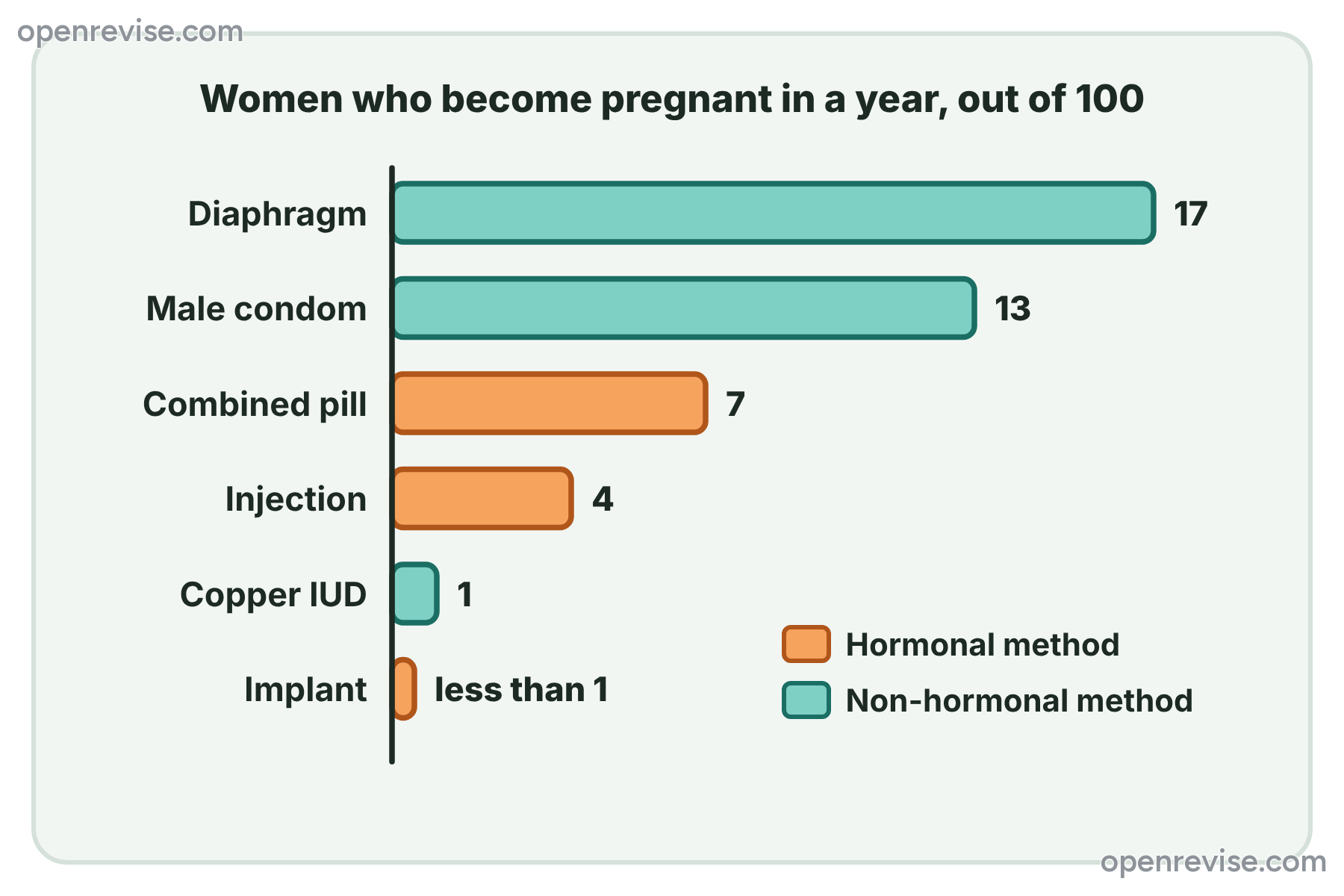
Methods that do not depend on remembering, such as the implant and the IUD, are the most effective.
Comparing the effectiveness of two methods
In a year, 7 women out of 100 who used the combined pill became pregnant, and 13 out of 100 who used the male condom became pregnant. Calculate the percentage of women who became pregnant with each method, and say how many times more likely it was with the condom.
Show the solutionHide the solution
- 1 Pill \(7 \div 100 \times 100 = 7\%\).
- 2 Condom \(13 \div 100 \times 100 = 13\%\).
- 3 Compare \(13 \div 7 = 1.86\), which is about 1.9 times.
- 4 Evaluate The pill is more effective, but the condom also protects against STIs, so many people use both.
AnswerWith the combined pill it was 7%, and with the condom 13%. Pregnancy was about 1.9 times more likely with the condom, which is nearly twice as likely.
Evaluating methods
The best method depends on the person, and on several factors.
-
Effectiveness
How many women become pregnant when it is used as normal. Methods that are used once, or last a long time, such as the implant, have fewer failures than those that must be remembered each time or each day.
-
Side effects
Hormonal methods can cause headaches, nausea, mood changes, and a small increase in the risk of blood clots. Others may cause irritation.
-
Protection against STIs
Only condoms give good protection against STIs, so they are advised for people with new partners.
-
Convenience and cost
Some methods are used before sex, some daily, and some last for years. In the UK, contraception is free from NHS clinics.
-
Reversibility
Most methods are reversible, but sterilisation is intended to be permanent.
-
Personal beliefs
Some people choose a method for religious or ethical reasons.
Case study
The contraceptive pill
The combined contraceptive pill was first approved in the USA in 1960, and in Britain in 1961. It was the first medicine that healthy people took for years, not to treat an illness. The early pill contained a high dose of hormones, with more side effects, but the dose has been reduced a great deal, and the pill is now one of the most widely used methods in the world. It gave women much more control over when to have children, and changed the lives of women, as they were able to plan education and careers.
Summary and exam focus
- Hormonal contraception uses oestrogen, progesterone, or both.
- It stops ovulation by keeping FSH and LH low, thickens the mucus and thins the lining.
- Barrier methods stop the sperm from reaching the egg.
- Only condoms protect against sexually transmitted infections.
- The best method depends on effectiveness, side effects, convenience, and the need for STI protection.
Exam focus
Explain how hormonal contraception prevents pregnancy, and evaluate hormonal and barrier methods of contraception. (6 marks) (6 marks)
For hormonal contraception, say that the hormones keep FSH and LH low, so no egg is released, and that they also thicken mucus and thin the lining. For the evaluation, compare effectiveness, side effects and STI protection, and give a conclusion.
Key terms
The words this lesson expects you to use. Each one is linked from the first place it appears above.
- Contraception
- A method of preventing pregnancy.
- Hormonal contraception
- Contraception that uses hormones to stop ovulation or to change the uterus and the mucus.
- Barrier method
- A method that stops the sperm from reaching the egg, such as a condom.
- Implant
- A small rod that is put under the skin, and releases progesterone for years.
- Intrauterine device (IUD)
- A small device that is put in the uterus to prevent pregnancy.
- Spermicide
- A chemical that kills sperm.
- Sterilisation
- An operation that makes a person unable to have children.
- STI
- A sexually transmitted infection.
- Diaphragm
- A rubber dome that covers the cervix.
You've finished the notes
Check your understanding
Test yourself while it is fresh. Start with the flashcards, then try the exam questions.
Something here looks wrong?
Tell us what and we will go and look. It goes to whoever writes these pages, nobody else, and we do not ask who you are — so there is nothing to sign and nothing comes back to you.