Biology · Hormones and Reproduction
Hormones and the Menstrual Cycle (Higher tier)
Four hormones take turns in the control of the menstrual cycle, and each one affects the next. This lesson is for the Higher tier only: Foundation students do not need it. It explains the interactions of oestrogen, progesterone, FSH and LH, including the repair and maintenance of the uterus lining, ovulation and menstruation.
Learning Objectives
- 1(Higher tier) Describe the roles of FSH and LH, which are made by the pituitary gland, in the menstrual cycle.
- 2(Higher tier) Explain the interactions of oestrogen, progesterone, FSH and LH in the control of the menstrual cycle.
- 3(Higher tier) Explain the repair and maintenance of the uterus wall, ovulation and menstruation in terms of these hormones.
- 4(Higher tier) Interpret a graph of hormone levels through the menstrual cycle.
Retrieval practice
-
1
What does oestrogen do?
Show answerHide answer
Repairs and thickens the lining of the uterus.
-
2
What does progesterone do?
Show answerHide answer
Maintains the lining of the uterus.
-
3
What is ovulation?
Show answerHide answer
The release of a mature egg from an ovary.
-
4
Which gland is called the master gland?
Show answerHide answer
The pituitary gland.
A chain of hormones
Two of the four hormones of the menstrual cycle come from the pituitary gland, and two from the ovaries. FSH, follicle stimulating hormone, and LH, luteinising hormone, are made by the pituitary gland, and they act on the ovaries. Oestrogen and progesterone, made by the ovaries, act on the uterus, and they also act back on the pituitary gland. The levels of all four rise and fall in a fixed pattern, which is why the cycle is regular, and why the ovary and the uterus work in step.
What each hormone does
Each hormone has a job, and the order matters.
-
FSH
Released by the pituitary gland. It causes a follicle in the ovary to mature and grow, and it stimulates the ovary to make oestrogen.
-
Oestrogen
Released by the follicle in the ovary. It causes the lining of the uterus to be repaired and to thicken. A high level of oestrogen stimulates the pituitary gland to release a surge of LH, and also inhibits the release of FSH.
-
LH
Released by the pituitary gland. The surge of LH, at about day 14, causes ovulation, the release of the egg from the follicle. It also causes the empty follicle to make progesterone.
-
Progesterone
Released by the empty follicle in the ovary. It maintains the lining of the uterus, and it inhibits the release of FSH and LH, so that no more eggs mature.
Hormone levels through the cycle
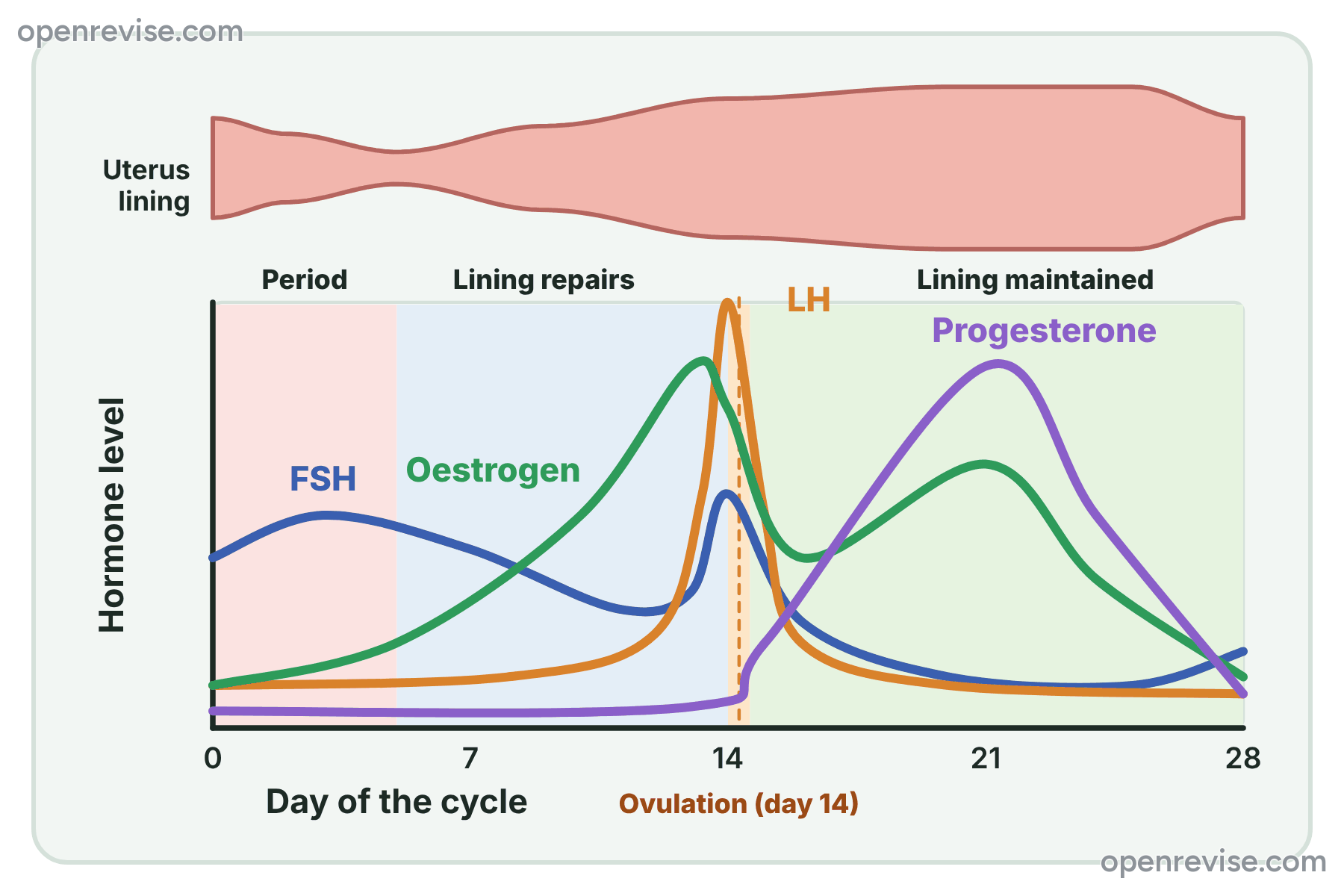
The levels of the four hormones rise and fall in a pattern that controls the stages of the cycle.
The sequence of events
Follow the hormones from the start of a cycle.
-
1
Days 1 to 5
The levels of oestrogen and progesterone are low, so the lining breaks down, and a period occurs. The low level of oestrogen allows the pituitary gland to release FSH.
-
2
FSH rises
FSH causes a follicle in the ovary to mature, and the follicle starts to make oestrogen.
-
3
Oestrogen rises
Oestrogen repairs and thickens the lining of the uterus, and it inhibits FSH, so only one follicle usually matures.
-
4
LH surge
When oestrogen is high enough, it stimulates the pituitary gland to release a surge of LH, and ovulation occurs at about day 14.
-
5
Progesterone rises
The empty follicle now makes progesterone, which maintains the lining. High progesterone and oestrogen inhibit FSH and LH.
-
6
No fertilisation
The empty follicle breaks down, progesterone and oestrogen fall, the lining breaks down, and the cycle starts again, as FSH is no longer inhibited.
Hormones from the pituitary gland and the ovaries
From the pituitary gland
- FSH makes the follicle mature, and the ovary make oestrogen
- LH causes ovulation
- Their levels are controlled by feedback from oestrogen and progesterone
- Act on the ovaries
From the ovaries
- Oestrogen repairs the lining, and triggers the LH surge
- Progesterone maintains the lining
- Both act on the uterus
- Both inhibit the pituitary gland at some stages
Reading a hormone graph
A graph shows that the level of LH has a sharp peak on day 14, and that the level of progesterone is highest on day 21. State what happens in the ovary at each time, and explain what would happen to the uterus lining if the level of progesterone fell on day 21.
Show the solutionHide the solution
- 1 Day 14 The LH surge causes the egg to be released from the follicle.
- 2 Day 21 The empty follicle is making progesterone, which maintains the lining.
- 3 A fall Without progesterone the lining cannot be maintained.
- 4 Result The lining breaks down, which is menstruation, and a new cycle begins.
AnswerOn day 14 the peak of LH causes ovulation. On day 21 the progesterone is maintaining the thick lining. If progesterone fell on day 21, the lining could no longer be maintained, and it would break down, causing a period.
Negative and positive feedback in the cycle
The hormones affect each other.
-
Negative feedback
Oestrogen and progesterone inhibit FSH, which stops more follicles maturing, and keeps the level of FSH in check.
-
A surge of LH
In the middle of the cycle, the high level of oestrogen stimulates the release of LH, which is why LH shows a sharp peak at ovulation.
-
Progesterone and the next cycle
When progesterone falls at the end of the cycle, FSH is no longer inhibited, and a new follicle can begin to mature.
Case study
Why ovulation is predictable
Doctors can predict ovulation by testing urine for LH. The LH level rises sharply about 24 to 36 hours before the egg is released, so a rapid test can show when a woman is about to ovulate. The tests use monoclonal antibodies, in the same way as pregnancy tests. Women who are trying to have a baby use them to find the best days to have sex, and doctors use the same idea when they plan fertility treatment such as IVF.
Summary and exam focus
- FSH causes a follicle to mature, and stimulates the ovary to make oestrogen.
- Oestrogen repairs the uterus lining, and a high level stimulates a surge of LH.
- LH causes ovulation, and the empty follicle makes progesterone.
- Progesterone maintains the lining, and inhibits FSH and LH.
- If progesterone falls, the lining breaks down, and menstruation begins.
Exam focus
Explain how FSH, LH, oestrogen and progesterone interact to control the menstrual cycle. (6 marks) (6 marks)
Go through the cycle in the right order: FSH matures a follicle, which makes oestrogen, which repairs the lining and triggers an LH surge, which causes ovulation, then progesterone maintains the lining. End with what happens to progesterone, and the lining, if there is no pregnancy.
Key terms
The words this lesson expects you to use. Each one is linked from the first place it appears above.
- FSH
- Follicle stimulating hormone, from the pituitary gland, which makes a follicle in the ovary mature.
- LH
- Luteinising hormone, from the pituitary gland, which causes ovulation.
- Surge
- A short, sharp rise in the level of a hormone.
- Follicle
- A structure in the ovary in which an egg matures.
- Corpus luteum
- The empty follicle after ovulation, which makes progesterone.
- Inhibit
- To reduce or to stop.
- Negative feedback
- A response that reverses a change.
- Oestrogen
- A hormone from the ovaries that repairs the lining of the uterus.
- Progesterone
- A hormone from the ovaries that maintains the lining of the uterus.
You've finished the notes
Check your understanding
Test yourself while it is fresh. Start with the flashcards, then try the exam questions.
Something here looks wrong?
Tell us what and we will go and look. It goes to whoever writes these pages, nobody else, and we do not ask who you are — so there is nothing to sign and nothing comes back to you.