Biology · Hormones and Reproduction
The Endocrine System
The nervous system sends fast messages along nerves, but the body has a second way of sending messages, which is slower and lasts longer. This lesson covers the endocrine system, which is made of glands that release hormones into the blood, and explains where the main hormones are made and what their target organs are.
Learning Objectives
- 1Describe a hormone as a chemical messenger that is made in an endocrine gland and carried in the blood to its target organ.
- 2Describe where hormones are produced, including the pituitary gland, thyroid gland, pancreas, adrenal glands, ovaries and testes.
- 3Describe the main hormone that each of these glands releases and the effect that it has on its target organ.
- 4Compare the nervous system and the endocrine system.
Retrieval practice
-
1
What is a gland?
Show answerHide answer
An organ that makes and releases a substance, such as a hormone or an enzyme.
-
2
What is the function of the blood plasma?
Show answerHide answer
To transport substances such as hormones, carbon dioxide and urea around the body.
-
3
What is a stimulus?
Show answerHide answer
A change in the environment that is detected by a receptor.
-
4
What is an organ?
Show answerHide answer
A group of tissues that work together to do a job.
Chemical messengers
Your body has two systems for sending messages. The nervous system uses electrical impulses, which travel quickly along neurones. The endocrine system uses chemicals, called hormones, which are made in glands and travel in the blood. A hormone is carried all around the body, but it only affects its target organs, which are the organs that have receptors for it. The effects are slower than those of the nerves, but they usually last for longer, so hormones control things such as growth, reproduction and the level of sugar in the blood.
How the endocrine system works
The same steps happen for every hormone.
-
A stimulus
A change in the body, such as a fall in the level of glucose in the blood, is detected.
-
A gland releases a hormone
An endocrine gland, which has no duct, releases the hormone straight into the blood.
-
Transport
The blood carries the hormone to every part of the body.
-
A target organ
The hormone is only detected by the cells that have the right receptors, in the target organs, and these cells respond.
-
The effect
The response of the target organ is the effect of the hormone, which may last for minutes, hours or many years.
The endocrine glands
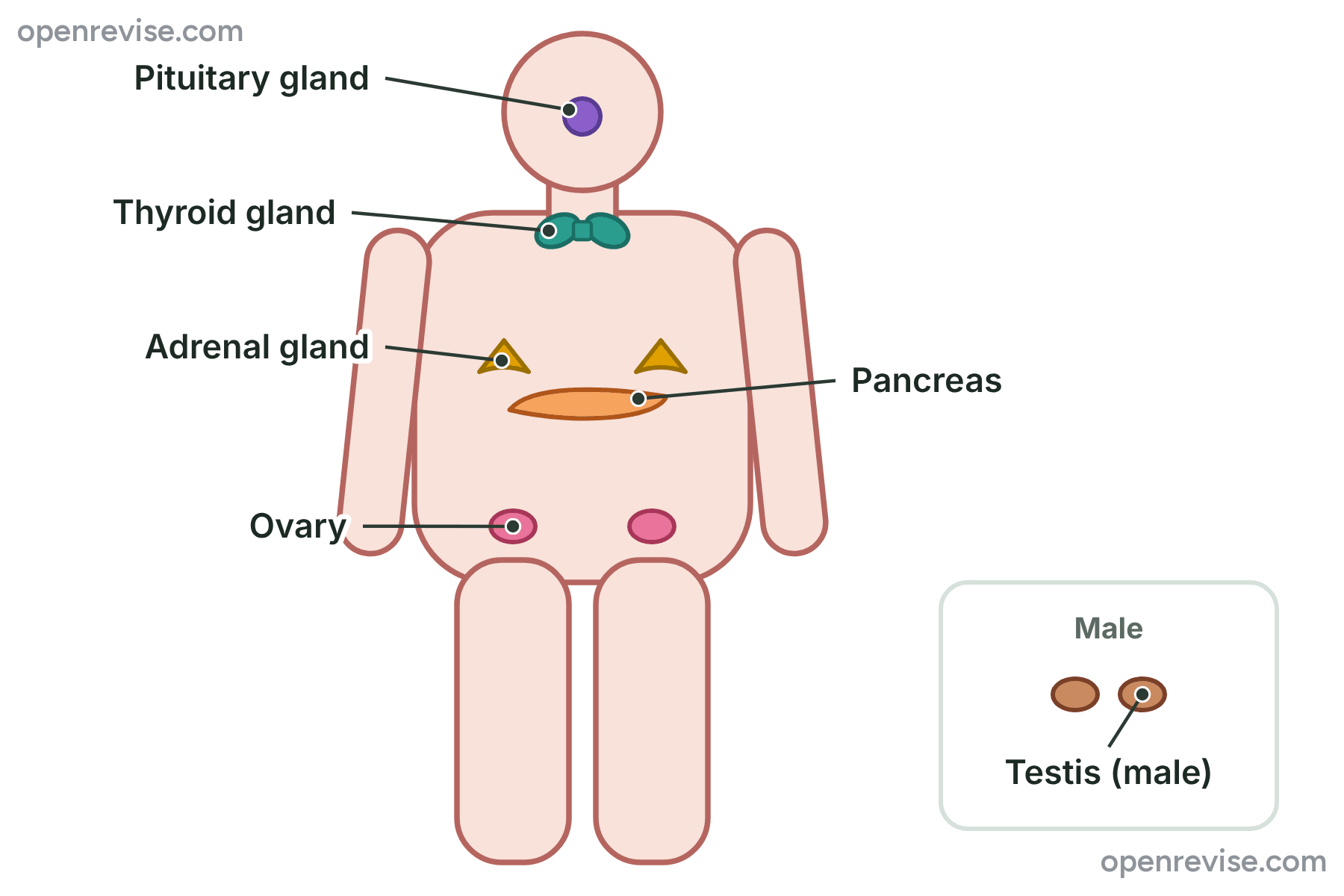
The main endocrine glands are in the head, neck and trunk, and in the reproductive organs.
The main endocrine glands
Each gland releases one or more hormones, and each hormone has its own target organs.
-
Pituitary gland
It is at the base of the brain, and is called the master gland, because its hormones control other glands. It releases hormones that include FSH and LH, which act on the ovaries, TSH, which acts on the thyroid, and ADH, which acts on the kidneys.
-
Thyroid gland
It is in the neck. It releases thyroxine, which controls the metabolic rate of cells all over the body.
-
Pancreas
It is below the stomach. It releases insulin and glucagon, which control the level of glucose in the blood, and act on the liver.
-
Adrenal glands
One sits on top of each kidney. They release adrenaline, which prepares the body for fight or flight, and acts on the heart, the muscles and the liver.
-
Ovaries
They are in the lower abdomen of a female. They release oestrogen and progesterone, which control the menstrual cycle, and act on the uterus.
-
Testes
They are in the scrotum of a male. They release testosterone, which causes the development of male features and the production of sperm.
The nervous system and the endocrine system
Nervous system
- Electrical impulses along neurones
- Very fast response
- Effects last a short time
- Acts on a very precise place, such as one muscle
Endocrine system
- Chemical messengers, called hormones, carried in the blood
- Slower response
- Effects last longer
- Acts on target organs that may be widely spread
Hormones and their target organs
A summary of the main hormones in Topic 7.
-
FSH
From the pituitary gland, acts on the ovaries to make eggs mature.
-
LH
From the pituitary gland, acts on the ovaries to cause ovulation.
-
TSH
From the pituitary gland, acts on the thyroid gland to release thyroxine.
-
Thyroxine
From the thyroid gland, acts on cells all over the body to control the metabolic rate.
-
Insulin
From the pancreas, acts on the liver and the muscles to lower the blood glucose.
-
Adrenaline
From the adrenal glands, acts on the heart, blood vessels, muscles and liver.
-
Oestrogen and progesterone
From the ovaries, act on the uterus lining and other organs.
-
Testosterone
From the testes, acts on the body to cause male features and sperm production.
Matching hormones, glands and organs
A hormone is made by the pancreas, and makes the liver turn glucose into glycogen. State the name of the hormone, and explain why it only affects the liver, although it travels all around the body.
Show the solutionHide the solution
- 1 Identify the gland The pancreas makes insulin and glucagon, and insulin makes the liver store glucose as glycogen.
- 2 Transport Hormones travel in the blood plasma, so reach every organ.
- 3 Target organs Only the cells with the receptors for the hormone respond, and these cells are the target organ.
- 4 Link This is how a hormone can be carried everywhere, but only have an effect in particular places.
AnswerThe hormone is insulin. It is carried all around the body in the blood, but only affects cells that have the right receptors, so only the target organs, such as the liver, respond to it.
Case study
The discovery of insulin
In 1921 two Canadian scientists, Frederick Banting and Charles Best, were working in a laboratory in Toronto. They found that an extract from the pancreas of a dog could lower the blood glucose of another dog whose pancreas had been removed. The extract contained the hormone insulin. In 1922 insulin was given to a 14-year-old boy, Leonard Thompson, who was dying of diabetes, and he recovered. Before insulin, a child who developed type 1 diabetes usually died within a few years. The discovery was so important that Banting shared a Nobel Prize in 1923.
Summary and exam focus
- Hormones are chemical messengers made in endocrine glands and carried in the blood.
- They affect only their target organs.
- The main glands are the pituitary, thyroid, pancreas, adrenal glands, ovaries and testes.
- The effects of hormones are slower and last longer than those of the nervous system.
- The pituitary gland is the master gland, because it controls other glands.
Exam focus
Describe how a hormone is made, how it travels around the body and how it brings about a response, and give two differences between the endocrine system and the nervous system. (6 marks) (6 marks)
Say that a hormone is made in an endocrine gland and released into the blood, and carried to its target organ, where it binds to receptors. Then give two clear differences, such as chemical against electrical, and slower with longer-lasting effects against fast and short-lived.
Key terms
The words this lesson expects you to use. Each one is linked from the first place it appears above.
- Hormone
- A chemical messenger that is made in an endocrine gland and carried in the blood.
- Endocrine gland
- A gland that releases hormones directly into the blood.
- Target organ
- An organ that responds to a particular hormone.
- Pituitary gland
- A gland at the base of the brain that releases hormones controlling other glands.
- Thyroid gland
- A gland in the neck that releases thyroxine.
- Pancreas
- An organ that releases insulin and glucagon, and also makes digestive enzymes.
- Adrenal gland
- A gland above the kidney that releases adrenaline.
- Ovary
- An organ that makes eggs and the hormones oestrogen and progesterone.
- Testis
- An organ that makes sperm and the hormone testosterone.
You've finished the notes
Check your understanding
Test yourself while it is fresh. Start with the flashcards, then try the exam questions.
Something here looks wrong?
Tell us what and we will go and look. It goes to whoever writes these pages, nobody else, and we do not ask who you are — so there is nothing to sign and nothing comes back to you.