Biology · Hormones and Reproduction
Adrenaline: Fight or Flight (Higher tier)
When something frightens you, your heart pounds and your mouth goes dry within seconds. This lesson is for the Higher tier only: Foundation students do not need it. It explains how the hormone adrenaline, which is made by the adrenal glands, prepares the body for fight or flight.
Learning Objectives
- 1(Higher tier) Explain that adrenaline is produced by the adrenal glands to prepare the body for fight or flight.
- 2(Higher tier) Explain how adrenaline increases the heart rate, the blood pressure and the blood flow to the muscles.
- 3(Higher tier) Explain how adrenaline raises the blood sugar level by stimulating the liver to change glycogen into glucose.
- 4(Higher tier) Explain how these effects help an animal to escape from, or to fight, a threat.
Retrieval practice
-
1
Where are the adrenal glands?
Show answerHide answer
On top of the kidneys.
-
2
What is glycogen?
Show answerHide answer
A carbohydrate that is used as a store of glucose in the liver and muscles.
-
3
What is aerobic respiration?
Show answerHide answer
Respiration that uses oxygen to release energy from glucose.
-
4
How is a hormone carried around the body?
Show answerHide answer
In the blood.
Ready for action
Imagine that a dog suddenly runs at you. Your brain detects the danger, and sends nerve impulses to the adrenal glands. These release the hormone adrenaline into the blood. The response is called fight or flight, because the body is prepared either to stay and fight the danger, or to run away from it. Both need a lot of energy, quickly, in the muscles, and adrenaline makes that possible by changing several things in the body at the same time. The effects of adrenaline are fast for a hormone, and they last for a few minutes, until the danger has gone.
The effects of adrenaline
The specification lists four effects, and each one helps muscles to release energy by aerobic respiration.
-
Increased heart rate
The heart beats faster, so blood is pumped around the body more quickly. Oxygen and glucose are delivered to the muscles faster, and carbon dioxide is removed more quickly.
-
Increased blood pressure
The blood is pushed round the circulation at a higher pressure, which also helps to get oxygen and glucose to the muscles quickly.
-
Increased blood flow to the muscles
The blood vessels to the muscles widen, and others, such as those to the gut and skin, narrow, so more blood goes to where the energy is needed.
-
Raised blood sugar level
Adrenaline stimulates the liver to change glycogen into glucose, which is released into the blood. The extra glucose is used by the muscles for respiration.
Adrenaline and fight or flight
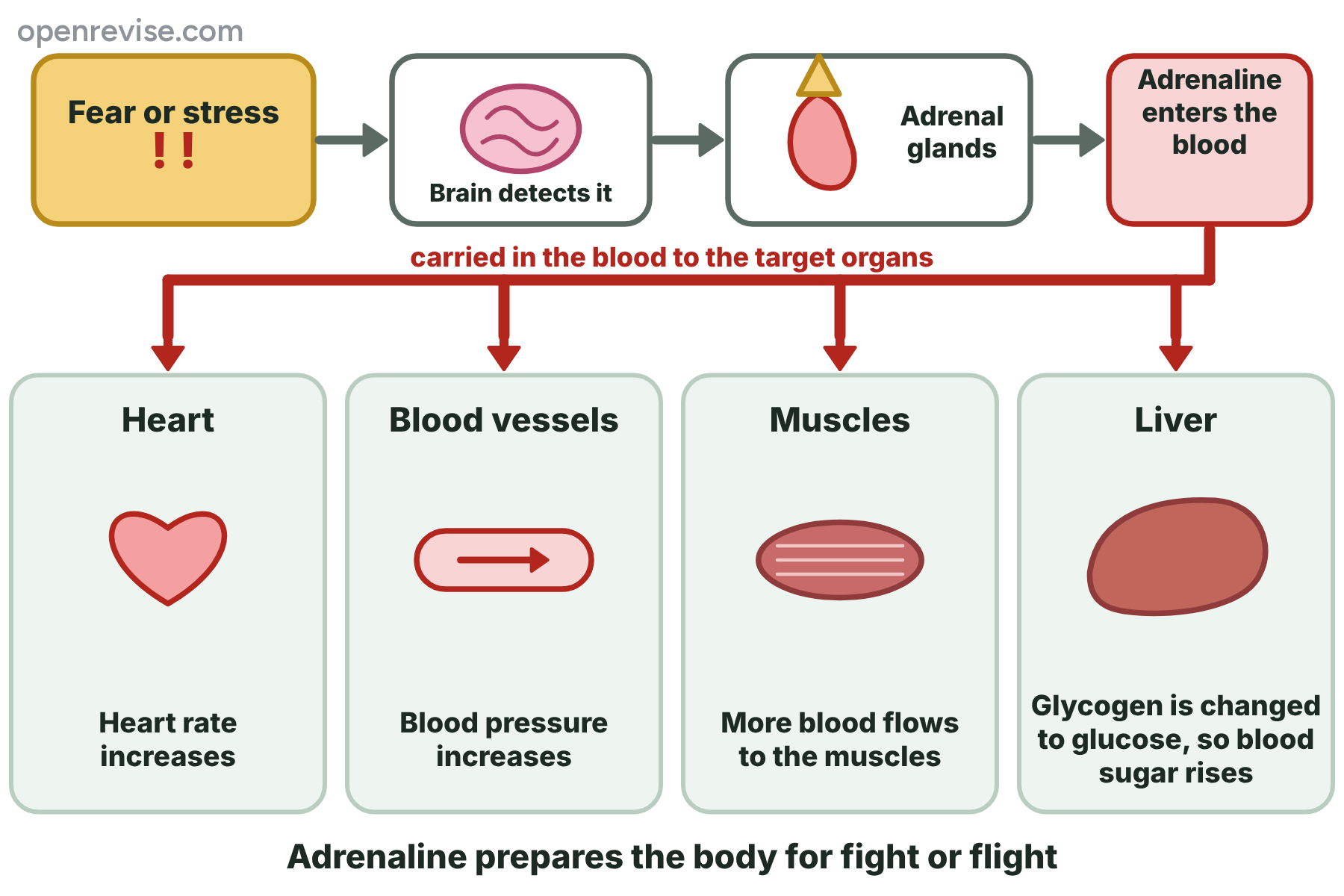
Adrenaline has four main effects, which all help the muscles to release energy quickly.
From danger to response
The response happens in order, and it takes only a few seconds.
-
1
Stimulus
The brain detects a threat, such as a loud noise or a dog running at you.
-
2
Message to the adrenal glands
Nerve impulses are sent to the adrenal glands.
-
3
Hormone released
The adrenal glands release adrenaline into the blood.
-
4
Transport
The adrenaline travels around the body in the blood, and reaches the heart, the blood vessels and the liver, which are its target organs.
-
5
Effects
The heart rate and blood pressure rise, more blood goes to the muscles, and the liver releases glucose.
-
6
Return to normal
When the danger has gone, the adrenaline is broken down, and the body returns to normal.
Why the response helps survival
Each effect makes the muscles work better.
-
More oxygen
The faster heart and the higher blood pressure bring more oxygen to the muscles for aerobic respiration.
-
More glucose
The liver releases glucose, so the muscles have more fuel.
-
More energy
The muscles can release energy faster, so they can contract strongly, for a sprint or a fight.
-
Other effects
The pupils widen so that more light enters the eyes, and the breathing rate increases. These are controlled by the nervous system as well.
-
The cost
The response uses up energy, and a lot of stress can cause problems, such as high blood pressure, if the body stays in this state for a long time.
Nervous and hormonal parts of the response
The nervous system
- Detects the danger and decides how to respond
- Sends impulses to the adrenal glands
- Very fast, over in a fraction of a second
- Controls the muscles directly
Adrenaline
- Released by the adrenal glands into the blood
- Carried to the heart, blood vessels and liver
- Slower, but lasts a few minutes
- Prepares the whole body at once
Calculating the change in heart rate
A student's resting heart rate is 70 beats per minute. After a sudden loud noise it rises to 105 beats per minute. Calculate the percentage increase in the heart rate, and explain how this helps the body to prepare for fight or flight.
Show the solutionHide the solution
- 1 Find the increase \(105 - 70 = 35\) beats per minute.
- 2 Divide by the original \(35 \div 70 = 0.5\).
- 3 Convert \(0.5 \times 100 = 50\%\).
- 4 Explain More blood is pumped each minute, so the muscles get more oxygen and glucose, and waste products are removed faster.
AnswerThe heart rate increased by 50%. A faster heart delivers oxygen and glucose to the muscles more quickly, so they can release more energy by aerobic respiration.
Adrenaline as a medicine
Because adrenaline has such powerful effects, it is also used to treat some medical emergencies.
-
Anaphylaxis
In a severe allergic reaction, the blood pressure falls and the airways narrow. An injection of adrenaline raises the blood pressure and opens the airways.
-
Auto-injectors
People who are at risk carry a pen that contains a measured dose of adrenaline, which they can inject into the muscle of the thigh.
-
Cardiac arrest
Adrenaline is given to help to restart a heart that has stopped.
Case study
Superhuman strength
There are many stories of people who have done things in emergencies that seem impossible, such as lifting a car off a trapped child. Adrenaline may help to explain them. It gives the muscles a large supply of oxygen and glucose, and the nervous system can reduce the sense of pain and tiredness, so that the muscles can be used to their limit. It does not make muscles stronger, but it can allow them to work at their maximum for a short time. After the emergency, the person is often exhausted, and may discover injuries that they had not noticed.
Summary and exam focus
- Adrenaline is produced by the adrenal glands to prepare the body for fight or flight.
- It increases the heart rate, and the blood pressure.
- It increases the blood flow to the muscles.
- It stimulates the liver to change glycogen into glucose, which raises the blood sugar level.
- Together these give the muscles more oxygen and glucose for aerobic respiration.
Exam focus
Explain how adrenaline prepares the body for fight or flight. (6 marks) (6 marks)
Say that adrenaline is made by the adrenal glands and carried in the blood. Then give the four effects, which are an increased heart rate, an increased blood pressure, increased blood flow to the muscles, and the liver changing glycogen into glucose. For each, say how it helps the muscles to respire and release energy.
Key terms
The words this lesson expects you to use. Each one is linked from the first place it appears above.
- Adrenaline
- A hormone, made by the adrenal glands, which prepares the body for fight or flight. It is also spelled adrenalin.
- Adrenal gland
- An endocrine gland on top of each kidney, which releases adrenaline.
- Fight or flight
- The response of the body to a threat, which prepares it to fight or to run away.
- Glycogen
- A carbohydrate that is a store of glucose in the liver and muscles.
- Blood pressure
- The force with which the blood pushes against the walls of the blood vessels.
- Heart rate
- The number of times the heart beats in a minute.
- Target organ
- An organ that responds to a hormone.
- Aerobic respiration
- Respiration that uses oxygen to release energy from glucose.
- Anaphylaxis
- A severe, life-threatening allergic reaction.
You've finished the notes
Check your understanding
Test yourself while it is fresh. Start with the flashcards, then try the exam questions.
Something here looks wrong?
Tell us what and we will go and look. It goes to whoever writes these pages, nobody else, and we do not ask who you are — so there is nothing to sign and nothing comes back to you.