Biology · Hormones and Reproduction
Thyroxine and Negative Feedback (Higher tier)
The thyroid gland acts like a thermostat for the speed of the chemical reactions in your body. This lesson is for the Higher tier only: Foundation students do not need it. It explains how thyroxine controls the metabolic rate, and how the hormones TRH and TSH keep the level of thyroxine steady by negative feedback.
Learning Objectives
- 1(Higher tier) Explain how thyroxine controls the metabolic rate.
- 2(Higher tier) Explain how a low level of thyroxine stimulates the production of TRH in the hypothalamus, which causes the release of TSH from the pituitary gland, and how TSH acts on the thyroid gland to produce thyroxine.
- 3(Higher tier) Explain how a normal level of thyroxine inhibits the release of TRH and the production of TSH.
- 4(Higher tier) Use the idea of negative feedback to explain the effects of too little or too much thyroxine.
Retrieval practice
-
1
What is metabolism?
Show answerHide answer
The sum of all of the chemical reactions in the cells of the body.
-
2
What does the pituitary gland do?
Show answerHide answer
It releases hormones that control other glands, so it is called the master gland.
-
3
What is homeostasis?
Show answerHide answer
The maintenance of a constant internal environment.
-
4
Where is the hypothalamus?
Show answerHide answer
In the brain, below the pituitary gland.
The body's thermostat for energy
The thyroid gland, in the neck, releases the hormone thyroxine. Thyroxine controls the metabolic rate, which is the speed at which the chemical reactions in the cells take place, and so how quickly the body uses energy. Too little thyroxine makes a person feel cold and tired, and too much makes them feel hot, restless and thin. The level of thyroxine therefore needs to be kept within a narrow range. This is done by negative feedback, in which a change in the level of a substance causes a response that reverses the change.
What thyroxine does
Thyroxine acts on cells in almost every part of the body.
-
Metabolic rate
Thyroxine increases the metabolic rate, so cells respire faster and release more energy.
-
Growth and development
It is important in the growth and the development of the brain and the body in children.
-
Heat
The extra respiration releases heat, which helps to keep the body warm.
-
Needs iodine
The thyroid gland needs the element iodine to make thyroxine, which people get from foods such as fish and dairy products, and from iodised salt.
The thyroxine feedback loop
Three glands work together. Follow the sequence from a low level of thyroxine.
-
1
Low thyroxine
When the level of thyroxine in the blood is low, the hypothalamus detects the change, and makes TRH (thyrotropin releasing hormone).
-
2
TRH
The TRH is carried to the pituitary gland, and causes it to release TSH (thyroid stimulating hormone).
-
3
TSH
The TSH is carried in the blood to the thyroid gland, where it acts, and stimulates the gland to produce thyroxine.
-
4
Thyroxine rises
As the level of thyroxine in the blood rises, the metabolic rate increases.
-
5
Normal thyroxine
When the level of thyroxine is normal, it inhibits the release of TRH from the hypothalamus, and the production of TSH by the pituitary gland, so the thyroid gland makes less thyroxine.
Negative feedback in the control of thyroxine
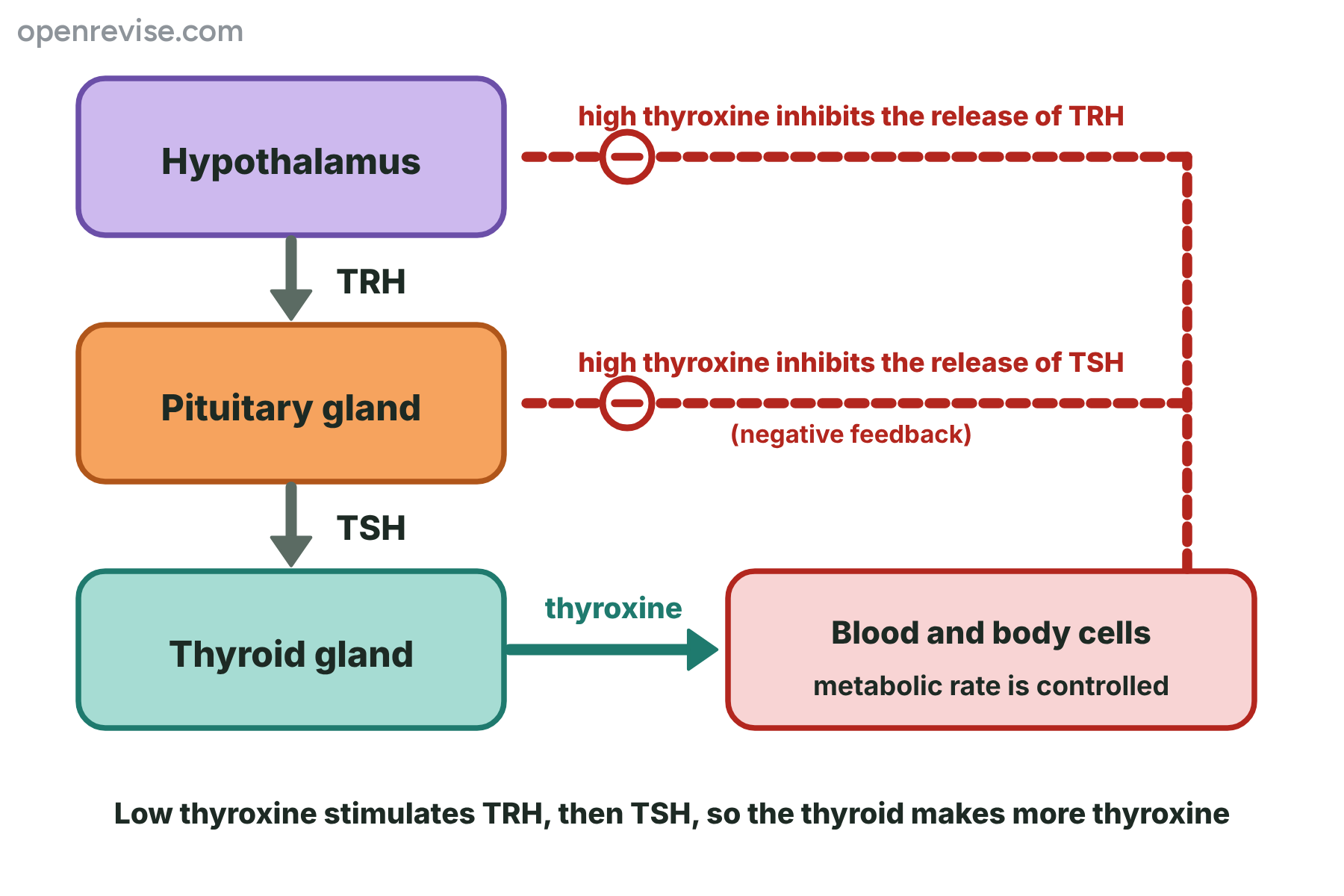
Thyroxine controls its own level by negative feedback, acting on the hypothalamus and the pituitary gland.
Too much and too little thyroxine
Too little thyroxine
- Metabolic rate falls
- Feels tired and cold
- Gains body mass
- TRH and TSH levels are high, as there is no feedback to stop them
Too much thyroxine
- Metabolic rate rises
- Feels hot, restless and anxious
- Loses body mass
- TRH and TSH levels are low, because of negative feedback
Understanding negative feedback
Many body systems work in the same way.
-
A set point
There is a normal level, such as of thyroxine, blood glucose or body temperature.
-
A change
The level rises or falls, and the change is detected.
-
A response
The response reverses the change, so the level returns to normal.
-
Why it works
The response is switched off when the level reaches the normal level, so the level does not go too far.
-
The opposite
In negative feedback the response is in the opposite direction to the change. A rise leads to a fall, and a fall leads to a rise.
Predicting the effect of a change
A person has a thyroid gland that has stopped making enough thyroxine. Predict the effect on the levels of TRH and TSH in their blood, and explain your answer.
Show the solutionHide the solution
- 1 Low thyroxine A low level of thyroxine stimulates the hypothalamus to make TRH.
- 2 High TRH and TSH TRH stimulates the pituitary gland to release TSH, so both stay high.
- 3 No feedback Normal levels of thyroxine inhibit TRH and TSH, but here the thyroxine level is too low to do this.
- 4 Result Both TRH and TSH are higher than normal.
AnswerThe levels of TRH and TSH will both be high. The thyroxine level is low, so there is no negative feedback to inhibit the hypothalamus and the pituitary gland. They keep releasing TRH and TSH, but the thyroid cannot respond.
Case study
Goitre and iodine
In some parts of the world, such as mountain regions where the soil has little iodine, many people used to develop a large swelling in the neck, called a goitre. Without iodine the thyroid gland cannot make thyroxine. The low level of thyroxine means that there is no negative feedback, so the pituitary gland keeps releasing TSH, which makes the thyroid gland grow larger. Adding iodine to salt has almost wiped out goitre in countries that do it. It is a good example of how a lack of a raw material can break a feedback loop.
Summary and exam focus
- Thyroxine controls the metabolic rate.
- A low level of thyroxine stimulates the hypothalamus to release TRH.
- TRH causes the pituitary gland to release TSH, which acts on the thyroid gland to make thyroxine.
- A normal level of thyroxine inhibits the release of TRH and the production of TSH.
- This is negative feedback, which keeps the level of thyroxine steady.
Exam focus
Explain how negative feedback keeps the level of thyroxine in the blood constant. Include the roles of TRH and TSH. (6 marks) (6 marks)
Start with a low level of thyroxine, then give the sequence: TRH from the hypothalamus, then TSH from the pituitary gland, then thyroxine from the thyroid gland. Finish by saying that when the level of thyroxine is normal, it inhibits the release of TRH and the production of TSH.
Key terms
The words this lesson expects you to use. Each one is linked from the first place it appears above.
- Thyroxine
- A hormone made by the thyroid gland, which controls the metabolic rate.
- Metabolic rate
- The speed at which the chemical reactions in the cells of the body take place.
- TRH
- Thyrotropin releasing hormone, released by the hypothalamus.
- TSH
- Thyroid stimulating hormone, released by the pituitary gland.
- Hypothalamus
- A part of the brain that monitors conditions in the blood and controls the pituitary gland.
- Negative feedback
- A response that reverses a change, and so keeps a level steady.
- Inhibit
- To reduce or to stop.
- Goitre
- A swelling of the thyroid gland, which is often caused by a lack of iodine.
- Iodine
- An element that the thyroid gland needs to make thyroxine.
You've finished the notes
Check your understanding
Test yourself while it is fresh. Start with the flashcards, then try the exam questions.
Something here looks wrong?
Tell us what and we will go and look. It goes to whoever writes these pages, nobody else, and we do not ask who you are — so there is nothing to sign and nothing comes back to you.