Biology · Human Impact on Ecosystems
The Benefits of Maintaining Biodiversity
Why should we care about a beetle, a fungus or a rainforest tree that nobody eats? This lesson is for both Combined Science and separate Biology. It explains why it matters to keep local and global biodiversity high, how animal species can be conserved, and what reforestation does for ecosystems and for people.
Learning Objectives
- 1Explain the benefits of maintaining biodiversity at a local and a global level, for ecosystems and for people.
- 2Describe and evaluate ways of conserving animal species.
- 3Explain the impact of reforestation on ecosystems, climate and people.
- 4Use data to evaluate conservation schemes, including calculating a percentage change.
Retrieval practice
-
1
What is biodiversity?
Show answerHide answer
The variety of different species of organisms in an ecosystem or on the whole Earth.
-
2
What is deforestation?
Show answerHide answer
The clearing of large areas of forest, usually by cutting or burning the trees.
-
3
What gas do trees take in for photosynthesis?
Show answerHide answer
Carbon dioxide.
-
4
Name one human activity that can reduce biodiversity.
Show answerHide answer
Examples: building, farming, pollution, overfishing or introducing non-indigenous species.
Why every species matters
Species do not live alone, so losing one can start a chain of losses in the rest of a community. Extinction is also permanent: once the last member of a species has died, no amount of money can bring it back. For these reasons, scientists and governments try to keep biodiversity high, both in local ecosystems, such as a pond or a woodland, and across the whole planet. The reasons are practical, as well as moral.
Local and global biodiversity
Biodiversity can be measured at different scales, and both scales matter.
-
Local biodiversity
This is the variety of species in a small area such as a pond, a hedgerow or a school field. A local area with many species is more likely to provide services such as pollination of crops, clean water and healthy soil for the people who live there.
-
Global biodiversity
This is the variety of all the species on the whole Earth, which is made up of millions of species. Human activity has greatly increased the rate of extinction, and a species that dies out in one ecosystem may be lost for ever if it lived nowhere else.
-
Why the two are linked
Global biodiversity is the sum of all the local ecosystems. Protecting species in many local places protects the planet's biodiversity as a whole.
Benefits of high biodiversity to ecosystems
An ecosystem with many species behaves very differently from one with few.
-
More stable
In an ecosystem with many species there are many food chains linked in a web. If one species declines, the animals that ate it have other food, so the ecosystem is better able to cope with disease, drought or a changing climate.
-
Interdependence is protected
Plants, pollinators, herbivores, predators and decomposers all depend on each other. Keeping the full range of species keeps these links working, such as bees for pollination and decomposers for recycling minerals.
-
A bigger gene pool
More species, and more variation within each species, means that there are more alleles available. This gives the living world a better chance of adapting when conditions change.
-
Healthy soil and water
Many different organisms help to keep soil fertile, to break down waste and to filter water, so these services continue.
Benefits of maintaining biodiversity to people
Biodiversity is not only a matter for wildlife. People depend on it in many ways.
-
Food and farming
Wild relatives of crop plants have alleles for disease resistance and drought tolerance that can be bred into crops, and insects pollinate about one third of the food crops people eat. Fish stocks need healthy ecosystems.
-
Medicines
Many drugs come from living organisms. Aspirin was first made from a chemical in willow bark, quinine for malaria comes from cinchona bark, and the rosy periwinkle of Madagascar provides drugs for leukaemia. Species that we have not yet studied may hold cures that would be lost if they die out.
-
Materials and fuel
People use wood, fibres, rubber, dyes and many other materials from wild species, and these are only available if the species survive.
-
Climate, jobs and wellbeing
Forests and oceans take carbon dioxide out of the air, and wild places support jobs in tourism and give people places to relax. Many people also believe that every species has a right to exist.
Low biodiversity and high biodiversity
Compare a wheat field with a meadow or woodland.
Why the meadow is more stable
- More food sources If one plant has a bad year, the herbivores can feed on others.
- Natural pest control Predators such as birds and ladybirds keep the pests in check.
- Greater resilience A disease that attacks one species cannot wipe out the whole habitat.
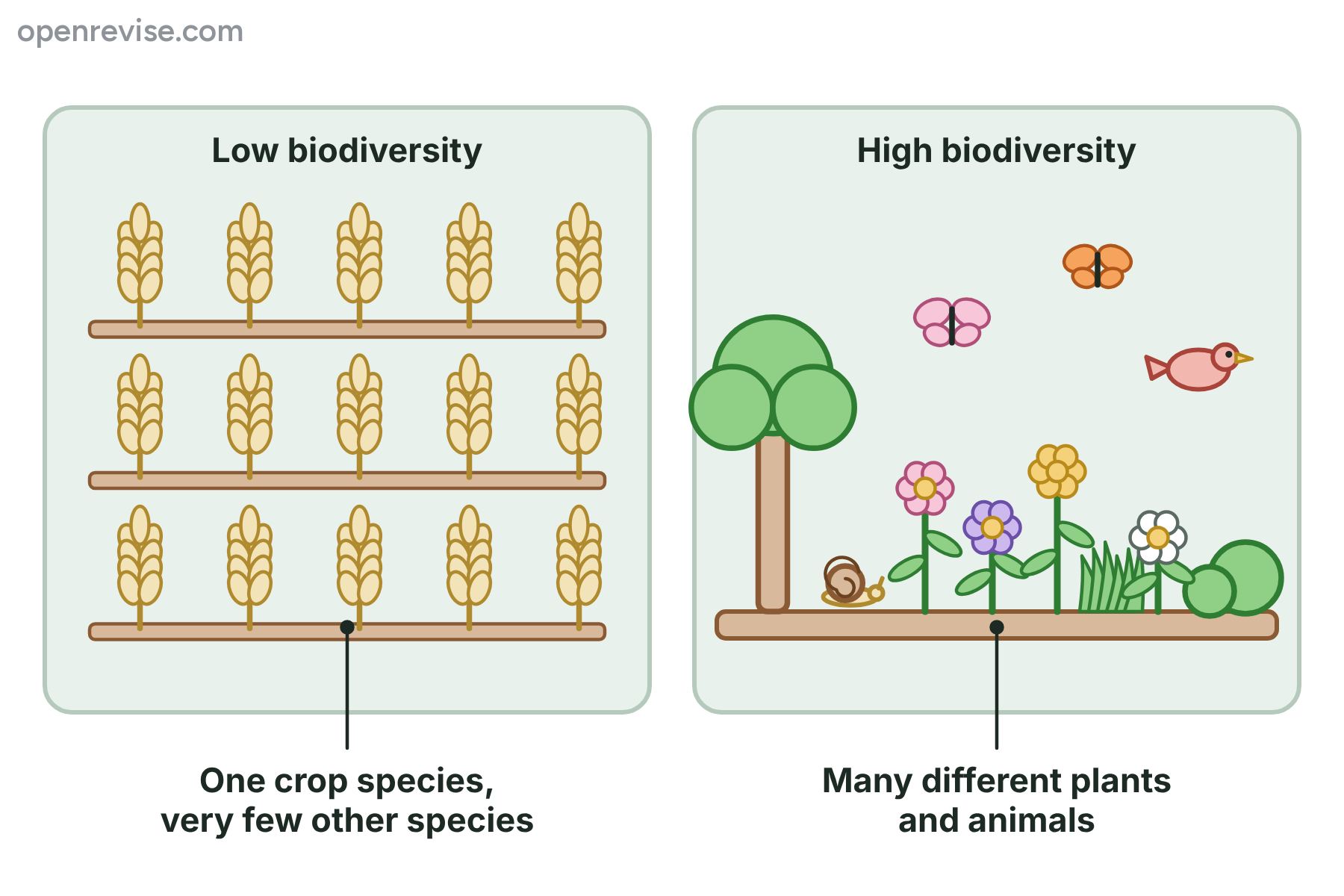
A field of a single crop supports few other species. A habitat with many species supports many more.
A crop monoculture or a mixed habitat?
Low biodiversity (one crop)
- Few species of plants and animals
- A single disease or pest can destroy it
- Little food and shelter for wildlife
- Often needs fertilisers and pesticides
High biodiversity (mixed habitat)
- Many species of plants and animals
- A disease or pest only affects some of the species
- Plenty of food and shelter for wildlife
- Natural pest control and natural recycling of minerals
Conserving animal species
Conservation means protecting and managing species and their habitats so that they do not become extinct. Several methods are used together.
-
Protected areas
National parks, nature reserves and marine reserves protect habitats from building, farming and hunting, and give animals a safe place to breed.
-
Laws and agreements
Laws ban the hunting of rare species, and international agreements ban the trade in endangered animals and products such as ivory, which cuts the demand for them.
-
Captive breeding
Zoos and breeding centres breed endangered animals and, where possible, release the young into the wild. Records of which animals are related are kept so that mates are matched to keep the gene pool as varied as possible.
-
Restoring habitats
Replanting hedgerows, restoring wetlands and creating wildlife corridors that link habitats gives animals more room to feed and breed, and cuts the risk of inbreeding.
-
Problems
Conservation can be expensive, it can conflict with farmers and local people who need the land, captive populations can have little genetic variation, and an animal bred in captivity may not survive in the wild.
Case study
The Arabian oryx
The Arabian oryx is an antelope of the deserts of the Arabian peninsula. It was hunted so heavily for its meat and horns that the last wild animals were shot in 1972. A few oryx had been kept in captivity, and zoos began a breeding programme with them. From 1982 the oryx were released into the wild in Oman, and herds have been released in other countries since. Hundreds now live wild, which shows that captive breeding, together with legal protection and the cooperation of local people, can save a species that was extinct in the wild.
Reforestation
Reforestation is the planting of trees on land that was forest but has been cleared. Trees are cut down for timber and fuel, for farmland for cattle, soya and palm oil, and for roads and housing.
-
Habitat and biodiversity
A forest provides food and shelter for many species, so planting native trees gives animals, fungi and other plants a habitat to move back into and increases biodiversity.
-
Climate
Trees take carbon dioxide from the air for photosynthesis and store the carbon in wood, so they remove a greenhouse gas from the atmosphere. This helps to slow global warming.
-
Soil and water
Roots bind the soil together and the trees take up water from it. This reduces erosion, lowers the risk of floods and landslides downstream, and keeps rivers clearer.
-
People
Replanted forests supply sustainable timber, protect water supplies and give jobs. The limits are that it takes decades for trees to mature, it costs money, and the land may no longer be available for growing food.
A slope without trees and a slope with trees
Two slopes are shown in the same rain.
What the trees change
- Without trees The rain runs off the slope and washes soil into the river, which becomes muddy and more likely to flood.
- With trees The roots hold the soil and the trees take up water, so the river stays clearer and the flood risk is lower.
- For biodiversity The trees give habitat to birds and other animals and take in carbon dioxide.
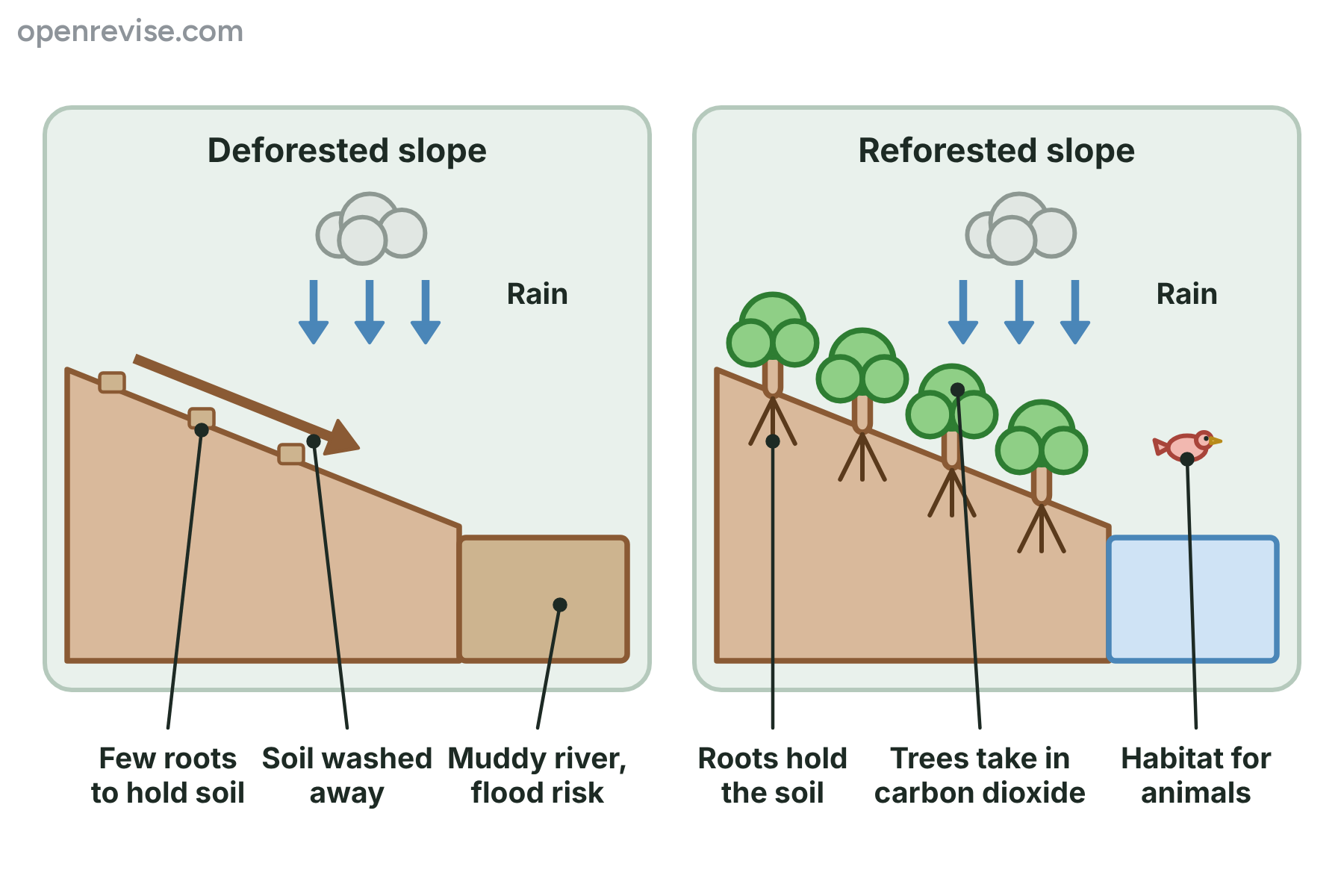
Reforestation holds soil in place, reduces flooding, removes carbon dioxide and gives animals a habitat.
Evaluating conservation and reforestation
Exam questions ask you to weigh up a scheme. Look at who benefits, what it costs and how long it takes.
-
Is the species or habitat better off?
Look for data, such as a rise in the numbers of an endangered animal or in the area of forest, and work out the percentage change.
-
Is it sustainable?
A scheme that works only while money is flowing is not sustainable. The best schemes give local people jobs or income from tourism and sustainable timber, so they have a reason to protect the species or forest.
-
Is the habitat really restored?
Planting a single fast-growing species of tree makes a plantation, not a forest. Restoring the biodiversity needs a mixture of native trees, and time.
-
Are there trade-offs?
Land used for reserves or trees cannot be used for farming or housing, so a balance between the needs of people and wildlife must be found.
Percentage change in a population
A captive breeding programme was started for an endangered species. In 1990 there were 120 animals in the wild. By 2020 there were 480. Calculate the percentage increase in the wild population.
Show the solutionHide the solution
- 1 Find the change \(480 - 120 = 360\)
- 2 Divide by the original value \(360 \div 120 = 3\)
- 3 Multiply by 100 \(3 \times 100 = 300\%\)
- 4 State the direction A 300% increase, so the population is four times as big
AnswerA 300% increase.
Percentage decrease in forest area
In the year 2000 a country had 52 million hectares of forest. In 2020 it had 44.2 million hectares. Calculate the percentage decrease in the forest area.
Show the solutionHide the solution
- 1 Find the change \(52 - 44.2 = 7.8\) million hectares
- 2 Divide by the original value \(7.8 \div 52 = 0.15\)
- 3 Multiply by 100 \(0.15 \times 100 = 15\%\)
AnswerA 15% decrease.
The big idea
Keeping biodiversity high keeps ecosystems stable and gives people food, medicines, materials and a healthy climate.
Link every point to who or what benefits, and say whether it is for people or for the ecosystem.
Maintaining biodiversity
Maintaining biodiversity
-
Why
- stable ecosystems
- gene pool
- interdependence
-
Benefits to people
- food
- medicines
- materials
- climate
- jobs
-
Conservation
- reserves
- laws
- captive breeding
- habitat restoration
-
Reforestation
- habitat
- carbon dioxide
- soil
- flood control
-
Evaluation
- data
- cost
- sustainability
- trade-offs
Summary and exam focus
- Biodiversity is the variety of species, and it matters both locally and globally because global biodiversity is the sum of local ecosystems.
- Ecosystems with high biodiversity are more stable, because there are more food sources and the interdependence between species is kept.
- People rely on biodiversity for food, medicines, materials, pollination, a stable climate and jobs.
- Conservation includes protected areas, laws, captive breeding and habitat restoration, and must be evaluated with data.
- Reforestation restores habitat, removes carbon dioxide, holds the soil and reduces flooding, but it takes time and works best with a mixture of native trees.
Exam focus
Explain why it is important to maintain biodiversity, for both ecosystems and people. (6 marks) (6 marks)
Organise the answer into two clear parts. For ecosystems, explain stability and interdependence, so that other species can fill the gap when one declines. For people, give named benefits, such as food crops, medicines from plants, pollination and the climate. Finish with a link back to the question, saying why losing species could be a problem for the future.
Key terms
The words this lesson expects you to use. Each one is linked from the first place it appears above.
- Conservation
- Protecting and managing species and their habitats so that they do not become extinct.
- Extinction
- The permanent loss of a species, when the last individual has died.
- Gene pool
- All the different alleles of all the genes in a population or species.
- Captive breeding
- Breeding endangered animals in zoos or breeding centres, often to release them into the wild.
- Nature reserve
- An area of land that is protected so that its wildlife and habitats can survive.
- Reforestation
- The planting of trees on land that was once forest but has been cleared.
- Deforestation
- The clearing of large areas of forest, usually for timber, farmland or building.
- Habitat
- The place where an organism lives, which provides its food, shelter and breeding sites.
- Monoculture
- A large area in which only one crop species is grown.
- Carbon sink
- Something that takes in more carbon dioxide than it releases, such as a growing forest.
You've finished the notes
Check your understanding
Test yourself while it is fresh. Start with the flashcards, then try the exam questions.
Something here looks wrong?
Tell us what and we will go and look. It goes to whoever writes these pages, nobody else, and we do not ask who you are — so there is nothing to sign and nothing comes back to you.