Biology · Human Impact on Ecosystems
Fish Farming, Introduced Species and Eutrophication
People change ecosystems every time they farm, fish, build or pollute. This lesson is for both Combined Science and separate Biology. It looks at three human interactions with ecosystems that the specification names, which are fish farming, the introduction of non-indigenous species and eutrophication, and explains their positive and negative impacts on biodiversity.
Learning Objectives
- 1Explain the positive and negative impacts of fish farming on ecosystems and biodiversity.
- 2Explain the positive and negative impacts of introducing a non-indigenous species, using named examples.
- 3Explain the sequence of events in eutrophication, from the run-off of fertiliser to the death of fish.
- 4Interpret graphs and tables of data about human impacts on ecosystems.
Retrieval practice
-
1
What is an ecosystem?
Show answerHide answer
A community of living organisms together with the non-living parts of their environment.
-
2
What do plants need to photosynthesise?
Show answerHide answer
Light, water and carbon dioxide.
-
3
What do aerobic organisms need for respiration?
Show answerHide answer
Oxygen.
-
4
What is a decomposer?
Show answerHide answer
A microorganism, such as a bacterium or fungus, that breaks down dead organisms and waste.
Biodiversity and people
Biodiversity is the variety of the different species of organisms in an ecosystem, or on the whole Earth. A wide variety of species makes an ecosystem more stable, because the organisms depend on each other. Human activity affects biodiversity, sometimes for the better and often for the worse. As the human population grows, we need more food, which leads to fish farming, the movement of species around the world, and the use of fertilisers. Each of these has benefits for people, but each can also damage ecosystems if it is not managed with care.
Fish farming
Fish farming means rearing fish, such as salmon, trout and tilapia, in enclosures such as net cages in the sea or in tanks and ponds, and feeding them until they can be harvested.
-
How it works
Young fish are kept at high density in cages and fed with pellets of food, often made from other fish. The farmer can control feeding, protect the fish from predators and treat disease, and then harvest them.
-
Positive impacts
Fish farms provide a reliable supply of protein for a growing human population and reduce the pressure of overfishing on wild stocks, which gives wild populations a chance to recover. They also provide jobs in coastal and rural areas.
-
Negative impacts on the water
Uneaten food and fish faeces fall to the seabed and add nutrients to the water, which can cause eutrophication and harm the organisms living on the seabed. Chemicals used to treat disease can also harm other marine organisms.
-
Negative impacts on wild fish
Parasites such as sea lice and diseases spread easily from the crowded farm fish to wild fish passing by. Farmed fish that escape can compete with wild fish and breed with them, which can reduce the genetic variation of the wild population.
A fish farm and its effects
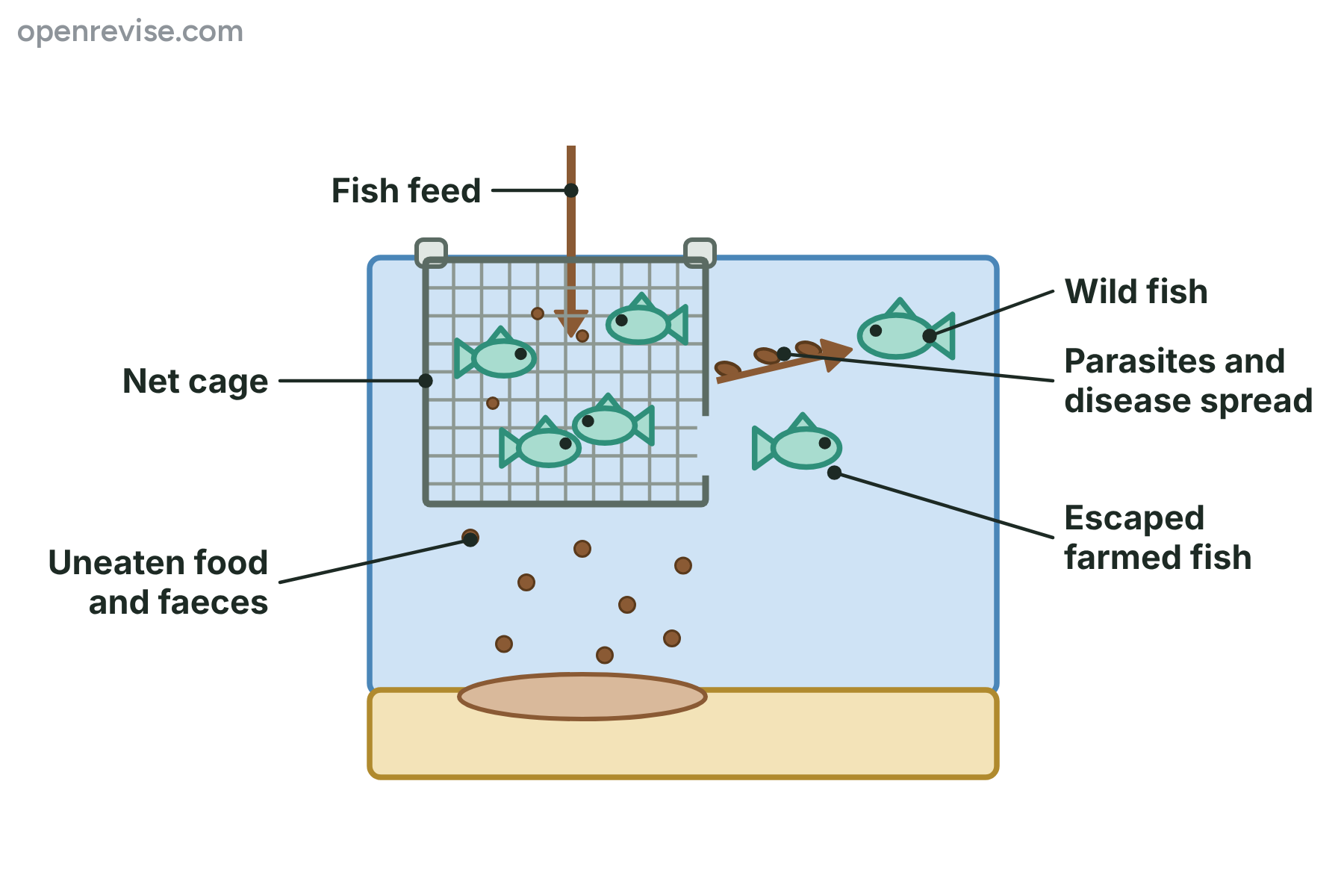
Fish farms bring food and jobs, but can pollute the water and harm wild fish.
Fish farming: benefits and problems
Benefits
- A reliable supply of protein for people
- Less overfishing of wild fish, so wild stocks can recover
- Jobs and income for coastal communities
- Conditions can be controlled, with fish protected from predators
Problems
- Waste and uneaten food pollute the water and can cause eutrophication
- Parasites and disease spread to wild fish
- Escaped fish compete and breed with wild fish
- Wild fish are caught to make the feed
- Chemicals used to treat disease harm other species
Non-indigenous species
A non-indigenous species (also called an introduced or alien species) is one that has been brought to a place where it does not naturally live. The native species are the indigenous ones.
-
How they arrive
Some are introduced deliberately, as crops, garden plants, pets or to control pests. Others arrive by accident, in cargo, in the ballast water of ships, or on boots and vehicles.
-
Negative impacts
A new species often has no natural predators or diseases in its new home, so it can multiply quickly. It may outcompete the native species for food and space, eat them, or bring a disease that kills them, so biodiversity falls.
-
Positive impacts
Many introduced species are useful: potatoes, tomatoes and sheep are not native to Britain, and they feed millions of people. A species that is introduced as a biological control agent can reduce the numbers of a pest, so fewer pesticides are needed.
-
Why care is needed
A species that does no harm in its own habitat can do great harm in a new one, so introductions should be assessed before they happen.
Case study
Grey squirrels and red squirrels
Grey squirrels were brought to Britain from North America in the 1870s and released in parks and estates. They spread across England, Wales and southern Scotland, and the native red squirrel disappeared from most of those areas. Grey squirrels are bigger and eat the same foods, so they compete with the red squirrels and win. They also carry the squirrelpox virus, which does not harm them but kills red squirrels. Habitat loss also reduced the red squirrel numbers, so it is not the only cause.
Grey squirrels replace red squirrels
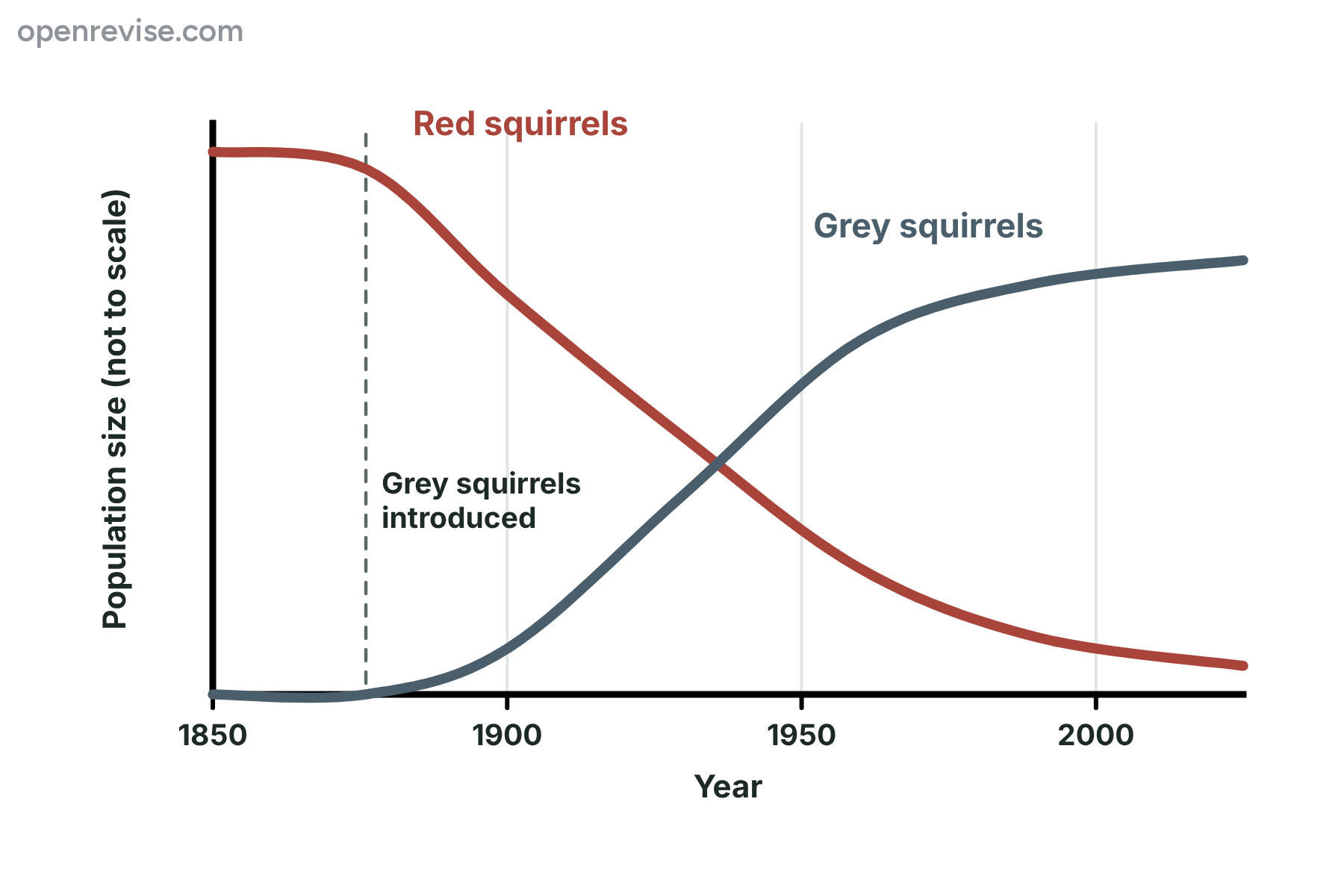
As the introduced grey squirrel spread, the native red squirrel declined. A simplified graph.
Other examples of introduced species
Examples of non-indigenous species show the same pattern again and again.
-
Cane toad
Cane toads were brought to Australia in 1935 to control beetles that were damaging sugar cane. They did not control the beetle, but their skin is poisonous, so native animals that ate them died, and the toads have spread across northern Australia.
-
Signal crayfish
These large crayfish were brought to Britain from North America. They carry a disease called crayfish plague, which kills the native white-clawed crayfish, and they also compete with them for food and shelter.
-
Himalayan balsam
This tall plant was brought to Britain as a garden plant. It grows along river banks, shades out native plants and then dies back each winter, which leaves the banks bare and open to erosion.
Eutrophication
Eutrophication happens when too many mineral ions, especially nitrates and phosphates, get into a lake, pond or river. It is a negative human interaction that can wipe out most of the life in the water.
-
Where the minerals come from
Farmers spread fertilisers containing nitrates and phosphates to increase crop yields. When it rains, some of the fertiliser is washed from the soil into streams and ponds. Untreated sewage and detergents add more.
-
The effect
The extra minerals act as a fertiliser for algae in the water, which grow and reproduce much faster than normal. The effect is a thick green layer of algae on the surface, called an algal bloom.
-
The effect on other organisms
Plants beneath the algae lose their light and die. Bacteria multiply on the dead material and use up the oxygen, so fish and other animals that need oxygen die too and the biodiversity of the water falls.
The sequence of events in eutrophication
Learn the sequence in order. Every link in the chain can earn a mark.
-
1
Fertiliser enters the water
Rain washes nitrates and phosphates from fertilised fields (or sewage) into a river, pond or lake.
-
2
Algal bloom
With plenty of mineral ions, the algae grow and reproduce very quickly, and form a thick layer at the surface called an algal bloom.
-
3
Light is blocked
The algal bloom stops light from reaching the plants below, so they cannot photosynthesise and they die.
-
4
Bacteria use up the oxygen
Bacteria decompose the dead algae and plants. As they respire, their numbers increase and they use up the oxygen in the water.
-
5
Animals die
Fish and other aerobic organisms do not get enough oxygen and die, so the biodiversity of the water falls.
Eutrophication in a pond
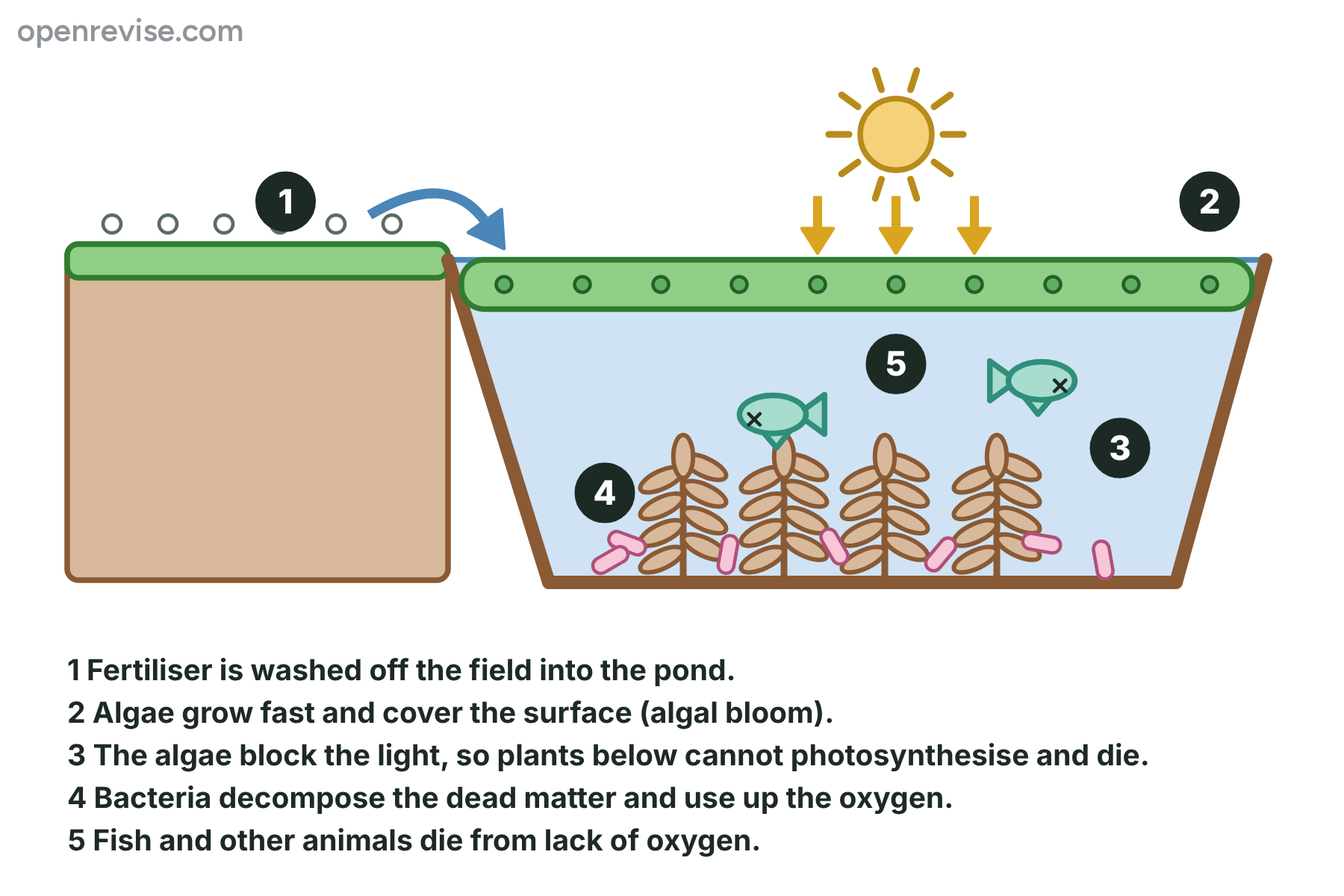
The five stages of eutrophication, in order.
Reducing the damage
Because each interaction has benefits as well as costs, the aim is to keep the benefits and cut the harm.
-
Fertilisers
Farmers can use only the amount of fertiliser the crop needs, avoid spreading it before heavy rain, and leave a strip of vegetation along the edge of fields to take up run-off. Sewage works can remove phosphates before water goes into rivers.
-
Fish farms
Farms can be placed where the water moves quickly to carry the waste away, use better feed so less is wasted, keep fish at lower density to reduce disease, and use strong nets and regular checks to stop escapes.
-
Introduced species
Strict rules on moving plants and animals, checks on ships and cargo, and fast action to remove a new invader before it spreads all help to keep biodiversity high.
The big idea
Every way in which people use ecosystems has benefits and costs, and biodiversity is what is lost when the costs are ignored.
In an exam, give at least one positive and one negative for each interaction.
Human impacts on biodiversity
Human impacts on biodiversity
-
Fish farming
- more protein
- less overfishing
- waste
- parasites and disease
- escapes
-
Non-indigenous species
- grey squirrel
- cane toad
- signal crayfish
- useful crops
-
Eutrophication
- fertiliser run-off
- algal bloom
- light blocked
- bacteria use oxygen
- fish die
-
Biodiversity
- variety of species
- falls if ecosystems are damaged
-
Exam skill
- give positives and negatives
- use the sequence in order
Summary and exam focus
- Fish farming gives a reliable protein supply and reduces overfishing, but its waste, parasites, disease and escaped fish can harm the ecosystem and wild fish.
- A non-indigenous species is one that has been introduced to a place where it does not naturally live. It can reduce biodiversity by competing, preying on natives or spreading disease, but some introductions, such as crops, are useful.
- Eutrophication begins when fertiliser or sewage enters the water and ends with the death of fish and loss of biodiversity.
- The sequence is: minerals in the water, algal bloom, light blocked so plants die, bacteria use up oxygen, animals die.
- People can reduce the harm by controlling fertiliser use, managing fish farms carefully and preventing the spread of invasive species.
Exam focus
Explain how the use of fertiliser on a farm can lead to the death of fish in a nearby pond. (5 marks) (5 marks)
Write the chain of events in order, with a link word between each step, such as so, because or which means. The sequence is: fertiliser run-off, an algal bloom, light blocked so plants die, bacteria decompose them and use up the oxygen, fish die from lack of oxygen. Name the minerals (nitrates and phosphates) for an extra mark.
Key terms
The words this lesson expects you to use. Each one is linked from the first place it appears above.
- Biodiversity
- The variety of different species of organisms in an ecosystem or on the whole Earth.
- Fish farming
- Rearing fish in cages, tanks or ponds, feeding them and harvesting them for food.
- Non-indigenous species
- A species that has been introduced to an area where it does not naturally live.
- Indigenous species
- A species that is native to an area and naturally lives there.
- Eutrophication
- The enrichment of water with mineral ions such as nitrates and phosphates, leading to an algal bloom, a fall in oxygen and the death of aquatic life.
- Algal bloom
- A thick layer of algae on the surface of the water, caused by an excess of mineral ions.
- Fertiliser
- A substance containing minerals such as nitrates and phosphates that is added to soil to help crops grow.
- Overfishing
- Catching fish faster than they can reproduce, so that wild stocks fall.
- Biological control
- Using a living organism to reduce the numbers of a pest.
- Run-off
- Water flowing off the land, carrying fertiliser and other substances into rivers and lakes.
You've finished the notes
Check your understanding
Test yourself while it is fresh. Start with the flashcards, then try the exam questions.
Something here looks wrong?
Tell us what and we will go and look. It goes to whoever writes these pages, nobody else, and we do not ask who you are — so there is nothing to sign and nothing comes back to you.