Biology · Plant Adaptations and Hormones
Commercial Uses of Plant Hormones (Higher tier)
Farmers and growers use plant hormones to control how their crops grow and ripen. This lesson is for separate Biology only, and for the Higher tier only: Combined Science and Foundation students do not need it. It covers the commercial uses of auxins in weedkillers and rooting powders, gibberellins in germination, fruit and flower formation and seedless fruit, and ethene in the ripening of fruit.
Learning Objectives
- 1(Higher tier) Describe the commercial uses of auxins in weedkillers and in rooting powders.
- 2(Higher tier) Describe the commercial uses of gibberellins in germination, fruit and flower formation and the production of seedless fruit.
- 3(Higher tier) Describe the use of ethene in the ripening of fruit.
- 4(Higher tier) Evaluate the use of plant hormones in agriculture and horticulture.
Retrieval practice
-
1
What does auxin do in a shoot?
Show answerHide answer
Makes cells elongate.
-
2
What is a plant hormone?
Show answerHide answer
A chemical made in a plant that controls growth and development.
-
3
What is a cutting?
Show answerHide answer
A piece of a stem, taken from a plant, that is used to grow a new plant.
-
4
What is germination?
Show answerHide answer
The start of the growth of a seed into a seedling.
Hormones for crops
People have learned to use plant hormones, and chemicals that are like them, to control the growth of plants. Growers can kill weeds without harming the crop, can persuade cuttings to make roots, can get seeds to germinate at the same time, can make fruit larger and seedless, and can have fruit ripen on demand. Most of the chemicals used are synthetic, which means that they are made in factories, and they act in the same way as the natural hormones, but may be more powerful and longer lasting.
Auxins
Auxins affect the elongation of cells, and the growth of roots, so they have two main commercial uses.
-
Weedkillers
A synthetic auxin is sprayed on a crop such as wheat, or on a lawn. Weeds with broad leaves take it up and grow too fast, and their growth becomes uncontrolled, so they die. Grasses and cereals, which have narrow leaves, are not harmed, so the weedkiller is selective.
-
Rooting powders
The cut end of a stem is dipped in powder that contains a synthetic auxin. The auxin makes the stem produce roots, so more of the cuttings take root, and they do so more quickly. Many identical plants can be grown from one parent plant.
Gibberellins
Gibberellins are plant hormones that stimulate growth in a different way from auxins.
-
Germination
Gibberellins can end the dormancy of seeds, which is a resting state, so that they germinate. Seeds that are treated all germinate at the same time, which is useful to growers.
-
Flowers
Gibberellins can bring on flower formation, so plants flower when the grower wants them to, for example for a market.
-
Fruit
Gibberellins help fruit to grow and so can increase the size of fruit.
-
Seedless fruit
If seedless grapes are sprayed with gibberellin, the fruit grows larger. Fruit can also develop without being pollinated, so that it is seedless, which many customers prefer.
Ethene
Ethene is a gas that plants make, and it controls the ripening of fruit.
-
Ripening
Ethene makes fruit ripen. Ripe fruit makes ethene, which makes the fruit near it ripen as well.
-
Harvest and transport
Fruit such as bananas is picked while it is green and hard, which is less easily damaged, and is carried to the shops in cool storage.
-
Ripening on demand
In a warehouse, ethene is added to the air, which makes the fruit ripen at the same time, and ready for sale.
-
Storage
Fruit can also be stored in cool conditions, with the ethene removed, to delay ripening and to keep it fresh for longer.
Commercial uses of plant hormones
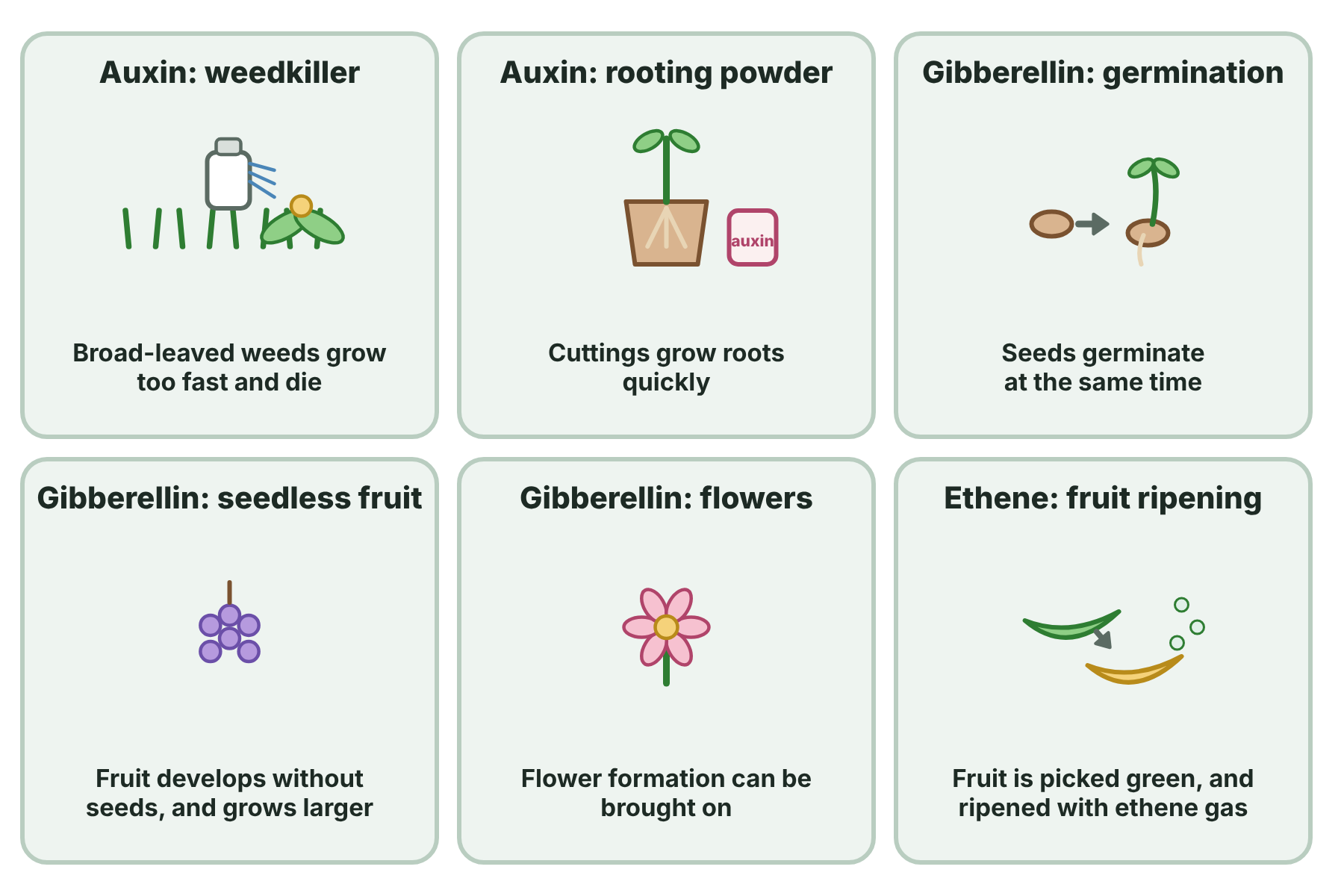
Auxins, gibberellins and ethene are used to control the growth, flowering and ripening of crops.
The three groups of plant hormone and their uses
Auxins and gibberellins
- Auxins: selective weedkillers
- Auxins: rooting powders for cuttings
- Gibberellins: germination of seeds
- Gibberellins: flowers, large fruit and seedless fruit
Ethene
- A gas made by plants
- Makes fruit ripen
- Fruit is picked green and ripened later
- Removed from storage to delay ripening
Advantages and disadvantages
Plant hormones are useful, but they have to be used with care.
-
Advantages
Crops are more uniform, and ready at the same time, harvesting can be planned, and fruit lasts longer and is less damaged in transport. Weeds are killed without harming the crop, so the yield is greater.
-
Cost
The chemicals are cheap compared to the extra income, but growers still need to pay for them, and for the equipment.
-
Environment
Weedkillers can drain into streams, and kill water plants, or harm insects that feed on weeds, so they can reduce biodiversity.
-
Health
Residues might stay on food, so the amounts used are limited by law.
-
Quality
Fruit that is ripened with ethene is sometimes thought to taste less sweet than fruit that ripened on the plant.
Evaluating the use of rooting powder
A grower tried to root 80 cuttings with rooting powder, and 80 cuttings without it. After 6 weeks, 68 of the cuttings with powder and 32 of those without it had rooted. Calculate the percentage which rooted in each group, and say what the results show.
Show the solutionHide the solution
- 1 With powder \(68 \div 80 \times 100 = 85\%\).
- 2 Without powder \(32 \div 80 \times 100 = 40\%\).
- 3 Compare \(85 \div 40 = 2.1\), so over twice as many rooted.
- 4 Evaluate More plants from the same number of cuttings is a benefit, but the cost of the powder should be less than the value of the extra plants.
Answer85% of the cuttings with powder rooted and 40% of those without. The rooting powder more than doubled the percentage of cuttings that rooted, so it is useful to the grower.
Case study
Bananas and ethene
Most of the bananas that are sold in Britain are grown in tropical countries and carried on ships for up to two weeks. If they ripened on the way, they would become soft and bruised. So they are picked while they are green, and stored in cool containers, where the ethene that they make is removed. When they arrive, they are moved to ripening rooms and exposed to ethene gas. In a few days all the fruit turns yellow, and it is sent to the shops while it is perfect. The system lets a supermarket sell fresh bananas all year round.
Summary and exam focus
- Auxins are used in selective weedkillers, and in rooting powders.
- Gibberellins are used to end dormancy, and to bring on flowers, larger fruit and seedless fruit.
- Ethene is used to ripen fruit that is picked green.
- Hormones make crops more uniform, and easier to plan, and help to reduce waste.
- Weedkillers can harm the environment, so their use must be controlled.
Exam focus
Describe the commercial uses of auxins, gibberellins and ethene, and evaluate the use of weedkillers that contain auxins. (6 marks) (6 marks)
Give at least one use for each hormone, such as rooting powder, seedless fruit and ripening bananas. For the evaluation, say that selective weedkillers raise yields, but they can wash into streams and harm other wildlife, and give a judgement.
Key terms
The words this lesson expects you to use. Each one is linked from the first place it appears above.
- Weedkiller
- A chemical that kills weeds, which are unwanted plants.
- Selective weedkiller
- A weedkiller that kills some kinds of plant but not others.
- Rooting powder
- A powder that contains auxin, used to make cuttings grow roots.
- Gibberellin
- A plant hormone that ends seed dormancy and promotes flowering and the growth of fruit.
- Ethene
- A gas that is made by plants, and makes fruit ripen.
- Seedless fruit
- Fruit that grows without any seeds.
- Cutting
- A piece of a plant which is used to grow a new plant.
- Dormancy
- A resting state of a seed, in which it does not germinate.
- Synthetic
- Made by people, and not found in nature.
You've finished the notes
Check your understanding
Test yourself while it is fresh. Start with the flashcards, then try the exam questions.
Something here looks wrong?
Tell us what and we will go and look. It goes to whoever writes these pages, nobody else, and we do not ask who you are — so there is nothing to sign and nothing comes back to you.