Biology · Plant Adaptations and Hormones
Investigating Tropic Responses
You can see a tropism happening in a few days with a pot of cress seedlings. This lesson is for separate Biology only: Combined Science students do not need it. It describes how to investigate tropic responses to light and to gravity, and how to control the variables, record the results and evaluate the method.
Learning Objectives
- 1Describe a method to investigate the response of seedlings to light and to gravity.
- 2Identify the independent, dependent and control variables, and explain the controls.
- 3Record, process and interpret the results, including calculating a mean angle of bending.
- 4Evaluate the method and suggest improvements, and describe how to work safely.
Retrieval practice
-
1
What is phototropism?
Show answerHide answer
Growth in response to the direction of light.
-
2
What is gravitropism?
Show answerHide answer
Growth in response to gravity.
-
3
What is a control variable?
Show answerHide answer
A variable that is kept the same, so that it does not affect the result.
-
4
Why are results repeated?
Show answerHide answer
To find a mean, spot anomalies and make the results more reliable.
Testing a tropism
The idea behind the investigation is simple. A tropism is a growth response to a stimulus from one direction, so you can test it by changing the direction of the stimulus, and seeing how the seedlings grow. Small, fast-growing seedlings, such as cress, mustard or wheat, are best, because their response can be seen within a few days. In each case a control is needed to show that the seedlings really are responding to the stimulus, and not growing in that direction for some other reason.
Investigating phototropism
The independent variable is the direction from which the light comes.
-
Set up
Sow cress seeds in several identical pots, and let them germinate in a warm place. Choose pots with seedlings of about the same height.
-
Condition A
Put one pot in a box with a lamp or a window at one side only, so the light comes from one direction.
-
Condition B
Put a second pot in a box with light from directly above.
-
Condition C
Put a third pot in a light-proof box in the dark.
-
Measure
After 3 to 5 days, measure the angle of the shoots from the vertical with a protractor, or the length of the shoots and the direction of their growth. Take a photograph to keep a record.
-
Result
The shoots in A bend towards the light. The shoots in B grow straight. The shoots in C grow straight, and are long and pale, because there is no light.
Investigating gravitropism
The independent variable is the direction of gravity relative to the seedling.
-
Set up
Place cress or mustard seeds on damp cotton wool or filter paper in clear dishes, and tape on the lids. Keep them in the dark so that the light cannot affect the direction of growth.
-
Dish A
Stand it upright, so that the seedlings grow with roots down.
-
Dish B
Lay it on its side, or stand it at 90 degrees, so that the seedlings start sideways.
-
Dish C
Fix it to a clinostat, which turns slowly, so that gravity pulls equally on all sides.
-
Measure
After 2 to 4 days measure the angle through which the roots and shoots have turned, using a protractor on a photograph.
-
Result
In B the roots curve down and the shoots curve up. In A they grow straight. In C they grow in no particular direction, which shows that gravity is the stimulus.
Set-ups for the tropism investigations
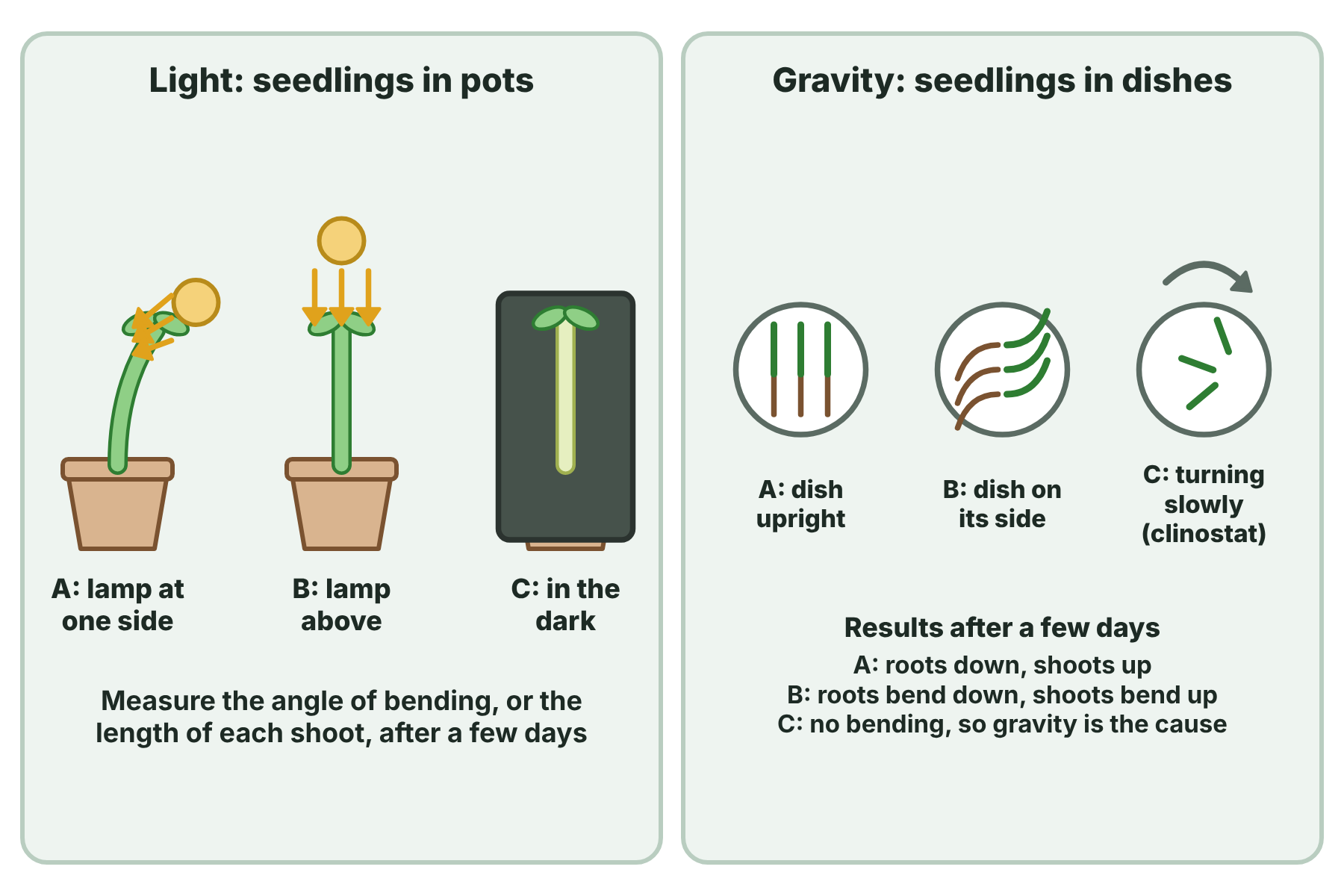
Changing the direction of the light or of gravity shows that these are the stimuli for the bending.
Variables and controls
A fair test changes one variable, and keeps all the others the same.
-
Independent variable
The direction of the light, or the direction of gravity.
-
Dependent variable
The angle of bending of the shoots or roots, or the direction of growth.
-
Control variables
The type and the age of the seeds, the volume of water, the temperature, the size of the pot, the distance from the lamp, and the time. Other light must be kept out.
-
Controls
The dark pot, the pot with light from above, and the clinostat show that the bending is a response to the stimulus.
-
Repeats
Use many seedlings in each pot, and repeat the investigation, so that a mean can be found and results that do not fit can be spotted.
Recording and processing the results
A good record uses numbers and also drawings or photographs.
-
Measure
Use a protractor to measure the angle of each shoot from the vertical, to the nearest 5 degrees, or a ruler to measure the length.
-
Calculate
Find the mean angle for each condition, and ignore, or check, any anomalous results.
-
Draw
Make labelled biological drawings, or take photographs, of typical seedlings.
-
Present
Draw a bar chart of mean angle against condition.
Evaluating the investigation
There are a number of ways in which the result could be less reliable.
-
Light leaks
Light from other directions might reach the dark pot or the clinostat, so it must be properly blocked off.
-
Heat from the lamp
A lamp close to the seedlings can warm one side, and so affect growth. A cool lamp, or a greater distance, can help.
-
Subjective measurements
Judging a bend by eye is not accurate, so a protractor, or a photograph, is better.
-
Seedlings
They differ from each other, so the sample must be large.
-
Safety
Wash hands after touching the damp seeds, and the cotton wool, as mould can grow. Take care with the lamp, which can get hot, and with electrical equipment near water.
Calculating a mean angle
In the investigation of phototropism, the angles from the vertical of the shoots in pot A were 40, 35, 45, 38 and 42 degrees. In pot B they were 2, 0, 3, 1 and 4 degrees. Calculate the mean angle for each pot, and say what the results show.
Show the solutionHide the solution
- 1 Mean for A \((40 + 35 + 45 + 38 + 42) \div 5 = 200 \div 5 = 40\) degrees.
- 2 Mean for B \((2 + 0 + 3 + 1 + 4) \div 5 = 10 \div 5 = 2\) degrees.
- 3 Conclusion The difference of 38 degrees shows that the direction of the light causes the bending.
AnswerThe mean for A is 40 degrees and the mean for B is 2 degrees. The seedlings with light from one side bent far more than those with light from above, so the one-sided light is the stimulus for the bending.
Case study
Plants in space
On the International Space Station there is almost no gravity, and scientists have grown plants such as lettuce and radishes there. The plants have no gravity to tell them which way is up. The roots and shoots still grow, but they do not all grow in the right direction unless light is used to guide them, as the gravitropism does not work. A clinostat on Earth does the same thing in a small way, by turning the seedlings so that gravity pulls on every side equally. The experiments help scientists to understand how plants sense gravity, and how to grow food on long space missions.
Summary and exam focus
- Phototropism is investigated by changing the direction of the light.
- Gravitropism is investigated by turning the seedlings, and with a clinostat.
- The dependent variable is the angle of bending, or the direction of growth.
- Controls and many repeats make the results valid and reliable.
- A mean angle is calculated for each condition.
Exam focus
Describe an investigation to show that shoots grow towards light, and explain how you would make the results reliable. (6 marks) (6 marks)
Describe the pots with light from one side, light from above and no light, and say that you measure the angle of bending. Then give control variables, such as the type of seeds, the temperature and the amount of water, and say that you use many seedlings, and calculate a mean.
Key terms
The words this lesson expects you to use. Each one is linked from the first place it appears above.
- Clinostat
- A device that turns plants slowly so that gravity acts on all sides equally.
- Seedling
- A very young plant that has just grown from a seed.
- Control
- A test in which the factor being investigated is not changed, for comparison.
- Independent variable
- The variable that you change.
- Dependent variable
- The variable that you measure.
- Control variable
- A variable that you keep the same.
- Anomaly
- A result that does not fit the pattern.
- Mean
- The sum of the values divided by the number of values.
- Protractor
- An instrument for measuring angles.
You've finished the notes
Check your understanding
Test yourself while it is fresh. Start with the flashcards, then try the exam questions.
Something here looks wrong?
Tell us what and we will go and look. It goes to whoever writes these pages, nobody else, and we do not ask who you are — so there is nothing to sign and nothing comes back to you.