Biology · Plant Adaptations and Hormones
Plants in Extreme Environments
A cactus in the desert, marram grass on a windy dune and a water lily on a pond all face very different problems. This lesson is for separate Biology only: Combined Science students do not need it. It explains how the leaf size and shape, the cuticle and the stomata of a plant are adapted to help it survive in an extreme environment.
Learning Objectives
- 1Explain how plants are adapted to survive in extreme environments.
- 2Explain the effect of leaf size and shape on the loss of water from a plant.
- 3Explain how the cuticle and the stomata are adapted in plants from very dry, cold and wet habitats.
- 4Use data on surface area to volume ratio and on stomata to compare plants from different environments.
Retrieval practice
-
1
What is transpiration?
Show answerHide answer
The loss of water vapour from a plant, mainly through the stomata of the leaves.
-
2
What is the cuticle?
Show answerHide answer
A waxy layer on the surface of a leaf that reduces the loss of water.
-
3
What do guard cells do?
Show answerHide answer
They open and close the stomata.
-
4
Which factors increase the rate of transpiration?
Show answerHide answer
Higher temperature, lower humidity, more air movement and more light.
Living at the extremes
Most plants live in places where water, temperature and light are good enough to grow in. Some places are extreme. A desert gets very little rain and has fierce sun, a sand dune is dry and windy, a mountain top is cold and exposed, and a pond is so wet that the leaves must float. A plant that lives in one of these places needs adaptations, which are features of its structure that help it to survive. Because plants lose water by transpiration through the stomata, and across the surface of the leaf, most of the adaptations involve the size and shape of the leaf, the thickness of the cuticle, and the number and position of the stomata.
Leaf size and shape
The bigger the surface of a plant, the more water it can lose. The shape and size of the leaves are therefore very important.
-
Large, flat leaves
They have a large surface area, so they absorb a lot of light for photosynthesis, but they also lose a lot of water. They suit places where water is easy to get.
-
Small, narrow leaves
A small surface area means that less water vapour escapes. Many plants from dry or cold places have small leaves, or needle-like leaves.
-
Leaves turned into spines
The leaves of a cactus are reduced to spines, which have almost no surface area, so almost no water is lost. The green stem does the photosynthesis.
-
Rolled leaves
Some grasses roll their leaves, so that the stomata are in a sheltered space where the air is humid, and the air next to the stomata does not blow away.
-
Surface area to volume ratio
A shape with a small surface area compared with its volume loses water slowly. A rounded stem or a low cushion of leaves has a smaller ratio than a thin flat leaf.
The cuticle
The cuticle is a waxy layer on the outside of the epidermis, which is waterproof.
-
Thick in dry places
A thick waxy cuticle reduces the loss of water through the surface of the leaf or stem. Plants from deserts and from windy, dry places have a very thick cuticle.
-
Thin in wet places
A plant that floats on water, such as a water lily, has no problem with a lack of water, so it has a thin cuticle.
-
A balance
The cuticle also reduces the gas exchange, so a very thick cuticle is only found where the loss of water is the main danger.
The stomata
The stomata are the pores that let carbon dioxide in and let water vapour out, so their number and position are a compromise.
-
Fewer stomata
Plants from dry places have fewer stomata per square millimetre than plants from wet places, so they lose less water.
-
Sunken stomata
Stomata in pits or grooves, often with hairs around them, trap a layer of humid air next to the stomata, which lowers the concentration gradient of water vapour and so slows its diffusion out of the leaf.
-
Open at night
Some desert plants, including many cacti, open their stomata only at night when it is cooler, and close them during the heat of the day.
-
Upper surface in floating leaves
The lower surface of a water lily leaf touches the water, so the stomata are on the upper surface, where they are in contact with the air.
-
Guard cells
In all of these plants the guard cells open and close the stomata, and close them if the plant is short of water.
Plants in four extreme environments
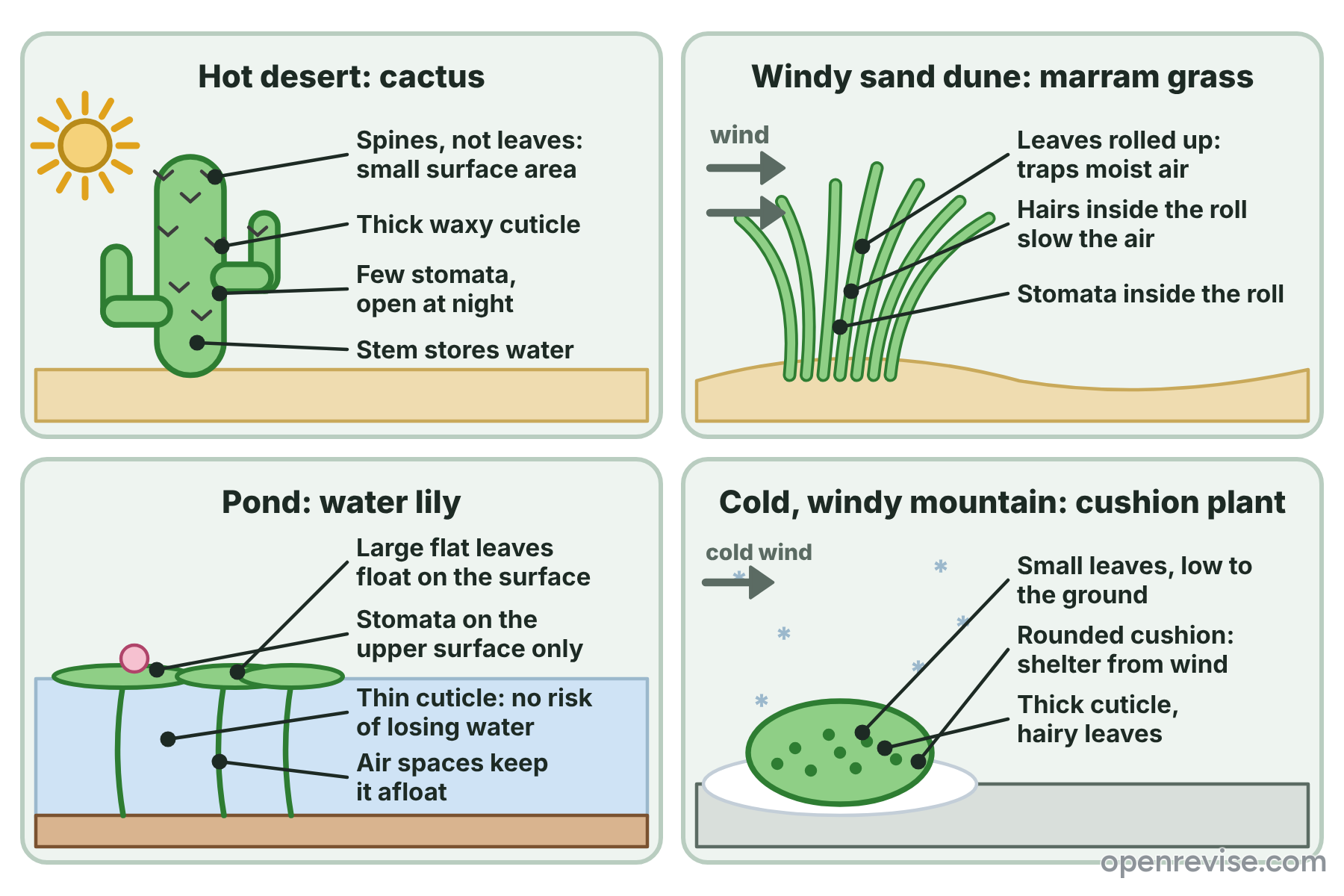
The leaf size and shape, the cuticle and the stomata are adapted to each environment.
A hot desert: the cactus
A desert plant must collect water when it rains, store it, and lose as little as possible.
-
Spines
The leaves are reduced to spines, which have a very small surface area, so little water vapour escapes. They also protect the plant from animals.
-
Thick stem
The fat green stem has a small surface area for its volume, and carries out photosynthesis.
-
Water storage
The stem is full of stored water, which swells up after rain.
-
Cuticle and stomata
A very thick cuticle covers the stem, and there are few stomata, which are open at night.
A windy sand dune: marram grass
Strong winds blow water vapour away from the stomata quickly, so the diffusion gradient is steep, and sand does not hold much water.
-
Rolled leaves
In dry weather the narrow leaves roll up, with the stomata on the inside.
-
Humid air trapped
The air inside the roll gets humid, so there is less of a gradient, and less water vapour diffuses out.
-
Hairs and pits
Hairs inside the roll, and stomata in grooves, slow the movement of air.
-
Thick cuticle
The outside surface of the leaf has a very thick cuticle.
A pond: the water lily
Here the problem is not too little water, but the need for gas exchange and light.
-
Large flat leaves
They float on the surface and catch lots of light, and water loss is not a problem.
-
Stomata on top
They are only on the upper surface of the leaf, which is in the air.
-
Thin cuticle
Water is always available, so a thick cuticle is not needed.
-
Air spaces
Large air spaces in the leaf and stem make the plant float, and carry oxygen to the roots in the mud.
Cold, windy places: cushion plants
In a cold place the soil water may be frozen, so water can be hard to get even if it is plentiful.
-
Small leaves
They have a small surface area, so they lose little water and little heat.
-
Low, rounded shape
The leaves grow in a cushion close to the ground, where it is warmer and the wind is weaker, and the shape has a small surface area for its volume.
-
Cuticle and hairs
A thick cuticle protects the leaves, and hairs trap a layer of warmer, still air.
Leaf sections from different environments
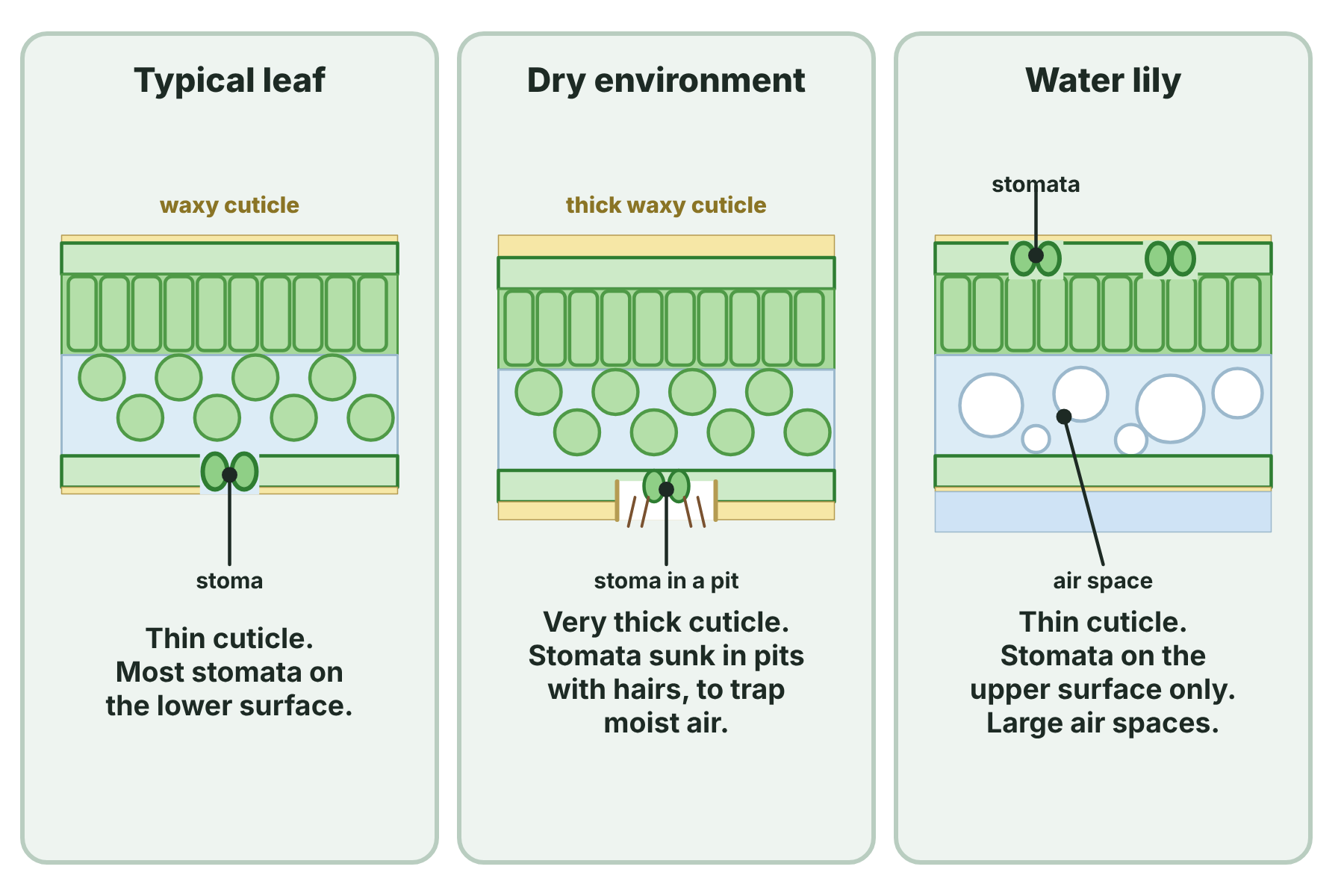
The cuticle, stomata and air spaces differ in leaves from different environments.
Dry-environment plants and water plants
A plant from a dry place
- Small leaves, spines or rolled leaves
- Very thick waxy cuticle
- Few stomata, often sunken, or open at night
- Stores water in its stem or roots
A floating water plant
- Large, flat leaves
- Thin cuticle
- Stomata only on the upper surface
- Large air spaces to float and carry oxygen
Comparing the surface area to volume ratio
A thin flat leaf is modelled as a block 4 cm long, 4 cm wide and 0.1 cm thick. A cactus stem is modelled as a cube with sides of 4 cm. Calculate the surface area to volume ratio of each, and say which will lose water vapour faster.
Show the solutionHide the solution
- 1 Leaf surface area \(2 \times (4 \times 4) + 4 \times (4 \times 0.1) = 32 + 1.6 = 33.6\) cm squared.
- 2 Leaf volume \(4 \times 4 \times 0.1 = 1.6\) cm cubed, so the ratio is \(33.6 \div 1.6 = 21\), written 21 : 1.
- 3 Cube surface area and volume \(6 \times (4 \times 4) = 96\) cm squared, and \(4 \times 4 \times 4 = 64\) cm cubed, so the ratio is \(96 \div 64 = 1.5\), written 1.5 : 1.
- 4 Conclude The larger the ratio, the more surface there is for each unit of volume, so the faster the water is lost.
AnswerThe leaf has a ratio of about 21 to 1, and the cube a ratio of 1.5 to 1. The leaf has the larger ratio, so it will lose water faster than the stem.
Calculating a percentage difference in stomata
A student counted 320 stomata per square millimetre on the lower surface of a leaf from a bean plant, and 80 per square millimetre on a leaf from a desert plant. Calculate how much fewer stomata the desert plant has, as a percentage of the number in the bean leaf.
Show the solutionHide the solution
- 1 Find the difference \(320 - 80 = 240\).
- 2 Divide by the original \(240 \div 320 = 0.75\).
- 3 Convert \(0.75 \times 100 = 75\%\) fewer.
- 4 Link Fewer stomata means fewer places where water vapour can leave the leaf.
AnswerThe desert plant has 75% fewer stomata than the bean plant, which reduces the loss of water vapour.
Case study
Marram grass: the dune builder
Marram grass grows on sand dunes around the coasts of Britain, where few other plants can survive. Its leaves roll up in dry weather, and its roots go deep into the sand to find water. As the wind blows sand against the plant, the stems grow upwards through the sand, and the plant traps more sand around it. In this way, it helps to build and to hold the dunes together, and so protects the coast from erosion. For this reason, marram grass is often planted on dunes that are being worn away.
Summary and exam focus
- Plants in extreme environments have adaptations to the size and shape of the leaf, the cuticle and the stomata.
- Small leaves, spines or rolled leaves reduce the surface area, so less water is lost.
- A thick cuticle and fewer, sunken stomata reduce the loss of water in dry places.
- A water lily has large floating leaves, a thin cuticle and stomata on the upper surface.
- A smaller surface area to volume ratio means that less water is lost.
Exam focus
Explain how a cactus is adapted to survive in a hot, dry desert, and compare these adaptations with those of a water lily. (6 marks) (6 marks)
For the cactus, give the leaf shape (spines), the thick cuticle and the few stomata, and say how each reduces the loss of water. For the water lily, say that water is not short, so it has a thin cuticle, large leaves and stomata on the upper surface, and then compare the two.
Key terms
The words this lesson expects you to use. Each one is linked from the first place it appears above.
- Adaptation
- A feature of structure or behaviour that helps an organism to survive in its environment.
- Xerophyte
- A plant that is adapted to live in a very dry habitat.
- Cuticle
- A waxy waterproof layer on the surface of a leaf or stem.
- Stoma
- A pore in the surface of a leaf, surrounded by two guard cells, which lets gases pass.
- Transpiration
- The loss of water vapour from a plant, mainly from the leaves.
- Surface area to volume ratio
- The surface area of an object divided by its volume.
- Humid
- Containing a lot of water vapour.
- Extreme environment
- A habitat where conditions such as temperature or water are very hard to survive.
- Spine
- A leaf that has become a sharp, narrow structure, as in a cactus.
You've finished the notes
Check your understanding
Test yourself while it is fresh. Start with the flashcards, then try the exam questions.
Something here looks wrong?
Tell us what and we will go and look. It goes to whoever writes these pages, nobody else, and we do not ask who you are — so there is nothing to sign and nothing comes back to you.