Biology · Plant Adaptations and Hormones
Plant Hormones and Tropisms
A plant has no nerves or muscles, but it still grows towards the light and sends its roots down. This lesson is for separate Biology only: Combined Science students do not need it. It explains how plant hormones, in particular auxins, control and coordinate plant growth, and how they cause phototropism and gravitropism.
Learning Objectives
- 1Describe a plant hormone as a chemical messenger that controls and coordinates growth and development.
- 2Explain how auxins cause phototropism in shoots.
- 3Explain how auxins cause gravitropism in shoots and roots.
- 4Explain why tropic responses help a plant to survive.
Retrieval practice
-
1
What is a hormone?
Show answerHide answer
A chemical messenger that is made in one place and carries a message to another place, where it has an effect.
-
2
What is a stimulus?
Show answerHide answer
A change in the environment that is detected.
-
3
Why do plants need light?
Show answerHide answer
For photosynthesis.
-
4
What is meant by growth in a plant?
Show answerHide answer
An increase in size, caused by cell division and by cells getting longer.
Growing in the right direction
A plant cannot move to a better place, but it can grow towards it. A shoot grows towards the light, so that the leaves can photosynthesise, and a root grows down into the soil, to get water and to hold the plant firm. These directional growth responses are called tropisms, and they are controlled by plant hormones. Unlike animals, plants have no glands and no nervous system. Their hormones are made in the cells of the growing tips, and carried through the plant by diffusion and in the phloem, to other parts where they change how the cells grow.
What is an auxin?
Auxins are plant hormones that control the growth of the shoot and of the root.
-
Where it is made
Auxin is made in the tip of the shoot and the tip of the root, where the cells are dividing.
-
What it does in a shoot
Auxin makes the cells in the shoot elongate, which means that they get longer. More auxin on one side makes the cells on that side grow longer.
-
Unequal distribution
If the auxin is spread out unequally, one side of the stem or root grows faster than the other, and it bends.
-
Different effects
The same amount of auxin which makes shoot cells grow longer slows the growth of the cells in a root.
Phototropism
Phototropism is the growth of a plant in response to the direction of light.
-
Detecting light
The tip of the shoot detects the direction of the light.
-
Auxin moves
When light shines from one side, auxin moves to the shaded side of the shoot.
-
Unequal growth
The cells on the shaded side elongate more than the cells on the lit side.
-
Bending
The shoot bends towards the light. This is positive phototropism, because the shoot grows towards the stimulus.
-
Why it helps
A leaf that is facing the light can absorb more light for photosynthesis.
How auxin causes phototropism
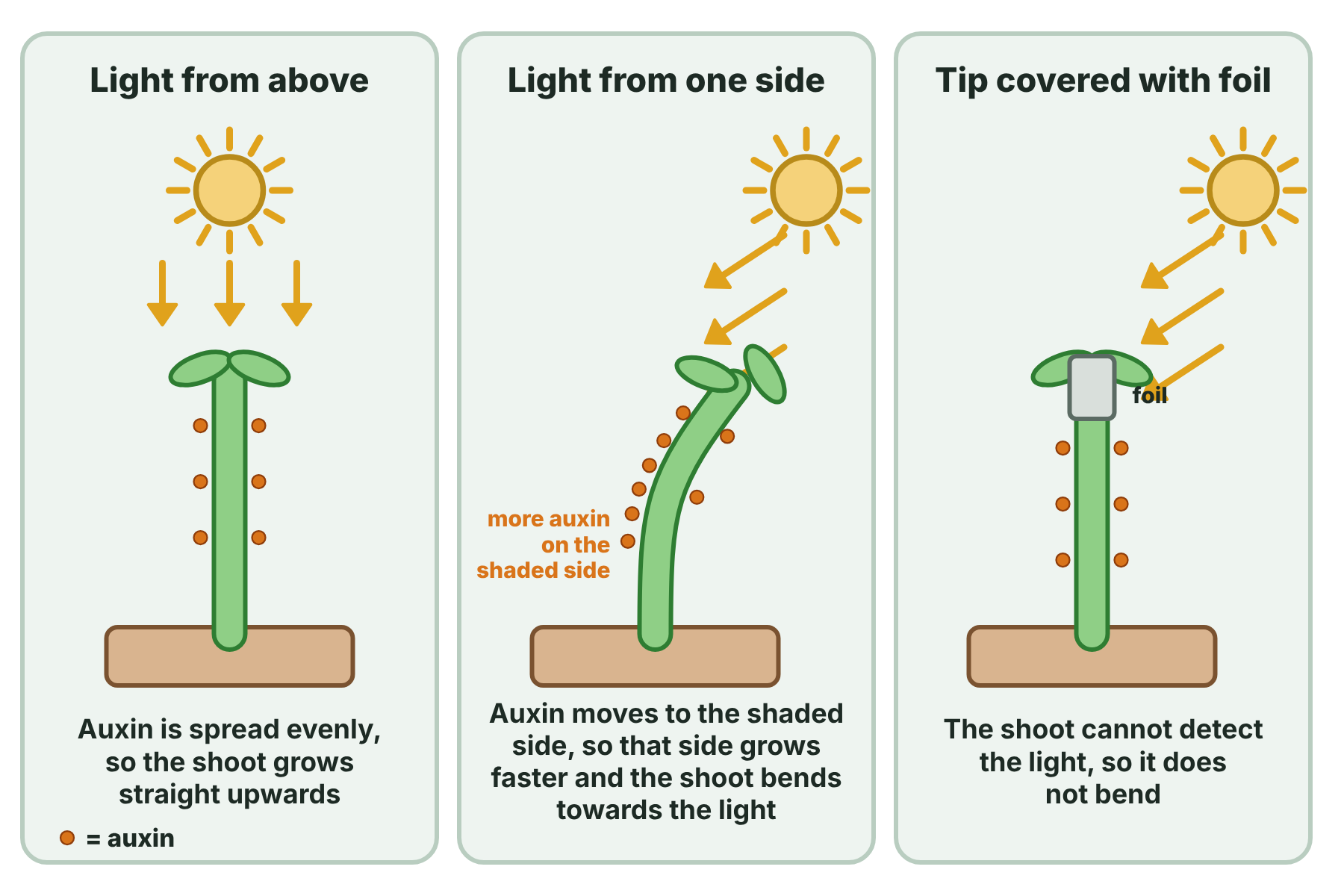
Auxin moves to the shaded side, and makes the cells there grow longer, so the shoot bends towards the light.
Gravitropism
Gravitropism is the growth of a plant in response to gravity.
-
A seedling on its side
Auxin collects on the lower side of both the shoot and the root, because of gravity.
-
In the shoot
The extra auxin makes the cells on the lower side grow longer, so the shoot bends upwards. This is negative gravitropism, because the shoot grows away from gravity.
-
In the root
The extra auxin slows the growth of the cells on the lower side of the root, so the upper side grows faster, and the root bends downwards. This is positive gravitropism, because the root grows towards gravity.
-
Why it helps
Roots grow down to find water and minerals, and to anchor the plant, and shoots grow up to reach the light.
How auxin causes gravitropism
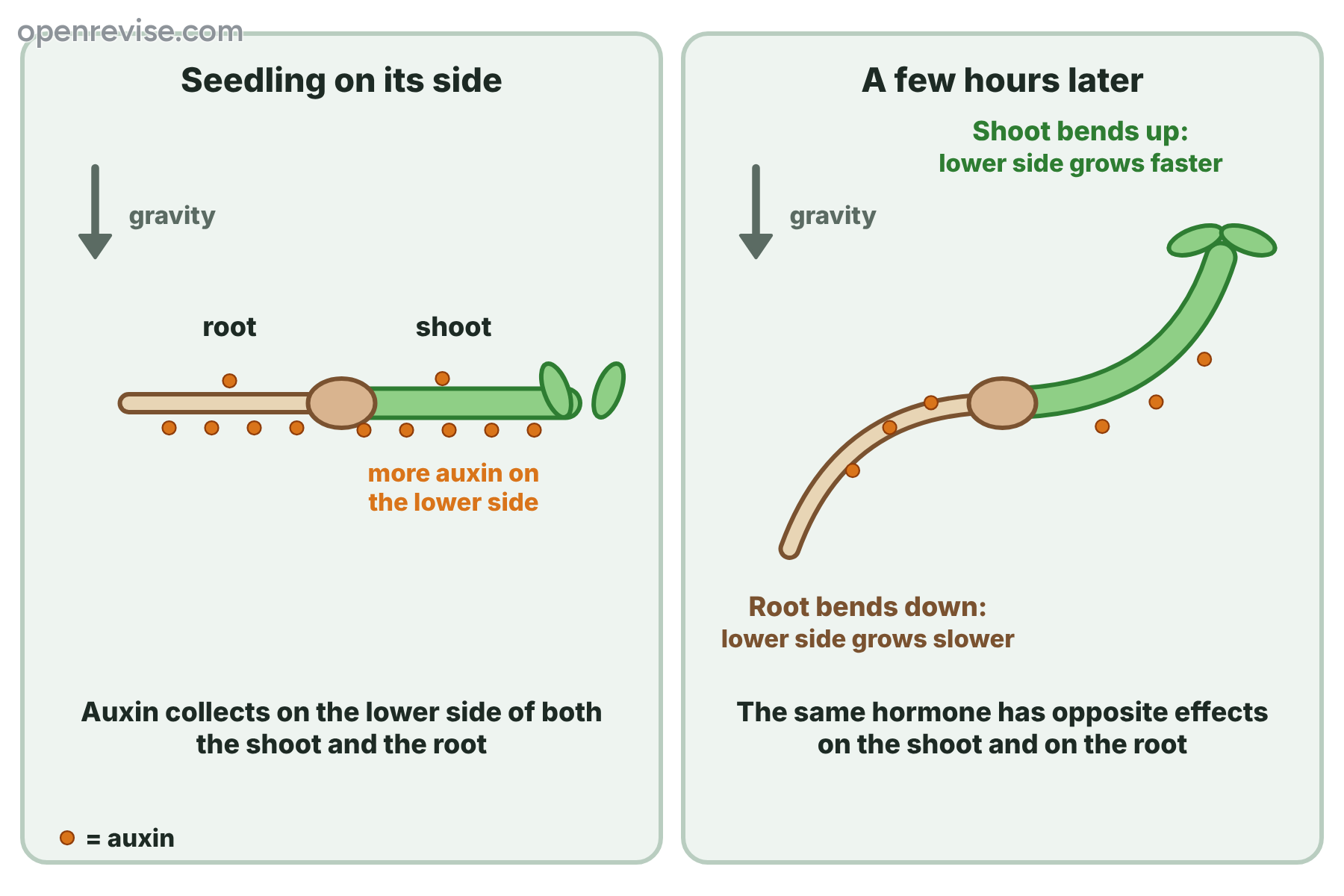
Auxin has opposite effects on the growth of a shoot and a root, so the shoot grows up and the root grows down.
Shoots and roots
A shoot
- Grows towards light (positive phototropism)
- Grows away from gravity (negative gravitropism)
- Auxin makes the cells on that side grow longer
- Reaches the light for photosynthesis
A root
- Grows away from light, or is not affected by it
- Grows towards gravity (positive gravitropism)
- Auxin slows the growth on that side
- Reaches water and minerals, and anchors the plant
Evidence for auxin
Scientists worked out how auxin works from experiments on young shoots.
-
Darwin
In 1880 Charles Darwin and his son Francis found that a young grass shoot bent towards the light, but did not bend if the tip was covered, or cut off. They suggested that something made in the tip moves to the lower part.
-
Boysen-Jensen
In 1913 Peter Boysen-Jensen put a thin piece of gelatine between the tip and the shoot, and the shoot still bent, which showed that a chemical, and not a nerve signal, passed down.
-
Went
In 1928 Frits Went put tips onto small blocks of agar jelly, and then put the blocks on one side of cut shoots. The shoots bent away from the side with the block, which showed that a chemical made in the tip makes the cells grow.
Interpreting a phototropism experiment
Four groups of 20 seedlings were grown for 3 days. Group A had light from above, group B had light from the right, group C had light from the right with the tips covered in foil, and group D had light from the right with the tips cut off. Group B bent towards the light, and the others did not bend. Explain the results.
Show the solutionHide the solution
- 1 Group A Light from above gives no difference between the sides, so the shoot grows straight.
- 2 Group B Auxin moved to the shaded side, and it grew faster, so the shoot bent towards the light.
- 3 Groups C and D The tip is the part that detects the light and makes the auxin, so with the tip covered or removed there was no response.
AnswerGroup A had light from all directions equally, so the auxin was spread evenly. Group B bent because the auxin moved to the shaded side. Group C did not bend because the tip could not detect the light. Group D did not bend because the tip, which makes the auxin, had been removed.
Case study
Went and the agar blocks
In 1928 Frits Went, a Dutch scientist, cut the tips off oat seedlings and placed them on blocks of agar jelly for an hour. He then placed an agar block on one side of the cut top of a seedling, in the dark. The seedlings bent, away from the side where the block was placed, and the amount of bending depended on how much of the chemical was in the block. Because he used the same plant material and blocks of agar, with no light to confuse the results, he showed that the chemical was made in the tip, and he could use the bend to measure how much auxin was present.
Summary and exam focus
- Auxins are plant hormones, made in the tips, that control the growth of cells.
- In phototropism, auxin moves to the shaded side, and the shoot bends towards the light.
- In gravitropism, auxin collects on the lower side of the shoot and the root.
- Auxin makes the cells of a shoot grow longer, but slows the growth of the cells in a root.
- Tropisms help plants to find light, water and minerals.
Exam focus
Explain how auxin causes a shoot to bend towards the light, and explain why a root grows downwards. (6 marks) (6 marks)
Say that the tip makes auxin, that light makes it move to the shaded side, and that this side elongates faster. For the root, say that auxin collects on the lower side, but slows growth in the root, so the upper side grows faster and the root bends down.
Key terms
The words this lesson expects you to use. Each one is linked from the first place it appears above.
- Plant hormone
- A chemical made in a plant which controls and coordinates growth and development.
- Auxin
- A plant hormone, made in the tip of the shoot and the root, which controls cell elongation.
- Tropism
- A growth response of a plant to a stimulus from one direction.
- Phototropism
- Growth in response to the direction of light.
- Gravitropism
- Growth in response to gravity.
- Elongation
- The growth of a cell by getting longer.
- Stimulus
- A change in the environment that a plant or animal detects.
- Positive tropism
- Growth towards the stimulus.
- Negative tropism
- Growth away from the stimulus.
You've finished the notes
Check your understanding
Test yourself while it is fresh. Start with the flashcards, then try the exam questions.
Something here looks wrong?
Tell us what and we will go and look. It goes to whoever writes these pages, nobody else, and we do not ask who you are — so there is nothing to sign and nothing comes back to you.