Biology · Plant Structures and Transport
Measuring Transpiration
Transpiration can be measured. This lesson explains how a potometer measures the uptake of water, how to investigate the factors that change the rate and how to find the distribution of stomata.
Learning Objectives
Retrieval practice
-
1
What is transpiration?
Show answerHide answer
The loss of water vapour from the leaves, mainly through the stomata.
-
2
Name four factors that affect the rate of transpiration.
Show answerHide answer
Temperature, humidity, air movement and light intensity.
-
3
What is the formula for rate?
Show answerHide answer
Rate = amount of change ÷ time.
-
4
What do guard cells do?
Show answerHide answer
Open and close the stomata.
Why measure water uptake?
It is difficult to measure the water leaving a leaf as vapour. But almost all the water that a plant takes up is lost by transpiration, so measuring how fast a cut shoot takes up water is a good estimate of how fast it transpires. The apparatus used is called a potometer.
The potometer
A potometer is an airtight apparatus with a cut shoot at one end and a thin tube with an air bubble in it.
-
A leafy shoot
Cut under water so that no air gets into the xylem, and fitted into the apparatus underwater so that the joints are airtight.
-
A capillary tube
A very thin tube along a scale. As the shoot takes up water, it pulls the air bubble along the tube.
-
A water reservoir
Lets the bubble be reset to the start, so the experiment can be repeated.
-
A scale
A ruler under the tube measures how far the bubble moves in a measured time.
A potometer
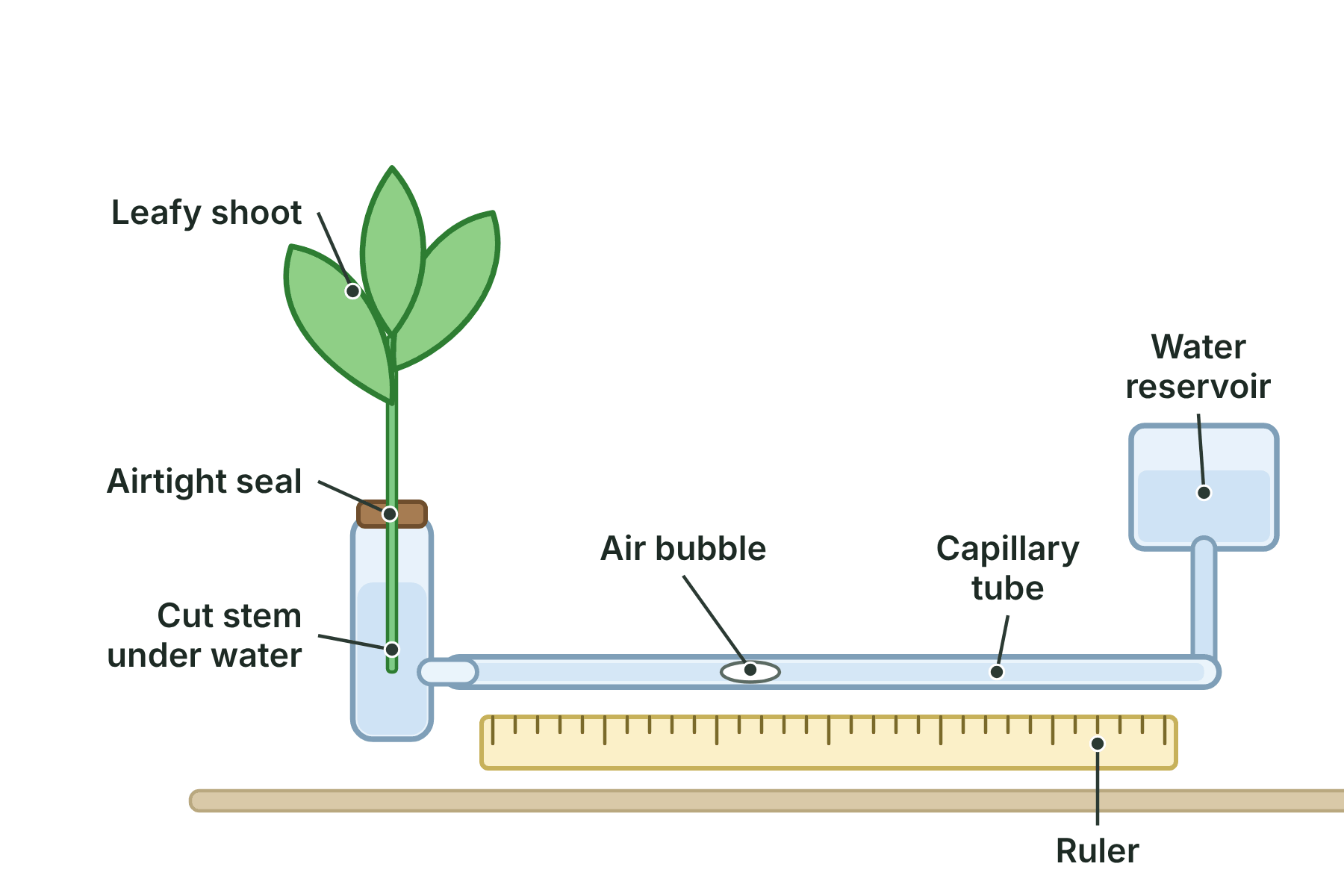
The bubble moves along the tube as the shoot takes up water.
Investigating the effect of a factor
Change one factor at a time and keep everything else the same.
-
1
Set up
Cut a shoot under water and join it to the potometer under water, making sure there are no air bubbles in the apparatus.
-
2
Dry the leaves
Dry the leaf surface and let the shoot adjust to the room.
-
3
Start
Make an air bubble in the capillary tube and note its starting position on the scale.
-
4
Measure
After a set time, such as 5 minutes, record how far the bubble has moved.
-
5
Repeat
Reset the bubble and repeat at least three times, then find a mean.
-
6
Change the factor
For example, put a fan next to the shoot, a bag over it for humidity, a lamp nearby, or warm the room.
Variables
A fair test changes only one variable.
-
Independent variable
The factor you change, such as the distance of a lamp, wind speed from a fan, or temperature.
-
Dependent variable
The distance moved by the bubble in a set time, which gives the rate of water uptake.
-
Control variables
Use the same shoot, the same time, the same temperature and light (unless that is the factor being changed) and the same airtight apparatus.
-
Limitations
The shoot may take up water for growth and photosynthesis, so the uptake is not exactly the same as water lost, but it is a good estimate.
Calculating a rate of water uptake
In a potometer experiment, the air bubble moves 36 mm in 12 minutes. Calculate the rate of water uptake in mm per minute.
Show the solutionHide the solution
- 1 Write the formula Rate = distance moved ÷ time
- 2 Substitute \(36\text{ mm} \div 12\text{ min}\)
- 3 Calculate and give the unit \(= 3\text{ mm per minute}\)
AnswerThe rate of water uptake is 3 mm per minute.
Calculating the volume of water taken up
The capillary tube has a radius of 0.5 mm. The bubble moves 20 mm. Calculate the volume of water taken up. Use \(\pi = 3.14\).
Show the solutionHide the solution
- 1 Treat the tube as a cylinder The water taken up fills a cylinder with radius 0.5 mm and length 20 mm.
- 2 Write the formula Volume = \(\pi r^{2} \times\) length
- 3 Substitute \(3.14 \times 0.5^{2} \times 20 = 3.14 \times 0.25 \times 20\)
- 4 Calculate \(= 15.7\text{ mm}^3\)
AnswerThe volume is about 15.7 mm³.
Distribution of stomata
You can count the stomata on a leaf using an impression of the surface.
-
Make an impression
Paint a small patch of the leaf surface with clear nail varnish. When it is dry, peel it off with clear sticky tape.
-
Look under a microscope
Stick the tape on a slide. The impression shows the stomata and guard cells as small marks.
-
Count
Count the stomata in several fields of view, find the mean and compare the upper and lower surfaces.
-
Calculate density
Stomatal density is the number of stomata divided by the area of the field of view, for example per mm².
Stomatal density
A student counts 24 stomata in a field of view of area 0.5 mm². Calculate the number of stomata per mm².
Show the solutionHide the solution
- 1 Write the formula Stomatal density = number of stomata ÷ area
- 2 Substitute \(24 \div 0.5\)
- 3 Calculate \(= 48\text{ stomata per mm}^2\)
AnswerThere are 48 stomata per mm².
Case study
Using the results
A student finds that the bubble moves 10 mm per minute with a fan switched on, but only 4 mm per minute with the fan off. The fan removes the water vapour from around the leaves, keeping the concentration gradient steep, so water is lost faster and pulled up faster. A graph of the mean uptake against the wind speed would show how the rate changes as the fan is moved closer.
The key idea
Water uptake in a potometer is a measure of the rate of transpiration.
Measuring transpiration
Measuring transpiration
-
Potometer
- shoot
- capillary tube
- air bubble
- scale
-
Rate
- distance moved ÷ time
-
One factor
- light
- wind
- humidity
- temperature
-
Fair test
- control variables
- repeats
- mean
-
Stomata
- nail varnish impression
- count
- density
Summary and exam focus
- A potometer measures how fast a shoot takes up water, which estimates the rate of transpiration.
- The rate is the distance the bubble moves divided by the time.
- Change one factor at a time and control all the others.
- Repeat and calculate a mean.
- Stomata can be counted using an impression of the leaf surface.
Exam focus
Describe how you would use a potometer to find the effect of wind on the rate of transpiration. (6 marks) (6 marks)
Give the method in order: set up, measure the bubble distance over a time, change one factor, keep other variables the same, repeat and calculate a mean and a rate. Always name the variable you change, the one you measure and the ones you control.
Key terms
The words this lesson expects you to use. Each one is linked from the first place it appears above.
- Potometer
- Apparatus that measures the rate at which a plant shoot takes up water.
- Capillary tube
- A very thin tube in which the bubble moves in a potometer.
- Independent variable
- The variable that is changed in an investigation.
- Dependent variable
- The variable that is measured in an investigation.
- Control variable
- A variable that is kept the same so the test is fair.
- Mean
- An average found by adding up the values and dividing by how many there are.
- Stomatal density
- The number of stomata in a given area of leaf.
- Reliable
- Giving similar results when the investigation is repeated.
You've finished the notes
Check your understanding
Test yourself while it is fresh. Start with the flashcards, then try the exam questions.
Something here looks wrong?
Tell us what and we will go and look. It goes to whoever writes these pages, nobody else, and we do not ask who you are — so there is nothing to sign and nothing comes back to you.