Biology · Plant Structures and Transport
The Structure of a Leaf
A leaf is an organ made of several different tissues, and its structure is adapted for photosynthesis and gas exchange. This lesson is for separate Biology. It names the tissues of a leaf, explains how each one is suited to its job and shows how guard cells control the stomata.
Learning Objectives
- 1Name the main plant tissues and state the function of each.
- 2Explain how the structure of each plant tissue is related to its function.
- 3Describe the structure of a leaf as a plant organ.
- 4Describe how guard cells open and close the stomata.
Retrieval practice
-
1
What is a tissue?
Show answerHide answer
A group of cells with a similar structure and function.
-
2
What is an organ?
Show answerHide answer
A group of different tissues working together to do a job.
-
3
What does photosynthesis make?
Show answerHide answer
Glucose (and oxygen).
-
4
Which cell structure absorbs light for photosynthesis?
Show answerHide answer
Chloroplasts, which contain chlorophyll.
The leaf as an organ
The leaf is a plant organ. It is made of several tissues working together, and its job is to make food by photosynthesis. A leaf is flat and thin, which gives it a large surface area to absorb light and a short distance for gases to diffuse. Knowledge of the leaf is limited to the epidermis, the palisade and spongy mesophyll, the xylem and phloem, and the guard cells that surround the stomata.
The tissues of a leaf
Each tissue has a structure that suits its job.
-
Epidermal tissues
A thin layer of cells covering the surface. The upper epidermis is covered by a waxy cuticle that reduces water loss, and it is transparent so that light passes through.
-
Palisade mesophyll
Tall, tightly packed cells just under the upper epidermis, packed with chloroplasts. Most photosynthesis happens here, where the most light arrives.
-
Spongy mesophyll
Rounded cells with large air spaces between them. The air spaces let carbon dioxide and oxygen diffuse through the leaf and give a large surface area for gas exchange.
-
Xylem and phloem
Transport tissues in the veins of the leaf. Xylem brings water and minerals to the leaf, and phloem carries away the sugars made there.
-
Guard cells
Pairs of cells that surround each stoma, a tiny pore, mostly found in the lower epidermis. They open and close the stoma.
A cross-section of a leaf
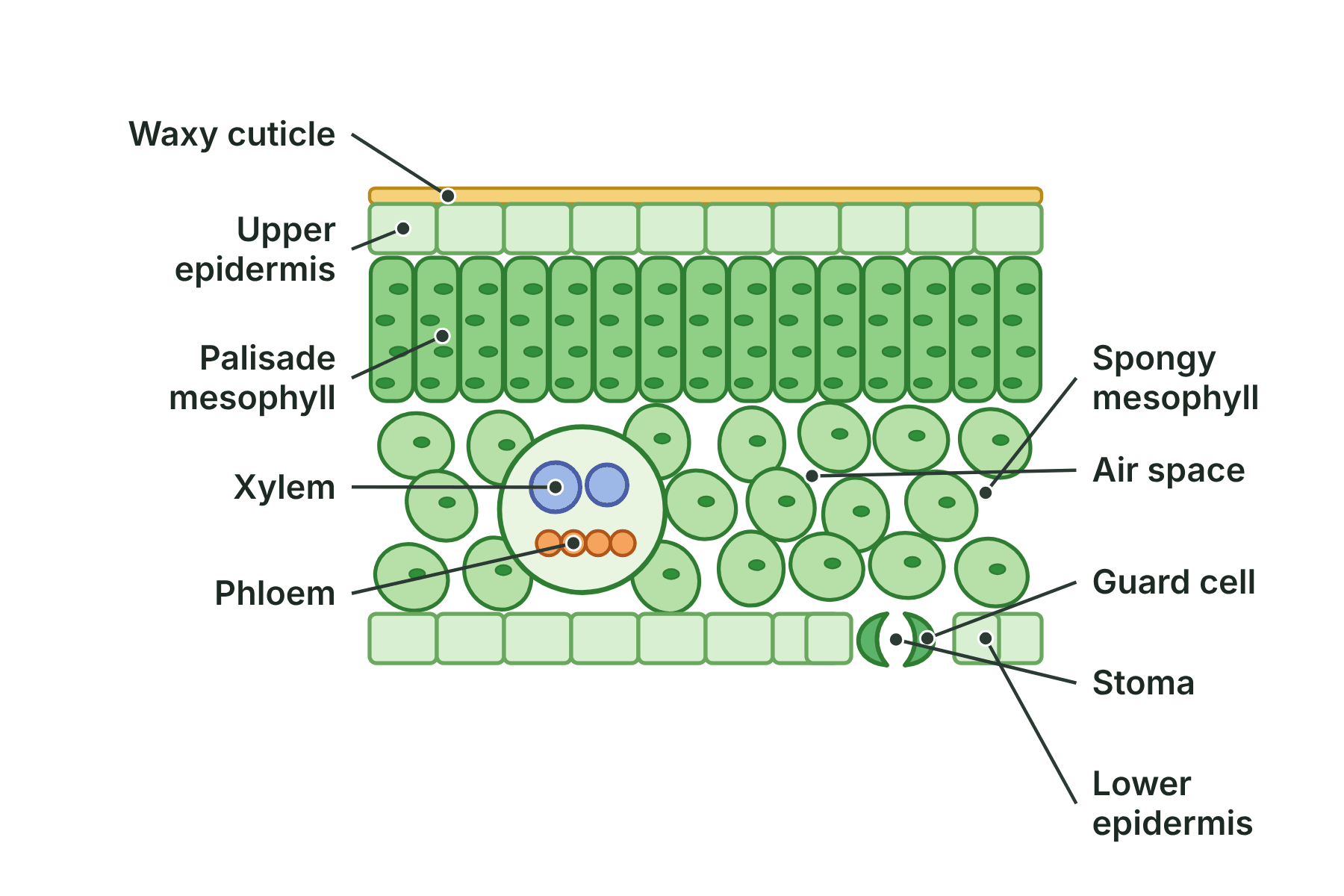
Each layer of a leaf has a different job.
Other plant tissues
Plants also have tissues in the roots and stems.
-
Meristem tissue
Found at the growing tips of shoots and roots. Its cells divide quickly and can differentiate into any type of plant cell, which lets the plant keep growing throughout its life.
-
Xylem
Tubes of dead cells that transport water and mineral ions up the plant. They are strengthened with lignin.
-
Phloem
Living tubes that transport dissolved sugars to wherever they are needed.
How guard cells control the stomata
Stomata are open for gas exchange when the plant has plenty of water, and closed when it is short.
-
1
Plenty of water
Water enters the guard cells by osmosis, so they swell and become turgid.
-
2
The stoma opens
The thin inner walls of the guard cells are stretched, so the cells curve apart and the pore opens.
-
3
Gases move
Carbon dioxide diffuses in for photosynthesis and oxygen and water vapour diffuse out.
-
4
Little water
If the plant loses too much water, the guard cells become flaccid and close the stoma, which stops more water being lost.
Palisade and spongy mesophyll compared
Palisade mesophyll
- Tall cells packed tightly together
- Many chloroplasts
- Near the top of the leaf, where most light arrives
- Main site of photosynthesis
Spongy mesophyll
- Rounded cells loosely packed
- Fewer chloroplasts
- Large air spaces between the cells
- Gives a large surface area for gas exchange
Case study
Why the stomata are on the lower surface
In most plants, there are far more stomata on the underside of a leaf than on the top. The upper surface faces the Sun, so it is warmer, and water would evaporate quickly from open stomata there. The cooler, shadier lower surface loses less water, so the plant can take in the carbon dioxide it needs without losing as much water vapour.
The exam skill
Every tissue in a leaf has a structure that fits its function.
Plant tissues
Plant tissues
-
Epidermis
- covers the leaf
- waxy cuticle
- transparent
-
Palisade mesophyll
- tall cells
- many chloroplasts
- photosynthesis
-
Spongy mesophyll
- air spaces
- gas exchange
-
Xylem and phloem
- transport water and sugars
-
Guard cells
- open and close the stomata
-
Meristem
- growing tips
- cells divide and differentiate
Summary and exam focus
- The leaf is an organ made of the epidermis, palisade mesophyll, spongy mesophyll, xylem, phloem and guard cells.
- Palisade cells are packed with chloroplasts and carry out most photosynthesis.
- Spongy mesophyll has air spaces, which give a large surface area for gas exchange.
- Guard cells open and close the stomata to control gas exchange and water loss.
- Meristem tissue at the growing tips can differentiate into any plant cell.
Exam focus
Explain how the structure of the palisade mesophyll is related to its function. (3 marks) (3 marks)
Name each feature and say why it helps: tall and tightly packed so that many cells fit near the surface, full of chloroplasts to absorb light, and under a transparent epidermis so the light reaches them.
Key terms
The words this lesson expects you to use. Each one is linked from the first place it appears above.
- Epidermis
- The thin outer layer of cells that covers a leaf.
- Waxy cuticle
- A waxy layer on the upper surface of a leaf that reduces water loss.
- Palisade mesophyll
- A layer of tall, tightly packed cells full of chloroplasts, where most photosynthesis takes place.
- Spongy mesophyll
- A layer of loosely packed cells with air spaces, which allow gases to move through the leaf.
- Stoma
- A tiny pore in the lower epidermis of a leaf that allows gases and water vapour to pass. The plural is stomata.
- Guard cell
- One of a pair of cells that open and close a stoma.
- Meristem
- Tissue at the tips of shoots and roots whose cells can divide and differentiate into any type of plant cell.
- Turgid
- Firm and swollen with water.
You've finished the notes
Check your understanding
Test yourself while it is fresh. Start with the flashcards, then try the exam questions.
Something here looks wrong?
Tell us what and we will go and look. It goes to whoever writes these pages, nobody else, and we do not ask who you are — so there is nothing to sign and nothing comes back to you.