Biology · Respiration
Core Practical: Investigating the Rate of Respiration
Respiration happens inside cells, so you cannot watch it, but you can measure how fast an organism uses oxygen. This lesson is for both Combined Science and separate Biology and covers core practical 8.11: the respirometer, the controls, the effect of temperature, calculating the rate, graphs, and the safety and ethical considerations that the exam asks about.
Learning Objectives
- 1Describe how a simple respirometer is set up to measure the oxygen consumption of germinating seeds or small invertebrates.
- 2Explain the purpose of the soda lime, the capillary tube with coloured liquid, the control tube and the water bath.
- 3Describe how to investigate the effect of temperature on the rate of respiration, controlling the other variables.
- 4Calculate the rate from the distance or volume moved by the liquid, plot and interpret a graph, and describe the safety and ethical considerations.
Retrieval practice
-
1
Which gas does aerobic respiration use up, and which does it make?
Show answerHide answer
It uses oxygen and makes carbon dioxide.
-
2
What is a control variable?
Show answerHide answer
A variable that is kept the same so that it does not affect the result.
-
3
What happens to an enzyme at a temperature that is too high?
Show answerHide answer
It is denatured, so its shape changes and it stops working.
-
4
What is the rate of a process?
Show answerHide answer
The amount of change, such as the distance moved or the volume used, divided by the time taken.
Measuring something you cannot see
A respirometer measures respiration by finding how much oxygen living organisms take in. Organisms in a sealed tube use up the oxygen and give out carbon dioxide, but soda lime in the tube absorbs the carbon dioxide. The only gas that changes the total volume is the oxygen that is used up, so the volume of gas in the tube goes down. This pulls a drop of coloured liquid along a thin capillary tube towards the organisms, and the distance the drop moves in a set time shows how fast the organisms are respiring.
The apparatus
A simple respirometer is a boiling tube with a bung, a capillary tube and a drop of coloured liquid.
-
The boiling tube
It holds the organisms, such as germinating seeds, woodlice or small insect larvae. They sit on cotton wool or gauze so that they do not touch the soda lime beneath them.
-
Soda lime
This absorbs the carbon dioxide that the organisms make. Without it the carbon dioxide would replace the oxygen that is used and the volume of gas would hardly change.
-
Capillary tube and coloured liquid
The capillary tube is pushed through an airtight bung. A drop of coloured liquid in it moves when the volume of gas changes, and a ruler beside the tube measures how far it moves.
-
Water bath
A beaker of water holds the tube at a steady temperature, which is checked with a thermometer. It must be set at each temperature that you want to test.
A simple respirometer
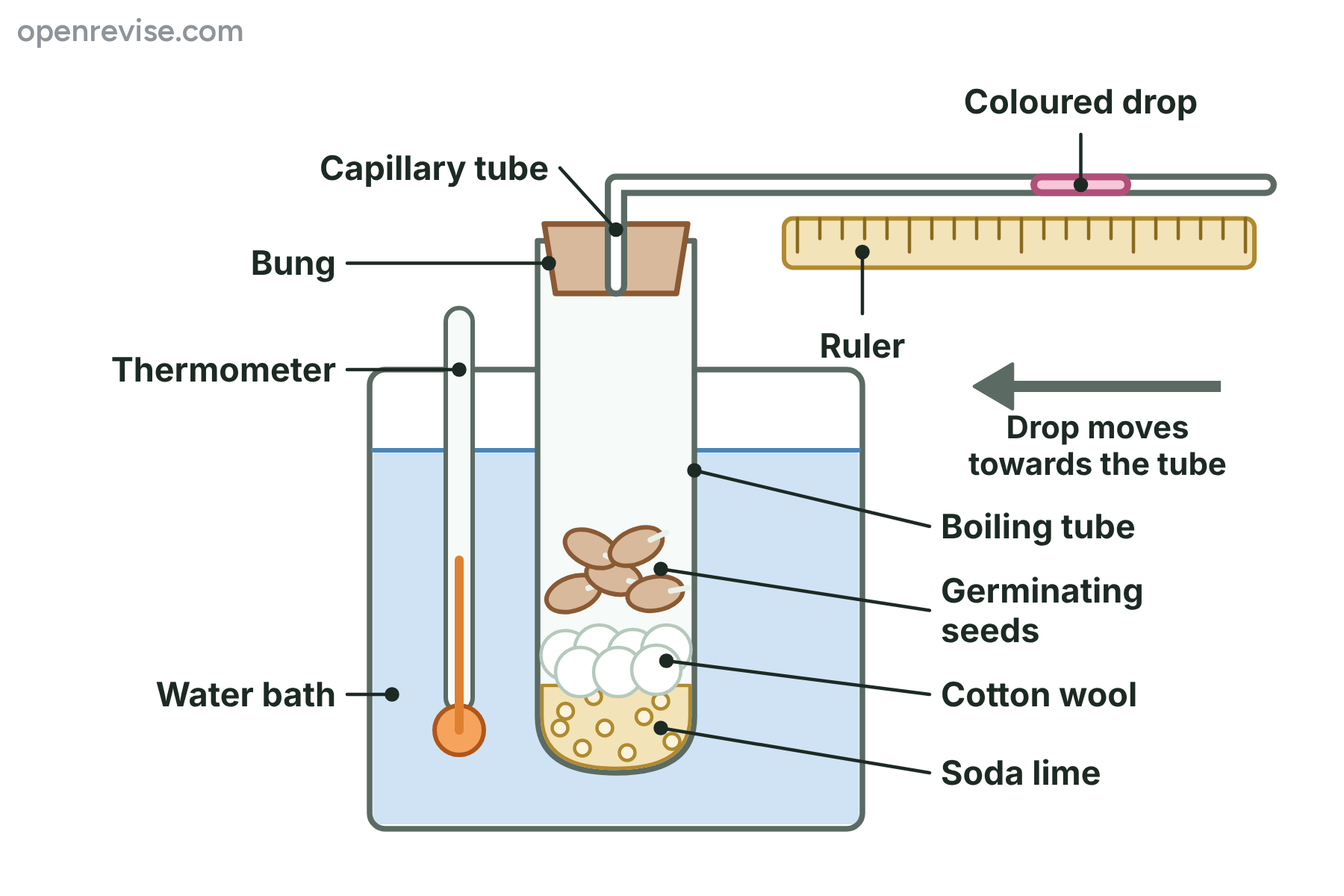
As the seeds use oxygen, the drop moves towards the tube.
Method: the effect of temperature on respiration
Follow these steps for each temperature, for example 10, 20, 30 and 40 degrees Celsius.
-
1
Set up the tubes
Put a layer of soda lime in the bottom of a boiling tube, add a plug of cotton wool, and put an equal mass of germinating seeds on top. Fit the bung and capillary tube so that it is airtight.
-
2
Set up a control
Make an identical tube but replace the seeds with glass beads of the same volume, or with seeds that have been boiled and cooled. This is the control tube.
-
3
Set the temperature
Stand both tubes in a water bath at the first temperature. Leave them for about five minutes so that the gas inside reaches the temperature of the water, and check it with the thermometer.
-
4
Add the drop
Put a drop of coloured liquid into the open end of the capillary tube, and note the position of the edge of the drop on the ruler. This is the starting position.
-
5
Measure
Start a stopwatch. After five minutes record the new position of the drop, and work out the distance it has moved. Repeat the measurement two more times and calculate a mean.
-
6
Change the temperature
Repeat the whole procedure at each of the other temperatures, keeping everything else the same.
Variables and controls
A fair test changes only one thing. In this practical that thing is the temperature.
-
Independent variable
The temperature of the water bath, which you choose and change, for example 10, 20, 30 and 40 degrees Celsius.
-
Dependent variable
The distance moved by the drop of coloured liquid in a set time, in millimetres. It measures the oxygen that was used.
-
Control variables
These are kept the same: the mass or number of organisms, their type and age, the mass of soda lime, the size of the tubes, the width of the capillary tube, the time and the starting position of the drop.
-
The control tube
A tube with no living organisms shows what happens to the drop without respiration. If it moves, the cause is a change in room temperature or air pressure and the results need to be corrected.
Safety and ethical considerations
The specification says that safety and ethical considerations must be covered, so be ready to describe them.
-
Soda lime
It is corrosive and can burn the skin and eyes. Wear eye protection and gloves, keep the cotton wool between it and the organisms, and wash any spills off the skin at once.
-
Glass
The capillary tube and boiling tube are glass and can break. Wet the capillary tube and hold it close to the bung when pushing it in, and hold the tube with a cloth.
-
Hot water
Take care with hot water from a kettle or a heated water bath, and do not heat it higher than the experiment needs.
-
Living organisms
Small invertebrates must be handled gently with a soft brush, kept in the tube for only a short time, never heated above a moderate temperature and returned unharmed to where they were found. Germinating seeds avoid most of these ethical issues.
Germinating seeds or small invertebrates
Germinating seeds
- Easy to weigh and to keep still
- Must be germinating, because dry seeds respire very slowly
- No animals are harmed, so there are few ethical issues
- Need several seeds to give a measurable result
Small invertebrates such as woodlice or maggots
- Respire quickly, so the drop moves a long way in a few minutes
- Must be handled gently and kept in the tube only briefly
- Must not be overheated and must be returned unharmed
- Move about, which can make the readings vary
Calculating the rate of respiration
At 30 degrees Celsius the drop moved 24 mm in 5 minutes. The capillary tube has an internal radius of 0.5 mm. Calculate (a) the rate of movement of the drop in mm per minute and (b) the volume of oxygen used per minute.
Show the solutionHide the solution
- 1 Divide the distance by the time \(24 \div 5 = 4.8\) mm per minute
- 2 Find the volume of gas used in 5 minutes The liquid moves along a cylinder, so \(V = \pi r^2 h = \pi \times 0.5^2 \times 24 = 18.85\) mm³
- 3 Divide by the time \(18.85 \div 5 = 3.77\), which is about 3.8 mm³ per minute
Answer(a) 4.8 mm per minute. (b) about 3.8 mm³ of oxygen per minute (3.77 mm³ before rounding).
Results and graphs
Present the results as a graph and explain the pattern with what you know about enzymes.
-
Plotting
Put the temperature on the horizontal axis and the distance moved, or the rate, on the vertical axis. Plot each mean as a cross and draw a smooth curve through the points.
-
The pattern
The rate of respiration increases as the temperature rises, because the enzymes and their substrates collide more often and with more energy. The drop moves further in the same time.
-
Above the optimum
At a high temperature the enzymes that control respiration are denatured, so the rate falls and the drop moves less far.
-
Anomalies
A point far from the pattern is an anomalous result. Repeat it, and leave it out when you calculate the mean.
Class results for germinating seeds
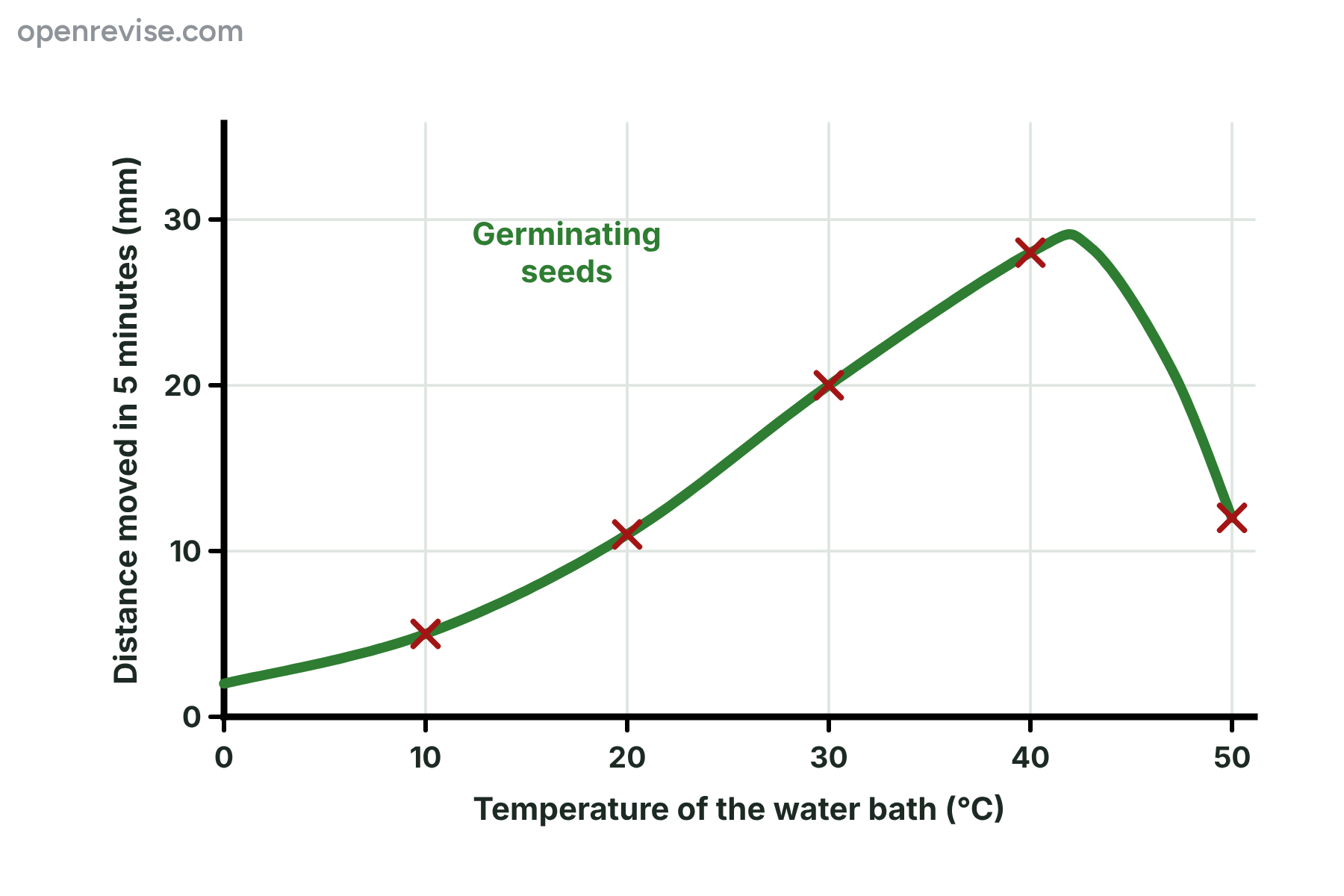
The rate rises with temperature until the enzymes begin to denature.
Improving the investigation
Examiners ask how to make results more accurate, more precise and more reliable.
-
Airtight apparatus
If the bung leaks, gas can move in or out and the drop will not show the oxygen used. Check the joints, and use the control tube to show whether the drop moves without respiration.
-
Equilibrate first
Leave the tubes in the water bath for several minutes before starting, because gas that is still warming up or cooling down changes its volume and moves the drop.
-
Repeats and means
Repeating each temperature three times and calculating a mean makes the results more reliable and shows up any anomalous result.
-
Better measurement
Use a ruler with 1 mm divisions, always read from the same edge of the drop, and keep the water temperature steady with a thermostatic water bath.
Case study
Reading a set of results
A class tested germinating seeds at five temperatures and measured the distance moved by the drop in 5 minutes. The distance rose from 5 mm at 10 degrees Celsius to 28 mm at 40 degrees, which is a rate of 1.0 mm per minute rising to 5.6 mm per minute. At 50 degrees it fell to 12 mm, a rate of 2.4 mm per minute, because the enzymes in the seeds were starting to denature. The control tube did not move.
The big idea
A respirometer measures the oxygen used by living organisms: soda lime removes the carbon dioxide, so the drop moves as the oxygen is used up.
Investigating respiration
Investigating respiration
-
Apparatus
- boiling tube
- soda lime
- cotton wool
- capillary tube
- coloured drop
- water bath
-
Variables
- temperature changed
- distance measured
- mass of seeds and time kept the same
-
Control
- glass beads or boiled seeds
- the drop should not move
-
Analysis
- distance divided by time
- volume is pi r squared h
- means
- graph
-
Safety and ethics
- soda lime is corrosive
- glass
- treat animals humanely
Summary and exam focus
- A respirometer measures the oxygen consumption of organisms: the volume of gas falls as oxygen is used, and the drop of coloured liquid moves towards the organisms.
- Soda lime absorbs the carbon dioxide, so only the oxygen used changes the volume.
- The independent variable is the temperature, the dependent variable is the distance moved by the drop, and the other variables are controlled.
- A control tube with glass beads or boiled seeds shows that the movement is caused by respiration.
- The rate is the distance divided by the time, and the volume is \(\pi r^2 h\); the rate rises with temperature until the enzymes denature.
Exam focus
A student uses a respirometer to investigate the effect of temperature on the respiration of germinating seeds. Describe how the student should carry out the investigation, and explain why soda lime is used. (6 marks) (6 marks)
Write the method in the order it is carried out, and name the independent variable, the dependent variable and at least two control variables. Explain the soda lime in full: it absorbs the carbon dioxide, so only the oxygen used changes the volume of gas. Mention the control tube and one safety point to reach the top marks.
Key terms
The words this lesson expects you to use. Each one is linked from the first place it appears above.
- Respirometer
- Apparatus that measures the rate of respiration of organisms by the oxygen they take in.
- Soda lime
- A chemical that absorbs carbon dioxide, so that only the oxygen used changes the volume of gas.
- Capillary tube
- A very thin glass tube in which a drop of coloured liquid moves as the volume of gas changes.
- Oxygen consumption
- The volume of oxygen used by organisms in a given time, a measure of the rate of aerobic respiration.
- Independent variable
- The variable that is deliberately changed in an investigation, here the temperature.
- Dependent variable
- The variable that is measured, here the distance moved by the drop of coloured liquid.
- Control variable
- A variable that is kept the same so that it does not affect the result.
- Control tube
- A tube with glass beads or dead seeds instead of living organisms, to show that the movement is caused by respiration.
- Anomalous result
- A result that does not fit the pattern of the other results and is probably caused by an error.
You've finished the notes
Check your understanding
Test yourself while it is fresh. Start with the flashcards, then try the exam questions.
Something here looks wrong?
Tell us what and we will go and look. It goes to whoever writes these pages, nobody else, and we do not ask who you are — so there is nothing to sign and nothing comes back to you.