Biology · Respiration
Anaerobic Respiration
Sometimes cells cannot get enough oxygen, or there is no oxygen at all, and they still have to release energy. This lesson is for both Combined Science and separate Biology. It covers anaerobic respiration in muscles and in yeast, oxygen debt, fermentation in brewing and baking, how aerobic and anaerobic respiration compare, and what exercise does to the body.
Learning Objectives
- 1Describe anaerobic respiration as the release of energy from glucose without using oxygen, and give the word equations for muscles and for yeast.
- 2Explain what is meant by oxygen debt and why lactic acid builds up in muscles during vigorous exercise.
- 3Describe fermentation in yeast and how it is used in brewing and baking.
- 4Compare aerobic and anaerobic respiration, including the efficiency of energy release, and explain the effects of exercise on the body.
Retrieval practice
-
1
Write the word equation for aerobic respiration.
Show answerHide answer
glucose + oxygen → carbon dioxide + water (+ energy).
-
2
Where do most of the reactions of aerobic respiration take place?
Show answerHide answer
In the mitochondria.
-
3
What does exothermic mean?
Show answerHide answer
A reaction that transfers energy to the surroundings.
-
4
What is yeast?
Show answerHide answer
A single-celled fungus.
When oxygen runs short
Aerobic respiration is the main way that most organisms release energy, but it needs oxygen. A sprinter's muscles can use energy faster than the blood can deliver oxygen, and the yeast in a sealed brewing vat or a ball of bread dough has almost no oxygen at all. In these cases cells switch to anaerobic respiration, which releases energy from glucose without using oxygen. It works quickly, but it releases much less energy from each glucose molecule, and what is left over depends on the organism.
Anaerobic respiration in muscles
Muscle cells can respire anaerobically for a short time when they are short of oxygen.
-
When it happens
During vigorous exercise, such as a sprint, muscles contract faster than the blood can bring them oxygen, so as well as aerobic respiration they respire anaerobically.
-
Word equation
glucose \(\rightarrow\) lactic acid, with a small amount of energy released. No carbon dioxide is made.
-
Lactic acid builds up
The lactic acid collects in the muscles and the blood. It causes muscle fatigue, so the muscles ache, tire and stop contracting efficiently.
-
A quick emergency supply
Anaerobic respiration is useful because it releases energy at once and without oxygen. It cannot be kept up for long, because the lactic acid builds up.
Oxygen debt and recovery
After vigorous exercise the body has to pay back the oxygen it did not have during the exercise.
-
Oxygen debt
The oxygen debt is the extra oxygen the body needs after exercise to break down the lactic acid that built up in the muscles.
-
Where the lactic acid goes
The blood carries the lactic acid from the muscles to the liver. There it is broken down using oxygen, and some is converted back to glucose.
-
Fast breathing and heartbeat
A person keeps breathing deeply and their heart rate stays high for several minutes after stopping. This takes in the extra oxygen and carries it to the muscles and liver, which is why you pant after a sprint.
-
Recovery time
The time that breathing rate and heart rate take to return to resting levels is the recovery time. A fitter person recovers faster, so the oxygen debt is repaid sooner.
Oxygen uptake before, during and after exercise
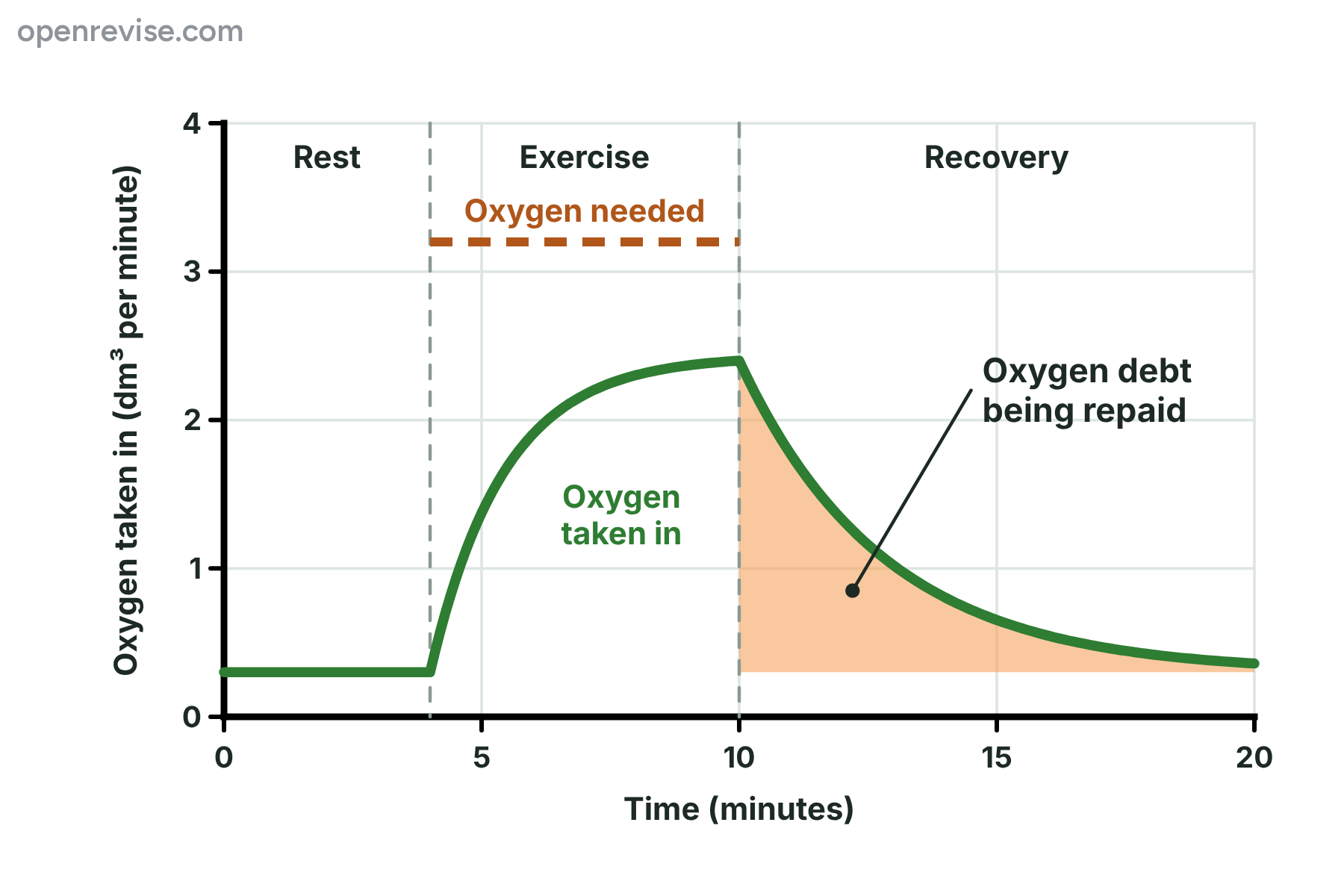
The shaded area shows the extra oxygen taken in after exercise to repay the oxygen debt.
Anaerobic respiration in yeast: fermentation
Yeast is a single-celled fungus. When it has no oxygen it respires anaerobically in a process called fermentation.
-
Word equation
glucose \(\rightarrow\) ethanol + carbon dioxide, with a small amount of energy released. Ethanol is the alcohol in drinks.
-
Different products from muscle cells
Yeast makes ethanol and carbon dioxide, not lactic acid. This is the main difference to learn between anaerobic respiration in yeast and in animal muscle.
-
Other organisms
Plant cells, such as the roots of a waterlogged plant, and some bacteria can also respire anaerobically to make ethanol and carbon dioxide.
-
Why no oxygen
If oxygen is present, yeast respires aerobically instead and makes carbon dioxide and water, so fermentation to ethanol only takes place when oxygen is absent.
Fermentation in brewing and baking
People have used yeast for thousands of years, and the two products of fermentation are each useful.
-
Brewing
Yeast is added to a sugary liquid, such as a barley extract for beer or grape juice for wine, in a closed vessel without oxygen. The ethanol makes the drink alcoholic and the carbon dioxide makes beer fizzy.
-
Baking
Yeast is mixed into bread dough with a little sugar. The carbon dioxide makes bubbles in the dough, which rises and is set by baking into a light, airy loaf. The ethanol evaporates in the hot oven.
-
Temperature matters
Yeast ferments fastest in a warm place, about 30 to 40 degrees Celsius, because its enzymes work best there. Dough is left somewhere warm to rise, and the yeast is killed in a hot oven.
-
Sealing the vessel
Brewers keep air out of the vessel so that the yeast ferments instead of respiring aerobically, which would make less ethanol.
Aerobic and anaerobic respiration compared
Aerobic respiration
- Needs oxygen
- Glucose is broken down completely to carbon dioxide and water
- Releases a large amount of energy from each glucose molecule
- Most of the reactions take place in the mitochondria
- Can be kept up for a long time without tiring the muscles
Anaerobic respiration
- Does not need oxygen
- Glucose is only partly broken down: to lactic acid in muscles, or to ethanol and carbon dioxide in yeast
- Releases much less energy from each glucose molecule
- Takes place in the cytoplasm
- Cannot be kept up for long in muscles, because lactic acid builds up
Three ways to release energy from glucose
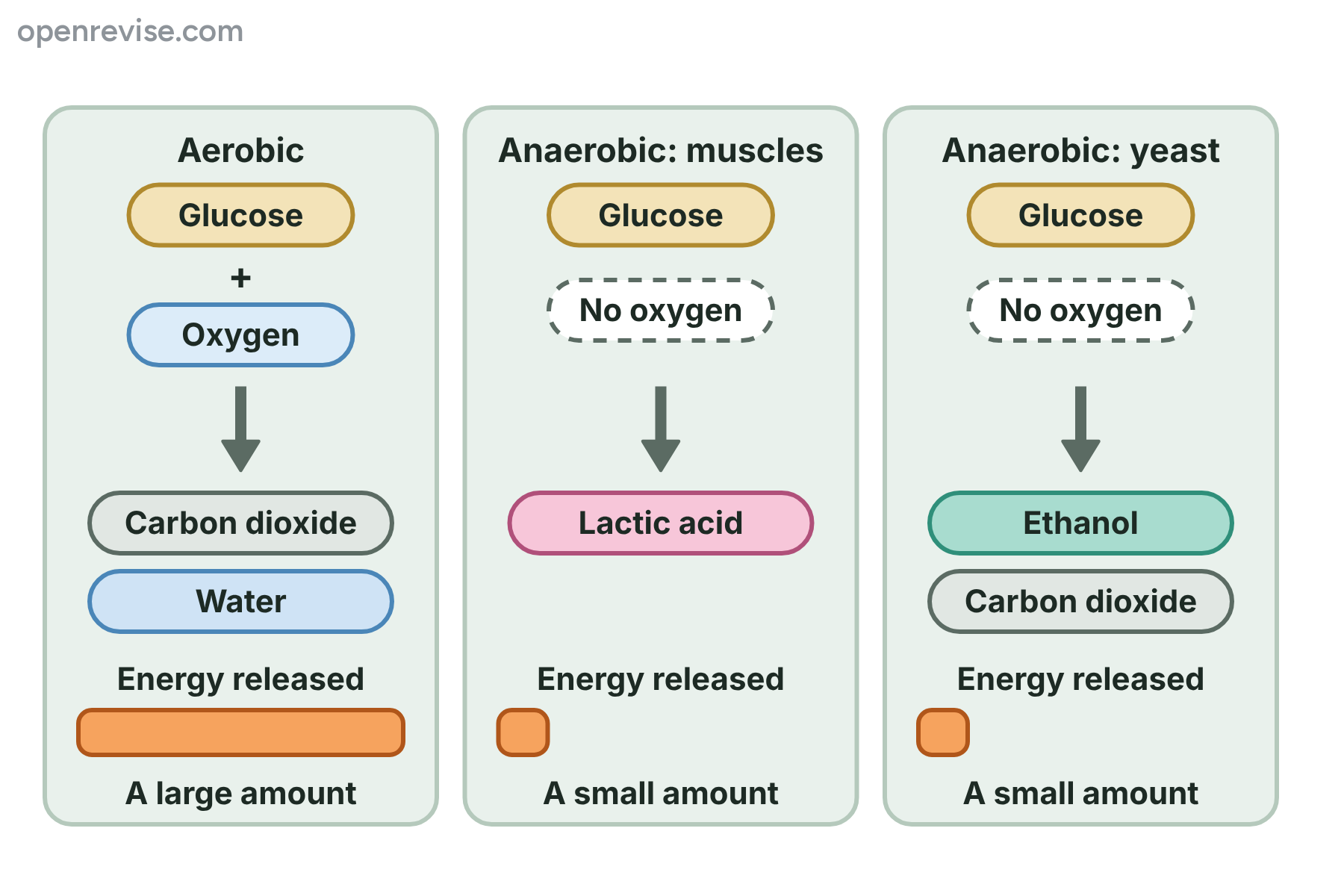
Aerobic respiration releases far more energy from the same glucose.
Efficiency of energy release
The big difference between the two types of respiration is how much of the energy in the glucose is released.
-
Complete and incomplete breakdown
In aerobic respiration the glucose is broken down completely, so most of its energy is released. In anaerobic respiration it is only partly broken down, and the lactic acid or ethanol that is left still contains a lot of energy.
-
How much difference
Aerobic respiration releases many times more energy from each glucose molecule, roughly fifteen times as much usable energy as anaerobic respiration.
-
What this means for muscles
A muscle that depends on anaerobic respiration has to use up glucose far faster to release the same amount of energy, which is why it cannot be kept up for long.
-
Why anaerobic still matters
It is still useful because it needs no oxygen and releases energy at once, giving a burst of energy in a sprint or in a cell that has no oxygen at all.
The effect of exercise
Exercise makes the muscles respire faster, and the body responds to supply them.
-
Heart rate and breathing rate
During exercise the muscle cells respire faster, so the heart rate and breathing rate increase, and each breath gets deeper. More oxygen arrives and more carbon dioxide is removed.
-
Gentle or vigorous
In gentle exercise the blood can deliver enough oxygen, so the muscles respire aerobically. In vigorous exercise it cannot, so they also respire anaerobically and lactic acid builds up.
-
After exercise
Heart rate and breathing rate stay high until the oxygen debt has been repaid and the lactic acid has been removed. They then fall back to resting levels.
-
Measuring the effect
You can measure the pulse in beats per minute and the breathing rate in breaths per minute at rest, straight after exercise and then every minute during recovery.
Percentage increase in heart rate
A student's pulse is 70 beats per minute at rest and 154 beats per minute straight after running. Calculate the percentage increase in her heart rate.
Show the solutionHide the solution
- 1 Find the increase \(154 - 70 = 84\) beats per minute
- 2 Divide by the starting value \(84 \div 70 = 1.2\)
- 3 Multiply by 100 \(1.2 \times 100 = 120\%\)
AnswerThe heart rate increased by 120%.
Case study
Investigating yeast and glucose
A suggested practical for this topic investigates how the concentration of glucose affects the rate of anaerobic respiration in yeast. Yeast is mixed with glucose solutions of different concentrations, a layer of oil is added to keep oxygen out, and the tubes are kept in a water bath at a constant warm temperature. The rate is found by counting the bubbles of carbon dioxide produced in a minute, or by measuring the volume of gas collected. The rate rises as the glucose concentration increases, then levels off when the yeast cannot use any more.
The big idea
Aerobic respiration releases far more energy from glucose, but anaerobic respiration works without oxygen and gives a quick burst of energy.
Anaerobic respiration
Anaerobic respiration
-
In muscles
- glucose to lactic acid
- fatigue
- vigorous exercise
-
Oxygen debt
- extra oxygen after exercise
- lactic acid broken down in the liver
-
In yeast
- fermentation
- ethanol and carbon dioxide
-
Uses
- brewing for ethanol
- baking for carbon dioxide
-
Compared with aerobic
- no oxygen
- much less energy
- cytoplasm
Summary and exam focus
- Anaerobic respiration releases energy from glucose without oxygen, but it releases much less energy than aerobic respiration.
- In muscles, glucose is converted to lactic acid, which causes muscle fatigue.
- The oxygen debt is the extra oxygen needed after exercise to break down the lactic acid.
- In yeast, fermentation changes glucose into ethanol and carbon dioxide, which is used in brewing and baking.
- Exercise increases heart rate and breathing rate, and vigorous exercise makes muscles respire anaerobically.
Exam focus
Compare aerobic respiration and anaerobic respiration in human muscle cells. (4 marks) (4 marks)
A comparison needs both sides in every point. Write sentences such as "Aerobic respiration needs oxygen but anaerobic respiration does not", and cover the oxygen, the products and the amount of energy released. A list of facts about only one type earns little.
Key terms
The words this lesson expects you to use. Each one is linked from the first place it appears above.
- Anaerobic respiration
- The release of energy from glucose without using oxygen, which releases much less energy than aerobic respiration.
- Lactic acid
- The product of anaerobic respiration in muscle cells, which causes muscle fatigue.
- Oxygen debt
- The extra oxygen needed after vigorous exercise to break down the lactic acid that has built up.
- Muscle fatigue
- The tiredness of muscles caused by a build-up of lactic acid, so they stop contracting efficiently.
- Fermentation
- Anaerobic respiration in yeast, which changes glucose into ethanol and carbon dioxide.
- Ethanol
- The alcohol made by yeast during fermentation, found in beer and wine.
- Yeast
- A single-celled fungus that can respire aerobically and anaerobically.
- Heart rate
- The number of times the heart beats in one minute.
- Recovery time
- The time taken for heart rate and breathing rate to return to resting levels after exercise.
You've finished the notes
Check your understanding
Test yourself while it is fresh. Start with the flashcards, then try the exam questions.
Something here looks wrong?
Tell us what and we will go and look. It goes to whoever writes these pages, nobody else, and we do not ask who you are — so there is nothing to sign and nothing comes back to you.