Biology · The Kidneys
Kidney Failure, Dialysis and Transplants
When the kidneys fail, urea and excess water and ions build up in the blood, and a patient will die without treatment. This lesson is for separate Biology only: Combined Science students do not need it. It describes the treatments for kidney failure, which are kidney dialysis and organ donation, and compares them.
Learning Objectives
- 1Describe what kidney failure is, and what happens to the body when the kidneys do not work.
- 2Describe how kidney dialysis works, including the role of the dialysis fluid and the partially permeable membrane.
- 3Describe how a kidney transplant works, and the problems of organ donation and rejection.
- 4Compare dialysis and kidney transplants, and evaluate the treatments.
Retrieval practice
-
1
What do the kidneys remove from the blood?
Show answerHide answer
Urea, excess water and excess ions.
-
2
What is diffusion?
Show answerHide answer
The net movement of particles from a high concentration to a low concentration.
-
3
What is an antigen?
Show answerHide answer
A molecule on the surface of a cell that the immune system can recognise.
-
4
What is a partially permeable membrane?
Show answerHide answer
A membrane that lets some substances pass through, but not others.
When the kidneys fail
The kidneys can be damaged by infection, by high blood pressure, by diabetes, or by an injury. When they fail, they can no longer remove urea, excess water and excess ions from the blood. These substances build up, and the person feels sick and tired, swells with fluid, and can die within days or weeks. There are two main treatments. The blood can be cleaned by a kidney dialysis machine, or a healthy kidney can be put into the patient from a donor, which is a kidney transplant. A person needs only one working kidney, so a living person can donate one.
Kidney dialysis
In dialysis, a machine does the job of the kidneys.
-
The machine
The blood of the patient flows out of the body into a dialysis machine, where it passes along a series of tubes, which are surrounded by dialysis fluid.
-
The membrane
The tubes have walls made of a partially permeable membrane, which allows small molecules, such as urea, to pass through, but not large molecules, such as proteins, or blood cells.
-
The dialysis fluid
It contains the right concentrations of glucose and ions, the same as in healthy blood, but it has no urea. So urea and excess ions diffuse out of the blood, into the fluid, and the glucose does not move.
-
Keeping the gradient
The dialysis fluid is replaced all the time, so the concentration gradient is kept high, and the urea keeps moving out.
-
Return
The cleaned blood returns to the patient.
-
How often
A patient usually needs dialysis about three times a week, for three to four hours each time, for as long as the kidneys are not working.
Kidney dialysis
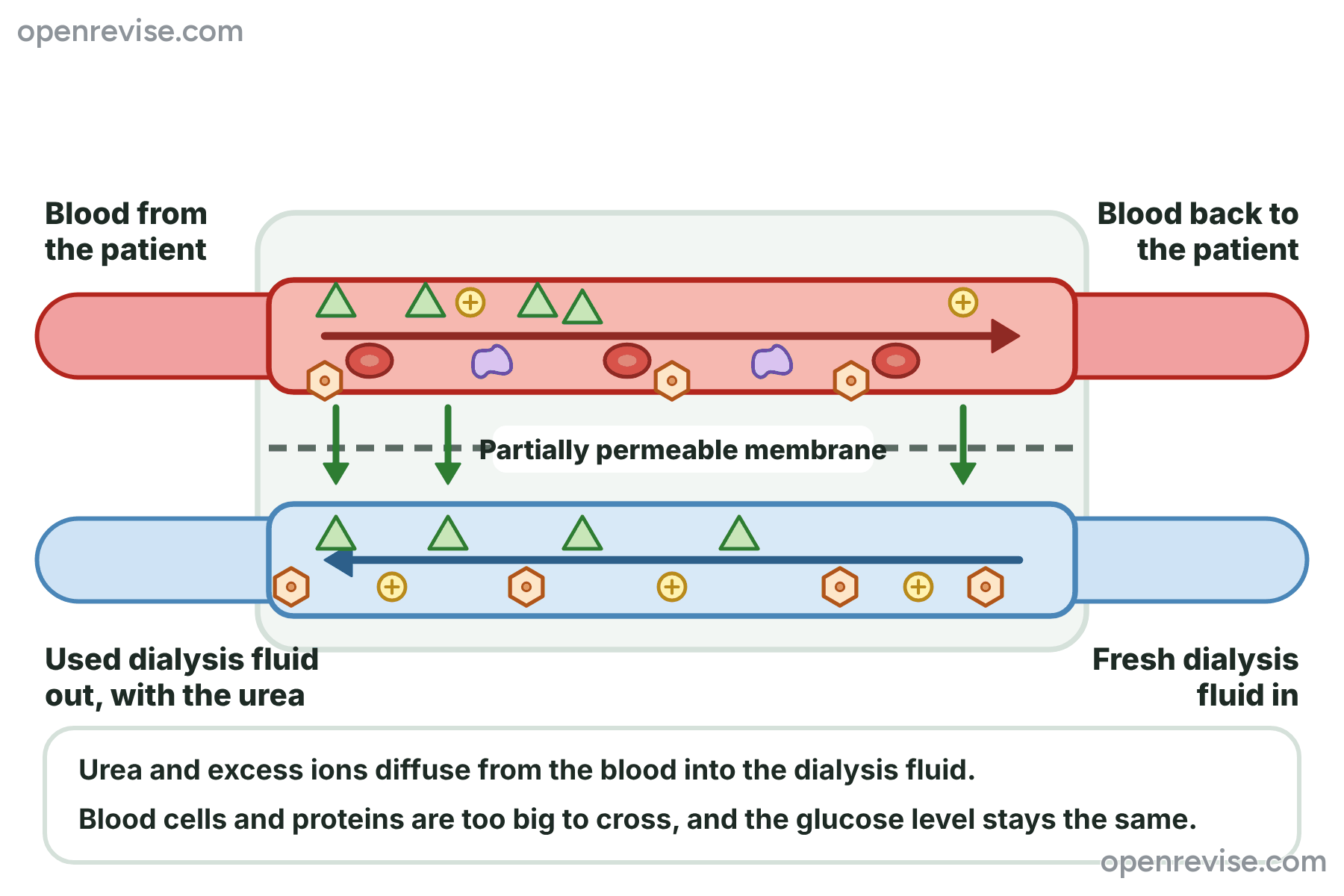
In dialysis, urea and excess ions diffuse from the blood into the dialysis fluid.
Kidney transplants
A transplant gives the patient a working kidney, from a donor.
-
The donor
The kidney may come from a person who has died, such as someone who has carried an organ donor card, or from a living person, often a relative, since a person can live with one kidney.
-
The operation
The donor kidney is placed in the abdomen of the patient. It is joined to the blood vessels and to the bladder. The patient's own kidneys are usually left in place.
-
Matching
The tissue type of the donor must be matched as closely as possible to the patient, so that the antigens on the cells are similar.
-
Rejection
The immune system of the patient can recognise the antigens on the donor kidney as foreign, and attack it. This is rejection.
-
Immunosuppressants
The patient takes drugs for the rest of their life, to suppress the immune system, and these make the patient more likely to get infections.
Comparing the treatments
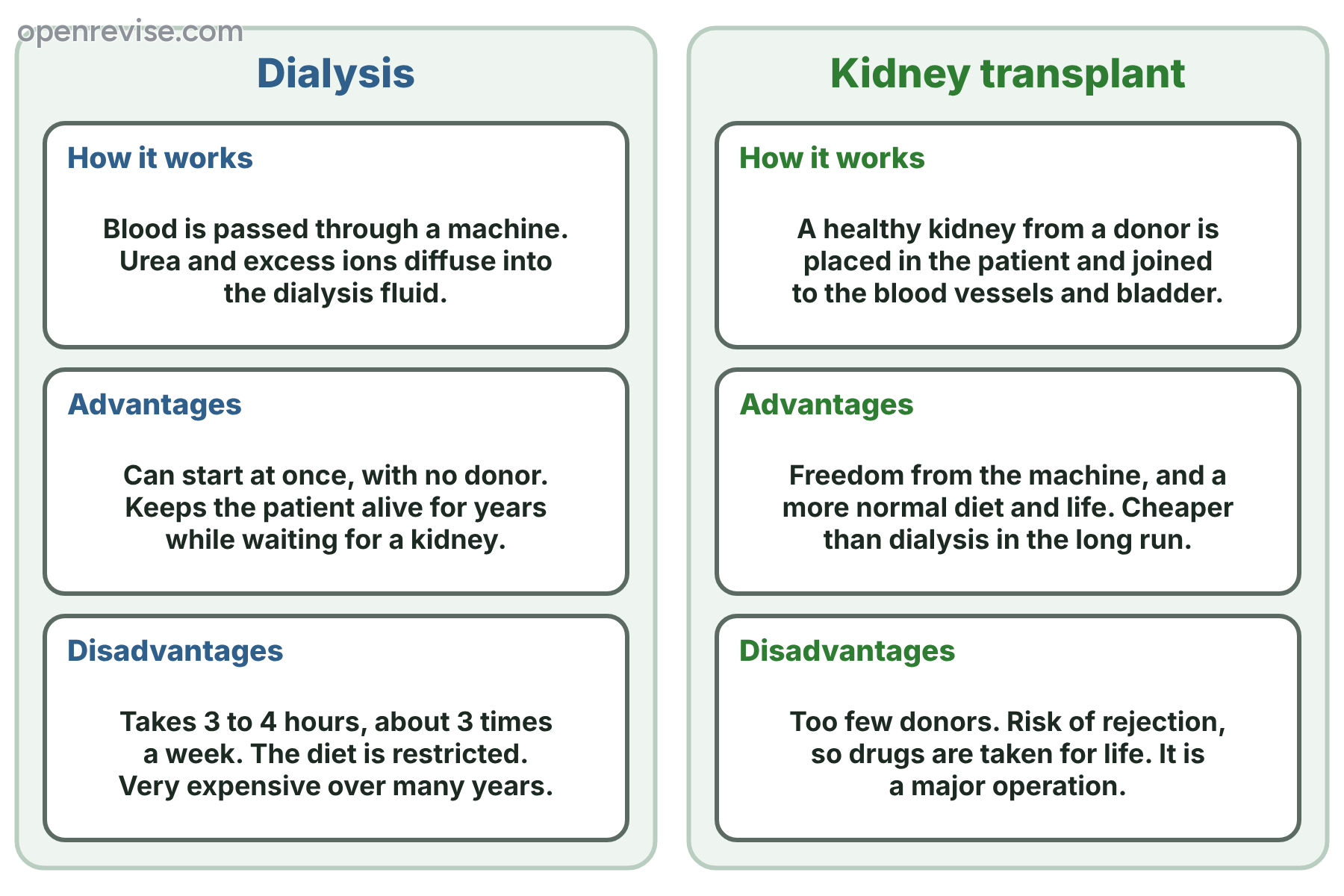
Dialysis keeps a patient alive, but a transplant gives a better quality of life, if a suitable donor can be found.
Dialysis and transplant
Dialysis
- A machine cleans the blood
- Needed about 3 times a week
- Available at once
- Expensive, and restricts diet
Transplant
- A donor kidney does the job
- Normal life if it works
- Needs a matching donor, so there may be a long wait
- Risk of rejection, and drugs for life
Why dialysis fluid has glucose
The dialysis fluid contains glucose at the same concentration as the blood of a healthy person. Explain why.
Show the solutionHide the solution
- 1 Same concentration There is no concentration gradient, so no net diffusion of glucose.
- 2 Useful substance Glucose is needed by the patient, so it must not be lost.
- 3 Waste Urea is not in the fluid, so there is a gradient, and it diffuses out.
- 4 Fluid replaced The fluid keeps the gradient for urea steep, and the glucose concentration is kept the same.
AnswerThe dialysis fluid has the same concentration of glucose as the blood, so there is no concentration gradient for glucose, and no net movement. So the glucose stays in the blood. If the fluid had no glucose, the glucose of the patient would diffuse out into the fluid, and be lost.
Case study
The shortage of donor kidneys
In many countries thousands of people are waiting for a kidney transplant, and not enough kidneys are available. Some people die while they wait. Different countries have tried different ways of increasing donations, such as an opt-out system, in which everyone is a donor unless they say that they do not want to be, and programmes where a living donor can give a kidney to a stranger. Some people have ethical objections to the use of organs, but most people agree that a kidney donated by a living person who has freely chosen to give it is acceptable. Research is also looking at making artificial kidneys and kidneys grown from stem cells.
Summary and exam focus
- In kidney failure, urea and excess water and ions build up in the blood.
- In dialysis, urea and excess ions diffuse out through a partially permeable membrane.
- Dialysis is needed about 3 times a week, and is expensive.
- A transplant gives a working kidney from a donor.
- Transplants can be rejected, so drugs are taken for life.
Exam focus
Compare dialysis and kidney transplants as treatments for kidney failure. (6 marks) (6 marks)
Describe how each treatment works in a line, then compare them in pairs: availability and waiting time, quality of life, cost, and risks, using the term rejection for transplants.
Key terms
The words this lesson expects you to use. Each one is linked from the first place it appears above.
- Kidney failure
- The condition in which the kidneys no longer filter the blood properly.
- Dialysis
- The treatment in which a machine cleans the blood.
- Dialysis fluid
- The fluid that contains the same glucose and ions as healthy blood, but no urea.
- Partially permeable membrane
- A membrane that allows small molecules to pass, but not large ones.
- Transplant
- The replacement of a failed organ with a donor organ.
- Donor
- A person who gives an organ.
- Rejection
- The attack by the immune system of the patient on a transplanted organ.
- Immunosuppressant
- A drug that reduces the activity of the immune system.
- Tissue type
- The pattern of antigens on a person's cells.
You've finished the notes
Check your understanding
Test yourself while it is fresh. Start with the flashcards, then try the exam questions.
Something here looks wrong?
Tell us what and we will go and look. It goes to whoever writes these pages, nobody else, and we do not ask who you are — so there is nothing to sign and nothing comes back to you.