Biology · The Kidneys
ADH and Water Balance (Higher tier)
You pass a small amount of dark urine on a hot day, and a large amount of pale urine after a big drink. This lesson is for separate Biology only, and for the Higher tier only: Combined Science and Foundation students do not need it. It explains how the hormone ADH changes the permeability of the collecting duct, and so controls the water content of the blood.
Learning Objectives
- 1(Higher tier) Describe how the water content of the blood is detected, and the role of the pituitary gland in releasing ADH.
- 2(Higher tier) Explain the effect of ADH on the permeability of the collecting duct.
- 3(Higher tier) Explain how the water content of the blood is controlled by negative feedback.
- 4(Higher tier) Predict and explain the volume and concentration of urine under different conditions.
Retrieval practice
-
1
What is the collecting duct?
Show answerHide answer
The tube in the kidney that carries urine, and in which water is reabsorbed.
-
2
What is osmosis?
Show answerHide answer
The net movement of water across a partially permeable membrane from a dilute to a more concentrated solution.
-
3
What is negative feedback?
Show answerHide answer
A response that reverses a change.
-
4
Which gland is the master gland?
Show answerHide answer
The pituitary gland.
Controlling the water content
The water content of the blood changes all the time, as we drink, sweat and breathe. The kidneys control it by changing the amount of water that is reabsorbed in the collecting ducts. The control uses the hormone ADH, which stands for antidiuretic hormone. It is released from the pituitary gland, and it makes the walls of the collecting duct more permeable to water, so more water is reabsorbed into the blood. The result is a small volume of concentrated urine. This is another example of negative feedback.
When the blood water content is too low
This happens on a hot day, after exercise, or if you do not drink enough.
-
Detection
The hypothalamus in the brain detects that the water content of the blood is too low, because the blood is too concentrated.
-
The hormone
The pituitary gland releases more ADH into the blood.
-
The target
ADH is carried by the blood to the kidneys, where it acts on the collecting ducts.
-
The effect
The walls of the collecting duct become more permeable to water, so more water is reabsorbed by osmosis, back into the blood.
-
The result
A small volume of concentrated urine is produced, and the water content of the blood rises back to normal.
When the blood water content is too high
This happens after a large drink.
-
Detection
The hypothalamus detects that the water content of the blood is too high, because the blood is too dilute.
-
The hormone
The pituitary gland releases less ADH.
-
The effect
The walls of the collecting duct become less permeable to water, so less water is reabsorbed.
-
The result
A large volume of dilute urine is produced, and the water content of the blood falls back to normal.
ADH and negative feedback
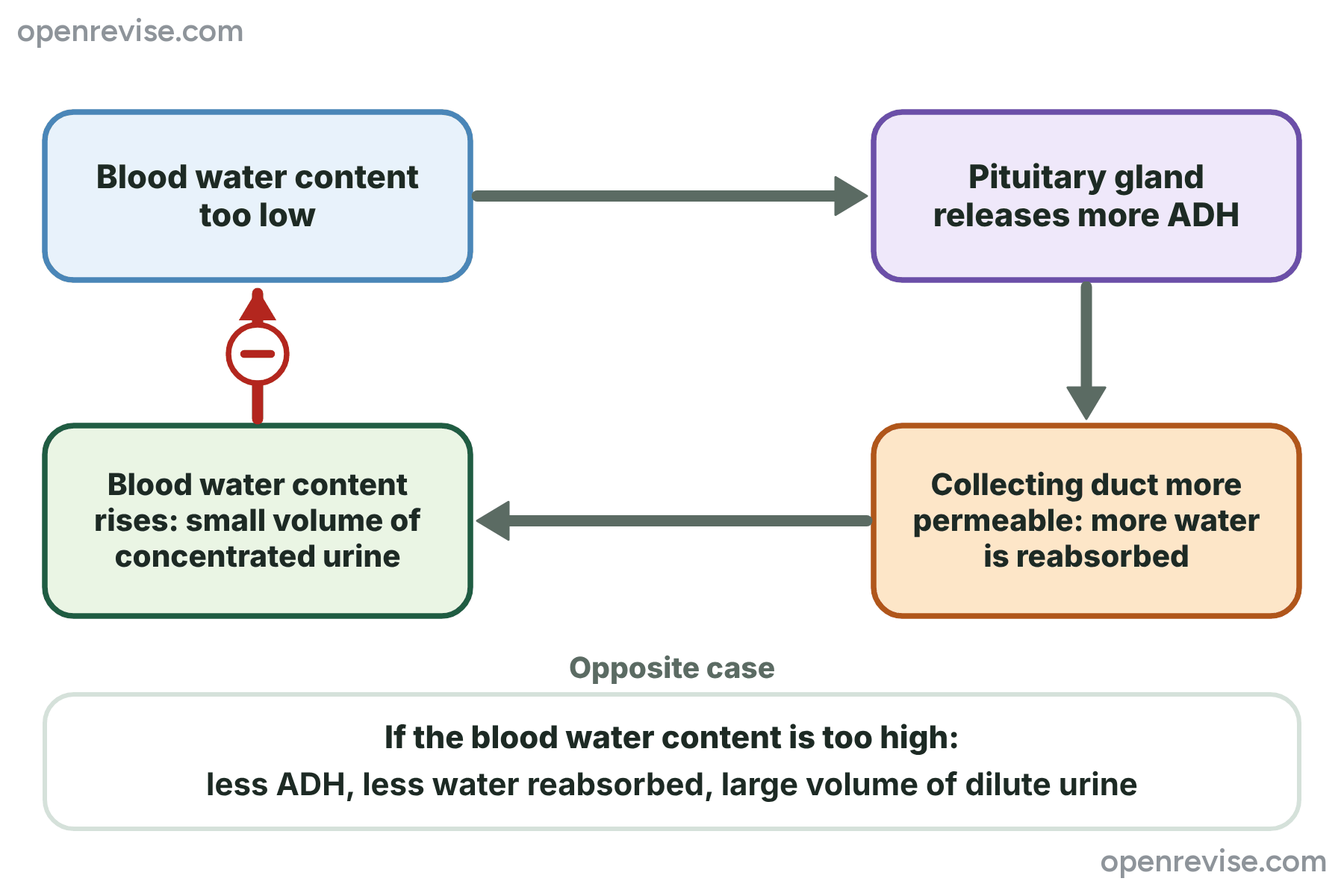
ADH makes the collecting duct more permeable, so more water is reabsorbed, which returns the water content to normal.
Hot day and cool day
Hot day, or after exercise
- More water lost in sweat
- Blood water content falls
- More ADH released
- Small volume of concentrated urine
Cool day, or after a large drink
- Less water lost, or more taken in
- Blood water content rises
- Less ADH released
- Large volume of dilute urine
Predicting the effect
A student goes for a long run on a hot day and does not drink. Predict what happens to the amount of ADH in the blood, and to the urine, and explain why.
Show the solutionHide the solution
- 1 Water lost Sweating lowers the water content of the blood.
- 2 Detection The hypothalamus detects the concentrated blood.
- 3 Response More ADH is released, so the collecting duct is more permeable.
- 4 Result More water is reabsorbed, and a small volume of concentrated, dark urine is produced.
AnswerThe amount of ADH rises, and the urine is a small volume of concentrated urine. The student loses water in sweat, so the water content of the blood falls, and the hypothalamus detects it. The pituitary gland releases more ADH, which makes the collecting ducts more permeable, so more water is reabsorbed into the blood.
Common errors
These mistakes are very common in answers about ADH.
-
Wrong organ
ADH acts on the collecting duct of the kidney. It is not released by the kidney.
-
Permeability
ADH changes the permeability of the collecting duct to water, and it does not make water go through by active transport. The water moves by osmosis.
-
Wrong direction
More ADH means more water is reabsorbed, and less urine.
-
Feedback
Say that the water content returns to normal, and so less ADH is released.
Case study
Diabetes insipidus
In a rare condition called diabetes insipidus, the pituitary gland does not release enough ADH, or the kidneys do not respond to it. The collecting ducts stay impermeable, so very little water is reabsorbed, and the person produces a very large volume of dilute urine, as much as 20 litres a day. The person is very thirsty, and can become dangerously dehydrated if they cannot drink enough. Patients who do not make ADH can be treated with a nasal spray of a drug that acts in the same way as ADH. This condition is not related to diabetes mellitus, which is a problem with insulin.
Summary and exam focus
- ADH is released from the pituitary gland.
- It makes the collecting duct more permeable to water.
- More water is reabsorbed, giving a small volume of concentrated urine.
- Less ADH gives a large volume of dilute urine.
- The system works by negative feedback.
Exam focus
Explain how the hormone ADH controls the water content of the blood. (6 marks) (6 marks)
Start with the detection of the change, then the release of ADH by the pituitary, then the effect on the permeability of the collecting duct, then the volume and concentration of the urine, and end with negative feedback.
Key terms
The words this lesson expects you to use. Each one is linked from the first place it appears above.
- ADH
- Antidiuretic hormone, which makes the collecting duct more permeable to water.
- Pituitary gland
- The gland at the base of the brain that releases ADH.
- Hypothalamus
- The part of the brain that detects the water content of the blood.
- Permeable
- Allowing a substance to pass through.
- Collecting duct
- The tube in the kidney in which the water content of the urine is adjusted.
- Concentrated urine
- Urine with little water, and a high concentration of urea.
- Dilute urine
- Urine with a lot of water.
- Osmoregulation
- The control of the water content of the body.
- Dehydration
- Loss of too much water from the body.
You've finished the notes
Check your understanding
Test yourself while it is fresh. Start with the flashcards, then try the exam questions.
Something here looks wrong?
Tell us what and we will go and look. It goes to whoever writes these pages, nobody else, and we do not ask who you are — so there is nothing to sign and nothing comes back to you.