Biology · The Kidneys
The Urinary System and Urea
Every day the kidneys filter about 180 litres of fluid from the blood, but only about 1.5 litres leave the body as urine. This lesson is for separate Biology only: Combined Science students do not need it. It describes the structure of the urinary system, and explains where urea comes from, and why it must be removed.
Learning Objectives
- 1Describe the structure of the urinary system, including the kidneys, the ureters, the bladder and the urethra.
- 2State that urea is produced from the breakdown of excess amino acids in the liver.
- 3Explain why urea must be removed from the blood.
- 4Describe the functions of the kidneys in excretion and in the control of water and ions.
Retrieval practice
-
1
What is excretion?
Show answerHide answer
The removal of waste products of metabolism from the body.
-
2
What are amino acids?
Show answerHide answer
The small molecules that proteins are made from.
-
3
What is the liver?
Show answerHide answer
An organ that processes digested food, makes urea and stores glycogen.
-
4
What is the blood plasma?
Show answerHide answer
The liquid part of the blood, which transports dissolved substances.
Removing waste
The reactions of the cells make waste products that must not be allowed to build up. Carbon dioxide is removed by the lungs. Urea is removed mainly by the kidneys, which filter the blood, take out the waste, and also regulate the amount of water and the amount of ions in the blood. The kidneys are part of the urinary system, which is a set of organs that make urine, store it, and pass it out of the body.
Where urea comes from
Urea is made in the liver, from amino acids.
-
Excess amino acids
The body can use amino acids to make proteins, but it cannot store them. Any amino acids that are not needed, for example from a high-protein meal, are broken down in the liver.
-
Breakdown
In the liver, the amino acids are broken down. The part that contains nitrogen is made into ammonia, which is poisonous, and then it is converted into urea, which is much less harmful.
-
Transport
Urea is released from the liver into the blood plasma, and carried to the kidneys.
-
Removal
The kidneys filter the urea out of the blood, and it leaves the body in the urine.
-
Why remove it
Urea is toxic if it builds up in the blood.
The parts of the urinary system
Each part has a job to do.
-
Kidneys
There are two. They filter the blood, and remove urea, excess water and excess ions, to make urine.
-
Renal artery
It brings blood, which contains urea, to each kidney.
-
Renal vein
It takes the filtered blood away from each kidney.
-
Ureters
They are two tubes, one from each kidney, which carry urine to the bladder.
-
Bladder
A muscular bag that stores urine until it is released.
-
Urethra
The tube that carries urine from the bladder out of the body.
The urinary system
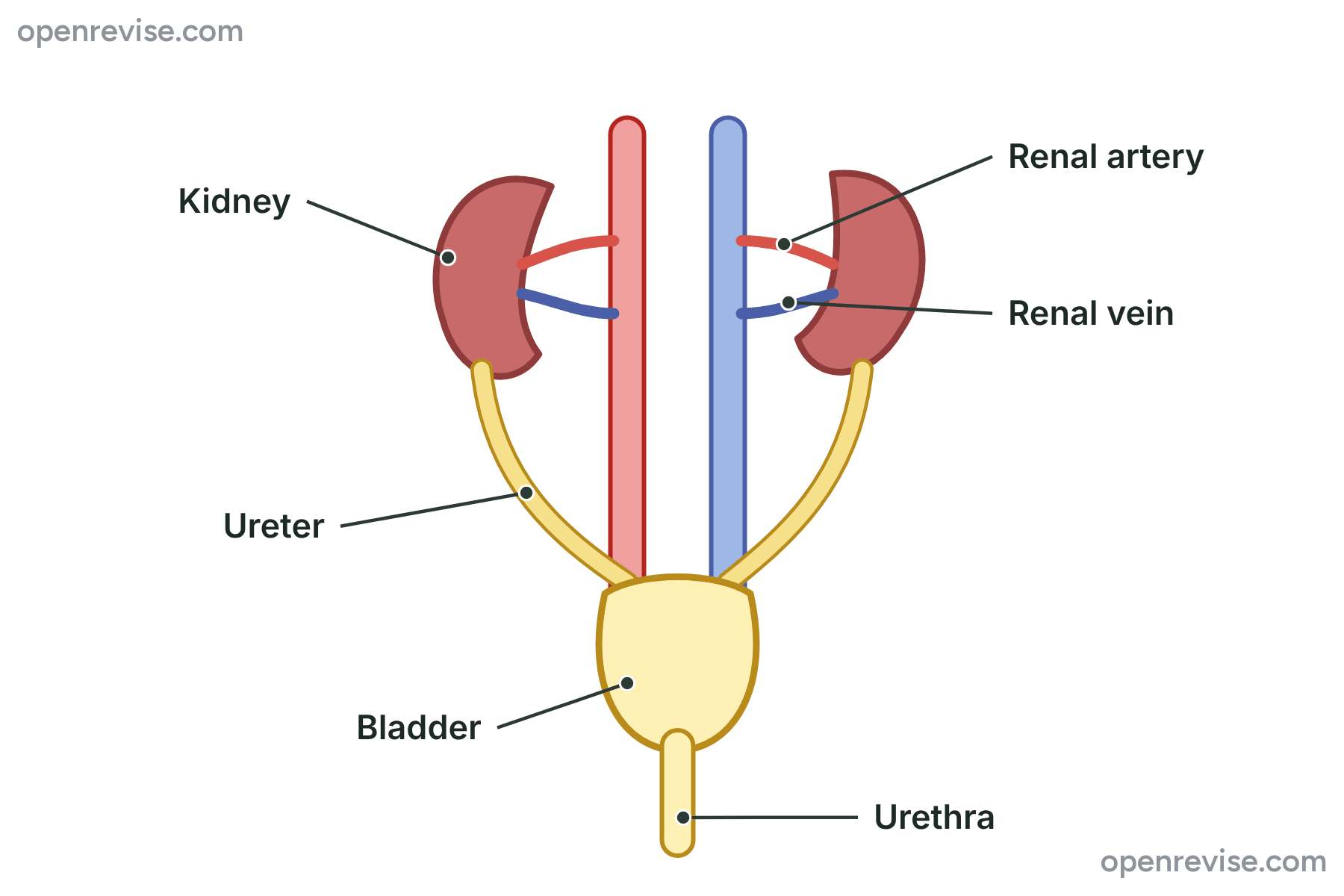
The kidneys make urine, which flows down the ureters to the bladder and leaves through the urethra.
Blood entering and leaving a kidney
Blood in the renal artery
- Contains urea
- Contains water, glucose and ions
- Comes from the heart and the body
- Has a high urea concentration
Blood in the renal vein
- Has very little urea
- Has the right amount of water and ions
- Goes back to the heart
- Has a low urea concentration
Following a molecule of urea
A person eats a large meal containing a lot of protein. Describe how the excess amino acids are removed from the body, in order.
Show the solutionHide the solution
- 1 Liver Excess amino acids are broken down, and urea is made.
- 2 Blood Urea is carried in the plasma to the kidneys.
- 3 Kidney The urea is filtered out, and becomes part of the urine.
- 4 Out of the body The urine goes down the ureter to the bladder, and leaves through the urethra.
AnswerThe excess amino acids are broken down in the liver, which makes urea. The urea is carried in the blood plasma to the kidneys. The kidneys filter the urea out of the blood, so it is in the urine, which goes down the ureters to the bladder, and leaves through the urethra.
Case study
Why a high-protein diet needs water
A person who eats a lot of protein has a lot of excess amino acids, so the liver makes more urea. The kidneys have to remove more urea, and they need water to carry it out in the urine. This is one reason why people on a high-protein diet, such as some athletes, are advised to drink more water. If the person does not drink enough, the urine becomes very concentrated, and the kidneys have to work harder.
Summary and exam focus
- The urinary system has the kidneys, ureters, bladder and urethra.
- Urea is made in the liver from the breakdown of excess amino acids.
- Urea is carried in the blood to the kidneys.
- The kidneys filter the blood and make urine.
- Urine is stored in the bladder, and leaves through the urethra.
Exam focus
Describe the structure of the urinary system, and explain where urea is made and how it leaves the body. (5 marks) (5 marks)
Name the parts in the order that the urine flows, and give the job of each: kidney, ureter, bladder, urethra. Then say that urea is made in the liver from excess amino acids.
Key terms
The words this lesson expects you to use. Each one is linked from the first place it appears above.
- Kidney
- An organ that filters the blood, and makes urine.
- Ureter
- A tube that carries urine from the kidney to the bladder.
- Bladder
- A muscular bag that stores urine.
- Urethra
- The tube that carries urine out of the body.
- Urea
- A waste product that is made in the liver from excess amino acids.
- Urine
- The liquid that contains urea, excess water and excess ions.
- Excretion
- The removal of waste products of metabolism from the body.
- Renal
- Relating to the kidney.
- Amino acid
- The small molecule that proteins are made from.
You've finished the notes
Check your understanding
Test yourself while it is fresh. Start with the flashcards, then try the exam questions.
Something here looks wrong?
Tell us what and we will go and look. It goes to whoever writes these pages, nobody else, and we do not ask who you are — so there is nothing to sign and nothing comes back to you.