Biology · The Kidneys
The Nephron and the Formation of Urine
Each kidney contains about a million tiny filtering units. This lesson is for separate Biology only: Combined Science students do not need it. It explains how the structure of the nephron is related to its function, with filtration in the glomerulus and Bowman's capsule, the selective reabsorption of glucose, and the reabsorption of water.
Learning Objectives
- 1Describe the structure of the nephron, including the glomerulus, Bowman's capsule, the tubule, the loop of Henle and the collecting duct.
- 2Explain how filtration takes place in the glomerulus and Bowman's capsule.
- 3Explain how the selective reabsorption of glucose takes place, and why all of it is reabsorbed.
- 4Explain how water is reabsorbed, and interpret data on the composition of blood, filtrate and urine.
Retrieval practice
-
1
What is diffusion?
Show answerHide answer
The net movement of particles from a high concentration to a low concentration.
-
2
What is active transport?
Show answerHide answer
The movement of substances against a concentration gradient, using energy from respiration.
-
3
What is osmosis?
Show answerHide answer
The net movement of water across a partially permeable membrane from a dilute solution to a more concentrated solution.
-
4
What is urea?
Show answerHide answer
A waste product made in the liver from excess amino acids.
The filter inside the kidney
The kidney is made of about a million tiny tubes called nephrons. Each nephron has a ball of capillaries, which is the glomerulus, held in a cup called Bowman's capsule, and a long tubule that leads to a collecting duct. Blood is filtered under high pressure in the capsule, and then the useful substances are taken back into the blood from the tubule. What is left is the urine. The process has three stages: filtration, selective reabsorption, and the release of urine.
Stage 1: filtration
Filtration takes place in the glomerulus and Bowman's capsule.
-
High pressure
Blood flows into the glomerulus in a wide vessel, and leaves in a narrower one, so the pressure in the capillaries is high.
-
Small molecules leave
The high pressure forces water, glucose, urea and ions through the thin walls of the capillary and the capsule, into the tubule. The liquid in the capsule is the filtrate.
-
Large molecules stay
Blood cells and large proteins are too big to pass through, so they stay in the blood.
-
Not selective
The filtration is not selective, so useful substances, such as glucose, are filtered out as well as the waste.
Stage 2: selective reabsorption
The useful substances are taken back into the blood, as the filtrate flows along the tubule.
-
All the glucose
Glucose is reabsorbed in the first part of the tubule. It is moved from the filtrate into the blood by active transport, against a concentration gradient. This needs energy from respiration, so the cells have many mitochondria. All of the glucose is normally reabsorbed, so there is none in the urine.
-
Water
Water is reabsorbed by osmosis, along the tubule, in the loop of Henle, and in the collecting duct. The amount that is reabsorbed is controlled by the hormone ADH.
-
Ions
Some ions are reabsorbed, and the amount depends on the needs of the body.
-
Urea
Urea is not reabsorbed, so it stays in the tubule, and it becomes more concentrated as the water is taken away.
The structure of a nephron
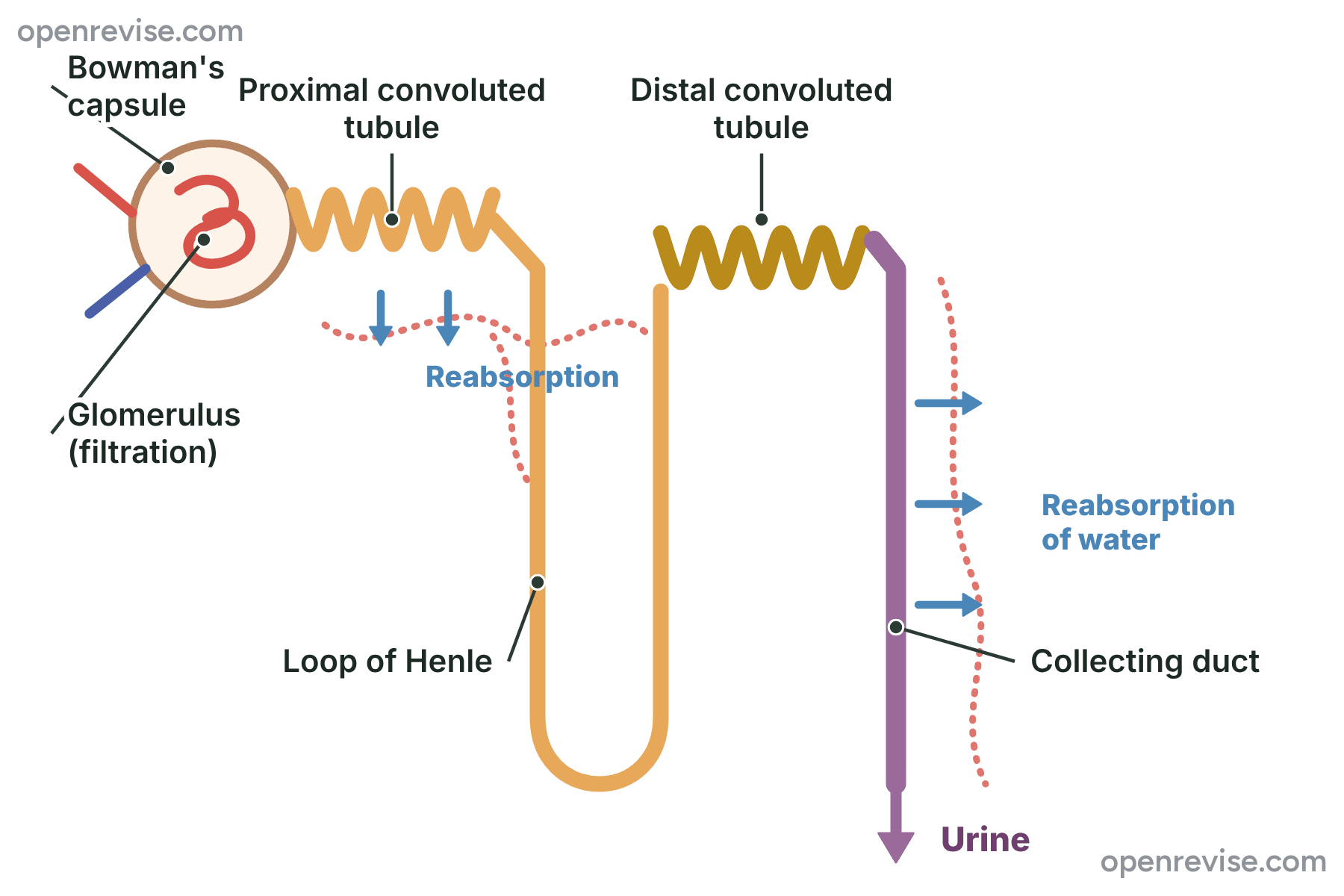
Blood is filtered in the glomerulus and the capsule, and useful substances are reabsorbed from the tubule.
What happens to the substances
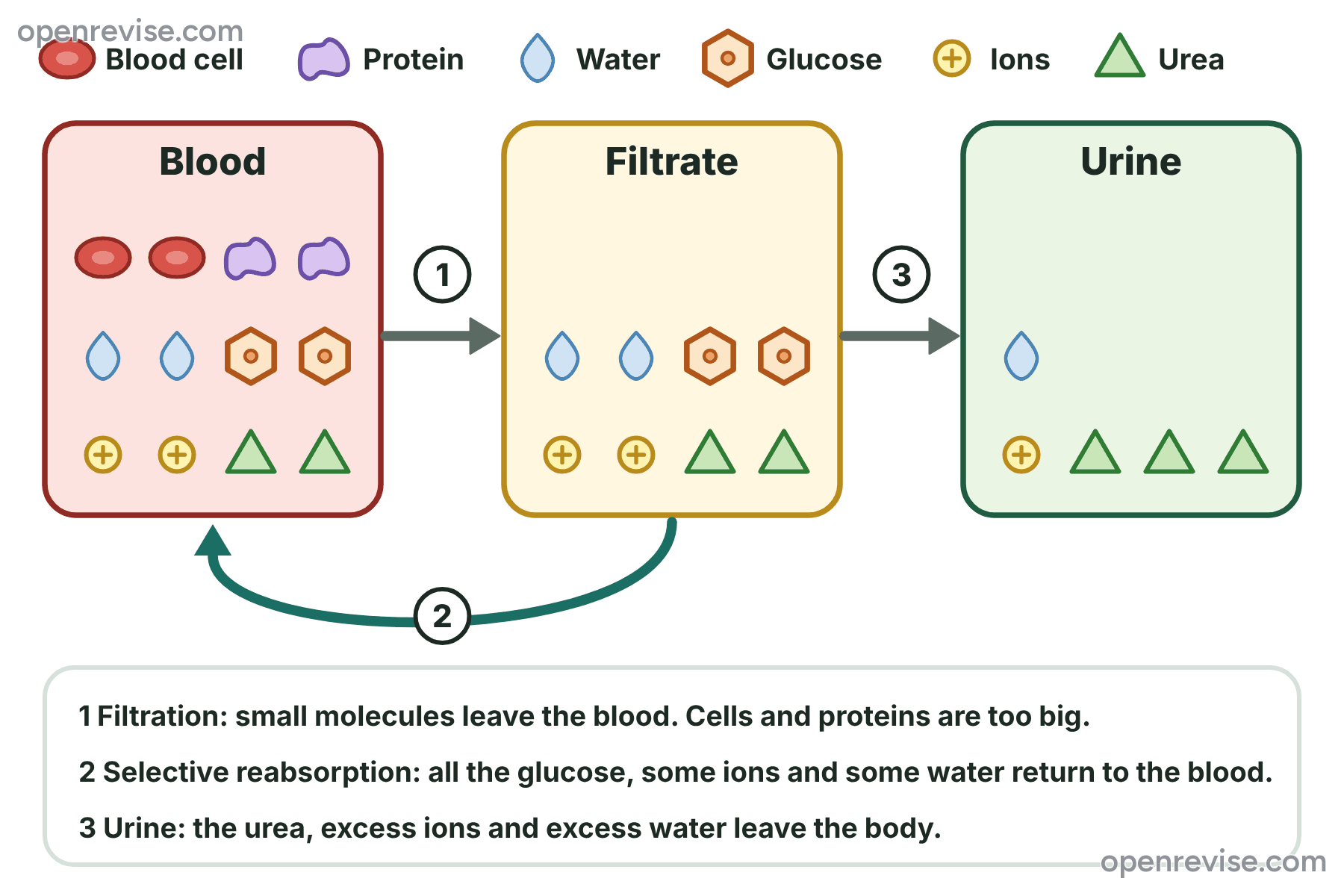
Filtration is not selective, but reabsorption is, so urine has urea and no glucose.
Blood plasma, filtrate and urine compared
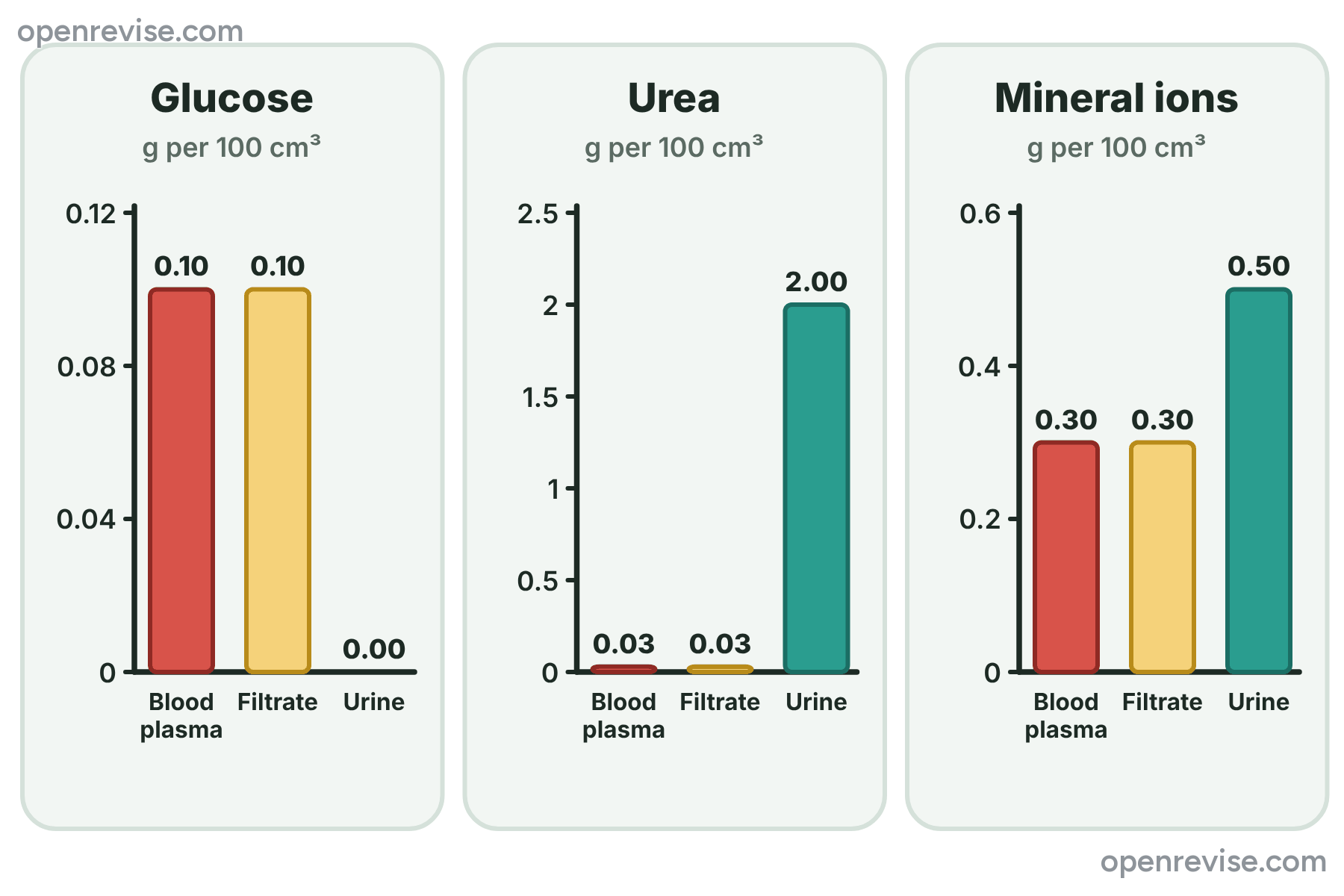
Glucose is in the plasma and the filtrate, but not in the urine, and urea is much more concentrated in the urine.
Filtration and reabsorption
Filtration
- In the glomerulus and Bowman's capsule
- Uses high pressure
- Not selective: it depends on size
- Water, glucose, urea and ions leave the blood
Selective reabsorption
- Along the tubule and collecting duct
- Glucose by active transport, which needs energy
- Water by osmosis
- Useful substances return to the blood
Interpreting the data
The concentration of glucose is 0.10 g per 100 cm³ in the plasma and in the filtrate, and 0.00 in the urine. The concentration of urea is 0.03 in the plasma and 2.00 in the urine. Explain these results.
Show the solutionHide the solution
- 1 Glucose in the filtrate The concentration is the same as in the plasma, because filtration is not selective.
- 2 Glucose in the urine It is 0.00, because all of it is reabsorbed by active transport.
- 3 Urea It is not reabsorbed, and the reabsorption of water makes it more concentrated.
- 4 Calculation 2.00 divided by 0.03 is about 67.
AnswerGlucose is small, so it is filtered into the filtrate, but all of it is reabsorbed into the blood by active transport, so there is none in the urine. Urea is filtered but is not reabsorbed, and water is reabsorbed, so the urea becomes more concentrated, 2.00 compared with 0.03, which is about 67 times more concentrated.
How the structure suits the function
The structures of the nephron are related to the functions.
-
Glomerulus
A ball of capillaries with a high pressure and thin walls, which forces small molecules out.
-
Bowman's capsule
A cup that surrounds the glomerulus and collects the filtrate.
-
Proximal tubule
Has cells with microvilli, to give a large surface area, and many mitochondria, to provide energy for active transport.
-
Loop of Henle and collecting duct
They reabsorb water, so that the urine can be concentrated.
-
Blood capillaries
They surround the tubule, with a good supply of blood, which keeps the concentration gradients steady.
Case study
Glucose in the urine
A healthy person has no glucose in the urine, because the carrier proteins that reabsorb the glucose can take up all of it. In a person with untreated diabetes, the blood glucose is so high that the filtrate contains more glucose than the carriers can reabsorb, so some glucose stays in the tubule, and is found in the urine. Doctors used to test for diabetes by testing the urine for glucose, and test strips are still used. The glucose in the tubule also keeps water in the urine, which is why people with diabetes pass a large volume of urine and are very thirsty.
Summary and exam focus
- Filtration in the glomerulus and capsule is by high pressure and size.
- Blood cells and proteins stay in the blood.
- All of the glucose is reabsorbed by active transport.
- Water is reabsorbed by osmosis.
- Urea, excess ions and excess water leave in the urine.
Exam focus
Explain how the structure of the nephron is related to its function in filtering the blood and forming urine. (6 marks) (6 marks)
Go through the nephron in order: glomerulus and capsule for filtration with high pressure, then the tubule for the reabsorption of all the glucose by active transport, then water. State which substances stay in the blood and which are in the urine.
Key terms
The words this lesson expects you to use. Each one is linked from the first place it appears above.
- Nephron
- A tiny filtering unit of the kidney.
- Glomerulus
- A ball of capillaries in Bowman's capsule, where the blood is filtered.
- Bowman's capsule
- A cup around the glomerulus that collects the filtrate.
- Filtrate
- The liquid that is filtered from the blood into the nephron.
- Selective reabsorption
- The movement of useful substances from the filtrate back into the blood.
- Loop of Henle
- The part of the tubule that reabsorbs water.
- Collecting duct
- The tube that carries urine, and in which water is reabsorbed.
- Active transport
- The movement of substances against a concentration gradient, using energy.
- Ultrafiltration
- Filtration under high pressure, in which small molecules are forced out.
You've finished the notes
Check your understanding
Test yourself while it is fresh. Start with the flashcards, then try the exam questions.
Something here looks wrong?
Tell us what and we will go and look. It goes to whoever writes these pages, nobody else, and we do not ask who you are — so there is nothing to sign and nothing comes back to you.