Biology · The Endocrine System
Plant Hormones
Plants have no nerves, but they still respond to light, gravity and other stimuli, using hormones. This lesson is for separate Biology. It covers how auxin causes phototropism and gravitropism, the effects of gibberellins and ethene, and how people use plant hormones to control growth.
Learning Objectives
- 1Explain how plant hormones are important in the control and coordination of plant growth and development.
- 2Explain how an unequal distribution of auxin causes phototropism and gravitropism.
- 3Describe the effects of auxins, gibberellins and ethene on plants.
- 4Describe some of the ways in which people use plant hormones to control plant growth.
Retrieval practice
-
1
What is a hormone?
Show answerHide answer
A chemical messenger that is carried around the body and affects target tissues.
-
2
What is a stimulus?
Show answerHide answer
A change in the surroundings that can be detected.
-
3
What process makes plants grow longer?
Show answerHide answer
Cells getting longer, called elongation, and dividing.
-
4
What is a meristem?
Show answerHide answer
A region at the tip of a shoot or root where stem cells divide.
Responding without nerves
A plant cannot move from place to place, but it can grow towards the light and its roots can grow down into the soil. These are responses to stimuli, and they are coordinated by plant hormones, which are chemicals that regulate plant growth and development. Unlike animal hormones they are not made in special glands. They are made in several places and move through the plant tissues.
Auxin and tropisms
A tropism is a growth response to a stimulus in a particular direction. Auxin is the hormone that controls the main ones.
-
Auxin
A plant hormone made in the tips of shoots and roots. It moves down the plant.
-
In shoots
Auxin makes the cells elongate, which makes the shoot grow longer.
-
In roots
Auxin in high concentration stops the cells elongating.
-
Unequal distribution
If auxin collects on one side of a shoot or root, the two sides grow at different speeds, and the plant bends.
Phototropism and gravitropism
Plants respond to light and to gravity by unequal growth.
-
Phototropism
A growth response to light. A shoot grows towards the light. Auxin moves to the shaded side of the shoot, where it makes the cells elongate more, so the shoot bends towards the light.
-
Gravitropism
A growth response to gravity. A root grows down, in the direction of gravity. Auxin collects on the lower side of the root, where it stops the cells elongating, so the upper side grows faster and the root bends downwards.
-
Shoots and gravity
A shoot grows up, away from gravity. Auxin collects on the lower side of the shoot, where it makes the cells elongate more, so the shoot bends upwards.
-
Why it helps
Growing towards light helps a shoot to photosynthesise, and growing roots down anchors the plant and takes in water.
How auxin bends a shoot and a root
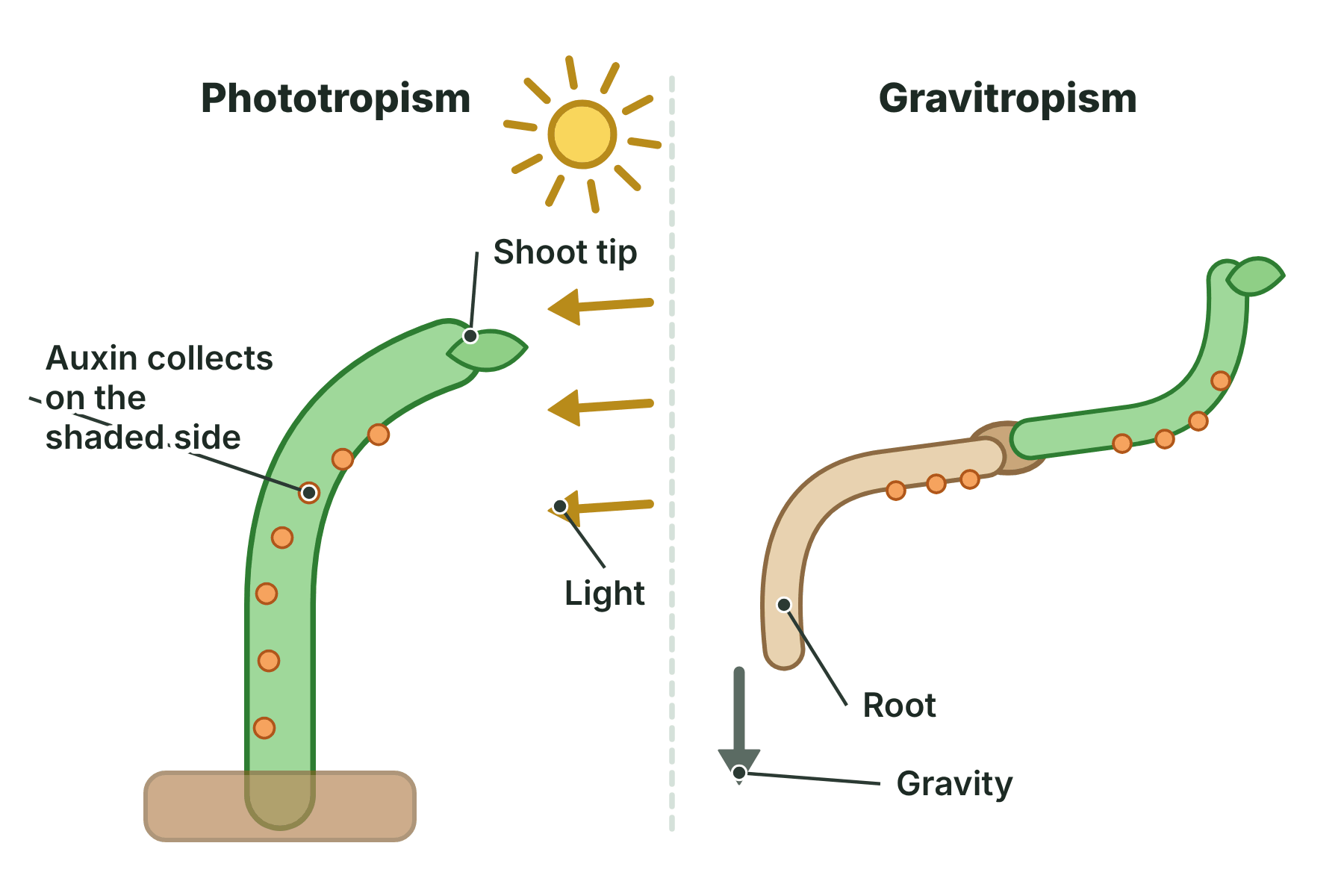
Unequal auxin makes one side of a shoot or root grow faster than the other.
Gibberellins and ethene
Other plant hormones have different jobs.
-
Gibberellins
Break the dormancy of seeds, so that they germinate. They also stimulate stem growth and flowering and help fruit to grow.
-
Ethene
A gas that makes fruit ripen. It also controls the opening of flowers and the shedding of leaves and fruit.
-
Controlling growth
Hormones control germination, growth, the ripening of fruit, the opening of flowers and the shedding of leaves.
Three plant hormones
Auxin
- Made in shoot and root tips
- Makes cells in shoots elongate
- Causes phototropism and gravitropism
- Used in weedkillers and rooting powder
Gibberellins and ethene
- Gibberellins: germination, stem growth, flowering
- Ethene: fruit ripening, leaf and fruit fall
- Ethene is a gas
- Used to control ripening and germination
Uses of plant hormones
People use plant hormones, and chemicals that act like them, to control the growth of crops and garden plants.
-
Selective weedkillers
Synthetic auxins make weeds with broad leaves grow too fast, so that they die. Narrow-leaved crops such as wheat are not affected.
-
Rooting powder
Auxin on the cut end of a stem makes roots grow, so that cuttings take root quickly.
-
Seedless fruit
Spraying unpollinated flowers with auxin makes the fruit develop without seeds.
-
Ripening fruit
Fruit such as bananas can be picked unripe and transported, and then ripened with ethene when it arrives.
-
Delaying or controlling dormancy
Gibberellins can end the dormancy of seeds, so they germinate together, and other chemicals can hold back ripening or leaf fall.
Case study
Ripening bananas
Bananas are grown in hot countries and picked while they are still green and hard. Green bananas are less easily bruised on the long journey by ship. When they arrive in the shops' warehouses, they are put into rooms containing ethene gas. The ethene makes them ripen quickly, so they are yellow and ready to eat when the shops need them.
The big idea
Plant hormones, such as auxin, coordinate growth, and the unequal distribution of auxin makes shoots grow towards light and roots grow down.
Plant hormones
Plant hormones
-
Auxin
- elongation
- phototropism and gravitropism
-
Gibberellins
- germination
- stem growth
- flowering
-
Ethene
- fruit ripening
- leaf and fruit fall
-
Uses
- weedkillers
- rooting powder
- seedless fruit
- ripening
-
Unequal growth
- a plant bends towards a stimulus
Summary and exam focus
- Plant hormones are chemicals that regulate plant growth and development.
- Auxin is made in the tips of shoots and roots, and an unequal distribution of auxin causes tropisms.
- Auxin moves to the shaded side of a shoot, making it bend towards the light.
- Gibberellins control seed germination and stem growth, and ethene controls fruit ripening.
- Plant hormones are used in weedkillers, rooting powders, to make seedless fruit and to ripen fruit.
Exam focus
Explain how auxin causes a shoot to grow towards the light. (4 marks) (4 marks)
Write the steps in order: light is from one side, auxin moves to the shaded side, cells on the shaded side elongate more, and so the shoot bends towards the light.
Key terms
The words this lesson expects you to use. Each one is linked from the first place it appears above.
- Plant hormone
- A chemical that regulates plant growth and development.
- Auxin
- A plant hormone made in shoot and root tips that controls growth.
- Phototropism
- Growth of a plant in response to light.
- Gravitropism
- Growth of a plant in response to gravity.
- Gibberellin
- A plant hormone that breaks seed dormancy and stimulates stem growth.
- Ethene
- A plant hormone, a gas, that makes fruit ripen.
- Tropism
- A growth response of a plant to a stimulus in a particular direction.
- Dormancy
- A resting state of a seed, in which it does not germinate.
You've finished the notes
Check your understanding
Test yourself while it is fresh. Start with the flashcards, then try the exam questions.
Something here looks wrong?
Tell us what and we will go and look. It goes to whoever writes these pages, nobody else, and we do not ask who you are — so there is nothing to sign and nothing comes back to you.