Biology · The Endocrine System
Contraception and Fertility Treatment
Hormones can be used to prevent pregnancy and to help people who cannot conceive. This lesson covers hormonal and non-hormonal contraception and how to evaluate them, and for Higher tier students how hormones are used in fertility treatments such as IVF.
Learning Objectives
- 1Explain the use of hormones in contraception.
- 2Evaluate hormonal and non-hormonal methods of contraception, using data on their relative effectiveness.
- 3(Higher tier) Explain the use of hormones in modern reproductive technologies to treat infertility.
- 4(Higher tier) Describe the stages of IVF and evaluate its advantages and disadvantages.
Retrieval practice
-
1
What does FSH do?
Show answerHide answer
Makes an egg mature in an ovary.
-
2
What causes ovulation?
Show answerHide answer
A surge of LH.
-
3
What does progesterone do?
Show answerHide answer
Maintains the lining of the uterus.
-
4
What does oestrogen do to FSH release?
Show answerHide answer
A high level stops it.
Choosing whether to have a child
Contraception lets people choose when, or whether, to have children. Some methods stop an egg being released, some stop sperm reaching it, and some stop an embryo from implanting. Hormones can also help in the opposite situation, when a couple find it difficult to conceive. Understanding how the hormones of the menstrual cycle work makes it possible to control fertility in both directions.
Hormonal methods of contraception
Hormonal methods use hormones to change the menstrual cycle so that pregnancy is unlikely.
-
The combined pill
Contains oestrogen and progesterone. These keep the level of the hormones high, so the pituitary gland does not release FSH and no egg matures. It is taken daily.
-
The progesterone-only pill, injection and implant
Progesterone thickens the mucus at the cervix, so sperm cannot pass, and can stop the release of an egg. The injection and the implant release hormone slowly, for weeks to years.
-
The patch
A patch on the skin releases hormones into the blood.
-
Effect
When used correctly these methods are very effective, but they do not protect against sexually transmitted infections.
Non-hormonal methods of contraception
Other methods do not use hormones.
-
Condoms
A barrier that stops sperm entering the vagina. Condoms also protect against sexually transmitted infections.
-
Diaphragm
A rubber cap placed over the cervix with spermicide, which kills sperm.
-
Intrauterine device (IUD)
A small device placed in the uterus. A copper IUD kills sperm and stops an embryo implanting.
-
Abstaining
Not having sex at the times when an egg may be in the oviduct.
-
Sterilisation
An operation to cut or tie the oviducts in women, or the sperm ducts in men. It is permanent.
How well do contraceptive methods work?
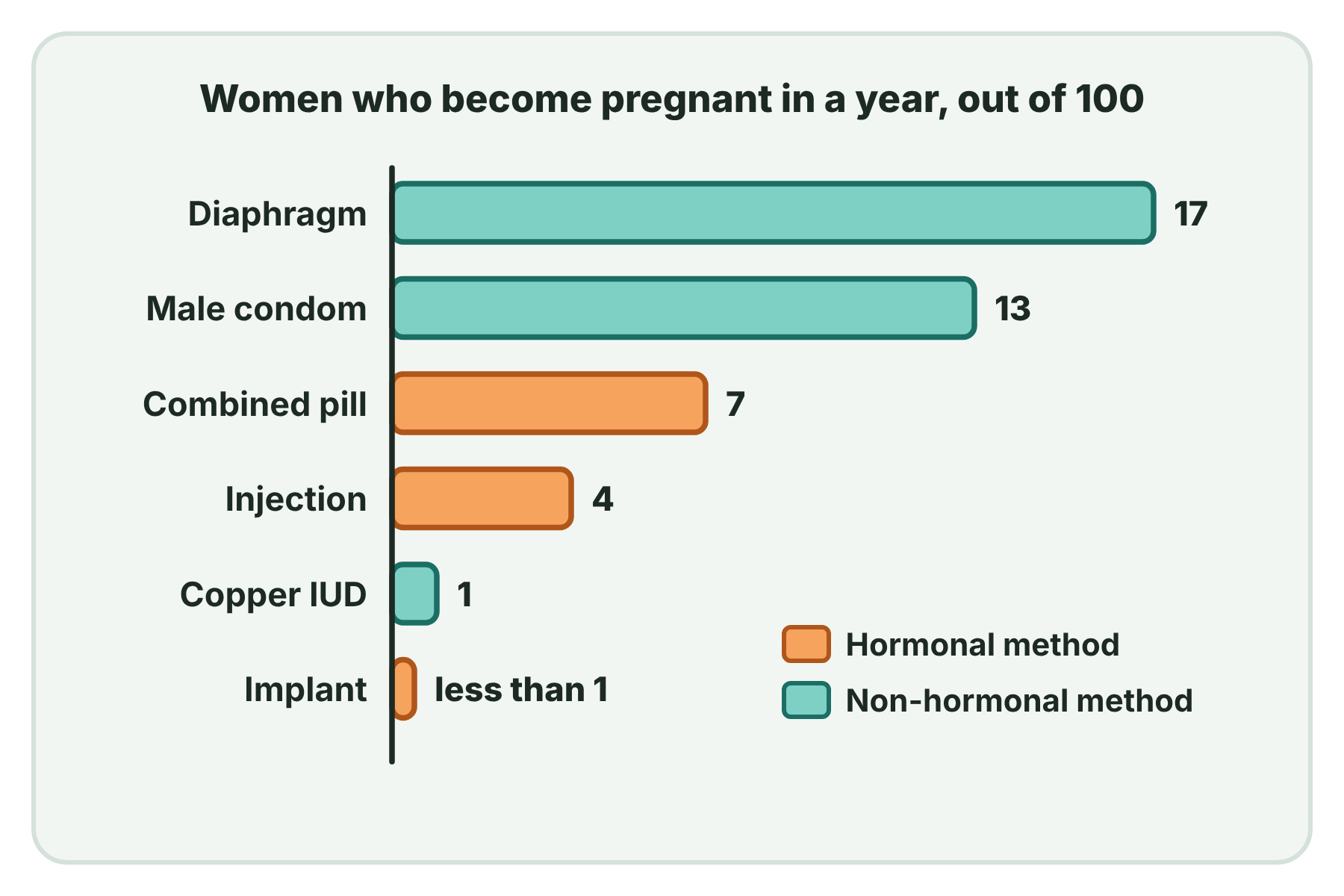
The implant and the IUD are the most effective methods in typical use.
Hormonal and non-hormonal contraception
Hormonal methods
- Very effective when used correctly
- Pill: taken daily, so easy to forget
- Implant and injection last for weeks or years
- Do not protect against infections
- Can have side effects such as headaches or mood changes
Non-hormonal methods
- Condoms protect against infections
- No effect on the hormones
- Barrier methods are less effective if used wrongly
- IUD lasts for years
- Sterilisation is permanent
Evaluating contraception
To evaluate a method you need to compare how well it works with its other advantages and disadvantages.
-
Effectiveness
Use the data. The lower the number of pregnancies per 100 women, the more effective the method.
-
Use
A method that depends on remembering, such as a daily pill, is less effective in real use than one that does not, such as an implant.
-
Side effects
Hormonal methods can have side effects. Some people cannot use them for health reasons.
-
Protection
Only condoms protect against sexually transmitted infections.
-
Permanence
Sterilisation cannot normally be reversed.
Hormones and fertility treatment (Higher tier)
Some people are infertile, which means they have difficulty conceiving. Hormones can help.
-
Fertility drugs
A woman who does not release eggs can be given FSH and LH. These make eggs mature in the ovaries and stimulate ovulation.
-
IVF
In vitro fertilisation means fertilisation in a laboratory dish. It can be used when a couple have not conceived in other ways.
-
Hormones in IVF
FSH and LH are given to stimulate several eggs to mature, so that more eggs can be collected.
-
Other hormones
Progesterone may be given after the embryo is put into the uterus, to maintain the lining.
The stages of IVF (Higher tier)
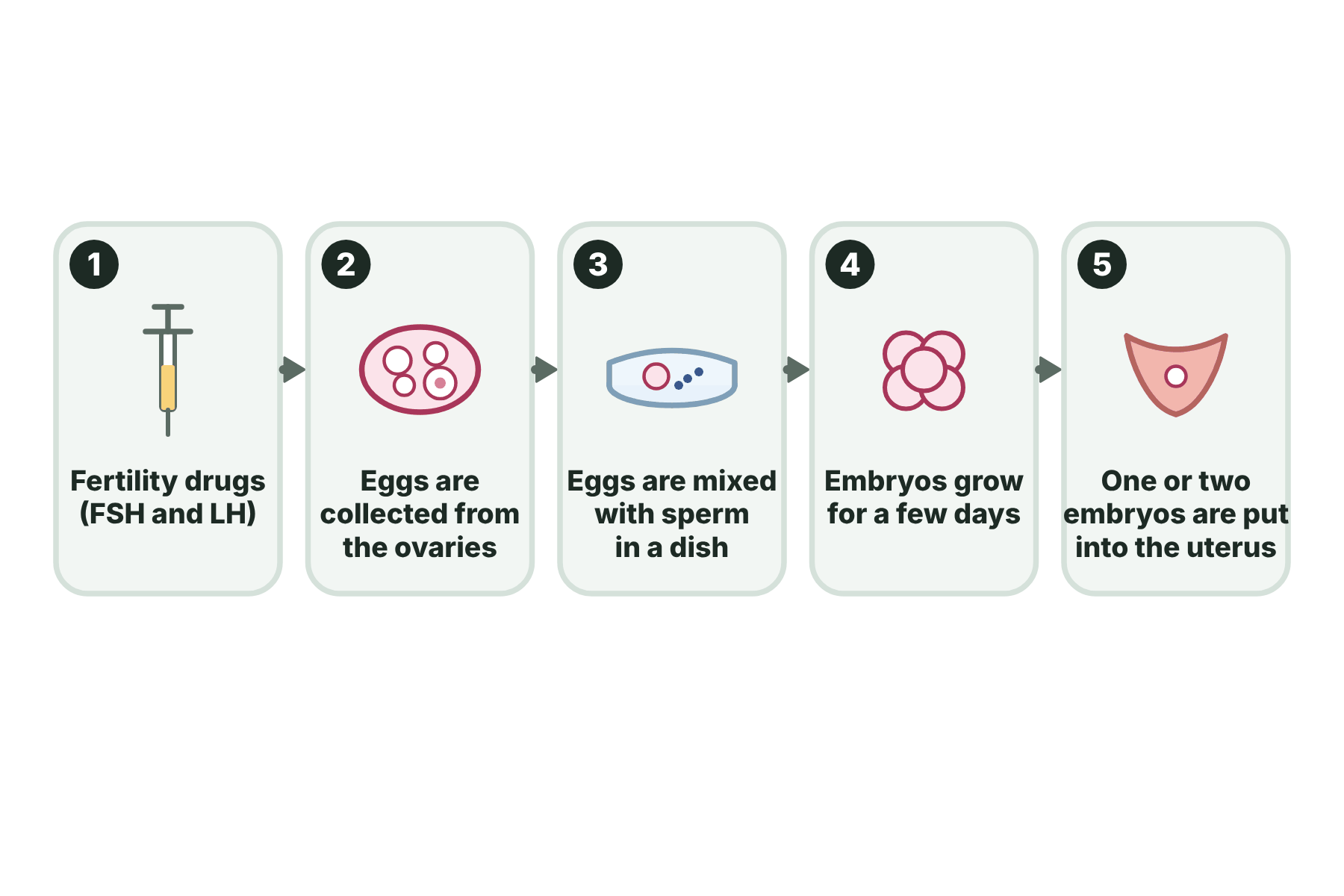
In IVF, eggs are fertilised in a dish and the embryo is put into the uterus.
Evaluating IVF (Higher tier)
IVF helps many couples to have a child, but it has disadvantages.
-
Advantage
It can give a baby to couples who cannot conceive in any other way.
-
Success rate
Many cycles do not work, and the chance of success falls as the woman gets older.
-
Health risks
The hormones can have side effects, and putting in more than one embryo can lead to twins or triplets, which carry more risk for the mother and babies.
-
Emotional and financial cost
Treatment is stressful and can be expensive.
-
Ethical issues
Some people disagree with the destruction or storage of embryos that are not used.
Case study
Choosing a method of contraception
A young woman wants contraception and looks at the data. The condom, used typically, is less effective than the pill, and the pill is less effective than the implant, because the pill can be forgotten. The implant works for three years without any action needed. But only the condom would protect her against sexually transmitted infections. Her best choice depends on what matters most to her, and on advice from a doctor.
The big idea
Hormonal contraception stops egg release, other methods block sperm or implantation, and for Higher tier hormones such as FSH and LH are also used to treat infertility, as in IVF.
Contraception and fertility
Contraception and fertility
-
Hormonal
- pill
- patch
- injection
- implant
-
Non-hormonal
- condom
- diaphragm
- IUD
- abstaining
- sterilisation
-
Evaluating
- effectiveness
- side effects
- protection
- permanence
-
Fertility drugs (Higher tier)
- FSH and LH
-
IVF (Higher tier)
- eggs fertilised in a dish
- embryo put into the uterus
Summary and exam focus
- The combined pill contains oestrogen and progesterone and stops FSH release, so no egg matures.
- Other hormonal methods use progesterone, as a pill, an injection or an implant.
- Condoms, diaphragms, IUDs, abstaining and sterilisation are non-hormonal methods.
- To evaluate a method compare effectiveness, side effects, protection against infection and permanence.
- (Higher tier) FSH and LH can be given to women who do not ovulate.
- (Higher tier) IVF fertilises eggs in a dish and puts embryos into the uterus.
Exam focus
Evaluate the use of the combined pill and condoms as methods of contraception. (4 marks) (4 marks)
Give an advantage and a disadvantage for each. Use data if you are given it, for example the number of pregnancies per 100 women, and say that only condoms protect against sexually transmitted infections.
Key terms
The words this lesson expects you to use. Each one is linked from the first place it appears above.
- Contraception
- A method of preventing pregnancy.
- Combined pill
- A contraceptive pill containing oestrogen and progesterone.
- Implant
- A small rod put under the skin that releases progesterone slowly.
- Condom
- A barrier method that stops sperm reaching an egg and protects against infection.
- IUD
- A small device put in the uterus that prevents pregnancy.
- Infertility
- Difficulty in conceiving a child.
- IVF
- In vitro fertilisation: fertilising an egg with sperm in a laboratory dish (Higher tier).
- Embryo
- A ball of cells that grows from a fertilised egg.
You've finished the notes
Check your understanding
Test yourself while it is fresh. Start with the flashcards, then try the exam questions.
Something here looks wrong?
Tell us what and we will go and look. It goes to whoever writes these pages, nobody else, and we do not ask who you are — so there is nothing to sign and nothing comes back to you.