Biology · The Nervous System
Neurones and the Nervous System
Your nervous system detects changes around you and inside you and produces a fast, coordinated response. This lesson covers the central nervous system, sensory receptors, effectors, the three types of neurone and how the nervous system produces a coordinated response.
Learning Objectives
- 1Describe the structure of the nervous system, including the central nervous system, sensory receptors and effectors.
- 2Describe the structure of sensory, relay and motor neurones and the role of a synapse.
- 3Describe the path of a nerve impulse from a stimulus to a response.
- 4Explain how the components of the nervous system produce a coordinated response.
Retrieval practice
-
1
What is a tissue?
Show answerHide answer
A group of similar cells working together to do a job.
-
2
What is an organ system?
Show answerHide answer
A group of organs working together to do a job.
-
3
What do muscles do when they contract?
Show answerHide answer
They shorten, which makes parts of the body move.
-
4
Name two things that your body needs to detect about its surroundings.
Show answerHide answer
For example light, sound, temperature, touch, taste and smell.
Detecting and responding
You can hear a shout, jump away from a hot pan and catch a ball, all in a fraction of a second. These actions need information to move quickly from the places where changes are detected to the places where a response is made. The nervous system carries this information as tiny electrical signals, called impulses, along cells called neurones.
The structure of the nervous system
The nervous system has a control centre and a network of nerves that reach every part of the body.
-
Stimulus
A change in the surroundings that can be detected, such as light, sound, heat or pressure.
-
Sensory receptors
Cells that detect a stimulus and change it into an electrical impulse. They are found in the sense organs, such as the eyes, ears, skin, tongue and nose.
-
Central nervous system
The brain and the spinal cord. It receives impulses from the receptors, coordinates the response and sends impulses out.
-
Effectors
Muscles and glands. They carry out the response. Muscles contract, and glands release chemicals such as hormones.
From stimulus to response
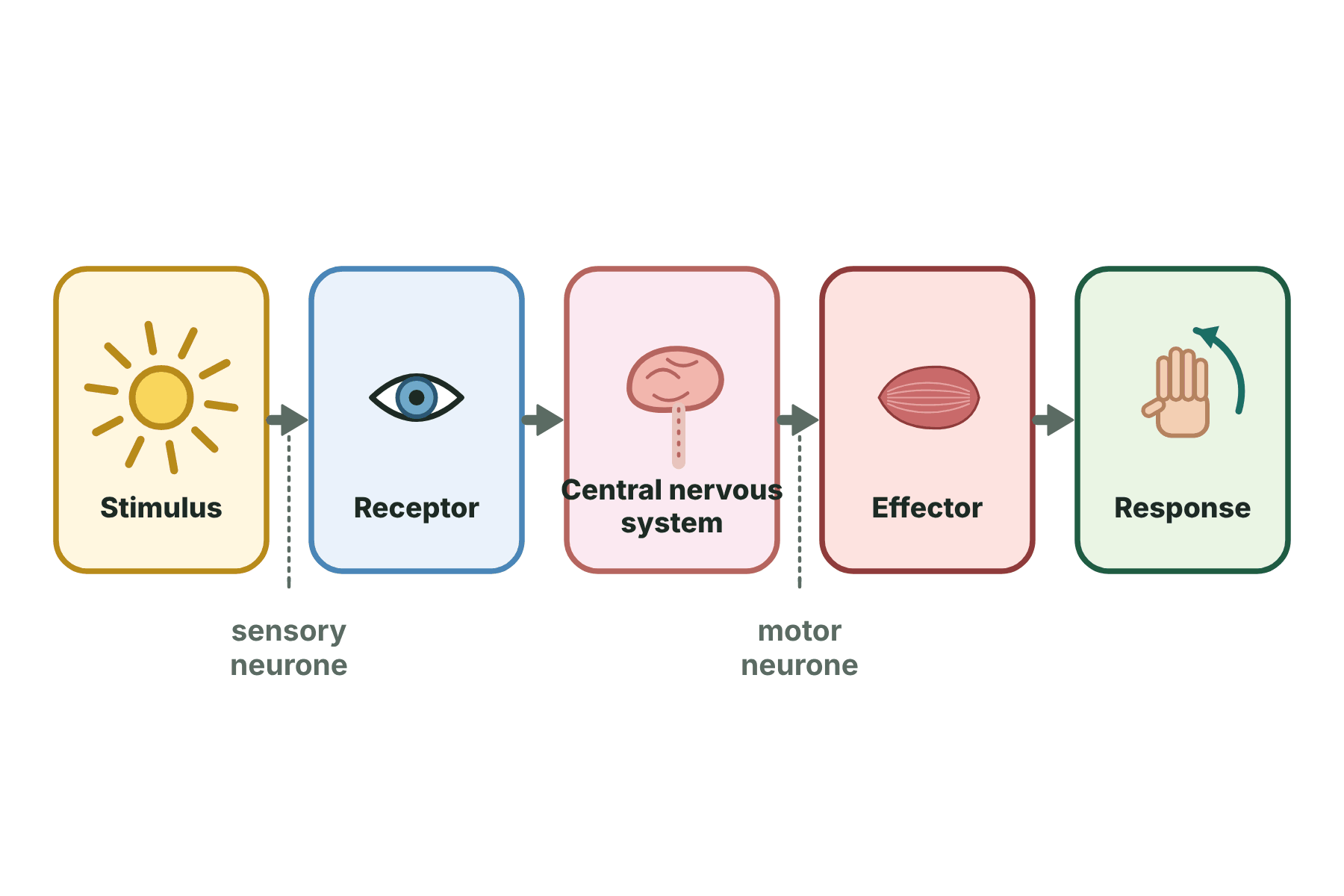
Impulses travel from the receptor to the central nervous system, and then to an effector.
Three kinds of neurone
A neurone is a nerve cell. Each kind has a different job in the pathway.
-
Sensory neurone
Carries impulses from a receptor to the central nervous system.
-
Relay neurone
Carries impulses within the central nervous system, linking a sensory neurone to a motor neurone.
-
Motor neurone
Carries impulses from the central nervous system to an effector.
-
One direction
In each pathway the impulse travels in one direction only, from the receptor to the effector.
The structure of a neurone
Neurones are long cells with features that suit them to carrying impulses quickly.
-
Cell body
Contains the nucleus and most of the cytoplasm.
-
Dendrites
Short branches that receive impulses from other neurones or from receptors.
-
Axon
A long fibre that carries the impulse away from the cell body. It is very long, so one neurone can reach from the spinal cord to a muscle.
-
Myelin sheath
A fatty layer around the axon of sensory and motor neurones. It insulates the axon and makes the impulse travel much faster.
-
Nerve endings
Branched ends of the axon that pass the signal on to the next cell.
Sensory, relay and motor neurones
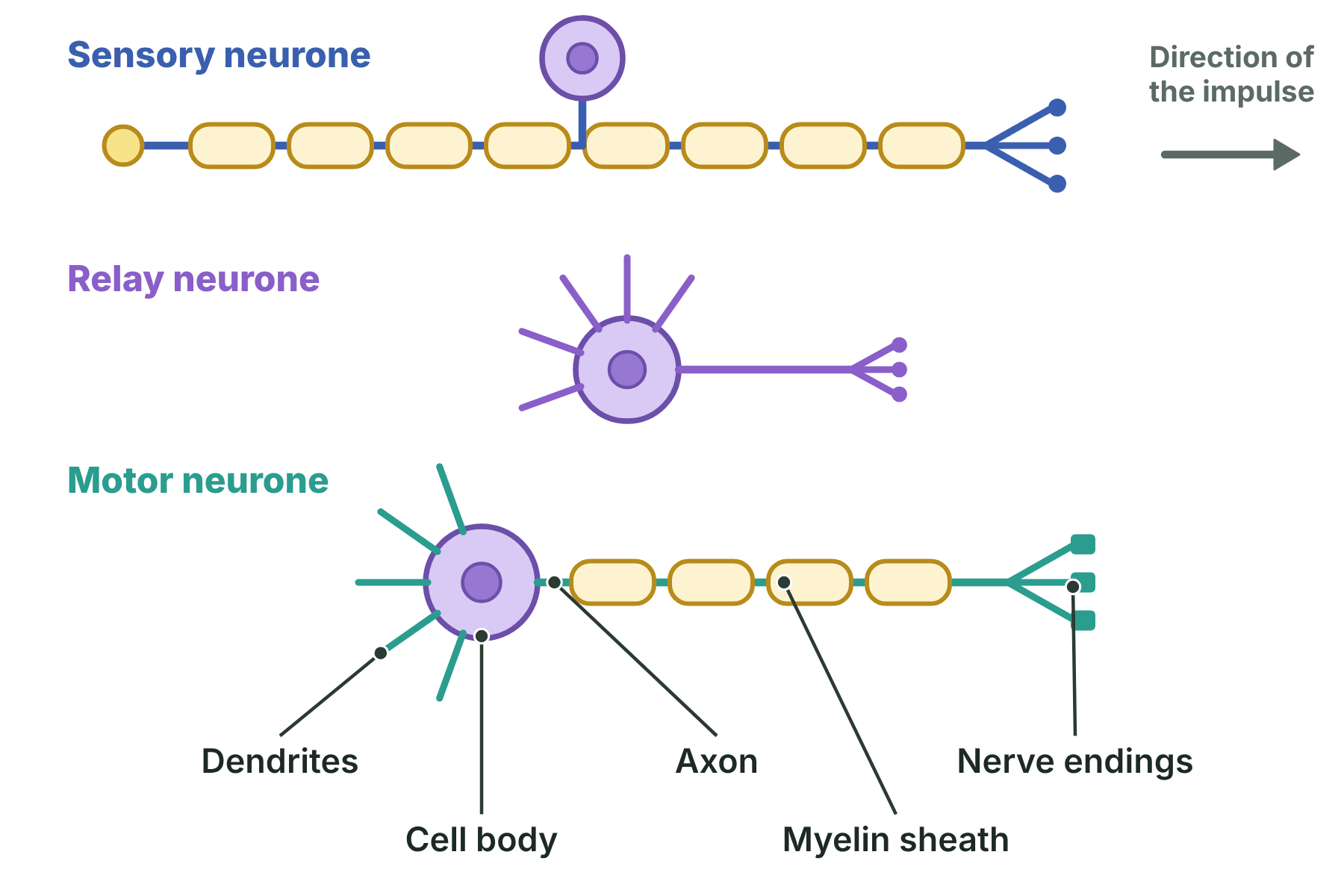
The myelin sheath speeds up the impulse in sensory and motor neurones.
The synapse
Neurones do not touch. A tiny gap, called a synapse, separates the end of one neurone from the next.
-
The gap
The synapse is a very small gap between two neurones, or between a neurone and an effector.
-
Chemical messengers
When an impulse arrives, the nerve ending releases chemicals called neurotransmitters.
-
Across the gap
The neurotransmitters diffuse across the gap and bind to receptors on the next neurone, which starts a new impulse.
-
One way
The chemicals are released from only one side, so impulses can pass one way only.
A coordinated response
The nervous system can respond to many different changes at once, and so the whole body can work together.
-
Reaches everywhere
Nerves go to all parts of the body, so a signal can reach any receptor or effector.
-
Many links
Neurones make many connections in the central nervous system, so one stimulus can lead to several responses.
-
Different receptors
The body has many types of sensory receptor, each detecting a different kind of stimulus.
-
Coordination
The central nervous system decides on a response and sends it to the right effectors, so a response is fast, precise and coordinated.
Receptors and effectors
Receptors
- Detect a stimulus
- Change it into an electrical impulse
- Found in sense organs such as the eye and skin
- Impulses go to the central nervous system
Effectors
- Carry out the response
- Muscles contract and glands release chemicals
- Receive impulses from motor neurones
- Impulses come from the central nervous system
Case study
Touching a hot object
When your finger touches something hot, heat receptors in your skin detect the stimulus and send impulses along a sensory neurone to the spinal cord. A relay neurone passes the impulse across synapses to a motor neurone. The motor neurone sends impulses to a muscle in your arm, which contracts and pulls your hand away. The whole sequence takes a fraction of a second, because the neurones are long and insulated.
The big idea
The nervous system uses neurones to carry electrical impulses from receptors, through the central nervous system, to effectors, and the gaps between neurones are crossed by chemical neurotransmitters.
The nervous system
The nervous system
-
Receptors
- detect stimuli and send impulses
-
Central nervous system
- brain and spinal cord coordinate the response
-
Effectors
- muscles and glands carry out the response
-
Neurones
- sensory
- relay and motor
-
Synapse
- a gap crossed by neurotransmitters
Summary and exam focus
- Receptors detect stimuli and effectors carry out responses.
- The central nervous system is the brain and the spinal cord.
- Sensory neurones carry impulses to the central nervous system, relay neurones link neurones inside it, and motor neurones carry impulses to effectors.
- A neurone has a cell body, dendrites, an axon with a myelin sheath, and nerve endings.
- Neurones are separated by synapses, which neurotransmitters cross by diffusion.
- Many receptors and many links let the nervous system produce a coordinated response.
Exam focus
Describe the path of a nerve impulse from a stimulus to a response. (4 marks) (4 marks)
Name every stage in order: stimulus, receptor, sensory neurone, central nervous system (relay neurone), motor neurone, effector, response. Say what each neurone does.
Key terms
The words this lesson expects you to use. Each one is linked from the first place it appears above.
- Neurone
- A nerve cell that carries electrical impulses.
- Stimulus
- A change in the surroundings that can be detected.
- Receptor
- A cell that detects a stimulus and starts an impulse.
- Effector
- A muscle or a gland that carries out a response.
- Central nervous system
- The brain and the spinal cord.
- Synapse
- The gap between two neurones, which neurotransmitters cross.
- Myelin sheath
- A fatty layer round an axon that speeds up the impulse.
- Neurotransmitter
- A chemical that carries the signal across a synapse.
You've finished the notes
Check your understanding
Test yourself while it is fresh. Start with the flashcards, then try the exam questions.
Something here looks wrong?
Tell us what and we will go and look. It goes to whoever writes these pages, nobody else, and we do not ask who you are — so there is nothing to sign and nothing comes back to you.