Biology · The Nervous System
Reflex Arcs
A reflex is a very fast, automatic response that protects the body. This lesson explains how the structure of a reflex arc is related to its function, how a synapse passes the impulse on, and how reaction times can be measured.
Learning Objectives
- 1Explain how the structure of a reflex arc is related to its function.
- 2Describe the path of an impulse in a reflex arc: receptor, sensory neurone, relay neurone, motor neurone, effector.
- 3Describe how a synapse passes an impulse from one neurone to the next.
- 4Compare a reflex action with a voluntary action.
- 5Describe how to investigate reaction time and calculate a mean.
Retrieval practice
-
1
What does a sensory neurone do?
Show answerHide answer
It carries impulses from a receptor to the central nervous system.
-
2
What is a synapse?
Show answerHide answer
A small gap between two neurones.
-
3
What is an effector?
Show answerHide answer
A muscle or a gland.
-
4
What is the central nervous system?
Show answerHide answer
The brain and the spinal cord.
Faster than thinking
If you touch something sharp, your hand pulls away before you feel the pain. Your brain has not decided anything yet. The response is a reflex, a very fast, automatic action that does not need conscious thought. Reflexes protect the body from danger, and they happen so quickly because the pathway is short and simple.
What is a reflex?
A reflex action is a rapid, automatic response to a stimulus.
-
Rapid
There are few neurones and few synapses in the pathway, so the response is very fast.
-
Automatic
You do not have to think about it or decide to do it.
-
Protective
Reflexes help to avoid injury, for example pulling away from a sharp or hot object, or blinking when something comes near the eye.
-
The same each time
A reflex always produces the same response to the same stimulus.
The reflex arc
The pathway followed by the impulse in a reflex is called a reflex arc.
-
Stimulus
A change that is detected, such as a pin prick.
-
Receptor
Detects the stimulus and starts an impulse in a sensory neurone.
-
Sensory neurone
Carries the impulse to the spinal cord, part of the central nervous system.
-
Relay neurone
In the spinal cord, it links the sensory neurone to a motor neurone, across synapses.
-
Motor neurone
Carries the impulse from the spinal cord to the effector.
-
Effector
A muscle that contracts, or a gland that releases a chemical. This is the response.
A reflex arc
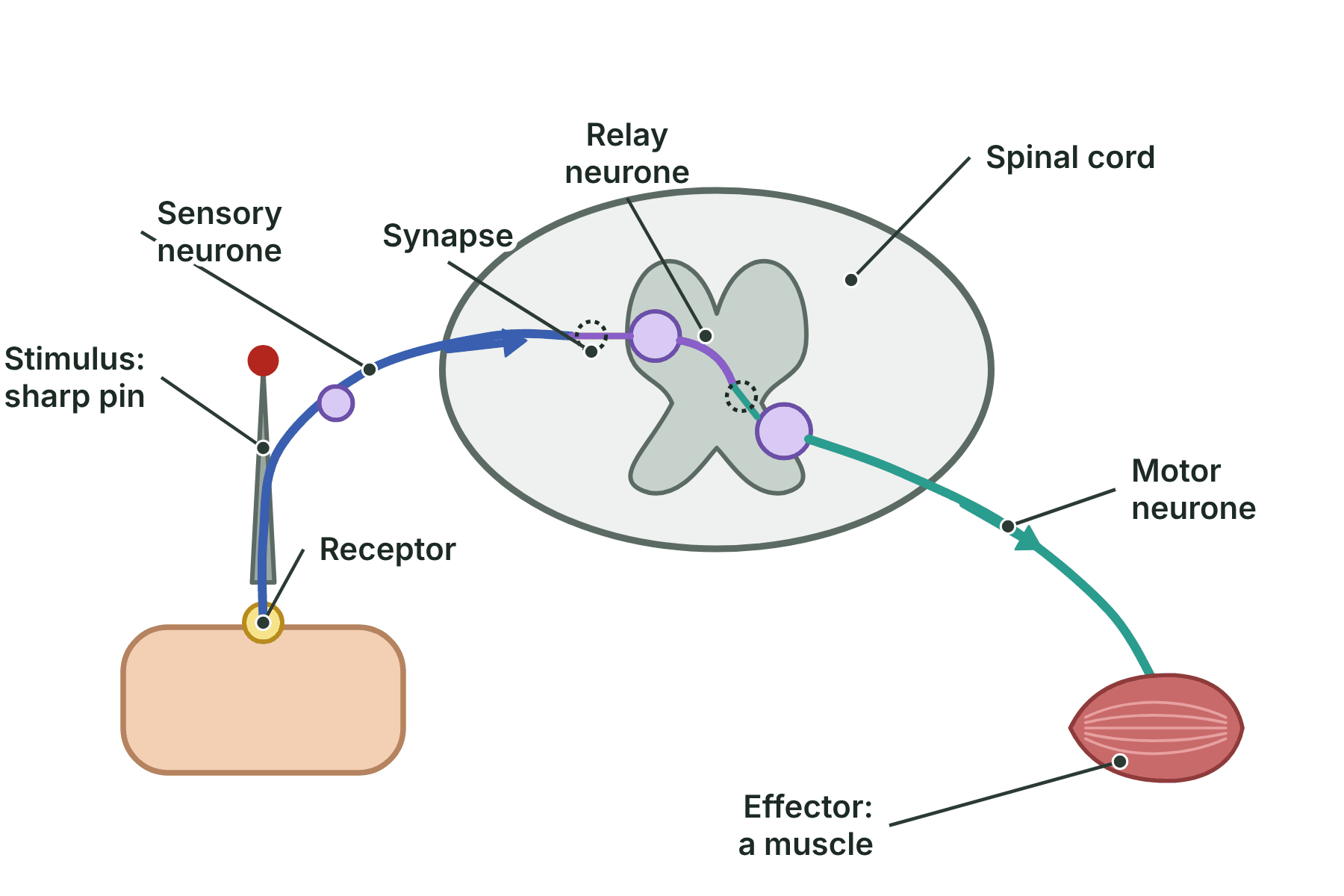
In a reflex arc the impulse passes from receptor to sensory neurone, relay neurone, motor neurone and effector.
How the structure suits the function
Each part of the reflex arc is adapted to make the response fast and reliable.
-
Long neurones
Sensory and motor neurones are very long, so they can carry the impulse from the skin to the spinal cord and back to a muscle.
-
Myelin sheath
The fatty sheath insulates the axons and speeds up the impulses.
-
Short pathway
The impulse does not go to the brain first. The relay neurone in the spinal cord links straight to the motor neurone.
-
Synapses
Synapses make sure the impulse passes in one direction, from the sensory neurone to the motor neurone.
A synapse
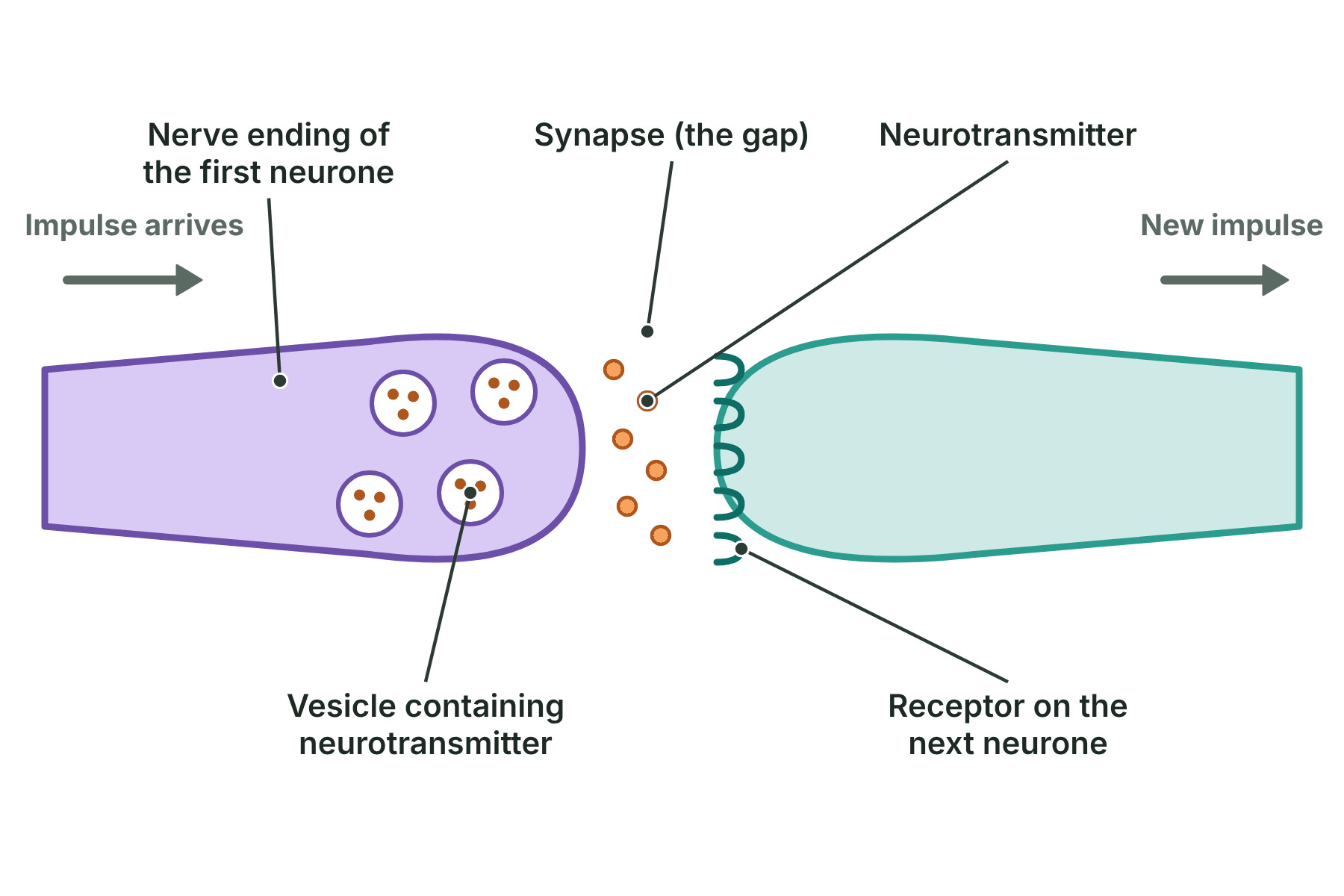
Neurotransmitter diffuses across the synapse and binds to receptors on the next neurone.
How a synapse passes the impulse on
The signal changes from electrical to chemical at the gap, and then back to electrical.
-
Arrival
The impulse reaches the nerve ending of the first neurone.
-
Release
Vesicles release a chemical neurotransmitter into the gap.
-
Diffusion
The neurotransmitter diffuses across the gap.
-
Binding
It binds to receptor molecules on the next neurone, and this starts a new impulse.
Reflex and voluntary actions
Reflex action
- Very fast
- Automatic, without thinking
- The pathway goes through the spinal cord
- Protects the body from harm
Voluntary action
- Slower
- You choose to do it
- The pathway goes through the brain
- For example picking up a pen
Investigating reaction time
A ruler drop test is a simple way to measure how fast a person responds.
-
1
Set up
A partner holds a ruler vertically so that the zero mark is level with the top of your open thumb and finger.
-
2
Drop
Your partner lets go without warning, and you catch the ruler as quickly as you can.
-
3
Measure
Read the distance on the ruler at the top of your thumb. A shorter distance means a faster reaction.
-
4
Repeat
Repeat at least three times and calculate a mean.
-
5
Compare
Compare results with and without a distraction, with the other hand, or after practice, changing one variable at a time.
Calculating a mean reaction distance
A student catches a dropped ruler three times. The distances are 14 cm, 18 cm and 16 cm. Calculate the mean distance caught.
Show the solutionHide the solution
- 1 Add the readings \(14 + 18 + 16 = 48\)
- 2 Divide by the number of readings \(48 \div 3\)
- 3 Give the answer with its unit \(= 16\) cm
AnswerThe mean distance is 16 cm.
Case study
Blinking
When something flies towards your face, you blink before you have time to think. Receptors in the eye detect the object, a sensory neurone carries the impulse to the central nervous system, and a motor neurone sends an impulse to the muscles of the eyelid, which close. Blinking is a reflex, so it protects the eye very quickly.
The big idea
A reflex arc is a short pathway from a receptor, along a sensory neurone, a relay neurone and a motor neurone, to an effector, and it makes a rapid, automatic response that protects the body.
Reflex arc
Reflex arc
-
Receptor
- detects the stimulus
-
Sensory neurone
- carries the impulse to the spinal cord
-
Relay neurone
- links to the motor neurone
-
Motor neurone
- carries the impulse to the effector
-
Synapse
- neurotransmitter crosses the gap
Summary and exam focus
- A reflex is a rapid, automatic, protective response.
- The reflex arc is receptor, sensory neurone, relay neurone, motor neurone and effector.
- The relay neurone is in the spinal cord, so the pathway is short and fast.
- Neurotransmitters diffuse across the synapse and start a new impulse.
- A ruler drop test measures reaction time.
Exam focus
Describe the pathway of a reflex action when a hand touches a sharp pin. (5 marks) (5 marks)
Write the pathway in order and name each neurone: receptors in the skin, sensory neurone, relay neurone in the spinal cord, motor neurone, effector muscle. Add that synapses join the neurones.
Key terms
The words this lesson expects you to use. Each one is linked from the first place it appears above.
- Reflex action
- A rapid, automatic response that protects the body.
- Reflex arc
- The pathway of neurones involved in a reflex action.
- Relay neurone
- A neurone in the central nervous system that links a sensory and a motor neurone.
- Synapse
- The gap between two neurones.
- Neurotransmitter
- A chemical that crosses a synapse and starts a new impulse.
- Voluntary action
- An action that you choose to do, which involves the brain.
- Reaction time
- The time taken to respond to a stimulus.
- Spinal cord
- A column of nervous tissue that runs inside the backbone.
You've finished the notes
Check your understanding
Test yourself while it is fresh. Start with the flashcards, then try the exam questions.
Something here looks wrong?
Tell us what and we will go and look. It goes to whoever writes these pages, nobody else, and we do not ask who you are — so there is nothing to sign and nothing comes back to you.