Biology · Transport in Plants
Translocation and the Phloem
Leaves make sugars, but every part of the plant needs them. This lesson explains how the phloem carries dissolved sugars to where they are used or stored, and how phloem differs from xylem.
Learning Objectives
- 1Describe translocation as the movement of dissolved sugars through the phloem.
- 2Explain how the structure of phloem is related to its function.
- 3Compare the structure and function of xylem and phloem.
- 4Explain why translocation is needed in a plant.
Retrieval practice
-
1
What is made in the leaves by photosynthesis?
Show answerHide answer
Glucose.
-
2
What does xylem carry?
Show answerHide answer
Water and mineral ions from the roots to the leaves.
-
3
What is transpiration?
Show answerHide answer
The loss of water vapour from the leaves.
-
4
Name two things plants use glucose for.
Show answerHide answer
Respiration, and making starch, cellulose, proteins or fats.
Moving the food
The leaves are where the plant's food is made, but a root buried in the soil, a growing shoot tip and a ripening fruit cannot photosynthesise. They have to be supplied with sugars by the leaves. The tissue that does this is the phloem, and the movement of food molecules through the phloem is called translocation.
What the phloem does
Phloem tissue transports dissolved sugars from the leaves to the rest of the plant.
-
Immediate use
Growing tips and roots use the sugars for respiration, to release energy for growth, and to make new cell walls and proteins.
-
Storage
Sugars can be carried to storage organs, such as roots, tubers and fruits, where they are turned into starch or other stores.
-
Both directions
Unlike the xylem, the phloem carries substances up and down. The direction is from the place where sugars are made to the place where they are needed.
The structure of phloem
Phloem is made of living cells, but you do not need the detailed structure or the mechanism of transport.
-
Tubes of elongated cells
The cells are long and joined end to end, which forms a continuous tube along the plant.
-
Pores in the end walls
The end walls of the cells have pores, so the cell sap can move from one phloem cell to the next.
-
Living cells
Unlike the xylem, the cells are alive, and are supported by companion cells that supply them with energy.
Xylem and phloem compared
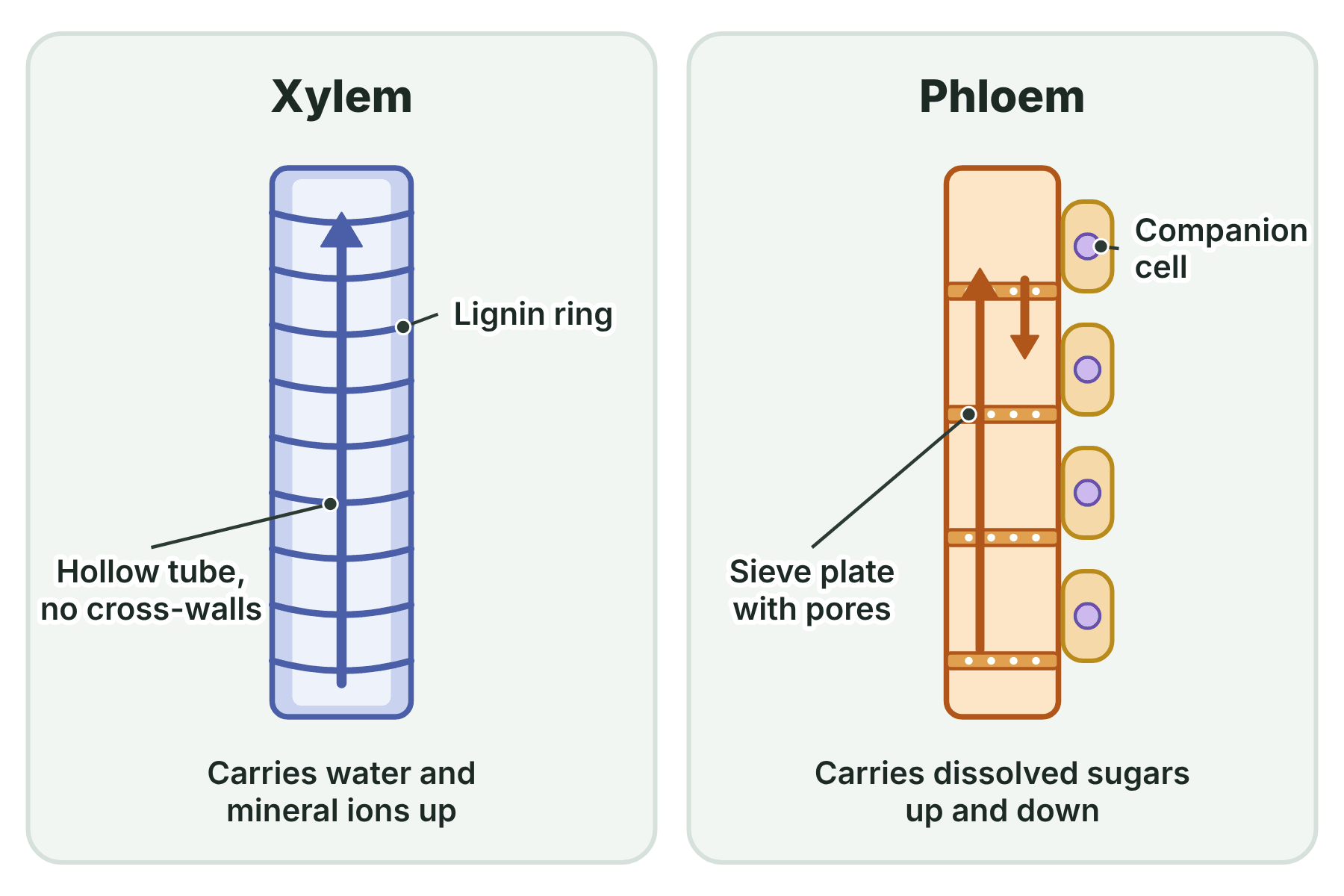
Xylem carries water up. Phloem carries sugars up and down.
Xylem and phloem compared
Xylem
- Carries water and mineral ions
- From the roots to the leaves
- Dead cells, hollow tubes with no end walls
- Walls strengthened with lignin
Phloem
- Carries dissolved sugars (food)
- From the leaves to where they are needed
- Living cells, with pores in the end walls
- Movement is called translocation
The journey of the sugars
Sugars follow a path from where they are made to where they are used.
-
1
Made in the leaf
Photosynthesis in the palisade cells makes glucose, which is converted to sucrose for transport.
-
2
Loaded into the phloem
The sucrose is moved into the phloem in the veins of the leaf.
-
3
Carried round the plant
Translocation carries it through the phloem to all other parts of the plant.
-
4
Used or stored
Cells use it for respiration and growth, or store it, for example as starch in a root.
Case study
Why ring-barking kills a tree
If a ring of bark, including the phloem, is cut right round a tree trunk, the xylem inside is not damaged, so the water can still reach the leaves. But the sugars made in the leaves cannot be carried down to the roots. The roots slowly run out of food and die, and then the whole tree dies. This shows that the phloem is essential for moving food around the plant.
Do not mix them up
Xylem carries water up. Phloem carries sugars up and down.
Translocation
Translocation
-
What moves
- dissolved sugars
-
Where
- in the phloem
-
Direction
- from the leaves to where they are needed
- up and down
-
Structure
- living cells
- pores in the end walls
-
Uses
- respiration
- storage
- growth
Summary and exam focus
- The movement of food molecules through the phloem is called translocation.
- Phloem carries dissolved sugars from the leaves to the rest of the plant, for use or storage.
- Phloem is made of living cells with pores in the end walls.
- Xylem carries water and ions upwards through dead hollow cells strengthened with lignin.
- Phloem moves substances in both directions.
Exam focus
Describe two differences between xylem tissue and phloem tissue. (2 marks) (2 marks)
Make each difference a pair: say what the xylem does or has, and what the phloem does or has instead. For example, xylem carries water but phloem carries sugars.
Key terms
The words this lesson expects you to use. Each one is linked from the first place it appears above.
- Phloem
- Living tissue made of tubes of elongated cells that carries dissolved sugars around a plant.
- Translocation
- The movement of dissolved sugars through the phloem from the leaves to the rest of the plant.
- Sucrose
- The sugar in which the glucose made in photosynthesis is transported.
- Companion cell
- A cell next to a phloem cell that supplies it with energy.
- Storage organ
- A part of a plant, such as a root or tuber, where food is stored.
- Cell sap
- The solution of sugars and other substances inside the cells.
- Source
- A part of the plant where sugars are made, such as a leaf.
- Sink
- A part of the plant where sugars are used or stored.
You've finished the notes
Check your understanding
Test yourself while it is fresh. Start with the flashcards, then try the exam questions.
Something here looks wrong?
Tell us what and we will go and look. It goes to whoever writes these pages, nobody else, and we do not ask who you are — so there is nothing to sign and nothing comes back to you.