Biology · Health and Communicable Disease
Health and Disease
Being healthy is more than not being ill. This lesson is for both Combined Science and separate Biology. It covers what health means, the different types of disease, and how diseases can interact, for example HIV and tuberculosis, and HPV and cervical cancer.
Learning Objectives
- 1Describe health as a state of physical and mental wellbeing, and describe the relationship between health and disease.
- 2Describe the different types of disease: communicable, non-communicable, inherited, deficiency and mental illness.
- 3Describe how different types of disease interact, using HIV and tuberculosis, and HPV and cervical cancer.
- 4Explain how a defect in the immune system can lead to infection, and interpret data on causes of death.
Retrieval practice
-
1
What is a pathogen?
Show answerHide answer
A microorganism, such as a virus, bacterium, protist or fungus, that causes disease.
-
2
What are the white blood cells for?
Show answerHide answer
They defend the body against pathogens.
-
3
What is a balanced diet?
Show answerHide answer
A diet that contains the right amounts of carbohydrates, proteins, fats, vitamins, minerals, fibre and water.
-
4
What is a gene?
Show answerHide answer
A small section of DNA on a chromosome that codes for a particular protein.
What is health?
Health is a state of physical and mental wellbeing, and not just the absence of disease. A person who has no illness may still be unhealthy if they are very anxious, if they live in poor housing or if they cannot get enough food. A disease is a condition that stops part of the body or the mind from working as it should. Disease and health are linked, because a disease lowers a person's health, and poor health, for example from a poor diet or stress, makes disease more likely.
The relationship between health and disease
Many factors work together, and the exam expects you to link them.
-
Physical health
This is how well the body works. It is damaged by disease and injury, and it is helped by a balanced diet, exercise and sleep.
-
Mental health
This is the state of a person's mind and emotions. Good mental health helps people to cope with stress and to look after their physical health, and poor mental health can make physical illness more likely.
-
Life situations
Poverty, poor housing, pollution and a lack of access to health care all make disease more likely and lower people's health.
-
Two-way links
Disease lowers health, but low health also makes disease more likely. For example, stress can weaken the immune system, and a long-term physical illness can cause depression.
Types of disease
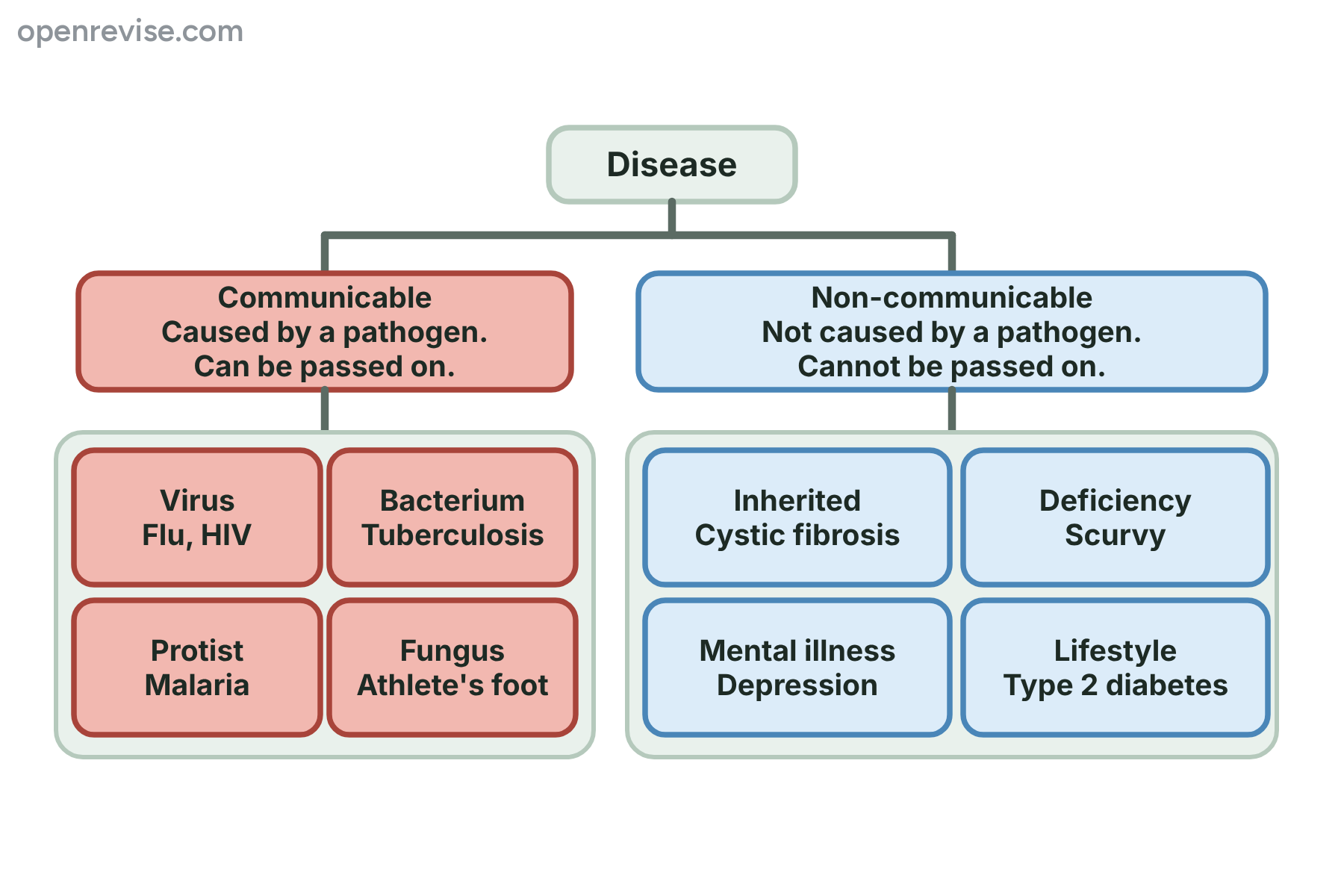
Diseases are communicable or non-communicable, and there are several kinds of each.
Types of disease
Learn the main types and an example of each, and be careful about which ones can be passed on.
-
Communicable
These are caused by pathogens, such as viruses, bacteria, protists and fungi, and they can spread from one organism to another. Examples are flu, tuberculosis, malaria and athlete's foot.
-
Non-communicable
These are not caused by a pathogen and cannot be passed from one person to another. They have causes such as genes, diet, lifestyle, ageing and the environment. Examples are cardiovascular disease, type 2 diabetes and most cancers.
-
Inherited
These are disorders caused by faulty alleles that are passed from parents to children in the genes, such as cystic fibrosis and Huntington's disease. They are not infectious.
-
Deficiency
These are caused by a lack of a nutrient in the diet. Scurvy is caused by too little vitamin C, rickets by too little vitamin D, and anaemia by too little iron.
-
Mental illness
These are conditions such as depression and schizophrenia that affect the mind. They can have many causes at once, such as genes, brain chemistry, stress and life events. They are not caused by a pathogen, so they are non-communicable.
Communicable and non-communicable disease
Communicable disease
- Caused by a pathogen
- Can be passed from one organism to another
- Examples: flu, tuberculosis, malaria, athlete's foot
- Prevented by stopping the pathogen spreading
Non-communicable disease
- Not caused by a pathogen
- Cannot be passed on to another person
- Examples: cystic fibrosis, scurvy, depression, type 2 diabetes
- Reduced by healthy lifestyle choices, or treated medically
Common misconceptions
Examiners know that students muddle some of these, so check your ideas.
-
Cancer is not caught
Most cancers are caused by changes to cells that build up during a lifetime, and they cannot be passed on to another person. Some people inherit an allele that raises their risk, but they do not inherit the cancer itself.
-
Inherited does not mean caught
An inherited disorder is carried in the genes, but an infection is passed on by a pathogen. You cannot catch cystic fibrosis.
-
Not all microorganisms are harmful
Many bacteria are harmless or helpful, for example in the gut, and only some are pathogens.
-
Health is not only physical
A person with a mental illness has poor health, even if there is nothing wrong with their body.
How different types of disease interact
One disease can make another more likely, so the types are not separate.
-
Communicable and communicable
HIV is a virus that damages the immune system. A person with HIV is much more likely to develop active tuberculosis, because the immune system can no longer control the bacteria that cause TB.
-
Communicable and non-communicable
The virus HPV can cause changes to the cells of the cervix, which may lead to cervical cancer. A pathogen can therefore lead to a non-communicable disease.
-
Immune defects
Anything that damages the immune system makes infections more likely. This includes HIV, an inherited defect in the immune system, drugs that suppress the immune system after a transplant, and a diet that lacks the nutrients needed to make white blood cells.
-
Physical and mental
A long-term physical illness can cause depression or anxiety, and stress and mental illness can lower a person's resistance to infection and make them less likely to look after themselves.
Interactions between diseases
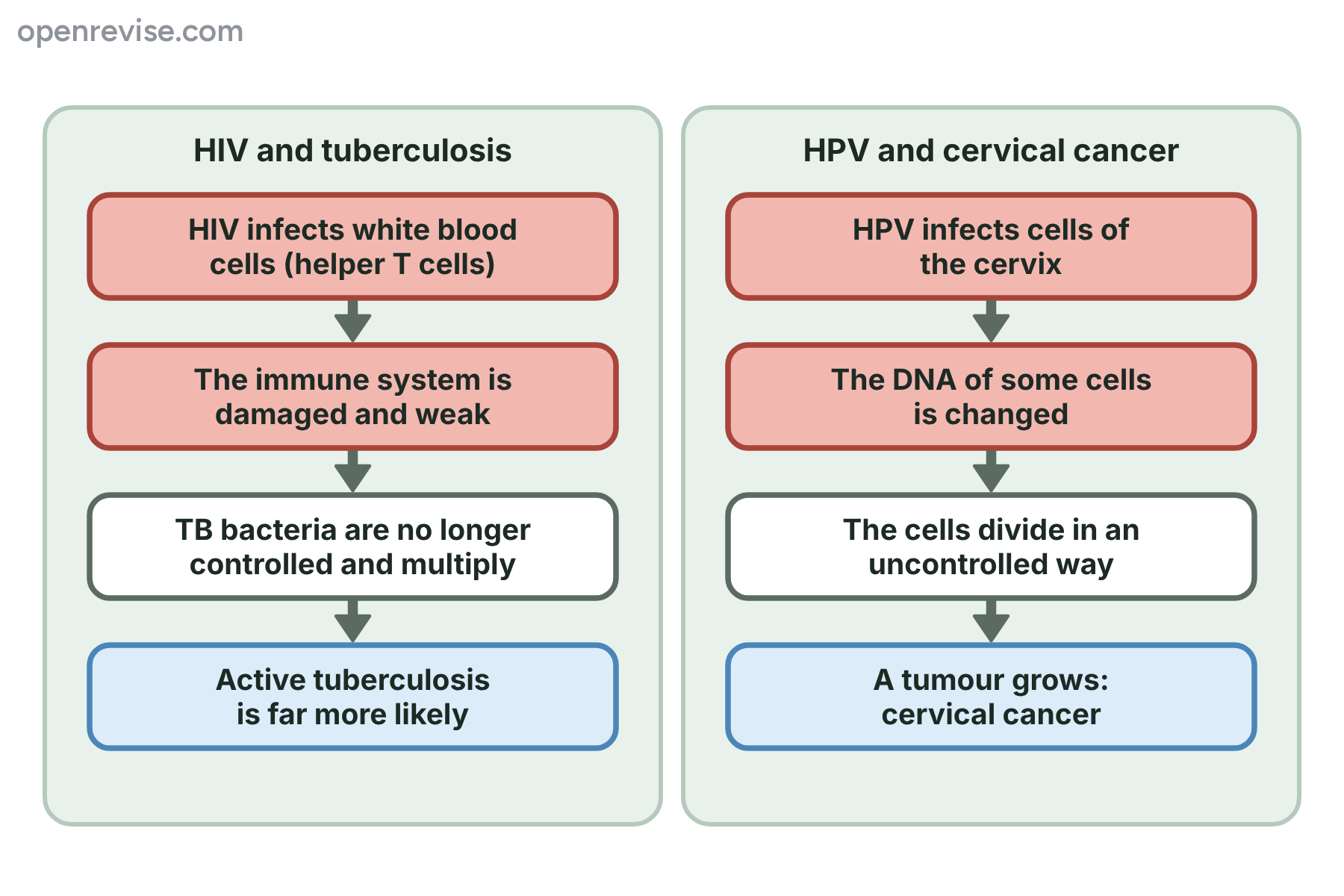
A communicable disease can make a second disease more likely.
Reading data on causes of death
In Country A, there were 80 000 deaths in a year, and 4 000 of them were caused by communicable diseases. In Country B, there were 60 000 deaths and 33 000 of them were caused by communicable diseases. Calculate the percentage of deaths caused by communicable diseases in each country, and suggest what this shows.
Show the solutionHide the solution
- 1 Country A \(\frac{4000}{80000} \times 100 = 5\%\)
- 2 Country B \(\frac{33000}{60000} \times 100 = 55\%\)
- 3 Compare The percentage is eleven times as large in Country B, so communicable disease is a much greater cause of death there. This could be because of poorer sanitation, less access to medicine and a higher rate of HIV.
AnswerCountry A: 5%. Country B: 55%. Communicable diseases cause a much larger share of deaths in Country B.
The big idea
Health is physical and mental wellbeing, and diseases of different types are linked, because one disease can make another more likely.
Health and disease
Health and disease
-
Health
- physical wellbeing
- mental wellbeing
- life situation
-
Communicable
- pathogens
- can be passed on
- flu, TB, malaria
-
Non-communicable
- cannot be passed on
- lifestyle
- ageing
- type 2 diabetes
-
Inherited and deficiency
- faulty alleles
- lack of a nutrient
- scurvy
-
Mental illness
- depression
- many causes
-
Interactions
- HIV and TB
- HPV and cancer
- immune defects
Summary and exam focus
- Health is a state of physical and mental wellbeing, and disease lowers health.
- Communicable diseases are caused by pathogens and can be passed on, while non-communicable diseases are not and cannot.
- Inherited disorders, deficiency diseases and mental illnesses are all non-communicable.
- HIV damages the immune system, so tuberculosis is much more likely, and HPV can lead to cervical cancer.
- A defect in the immune system, from HIV, from an inherited fault, from drugs or from a poor diet, makes infections more likely.
Exam focus
Explain how HIV infection can lead to tuberculosis, and how HPV infection can lead to cervical cancer. (4 marks) (4 marks)
Name the effect of each virus, then link it to the second disease. HIV damages the immune system, so tuberculosis bacteria are not controlled. HPV changes the cells of the cervix so that they divide in an uncontrolled way. Say what type of disease each one is, if the question asks.
Key terms
The words this lesson expects you to use. Each one is linked from the first place it appears above.
- Health
- A state of physical and mental wellbeing, not only the absence of disease.
- Disease
- A condition that stops part of the body or mind from working properly.
- Pathogen
- A microorganism that causes disease.
- Communicable disease
- A disease caused by a pathogen that can be passed from one organism to another.
- Non-communicable disease
- A disease that is not caused by a pathogen and cannot be passed from one person to another.
- Inherited disorder
- A disease caused by a faulty allele that is passed from parents to their children.
- Deficiency disease
- A disease caused by a lack of a nutrient, such as scurvy from too little vitamin C.
- Mental illness
- A disease that affects the mind and a person's thoughts, feelings and behaviour, such as depression.
- Immune system
- The body's defence against pathogens, which includes the white blood cells.
- Immune deficiency
- A defect in the immune system that makes a person more likely to get infections.
You've finished the notes
Check your understanding
Test yourself while it is fresh. Start with the flashcards, then try the exam questions.
Something here looks wrong?
Tell us what and we will go and look. It goes to whoever writes these pages, nobody else, and we do not ask who you are — so there is nothing to sign and nothing comes back to you.