Biology · Health and Communicable Disease
How Communicable Diseases Spread
A cold in one student can become a cold in a whole class, and a fungus on one leaf can spread across a field. This lesson is for both Combined Science and separate Biology. It covers the four types of pathogen, how communicable diseases spread in animals and in plants, and how to work with numbers of pathogens and cases.
Learning Objectives
- 1Describe the four types of pathogen: viruses, bacteria, protists and fungi, with an example of a disease that each causes.
- 2Explain how communicable diseases spread in animals by direct contact, in the air, in water, by ingestion of food and by vectors.
- 3Explain how communicable diseases spread in plants, giving examples.
- 4Use scientific quantities, such as the number of pathogens and the number of infected cases, to explain and estimate the spread of disease.
Retrieval practice
-
1
What is a communicable disease?
Show answerHide answer
A disease caused by a pathogen that can be passed from one organism to another.
-
2
What does asexual reproduction in bacteria produce?
Show answerHide answer
Genetically identical copies of the bacterium, by binary fission.
-
3
What is the cell wall of a plant cell made from?
Show answerHide answer
Cellulose.
-
4
What is the job of the white blood cells?
Show answerHide answer
To defend the body against pathogens.
Pathogens everywhere
A pathogen is a microorganism that causes disease. Pathogens are found in the air, in water, in soil and on every surface, but they cause disease only when they get into a host and reproduce. They reproduce fast, so a few pathogens can quickly become millions, and the disease can then be passed to new hosts in a number of different ways. Both animals and plants are infected, and the type of pathogen decides how it gets in, what it does and how it moves on.
The four types of pathogen
All four types can infect humans, and all four can infect plants.
-
Viruses
These are tiny particles, much smaller than a cell, which are not alive on their own. A virus enters a host cell and uses it to make more viruses, which usually kills the cell. Examples are the flu virus, HIV and the tobacco mosaic virus in plants.
-
Bacteria
These are single cells that have no nucleus. They reproduce by binary fission, and some release poisons called toxins that make us ill. Examples are the bacteria that cause tuberculosis, cholera and crown gall in plants.
-
Protists
These are single-celled organisms with a nucleus, and many are parasites that live on or in another organism. The protist that causes malaria lives in the liver and red blood cells, and a protist-like organism causes potato blight.
-
Fungi
Fungi have thin threads called hyphae that grow into the host and spores that spread the fungus. Athlete's foot affects the skin, and powdery mildew and rose black spot affect plants.
The four types of pathogen
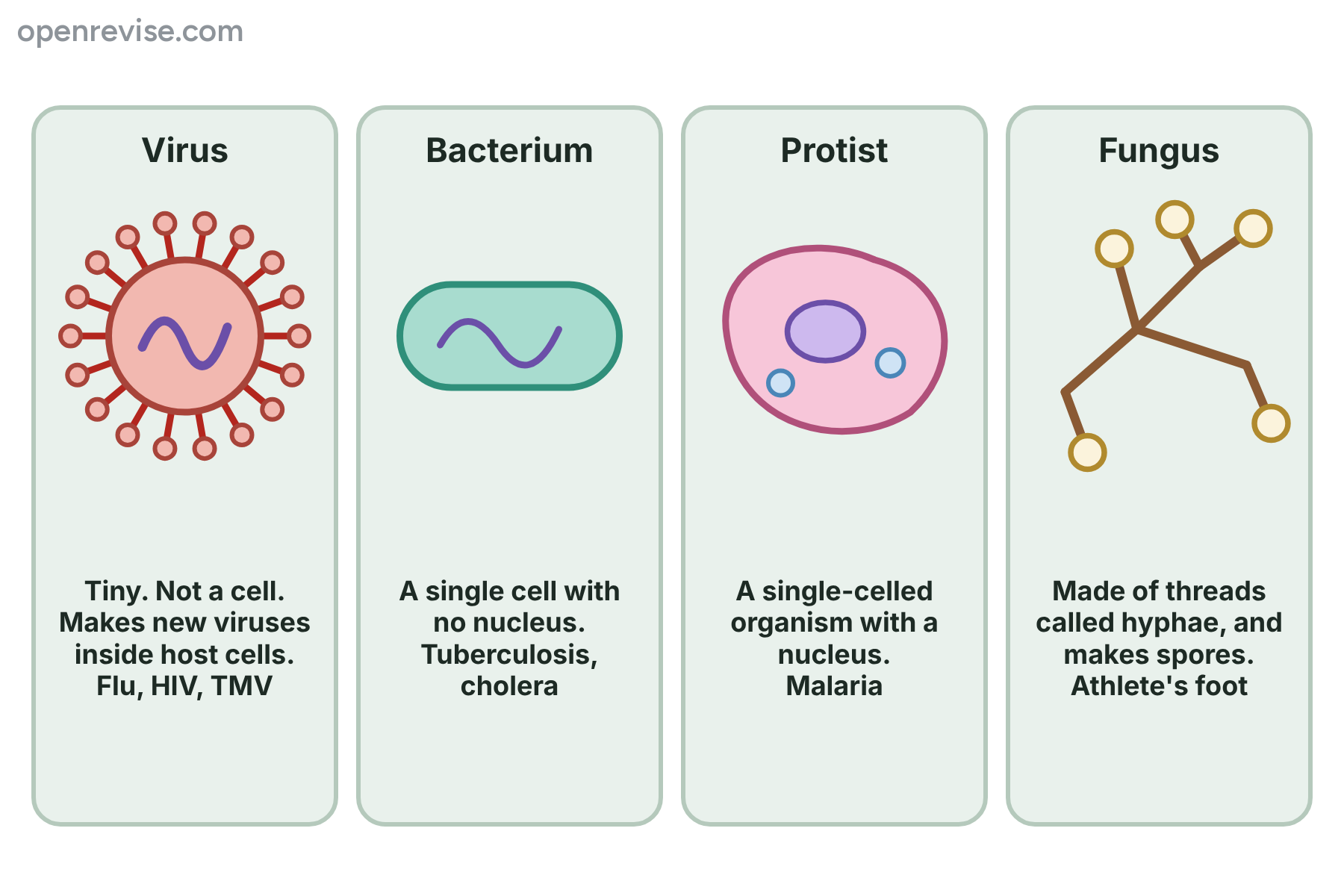
The four types of pathogen and a disease that each one causes.
How pathogens harm their host
Whatever the pathogen, it harms the host by damaging cells or by releasing poisons.
-
Damage to cells
Viruses burst the cells that they have infected, and the loss of cells makes the host ill. HIV, for example, destroys white blood cells.
-
Toxins
Bacteria such as Salmonella and the cholera bacterium release toxins that damage tissues or upset the gut, causing symptoms such as diarrhoea and fever.
-
Using up resources
Parasites such as the malaria protist feed on the host, and fungi take nutrients from the plant that they grow in.
-
Fast reproduction
A single bacterium can divide about every 20 minutes in good conditions, so a small infection can become a large one in a few hours.
How diseases spread in animals
There are five main routes, and you should know an example of each.
-
Direct contact
Pathogens pass from one person to another by touching the skin, by blood, or by sexual contact. HIV and chlamydia pass in body fluids, and athlete's foot spreads when infected skin touches the skin of another person or a damp floor.
-
Air
Coughs and sneezes release droplets that contain pathogens, and these are breathed in by other people nearby. The flu virus and the TB bacteria spread this way.
-
Water
Drinking water or washing in water that has been contaminated by sewage spreads pathogens. Cholera is caused by a bacterium that spreads in dirty drinking water.
-
Ingestion of food
Food that is contaminated, or that is not cooked or stored properly, carries pathogens into the gut. Salmonella bacteria in raw eggs and undercooked chicken are an example.
-
Vectors
A vector is an organism that carries a pathogen from one host to another without being harmed. Female Anopheles mosquitoes carry the malaria protist from person to person when they bite, and houseflies carry bacteria on their feet onto food.
How diseases pass from person to person
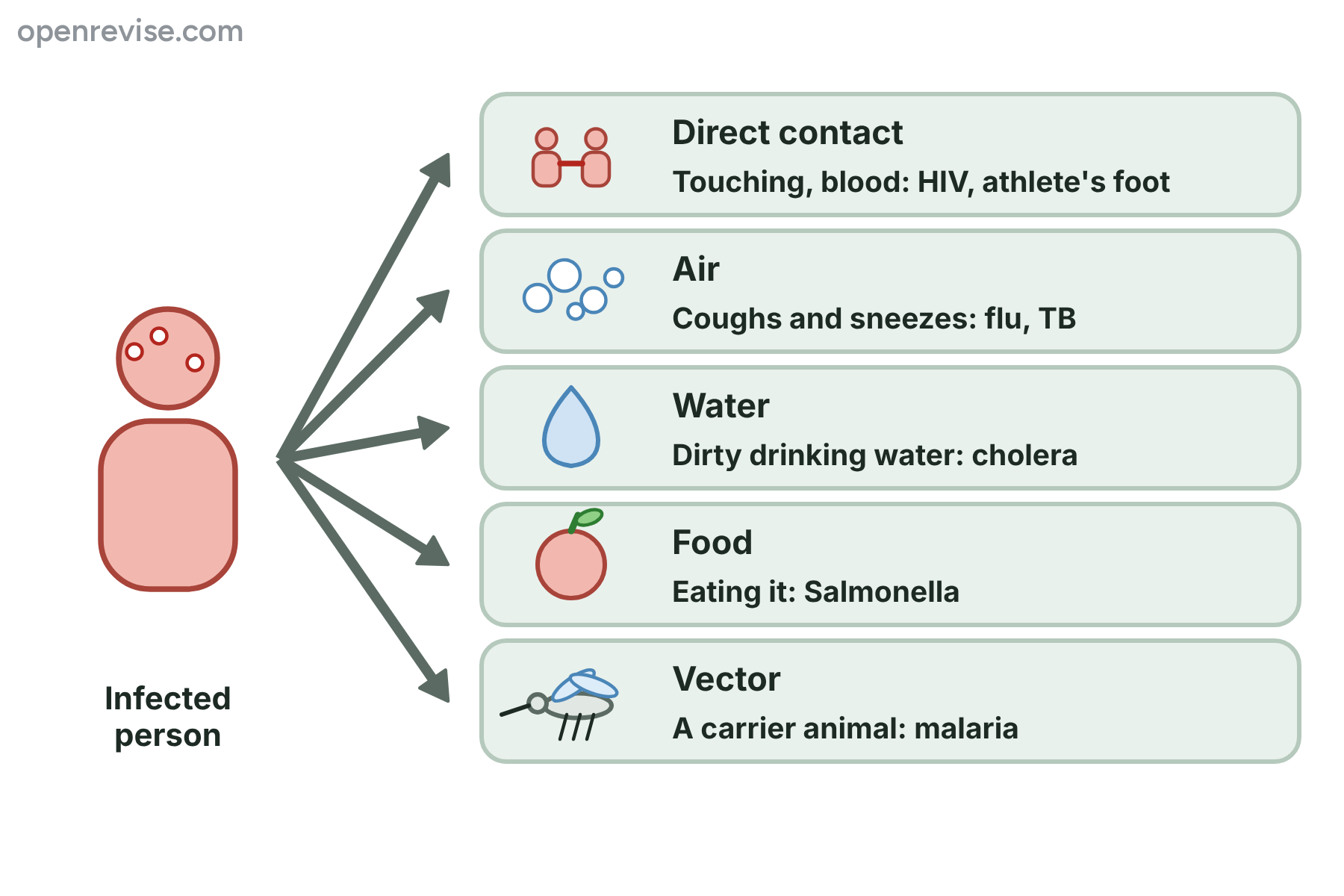
The routes by which pathogens pass to new hosts, with an example of a disease that spreads that way.
Case study
Cholera and the Broad Street pump
In 1854 there was an outbreak of cholera in Soho, London, in which over 500 people died in ten days. Dr John Snow plotted the homes of the people who had died on a map, and found that most of them were around a water pump in Broad Street. He persuaded the authorities to remove the pump handle, and the outbreak fell. It was an early demonstration that a disease can spread in contaminated water, years before bacteria were known to cause disease.
How diseases spread in plants
Plants cannot move, so pathogens reach them through wind, water, soil, vectors and people.
-
Direct contact
Pathogens pass from plant to plant where leaves or roots touch, and on the hands and tools of gardeners and farmers. Tobacco mosaic virus is passed on in the sap of an infected plant.
-
Wind
Fungi release huge numbers of spores that are carried on the wind. The spores of barley powdery mildew can be blown for long distances.
-
Water
Rain splashes spores from leaf to leaf, and spores can be carried in water used for irrigation. Rose black spot spreads in this way.
-
Soil
Some bacteria and fungi live in the soil and infect roots and stems. Crown gall bacteria are carried in the soil and enter the plant through wounds.
-
Vectors
Insects such as aphids carry viruses from plant to plant as they feed on the sap, and humans carry pathogens when infected plants or soil are moved.
Spread in animals and in plants
In animals
- Direct contact, air, water, food and vectors
- Coughs and sneezes release droplets
- Vectors include mosquitoes and flies
- Crowded places and poor sanitation help the spread
In plants
- Direct contact, wind, water, soil and vectors
- Fungal spores are blown by the wind
- Vectors include aphids
- Growing one crop in a large area and moving infected plants help the spread
How fast do bacteria multiply?
A single bacterium divides by binary fission once every 20 minutes. Calculate the number of bacteria that could be produced from one bacterium after 3 hours.
Show the solutionHide the solution
- 1 Find the number of divisions \(3\ \text{hours} = 180\ \text{minutes}\), and \(180 \div 20 = 9\) divisions
- 2 Each division doubles the number \(1 \rightarrow 2 \rightarrow 4 \rightarrow 8 \rightarrow \ldots\), which is \(2^9\)
- 3 Calculate \(2^9 = 512\) bacteria
AnswerAfter 3 hours there are 512 bacteria.
Estimating the number of cases
A school with 1200 pupils tests a random sample of 150 pupils for a virus, and 21 of them are infected. Estimate how many pupils in the whole school are infected.
Show the solutionHide the solution
- 1 Find the fraction infected in the sample \(\frac{21}{150} = 0.14\)
- 2 Multiply by the number of pupils \(0.14 \times 1200 = 168\)
- 3 Comment This is an estimate, because the sample may not be exactly like the whole school, and a larger random sample would be more reliable.
AnswerAbout 168 pupils in the school are likely to be infected.
The big idea
A pathogen spreads when it gets from an infected host to a new host, so the route it takes is the thing to block.
How diseases spread
How diseases spread
-
Pathogens
- viruses
- bacteria
- protists
- fungi
-
Animals
- direct contact
- air
- water
- food
- vectors
-
Plants
- contact
- wind
- water
- soil
- vectors
-
Harm
- damaged cells
- toxins
- fast reproduction
-
Quantities
- number of pathogens
- infected cases
- estimates
-
Examples
- HIV
- flu
- cholera
- malaria
- TMV
Summary and exam focus
- Communicable diseases are caused by viruses, bacteria, protists and fungi.
- In animals, pathogens spread by direct contact, in the air, in water, by ingestion of contaminated food and by vectors.
- In plants, they spread by direct contact, wind, water, soil and vectors such as aphids.
- Bacteria reproduce very quickly, so a few pathogens can become many in a few hours.
- Numbers of pathogens and of infected cases can be calculated and estimated from samples.
Exam focus
Describe how communicable diseases can spread between people. (4 marks) (4 marks)
Give four different routes and match each one to a disease, such as direct contact (HIV), droplets in the air (flu), contaminated water (cholera) and vectors (malaria). Say what carries the pathogen: describe how it passes into the new person, and do not just name the route.
Key terms
The words this lesson expects you to use. Each one is linked from the first place it appears above.
- Pathogen
- A microorganism that causes disease.
- Virus
- A tiny particle that infects a host cell and uses it to make more viruses.
- Bacterium
- A single-celled organism with no nucleus that reproduces by binary fission.
- Protist
- A single-celled organism with a nucleus, many of which are parasites.
- Fungus
- An organism made of threads called hyphae that reproduces by spores.
- Vector
- An organism that carries a pathogen from one host to another without being harmed.
- Spore
- A tiny structure made by a fungus that is carried by wind or water to spread it.
- Toxin
- A poison made by a pathogen that damages the cells of the host.
- Direct contact
- The spread of a pathogen by touching, or through blood or body fluids.
- Ingestion
- Taking food or drink into the body, which can carry pathogens into the gut.
You've finished the notes
Check your understanding
Test yourself while it is fresh. Start with the flashcards, then try the exam questions.
Something here looks wrong?
Tell us what and we will go and look. It goes to whoever writes these pages, nobody else, and we do not ask who you are — so there is nothing to sign and nothing comes back to you.