Biology · Cell Division
Viewing as
Teaching this? The teacher view opens every answer and mark scheme.
Chromosomes, Genes and DNA
Every cell nucleus holds a full set of instructions for building the organism. This lesson shows how those instructions are stored, from the nucleus down to a single gene, and why chromosomes in body cells come in pairs.
Learning Objectives
- 1Describe how the nucleus, chromosomes, DNA and genes are related.
- 2State that each chromosome is made of a DNA molecule and carries a large number of genes.
- 3State that chromosomes are normally found in pairs in body cells, and give the number for humans.
- 4Work out the number of pairs, or the total number of chromosomes, from the other.
The instructions inside every cell
Your body is built from trillions of cells, and nearly every one of them contains a complete set of instructions for making you. Those instructions are stored in the nucleus. Before cells can divide, the instructions have to be copied, so this lesson starts with how they are organised. It is the first step towards understanding mitosis.
From the nucleus down to a gene
The instructions are stored in layers, each one inside the one before.
-
Nucleus
The part of the cell that contains the genetic material. In a cell that is not dividing, the chromosomes lie loosely inside it.
-
Chromosome
A long, coiled molecule of DNA. Each chromosome carries a large number of genes.
-
DNA
The chemical the instructions are written in. A DNA molecule is made of two strands twisted together into a double helix.
-
Gene
A short section of a DNA molecule that contains the instructions for making one protein. Chromosomes carry lots of them, one after another.
From cell to gene
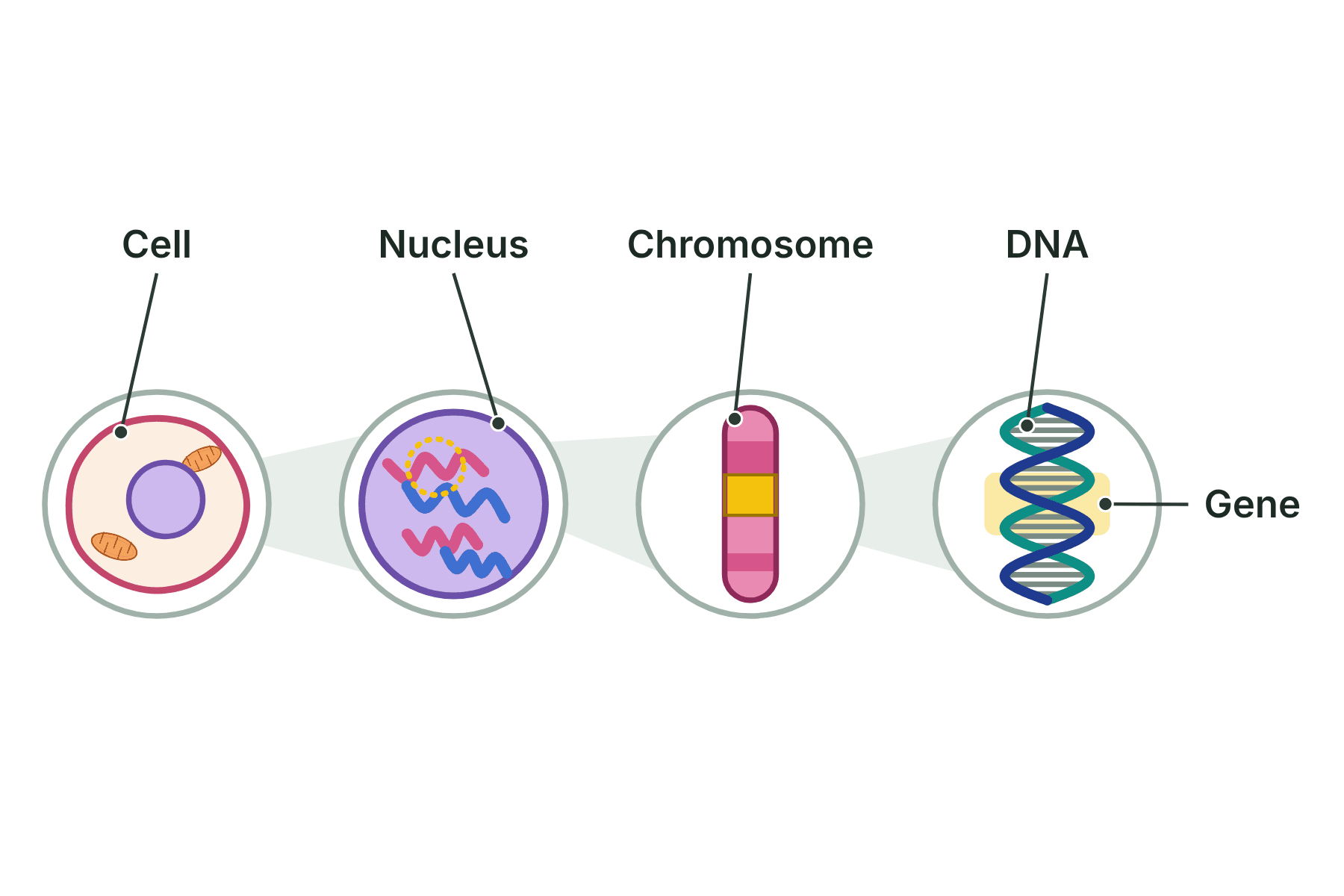
The nucleus holds chromosomes, each chromosome is one long DNA molecule, and a gene is a short section of it.
Chromosomes come in pairs
In body cells the chromosomes are normally found in pairs.
-
23 pairs in humans
A human body cell has 46 chromosomes, which is 23 pairs.
-
One from each parent
Of each pair, one chromosome came from the mother's egg cell and one from the father's sperm cell.
-
Matching pairs
The two chromosomes in a pair are the same size and carry the same genes in the same places, although they may carry different versions of those genes.
-
Sex chromosomes
One of the 23 pairs decides whether a person is female (XX) or male (XY).
The 23 pairs in a human cell
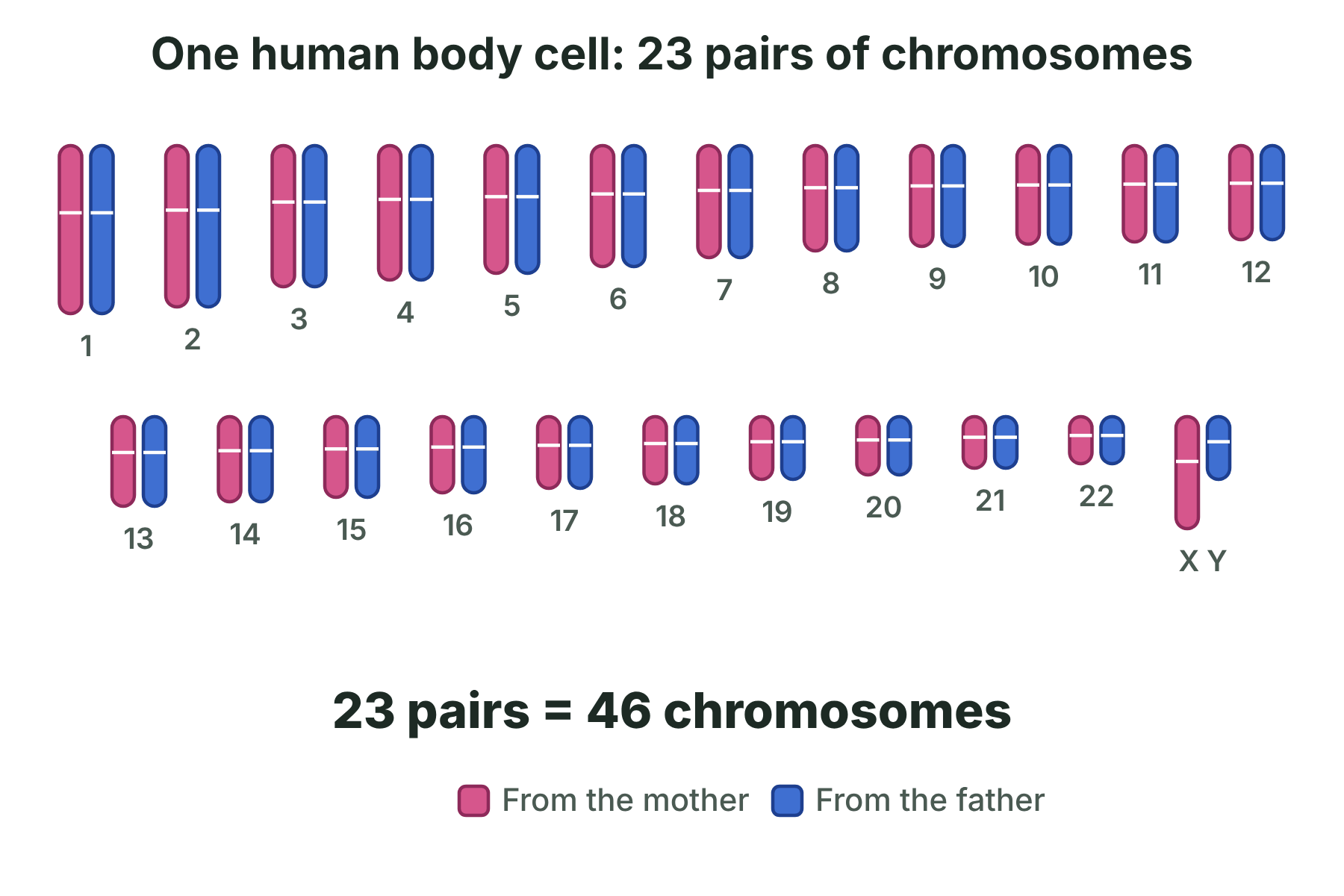
Each pair has one chromosome from each parent.
How many chromosomes, or how many pairs?
A body cell from a dog has 39 pairs of chromosomes. How many chromosomes is that? A fruit fly body cell has 8 chromosomes. How many pairs is that?
Show the solutionHide the solution
- 1 Remember that a pair is two chromosomes One pair = 2 chromosomes.
- 2 Going from pairs to chromosomes, multiply by 2 \(39 \times 2 = 78\) chromosomes in the dog cell.
- 3 Going from chromosomes to pairs, divide by 2 \(8 \div 2 = 4\) pairs in the fruit fly cell.
AnswerA dog body cell has 78 chromosomes. A fruit fly body cell has 4 pairs.
Different species, different numbers
Every species has its own number of chromosomes, and a bigger number does not mean a more complicated organism. What matters is the instructions written along the chromosomes, not how many chromosomes there are.
-
Human
46 chromosomes in a body cell (23 pairs).
-
Chimpanzee
48 chromosomes (24 pairs).
-
Dog
78 chromosomes (39 pairs), far more than a human.
-
Pea plant
14 chromosomes (7 pairs).
-
Fruit fly
8 chromosomes (4 pairs), far fewer than a human.
Keep the order straight
Chromosomes are made of DNA, and genes are short sections of that DNA.
A nucleus contains chromosomes. A chromosome carries many genes. A gene is a piece of DNA, not a piece of a gene.
How genetic material is stored
How genetic material is stored
-
Nucleus
- holds the chromosomes
-
Chromosome
- one long coiled DNA molecule
- many genes
-
DNA
- double helix
- the code for the cell
-
Gene
- a short section of DNA
- one protein
-
Pairs
- 23 pairs in humans
- one from each parent
Summary and exam focus
- The nucleus contains the cell's chromosomes.
- Each chromosome is a DNA molecule and carries a large number of genes.
- A gene is a short section of DNA.
- In body cells the chromosomes are normally found in pairs.
- A human body cell has 23 pairs of chromosomes, which is 46.
Exam focus
Describe how genes, chromosomes and DNA are related. (3 marks) (3 marks)
Use the words "section of" and "carries". A gene is a section of DNA, a chromosome is a long molecule of DNA that carries many genes. Mixing the order up, for example saying that a gene contains chromosomes, loses the marks.
Key terms
The words this lesson expects you to use. Each one is linked from the first place it appears above.
- Nucleus
- The part of a eukaryotic cell that contains the genetic material and controls the cell's activities.
- Chromosome
- A long, coiled molecule of DNA in the nucleus that carries a large number of genes.
- DNA
- The molecule that stores genetic information, made of two strands twisted into a double helix.
- Gene
- A short section of DNA that contains the instructions for making a particular protein.
- Double helix
- The shape of a DNA molecule: two strands twisted around each other.
- Body cell
- Any cell of the body other than the sex cells (egg and sperm). It has chromosomes in pairs.
- Pair of chromosomes
- Two chromosomes of the same size that carry the same genes, one inherited from each parent.
- Genome
- All of the genetic material in an organism.
- Genetic material
- The DNA that carries the instructions for building and running an organism.
You've finished the notes
Check your understanding
Test yourself while it is fresh. Start with the flashcards, then try the exam questions.
Something here looks wrong?
Tell us what and we will go and look. It goes to whoever writes these pages, nobody else, and we do not ask who you are — so there is nothing to sign and nothing comes back to you.